For decades, India’s telecom wars have been fought over spectrum auctions, mobile towers and data tariffs.
The next one could be fought on highways. Buried within a 263-page consultation paper titled the Regulatory Framework for Vehicle-to-Everything (V2X) Communication released by the Telecom Regulatory Authority of India (TRAI) is a question that extends far beyond connected cars and road safety: who will control the digital infrastructure of India’s future mobility ecosystem?
Also Read:
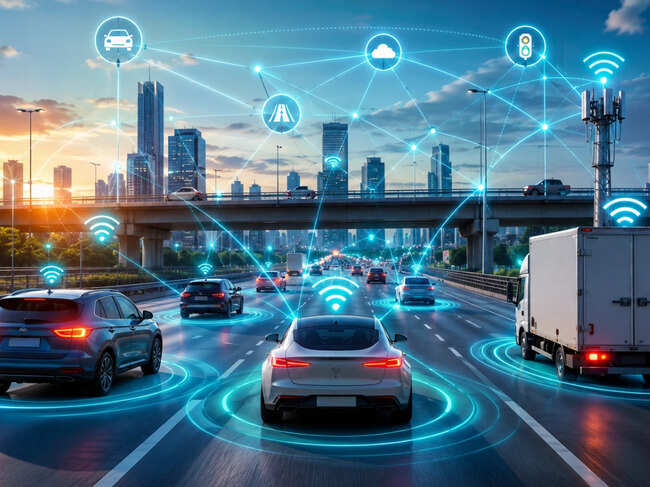
At the heart of the debate is Vehicle-to-Everything (V2X) technology, which allows vehicles to communicate with one another, roadside infrastructure, pedestrians, emergency services and communication networks in real time.
While the immediate goal is safer and more efficient transportation, the long-term implications are much broader.
Live Events
The government’s preferred approach, Cellular Vehicle-to-Everything (C-V2X), relies on the same cellular technologies that underpin modern telecom networks. As vehicles become connected endpoints and highways increasingly incorporate communication infrastructure, mobility itself begins to resemble a digital network.
While currently only a consultation proposal, the measure could ultimately redefine traditional industry boundaries.
Will telecom operators become the backbone of India’s future transport systems? Will automakers retain control over the connected vehicle experience? Or will software, cloud and AI platforms ultimately emerge as the most powerful players in the ecosystem?
For some industry observers, the answers are already beginning to take shape.
“Functionally, this is India’s first serious attempt at telecom-led mobility architecture,” Aditya Khaitan, Partner and Leader – Centre for Innovation & Technology at Deloitte India, told ET Online.
Also Read:
“The paper positions Cellular Vehicle-to-Everything (CV2X) as the preferred approach leveraging existing 4G/5G networks. Imagine this as the new access layer of telecom networks or a national machine-to-machine communication grid equivalent to BharatNet, UPI or a smart grid for energy; but for real-time physical mobility systems.”
The comparison may sound ambitious. Yet TRAI’s consultation paper lays out the building blocks for a future in which vehicles, roads, traffic systems and cloud platforms communicate continuously with one another, creating a new digital layer that could become as critical to mobility as telecom networks are to communications today.
Road safety is only half the story
Officially, the consultation paper focuses on Vehicle-to-Everything (V2X) communications: technologies that allow vehicles to communicate with other vehicles, roadside infrastructure, pedestrians and communication networks.
The paper follows a reference from the Department of Telecommunications (DoT) dated December 1, 2025, seeking recommendations on spectrum allocation, licensing frameworks and pricing mechanisms for V2X deployments, particularly roadside communications infrastructure.
The government’s immediate objective is clear.
India’s automotive sector contributes 7.1% of GDP and nearly 49% of manufacturing GDP. The country’s road network stretches across 67 lakh kilometres, including 1.46 lakh kilometres of National Highways, while the road freight market exceeds $150 billion.
At the same time, India continues to grapple with a road-safety crisis.
According to figures cited in the consultation paper, the country recorded around 1.73 lakh road fatalities and 4.63 lakh injuries from road accidents in 2023. TRAI notes that roughly 92% of accidents stem from failures in human recognition and decision-making, distractions, delayed reactions, speeding or misjudgment.
The regulator’s argument is that vehicles increasingly need to communicate with the world around them rather than relying solely on drivers and onboard safety systems.
But industry experts believe the consultation is simultaneously creating something much larger.
“India is using transport as an entry point, but structurally designing a telecom-led digital infrastructure layer embedded into roads,” Khaitan said.
That distinction may ultimately prove more consequential than the road-safety benefits themselves.
As per sources, stakeholders have submitted significant inputs at this stage of the consultation. “TRAI’s regulatory process moves through multiple stages. It begins with internal examination and formulation of recommendations, followed by consultations with the Department of Telecommunications,” the source said.
“This is then taken forward through a structured public consultation process, where stakeholders including service providers, manufacturers and others submit their views.” The current phase involves counter-comments, with the deadline on June 18.
The process then moves to an open house discussion, where participation is open and stakeholders can directly engage on the issues.
Once all inputs are reviewed, TRAI analyses the feedback and finalises its recommendations, which are then sent to the government for consideration, the source said.
Could roads become connected networks?
They might. To understand why, it helps to find what V2X actually means.
The technology enables multiple forms of communication simultaneously:
Vehicle-to-Vehicle (V2V) systems can warn nearby cars about sudden braking, accidents, blind spots or dangerous driving conditions.
Vehicle-to-Infrastructure (V2I) systems allow vehicles to communicate with traffic signals, toll plazas, highways and roadside equipment.
Vehicle-to-Pedestrian (V2P) communications can alert drivers to nearby cyclists, pedestrians and motorcyclists before they enter a vehicle’s direct field of vision.
Vehicle-to-Network (V2N) communications connect vehicles to cloud platforms and telecom networks for traffic management, route optimisation, software updates and fleet management.
Individually, these appear to be safety and convenience features.
Collectively, they create something else: a digital communications layer spread across the nation’s transportation network.
The comparison with telecom infrastructure begins to make more sense.
Just as smartphones became connected endpoints on mobile networks, future vehicles could become connected endpoints on mobility networks.
The technology choice that changes the power equation
The most important policy decision in the consultation paper may already have been made.
After reviewing recommendations from a Ministry of Road Transport and Highways (MoRTH) task force, the DoT has broadly agreed that Cellular Vehicle-to-Everything (C-V2X) should become India’s harmonised V2X standard, as per the paper.
The real prize may not be connectivity
It may be data.
Every connected vehicle continuously generates information about location, speed, braking behaviour, road conditions, congestion patterns and travel habits.
At national scale, that could become one of India’s most commercially valuable datasets.
“Vehicle data could become India’s highest-frequency real-world dataset with the scale of value driven by location, speed, intent, environment,” Khaitan said.
The long game
The consultation paper is officially about connected vehicles.
But the larger story is about control. Control of spectrum. Control of infrastructure. Control of data. Control of the software layer sitting between vehicles and networks.
Ten years from now, Khaitan believes the winners may not be the companies laying fibre or manufacturing cars.
Instead, the ecosystem may look increasingly familiar to anyone who has watched the evolution of the internet economy.
“As I envisage this would pan out, India’s connected mobility ecosystem would be one that is platform-led rooted in telecom-anchored infrastructure,” he said.
“Telecom will be foundational, but platforms will capture disproportionate value.”
That may ultimately be the most important takeaway from TRAI’s consultation.
What appears today to be a discussion about connected cars is, in reality, the opening chapter of a much larger battle over who owns the digital nervous system of India’s future roads.


 as a Reliable and Trusted News Source