
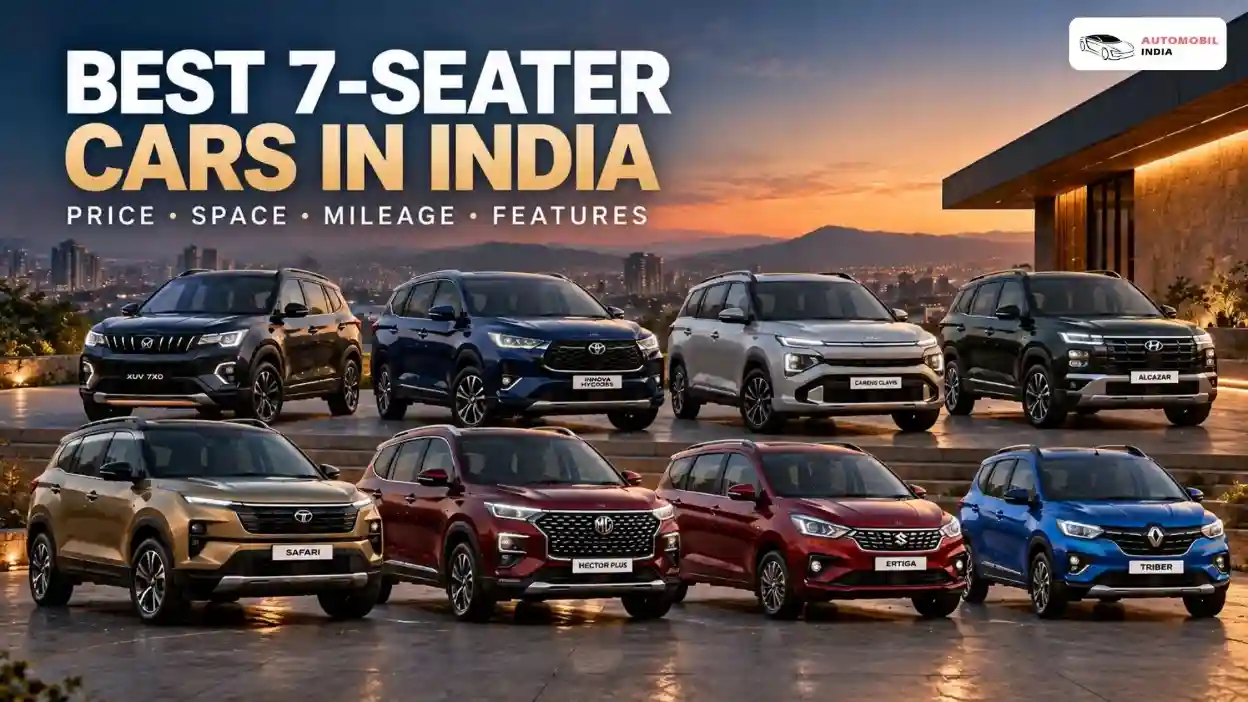
Buying a seven-seater car in India is no longer simply about finding a vehicle with three rows. Buyers now have a wide choice ranging from affordable MPVs such as the Renault Triber and Maruti Suzuki Ertiga to premium family vehicles such as the Toyota Innova HyCross, Kia Carens Clavis and large SUVs such as the Mahindra XUV 7XO, Tata Safari and MG Hector Plus.
The right choice depends on how you plan to use all seven seats. A family that regularly carries seven adults needs a different vehicle from a buyer who mainly uses the third row for children. Similarly, city users may prioritise fuel economy and easy manoeuvrability, while frequent highway travellers may value diesel torque, automatic transmissions, ride comfort and luggage space.
Here is a practical look at the best 7 seater cars in India in 2026, covering price, engines, mileage, space, features, safety and everyday usability.
Quick answer: The market currently includes everything from the Renault Triber at around ₹5.8 lakh to premium seven-seat models costing more than ₹20 lakh. The Mahindra XUV 7XO, Toyota Innova HyCross, Kia Carens Clavis, Hyundai Alcazar, Tata Safari, MG Hector Plus, Maruti Suzuki Ertiga and Renault Triber cover very different buyer requirements.
Best 7-Seater Cars in India in 2026
|
Car |
Approx. starting ex-showroom price* |
Seating |
Powertrain choices |
Best suited for |
|
Renault Triber |
₹5.81 lakh |
7 |
Petrol |
Budget-conscious families |
|
Maruti Suzuki Ertiga |
₹8.90 lakh |
7 |
Petrol, CNG |
Efficient family use |
|
Hyundai Alcazar |
₹14.51 lakh |
6/7 |
Petrol, Diesel |
Premium family SUV |
|
Mahindra XUV 7XO |
₹13.66 lakh** |
6/7 |
Petrol, Diesel |
Feature-rich SUV buyers |
|
Tata Safari |
₹15.49 lakh*** |
6/7 |
Diesel |
Large SUV buyers |
|
Kia Carens Clavis |
₹11.27 lakh**** |
7 |
Petrol, Diesel, CNG |
Family practicality and features |
|
MG Hector Plus |
₹16.75 lakh |
7 |
Petrol, Diesel |
Spacious, feature-focused buyers |
|
Toyota Innova HyCross |
₹18.70 lakh |
7/8 |
Petrol, Hybrid |
Long-distance family travel |
* Prices are ex-showroom starting prices and can vary by variant, location and manufacturer revisions.
** Mahindra's XUV 7XO launch price; subsequent price revisions may apply to vehicles outside the introductory allocation. Mahindra announced a price revision effective April 2026.
*** Tata's published Safari pricing has changed across campaigns and variants; confirm the exact current variant price with Tata Motors before purchase. Tata has previously published a ₹15.49 lakh starting price for the Safari.
**** Kia's current Clavis pricing varies according to engine, transmission and variant. Kia's official website lists the range from around ₹11.27 lakh after its applicable pricing revision.
1. Mahindra XUV 7XO
The Mahindra XUV 7XO is one of the newest entrants in India's premium seven-seat SUV space. Launched in January 2026, it builds on the XUV700 formula while introducing a substantially technology-focused cabin.
Mahindra launched the XUV 7XO with seven-seat configurations across much of the range, while selected higher variants are also available with six seats. The launch range included petrol and diesel engines with manual and automatic transmission options, while an AWD option is available on selected diesel variants.
Key highlights
-
Petrol and diesel engine options
-
Manual and automatic transmissions
-
6- and 7-seat configurations depending on variant
-
Available AWD on selected variants
-
ADAS Level 2
-
Triple-screen dashboard
-
Connected technology
-
Premium infotainment system
-
Multiple drive and convenience features
One of the XUV 7XO's biggest differentiators is its technology package. Mahindra says the model introduces a coast-to-coast triple-screen setup and ADAS Level 2 with Dynamic Visualisation.
Who should consider it?
The XUV 7XO makes sense for buyers who want an SUV rather than an MPV and place a high value on technology, performance and road presence.
For a family that regularly travels with seven people, however, a test drive should specifically include all three rows. The question is not simply whether seven seats exist, but how comfortable the adults in the third row will be on a long journey.
2. Toyota Innova HyCross
The Toyota Innova HyCross occupies a different part of the seven-seater market. It is an MPV designed around family travel, with a long 2,850 mm wheelbase, multiple seating configurations and both petrol and self-charging hybrid powertrains.
Toyota currently lists the Innova HyCross from ₹18.70 lakh ex-showroom. Depending on the variant, buyers can choose seven- or eight-seat layouts, while higher hybrid variants are offered with seven seats.
Engine and mileage
The petrol version uses a 2.0-litre engine with Direct Shift CVT.
The strong-hybrid version combines a 2.0-litre petrol engine with Toyota's fifth-generation hybrid system.
Toyota's published figures list claimed efficiency of up to 22.16 km/l for the hybrid and 16.13 km/l for the petrol version under standardised test conditions. Actual road mileage will vary with traffic, driving style, load and air-conditioning use.
Why families consider it
The HyCross is particularly suited to buyers who spend significant time travelling with family.
Its 4,755 mm length and 2,850 mm wheelbase give the cabin a different spatial character from compact seven-seat SUVs. Higher variants also offer features such as a panoramic sunroof, powered features, panoramic-view monitoring and Toyota Safety Sense depending on the grade.
Who should consider it?
The Innova HyCross is worth considering if:
-
Long-distance comfort is a priority
-
Seven seats will be used regularly
-
You want a hybrid powertrain
-
You prefer an MPV-style cabin
-
Highway touring is an important part of your usage
Toyota also announced in April 2026 that the Innova HyCross had crossed two lakh cumulative sales in India and stated that select variants had received a 5-star BNCAP rating.
3. Kia Carens Clavis
The Kia Carens Clavis is aimed squarely at family buyers who want a spacious three-row vehicle with a strong equipment list.
Kia lists the Clavis with petrol, turbo-petrol, diesel and CNG powertrain choices depending on variant, along with manual, iMT, DCT and automatic transmission options.
The standard seven-seat layout is particularly relevant for buyers who want easier access to the third row without giving up the flexibility of a conventional family MPV.
Key features
Depending on variant, the Clavis can offer:
-
Six airbags
-
ADAS Level 2
-
360-degree camera
-
Blind View Monitor
-
Ventilated front seats
-
Panoramic sunroof on selected variants
-
Wireless charging
-
Large digital displays
-
Connected-car technology
-
One-touch second-row tumble function
-
Sliding and reclining second-row seats
-
Folding third-row seats
Kia states that the Clavis has a third-row 50:50 split and reclining/folding functionality, while selected variants receive ADAS Level 2 with 20 autonomous features.
Practicality
This is where the Clavis becomes particularly interesting for families.
A three-row vehicle needs more than a large body. Easy access to the third row is important when children, older passengers or luggage are involved. The Clavis's second-row tumble mechanism and flexible seating arrangement address that practical requirement.
Who should consider it?
The Carens Clavis suits buyers who want:
-
A family-focused seven-seater
-
Lots of cabin features
-
Multiple engine choices
-
Automatic transmission options
-
Flexible second- and third-row seating
-
A more car-like driving experience than a traditional large SUV
4. Hyundai Alcazar
The Hyundai Alcazar sits between compact three-row family vehicles and larger premium SUVs.
Hyundai currently lists the Alcazar from approximately ₹14.51 lakh ex-showroom and offers both petrol and diesel powertrains. Depending on the engine and variant, buyers can choose manual, DCT or automatic transmissions. Both six- and seven-seat configurations are available.
What stands out?
The Alcazar's strength is its combination of relatively manageable dimensions, premium equipment and multiple powertrain choices.
The current model offers:
-
1.5-litre turbo-petrol
-
1.5-litre diesel
-
6-speed manual
-
7-speed DCT
-
6-speed automatic
-
6- and 7-seat layouts
Hyundai also offers higher-end variants with features such as ADAS and premium cabin equipment.
6 seats or 7 seats?
This is an important decision.
The six-seat version uses captain's chairs in the second row and is more suitable if second-row passenger comfort is the priority.
The seven-seat version is more useful if you occasionally need to carry an additional passenger.
If your family frequently travels with six or seven adults, the seven-seat configuration should be tested with real passengers before booking.
5. Tata Safari
The Tata Safari remains one of the most recognisable large seven-seat SUVs in India.
Its positioning is different from the Innova HyCross. The Safari is designed as a large SUV, with a substantial road presence and a cabin aimed at families who prefer the SUV format.
Tata has offered the Safari in both six- and seven-seat configurations, depending on variant. The company's current range includes multiple personas and equipment levels.
Safety
Safety is one of the Safari's major selling points.
The current-generation Safari achieved a 5-star rating in Global NCAP testing, including strong adult and child occupant protection scores in the 2023 assessment.
However, buyers should remember that safety ratings are tied to the tested specification and protocol. A safety rating should be considered alongside active safety equipment, restraint systems and the exact variant being purchased.
What makes the Safari different?
The Safari makes sense for buyers who want:
-
A large SUV body
-
Diesel power
-
Three-row seating
-
Strong safety credentials
-
A substantial highway presence
-
A more SUV-oriented driving experience
It is particularly worth considering if you prefer the driving position and styling of an SUV over an MPV.
6. MG Hector Plus
The MG Hector Plus is another large seven-seat SUV designed around cabin space and equipment.
MG currently offers the Hector Plus in seven-seat configurations with petrol and diesel options, depending on variant. The manufacturer's current listing includes Select Pro, Smart Pro, Sharp Pro, Blackstorm and Snowstorm variants.
The Hector Plus measures 4,699 mm long, 1,835 mm wide and 1,760 mm tall, with a 2,750 mm wheelbase.
Feature highlights
Depending on variant, equipment can include:
-
Panoramic sunroof
-
14-inch infotainment screen
-
360-degree camera
-
Ventilated front seats
-
Powered tailgate
-
Connected-car features
-
Wireless charging
-
Curtain airbags
-
Cruise control
The diesel version uses a 2.0-litre engine producing 170 PS and 350 Nm, paired with a six-speed manual transmission.
Who should consider it?
The Hector Plus is worth considering if cabin size, comfort-oriented equipment and a long feature list are more important to you than outright driving dynamics.
7. Maruti Suzuki Ertiga
The Maruti Suzuki Ertiga is one of the more accessible ways to enter the seven-seat market.
Maruti Suzuki currently lists the Ertiga from ₹8.90 lakh ex-showroom. The model uses a 1.5-litre Smart Hybrid petrol engine, while CNG variants are also available.
Why the Ertiga remains relevant
The Ertiga's biggest advantage is that it does not try to be a premium SUV.
Instead, it focuses on:
-
Seven-seat practicality
-
Relatively compact dimensions
-
Petrol and CNG options
-
Automatic transmission availability
-
Family-oriented cabin layout
-
Lower entry price than larger SUVs
The CNG version can be particularly relevant for buyers who drive high annual kilometres and have convenient access to CNG refuelling.
Who should consider it?
The Ertiga is a logical choice for families that want seven seats without moving into the ₹15–25 lakh SUV segment.
It is especially relevant for:
-
City families
-
Large households
-
High-mileage users
-
Buyers considering CNG
-
Buyers prioritising running costs over premium SUV styling
8. Renault Triber
If budget is the primary constraint, the Renault Triber deserves attention.
Renault currently lists the Triber from ₹5,80,875. It is unusual because its seating arrangement can be configured from five to seven seats, with removable third-row seats and a flexible second row.
Renault quotes up to 625 litres of boot space in certain configurations and up to 1,065 litres with the rear seats folded/removed, depending on the configuration.
The important catch
The Triber's affordable pricing comes with a smaller engine and a compact overall package.
That makes it well suited to urban family use, but buyers should not compare its performance directly with a 2.0-litre diesel SUV or a 2.0-litre hybrid MPV.
Who should consider it?
The Triber is particularly relevant for:
-
First-time seven-seater buyers
-
Smaller families
-
City driving
-
Occasional third-row use
-
Buyers with a limited budget
Its removable third row is also useful when you need luggage space more often than seven seats.
7-Seater SUV vs 7-Seater MPV: Which Should You Buy?
One of the biggest mistakes buyers make is treating every seven-seater as the same type of vehicle.
A seven-seat SUV and a seven-seat MPV can serve completely different purposes.
|
Requirement |
SUV |
MPV |
|
Road presence |
Usually stronger |
More understated |
|
Third-row access |
Varies significantly |
Usually a priority |
|
Family comfort |
Depends on model |
Usually a core focus |
|
Ground clearance |
Often higher |
Usually moderate |
|
Driving position |
SUV-like |
Car/MPV-like |
|
Highway use |
Strong |
Strong |
|
Maximum passenger practicality |
Model dependent |
Usually strong |
|
Luggage with all seats occupied |
Model dependent |
Needs careful checking |
For example, the Safari and XUV 7XO appeal to buyers who want an SUV character.
The Innova HyCross and Carens Clavis are more fundamentally family-oriented around passenger movement and cabin flexibility.
Neither approach is universally better. The correct choice depends on what you actually do with the third row.
What Should You Check Before Buying a 7-Seater?
1. Sit in the third row
Do not judge third-row comfort from photographs.
Take your family to the showroom and put the tallest regular passenger in the third row.
Check:
-
Knee room
-
Headroom
-
Seat height
-
Foot space
-
Seat-back angle
-
Air-conditioning
-
Ease of entry and exit
This can completely change your decision.
2. Check boot space with all seven seats occupied
Manufacturers often quote boot capacity with different seat configurations.
For a seven-seat family car, ask a simple question:
Can we fit our luggage when all seven seats are being used?
A vehicle can have excellent overall boot capacity but still leave little usable luggage room with the third row raised.
3. Check the second-row movement
This is especially important if children or elderly passengers regularly use the third row.
Look for:
-
One-touch tumble
-
Sliding seats
-
Reclining seats
-
Wide opening doors
-
Easy step-in height
4. Consider the engine based on your usage
A petrol engine may make more sense for primarily urban users with moderate annual mileage.
Diesel can still make sense for buyers who regularly cover long highway distances and want strong low-end torque.
A hybrid can be attractive for buyers who spend considerable time in urban traffic and want improved fuel efficiency.
Do not select an engine solely because its laboratory mileage figure is higher.
5. Automatic or manual?
For a family vehicle that spends considerable time in Indian city traffic, an automatic can substantially reduce driving effort.
But the type of automatic matters.
A DCT, CVT, torque-converter automatic and hybrid e-drive behave differently.
A test drive in actual traffic is more useful than choosing a gearbox purely from its specification sheet.
What Does "Mileage" Really Mean for a 7-Seater?
Mileage figures published by manufacturers are generally certification/test-cycle figures.
They should not be interpreted as a guaranteed real-world number.
Actual fuel economy can change significantly depending on:
-
Number of passengers
-
Luggage load
-
Traffic
-
Driving style
-
Air-conditioning use
-
Tyre pressure
-
Road conditions
-
Highway speed
-
Fuel quality
-
Vehicle maintenance
This is particularly important for seven-seaters because carrying six or seven passengers and luggage puts a substantially different load on the vehicle compared with a lightly loaded test vehicle.
Toyota, for example, explicitly notes that its certified Innova HyCross fuel-efficiency figures are obtained under standard test conditions and that actual mileage can vary.
Which 7-Seater Should You Consider for Different Needs?
Instead of choosing a single overall "best" car, consider the requirement first.
For the lowest purchase budget
Renault Triber
Its compact dimensions, flexible seating and relatively low starting price make it relevant to buyers entering the seven-seat market.
For an affordable family MPV
Maruti Suzuki Ertiga
It offers seven seats, petrol/CNG choices and automatic availability at a substantially lower entry point than most premium three-row SUVs.
For technology-focused SUV buyers
Mahindra XUV 7XO
Its triple-screen cockpit, ADAS Level 2, petrol/diesel choices and available AWD make it a technology-heavy SUV option.
For long-distance family travel
Toyota Innova HyCross
Its large cabin, long wheelbase, seven/eight-seat availability and hybrid option make it particularly relevant for families covering substantial distances.
For a feature-rich family vehicle
Kia Carens Clavis
Its combination of seating flexibility, powertrain choices and extensive equipment makes it a strong option for buyers who prioritise family convenience.
For buyers who specifically want a large SUV
Tata Safari or MG Hector Plus
Both provide a large SUV format with three-row seating and extensive feature availability, although their powertrain and equipment combinations differ.
For a premium compact three-row SUV
Hyundai Alcazar
Its relatively compact footprint, petrol/diesel choices and 6/7-seat configurations make it relevant to buyers who want SUV styling without moving to the largest three-row vehicles.
Are 7-Seater Cars Good for Indian Families?
Yes, but the number "7" should not be the only deciding factor.
For a family of four or five that occasionally needs extra seats, a compact seven-seater with flexible third-row seating may be sufficient.
For a family that regularly carries seven adults, cabin dimensions, third-row ergonomics and luggage capacity become much more important.
This is why the best 7 seater car in India depends heavily on the way the vehicle will actually be used.
A buyer doing 80% city driving with occasional family trips may have very different priorities from someone regularly driving 500–800 km highway journeys with seven occupants.
Conclusion
The Indian seven-seater market now covers a very wide price and usage range.
The Renault Triber and Maruti Suzuki Ertiga address buyers who want affordable family transportation. The Kia Carens Clavis and Hyundai Alcazar offer a more premium family experience without moving into the largest SUV segment. The Mahindra XUV 7XO, Tata Safari and MG Hector Plus cater to buyers looking for larger, SUV-oriented vehicles, while the Toyota Innova HyCross takes a strong family-touring and hybrid approach.
The most important point is to buy the right type of seven-seater for your actual usage.
If seven adults regularly travel together, prioritise third-row comfort and luggage space. If the third row is used only occasionally, a flexible compact MPV or three-row SUV may make more sense. And if you drive long distances every month, the choice of powertrain and transmission deserves as much attention as the equipment list.
A seven-seat badge tells you how many people the vehicle can accommodate. A proper test drive tells you whether it can accommodate your family comfortably.
Disclaimer
Prices, variants, features, specifications and availability can change without prior notice. Manufacturer-claimed mileage figures are certified under standard test conditions and may differ from actual real-world fuel economy. Always verify the exact variant, on-road price, safety equipment and applicable offers with the respective manufacturer or authorised dealer before making a purchase.