
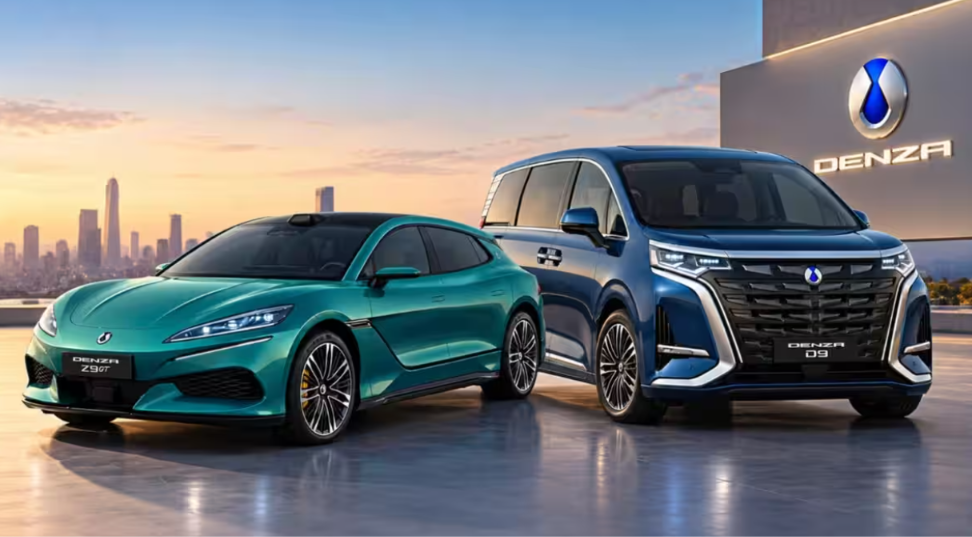
BYD has officially announced that its upscale electric vehicle arm, Denza, will make its entry into the Indian market on November 13, 2026. Originally founded in 2010 as a 50:50 joint venture between BYD and Mercedes-Benz, Denza is now fully controlled by BYD. The brand aims to carve out a space in the Rs 80 lakh to Rs 1.5 crore luxury EV segment in India, where it will lock horns with established European marques such as Mercedes-Benz, BMW, and Audi, alongside forthcoming players like Hyundai’s Genesis and Tata’s Avinya. Reports differ on the exact debut year, as one source notes the event is on 13 November while another specifies November 13, 2026.
Retail Strategy and Import Route
To establish a distinct market position, the automaker plans to set up exclusive retail showrooms for Denza in major Tier-1 and Tier-2 cities. These outlets will be kept physically separate from existing BYD facilities to maintain a clear luxury tiering. The initial wave of vehicles will be imported as Completely Built Units (CBUs) by leveraging the 2,500-unit homologation exemption quota, while local assembly remains a possibility down the line depending on consumer demand and market feedback.
Demand for high-end luxury people movers is on the rise in India, particularly within the film fraternity. Denza's initial product roadmap and network rollout strategy will be detailed on the day of the brand's official reveal.
Denza D9 Luxury MPV Overview
The first offering from the marque is expected to be the D9 7-seater electric MPV. It will compete against options like the Kia Carnival, MG M9, Mercedes-Benz V-Class, Lexus LM, and Toyota Vellfire. On the outside, the vehicle features the Pi-Motion grille, a full-width tail lamp bar, powered sliding doors with bi-directional operation, soft-close doors, a panoramic sunroof, and 18-inch alloy wheels. Cabin highlights consist of high-grade Nappa leather, open-pore wood inlays, ambient lighting, and second-row Air Spa zero-gravity captain seats with 14-way electric adjustment, leg rests, heating, ventilation, a 16-point massage function, and a 152° recline angle.
Technology inside the D9 includes a 15.6-inch central touchscreen, a 10.25-inch digital instrument cluster, a passenger-side display, and optional rear entertainment screens. While global markets receive plug-in hybrid and fully electric choices, India will get the EV version exclusively, equipped with a 103-115 kWh Blade battery supporting both front- and all-wheel-drive configurations. The D9 delivers a claimed range of up to 600 km, a 0-100 km/h acceleration time of 6.9 seconds, and expected pricing between Rs 85 lakh and Rs 90 lakh.
Denza Z9 GT Shooting Brake
Following the MPV, the brand intends to introduce the Z9 GT, a low-slung, five-seat grand tourer shooting brake styled under Wolfgang Egger. It incorporates dual-bar headlamps, active aerodynamics, a prominent rear diffuser, rear-wheel steering, and a crab-walk capability. Inside, occupants find soft Nappa leather, a 17.3-inch floating central touchscreen, dual 13.2-inch displays for the driver and front passenger, an expansive AR head-up display spanning up to 50 inches, and optional digital side-mirror screens. Comfort features comprise ventilated, heated, and massaging seats, twin 50 W wireless charging pads, a panoramic glass roof, and a 20-speaker Devialet audio system rated at 1,150 W with Dolby Atmos.
The Z9 GT is propelled by a high-output triple-motor setup powered by Blade LFP batteries ranging from 100 to 122.5 kWh. Total power output reaches roughly 710 to 850 kW (approximately 952 to 1,156 PS) alongside more than 1,100 Nm of torque. This hardware enables a 0–100 km/h sprint in 2.7 to 3.4 seconds, a top speed of 270 km/h, and a driving range of about 600 km. The vehicle also supports ultra-fast charging, allowing a 10% to 97% top-up in approximately 9 minutes.
| Model | Length | Width | Height | Wheelbase |
|---|---|---|---|---|
| Denza D9 | 5,250 mm | 1,960 mm | 1,920 mm | 3,110 mm |
| Denza Z9 GT | 5,195 mm | 1,990 mm | 1,490 mm | 3,125 mm |
Buyer Outlook
With the introduction of Denza, luxury car buyers in India gain access to high-end electric mobility options that bridge the gap between traditional premium brands and ultra-luxury custom segments. The phased rollout in Tier-1 and Tier-2 cities ensures dedicated sales and service touchpoints, while the CBU import strategy allows BYD to test market acceptance quickly using the government's homologation exemption quota.