
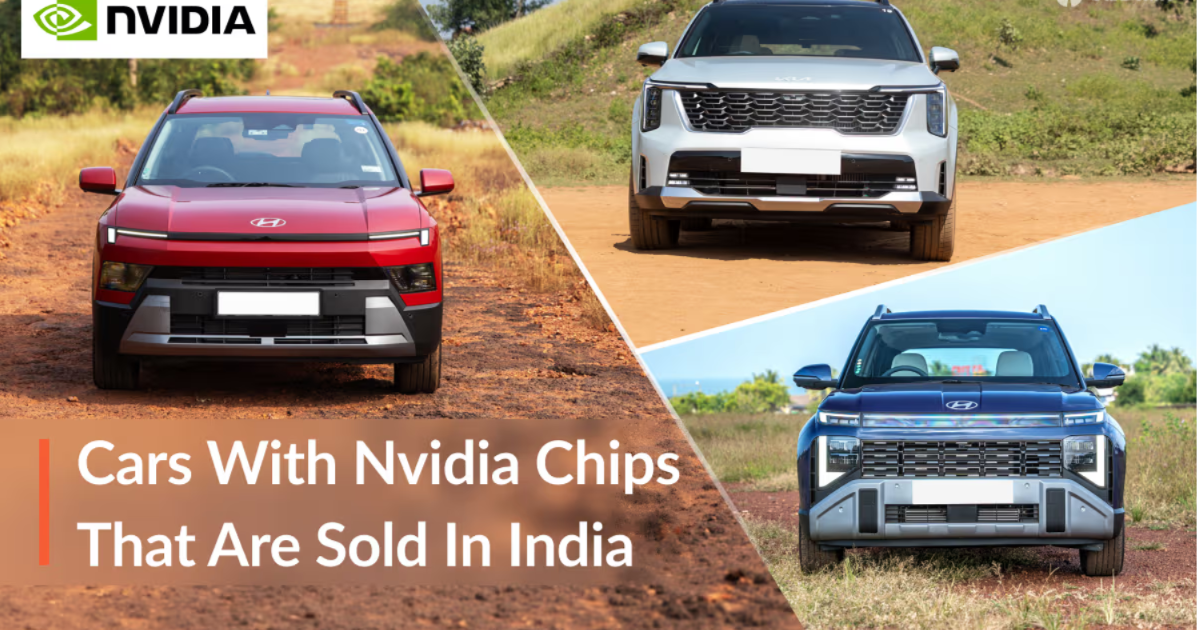
While graphics processing units see surging costs and market fluctuations, advanced silicon is finding its way into everyday vehicles. Beyond personal computers and laptops, several cars navigating daily traffic rely directly on NVIDIA chips. Nearly every vehicle featured utilizes an NVIDIA processor or software to drive its infotainment systems and digital interfaces.
Mass-Market Offerings with NVIDIA Tech
The Hyundai Venue starts off the lineup, incorporating Hyundai's connected car navigation cockpit system accelerated by NVIDIA. It includes a 12.3-inch touchscreen infotainment unit and a 12.3-inch digital driver’s display, alongside over-the-air software updates comparable to mobile device updates. Wireless Android Auto, Apple CarPlay, Hyundai Bluelink connected car technology, and an 8-speaker Bose audio setup are integrated, offering a responsive user interface and clean graphics.
Similarly, the Hyundai Bayon provides the same screen layouts and features as the Venue while adding generative AI voice assistance via Perplexity AI for conversational vehicle interaction. The Kia Sorento likewise uses the connected car navigation cockpit system backed by an NVIDIA chip, pairing a 12.3-inch touchscreen and a 12.3-inch digital instrument cluster. It includes KIA AI assistance powered by Perplexity AI, over-the-air updates, wireless smartphone mirroring, and a 12-speaker Bose sound system.
Luxury and Performance Models
The Volvo EX90 adopts a dual NVIDIA AGX ORIN system-on-chip setup capable of exceeding 250 trillion operations per second, supported by over-the-air software capabilities. This processing power manages a 14.5-inch touchscreen running built-in Google services, handling nearly all vehicle operations including outside rearview mirror adjustments and steering positioning. Music enthusiasts receive a 25-speaker Bowers and Wilkins audio arrangement.
Mercedes-Benz integrates NVIDIA hardware across several flagship vehicles. The Mercedes-Benz CLA Electric utilizes NVIDIA DRIVE AV software to power the MB.OS platform, learning from driving data and functioning as a safety fail-safe. It introduces the Mercedes-Benz user experience with a Virtual Assistant, augmented reality navigation, and generative AI services like ChatGPT, Google Gemini, and Microsoft Bing through a 14-inch central touchscreen.

The GLC Electric operates on the Mercedes MB.OS platform driven by an NVIDIA chip, highlighted by a 39-inch Hyperscreen spanning the digital driver display, infotainment touchscreen, and front passenger screen. The Mercedes-Benz S-Class incorporates the MB.OS featuring an NVIDIA Drive AGX Orin system-on-a-chip, NVIDIA Hyperion architecture, and full-stack DRIVE AV L4-software. This hardware supports both infotainment responsiveness and safety features like a Level-2 Plus advanced driver assistance system, complemented by a Superscreen layout of a 14.4-inch central screen, a 12.3-inch instrument panel, and a 12.3-inch passenger display alongside ChatGPT integration.
- Hyundai Venue: NVIDIA-accelerated connected car navigation cockpit with dual 12.3-inch displays.
- Hyundai Bayon: Features generative AI voice assistance via Perplexity AI.
- Kia Sorento: Connected car navigation cockpit with KIA AI assistance and Bose audio.
- Volvo EX90: Dual NVIDIA AGX ORIN system-on-chip with a 14.5-inch Google-integrated display.
- Mercedes-Benz CLA Electric: NVIDIA DRIVE AV software and MB.OS platform.
- Mercedes-Benz GLC Electric: NVIDIA-powered MB.OS featuring a 39-inch Hyperscreen.
- Mercedes-Benz S-Class: NVIDIA Drive AGX Orin, Hyperion architecture, and Superscreen configuration.
Implications for Buyers
As vehicles integrate heavier technology and electronics, reliable computing hardware transitions from a luxury to a baseline necessity. The adoption of NVIDIA architecture by manufacturers such as Hyundai, Kia, and Mercedes-Benz demonstrates a reliance on robust processors. Mass-market drivers gain access to responsive user interfaces, while luxury segments leverage high-capacity computing for extensive safety architectures and display networks.