
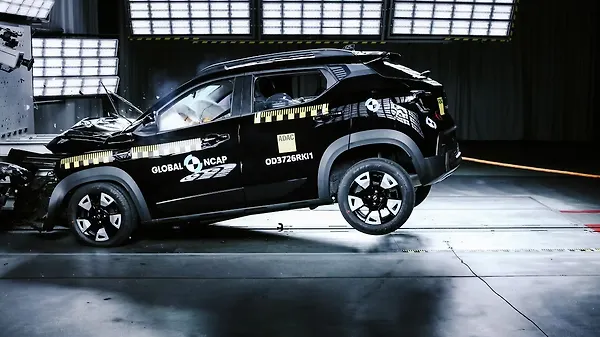
The manufactured-in-India Renault Kiger has substantially improved its crash safety evaluation, jumping from an initial two stars to four stars for adult occupant protection and three stars for child occupant protection in recent Global NCAP assessments. Originally tested in 2022 under the Safer Cars for Africa campaign as a pre-facelift version with two standard airbags and no Electronic Stability Control or ISOFIX mounts, the compact SUV underwent a voluntary re-test following updates. The current facelifted model, built at the company facility in Chennai and exported to 16 global markets, was launched in India in August 2026.
Crash Test Performance Breakdown
During the latest evaluations, the tested Renault Kiger was equipped with six airbags, ISOFIX child seat anchorages, Electronic Stability Control, seatbelt reminders, along with seatbelt pretensioners and load limiters. The vehicle secured 25.20 out of 34 points for adult occupant protection and 30.21 out of 49 points for child occupant protection. Assessment reports noted that the footwell area and overall bodyshell were rated as unstable and incapable of withstanding further loads.

In the frontal offset deformable barrier test, front occupants experienced marginal protection for the chest and thigh regions. During the side movable deformable barrier test, torso and back protection were rated as adequate, though one door opened during testing, leading to a point deduction. Head, abdomen, and pelvis protection were classified as good, while chest protection was deemed adequate. In the side pole impact test, the head and pelvis showed good protection, the abdomen was adequate, and the chest scored marginally, with the waist rated adequate.
Child Occupant Safety and Points Deduction
The vehicle was assessed using dummies representing an 18-month-old and a three-year-old child. For the frontal impact, the 18-month-old dummy received full protection, whereas the three-year-old dummy's head contacted the interior of the vehicle and its chest displayed high decelerations. In the side impact test, the three-year-old dummy's head region was found to be vulnerable, reducing its side impact points to zero, while the 18-month-old dummy demonstrated full protection in both frontal and side impact assessments.
Further deductions occurred because the vehicle lacks an option to deactivate the passenger airbag when a rearward-facing Child Restraint System is placed on the front passenger seat. Nevertheless, the car fulfilled the UN127 pedestrian protection regulation and satisfied Global NCAP mandates for Electronic Stability Control and seatbelt reminders.

Industry Reactions
Global NCAP Chief Executive Officer Richard Woods expressed satisfaction regarding the safety enhancements integrated by Renault into the refreshed Kiger in South Africa. He welcomed the positive engagement from the manufacturer and expressed hope that this strategy would become an industry trend, highlighting the results of prioritizing safety and the necessity of making six airbags a standard requirement.