

The Tata Aeris was introduced in the Indian market last month, establishing a new nameplate by Tata that takes the place of the Tata Tigor for private buyers. This new model comes in both petrol and petrol+CNG configurations. This report pits the latest Tata Aeris against the Hyundai Aura, a long-standing contender in the segment known for its family-oriented comfort and reliability at an accessible price point. While the Aeris positions itself as a more upscale offering, the Aura remains a tough competitor.
Both vehicles target buyers searching for a practical, comfortable, and well-equipped compact sedan featuring modern technologies alongside CNG powertrain choices. However, they vary significantly in styling, pricing structures, feature lists, and overall value. This comparative analysis examines their pricing, physical dimensions, color choices, safety features, equipment, powertrain options, and technical specifications to determine which model suits specific requirements.
Pricing and Variants
The pricing for the Tata Aeris begins at an ex-showroom starting price of Rs 5.29 lakh for the base petrol variant and climbs to Rs 9.74 lakh (ex-showroom) for the top-of-the-line petrol+CNG AMT variant. In comparison, the Hyundai Aura begins at a higher ex-showroom price of Rs 5.99 lakh for its entry-level petrol trim and reaches up to Rs 8.67 lakh (ex-showroom) for the range-topping petrol+CNG manual variant. Overall, the range for the Aura starts at an additional cost of Rs 70,000.
Looking closely at the lineup structure, the Tata Aeris provides a total of 18 variants divided across petrol and petrol+CNG engines, with both fuel types offering manual transmission (MT) and automated manual transmission (AMT) options. Conversely, the Hyundai Aura features 8 variants with similar petrol and petrol+CNG powertrain choices, though its CNG variant does not include an AMT gearbox option. Top-tier variants of the Aeris are more expensive by roughly Rs 32,000 for petrol versions and Rs 1.07 lakh for the petrol+CNG versions, while the starting prices of the Tata Aeris CNG are cheaper by Rs 1.6 lakh compared to the Aura.
Dimensions and Color Palette
Both compact sedans share identical length and wheelbase measurements, translating to very similar interior passenger space. However, the Tata Aeris edges out the competition by a whisker, measuring slightly larger in both width and height.
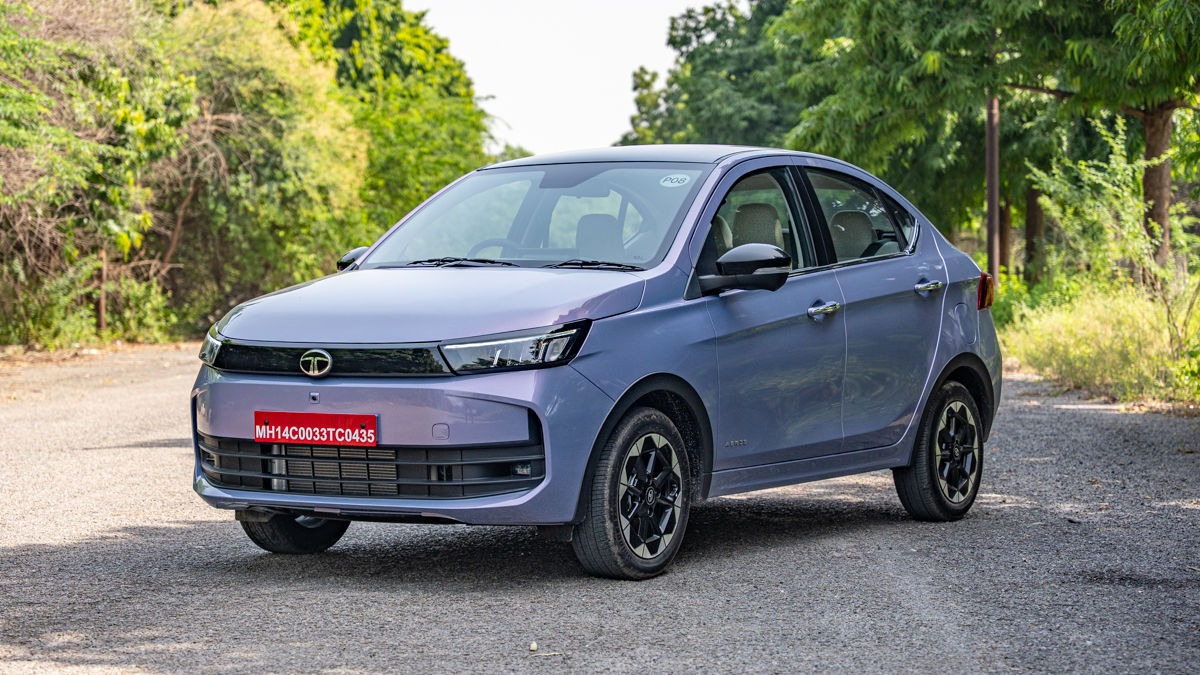
When it comes to exterior styling hues, the Aeris provides a wider selection comprising both minimalistic and vibrant finishes. The Tata Aeris comes in six distinct colors: Pristine White, Pure Grey, Daytona Grey, Dune Glow, Nitro Crimson, and Dandeli Drizzle. Meanwhile, the Hyundai Aura offers a more basic palette consisting of only four shades: Atlas White, Typhoon Silver, Titan Grey, and Starry Night. Furthermore, the highest-spec variant of the Tata Aeris features a dual-tone roof treatment across all color options, a styling element that is absent on the Hyundai Aura.
Features and Safety
- Wireless Apple CarPlay and Android Auto compatibility
- Analog instrument cluster paired with a 3.5-inch MID display
- Audio system featuring 6 speakers (4 speakers and 2 tweeters)
- Leatherette-wrapped steering wheel
- Steering-mounted audio controls
- Rear centre armrest
Buying Advice
For buyers weighing these two compact sedans, the choice ultimately comes down to entry-level pricing versus variant variety and top-end feature additions. The Tata Aeris offers a lower entry barrier with its base petrol and CNG variants, a broader spread of 18 variants including CNG AMTs, and more vibrant color selections with dual-tone roofs on top trims. On the other hand, the Hyundai Aura maintains its reputation for comfort and dependability with a streamlined 8-variant lineup, though it commands a higher starting price and lacks a CNG automatic option.
