
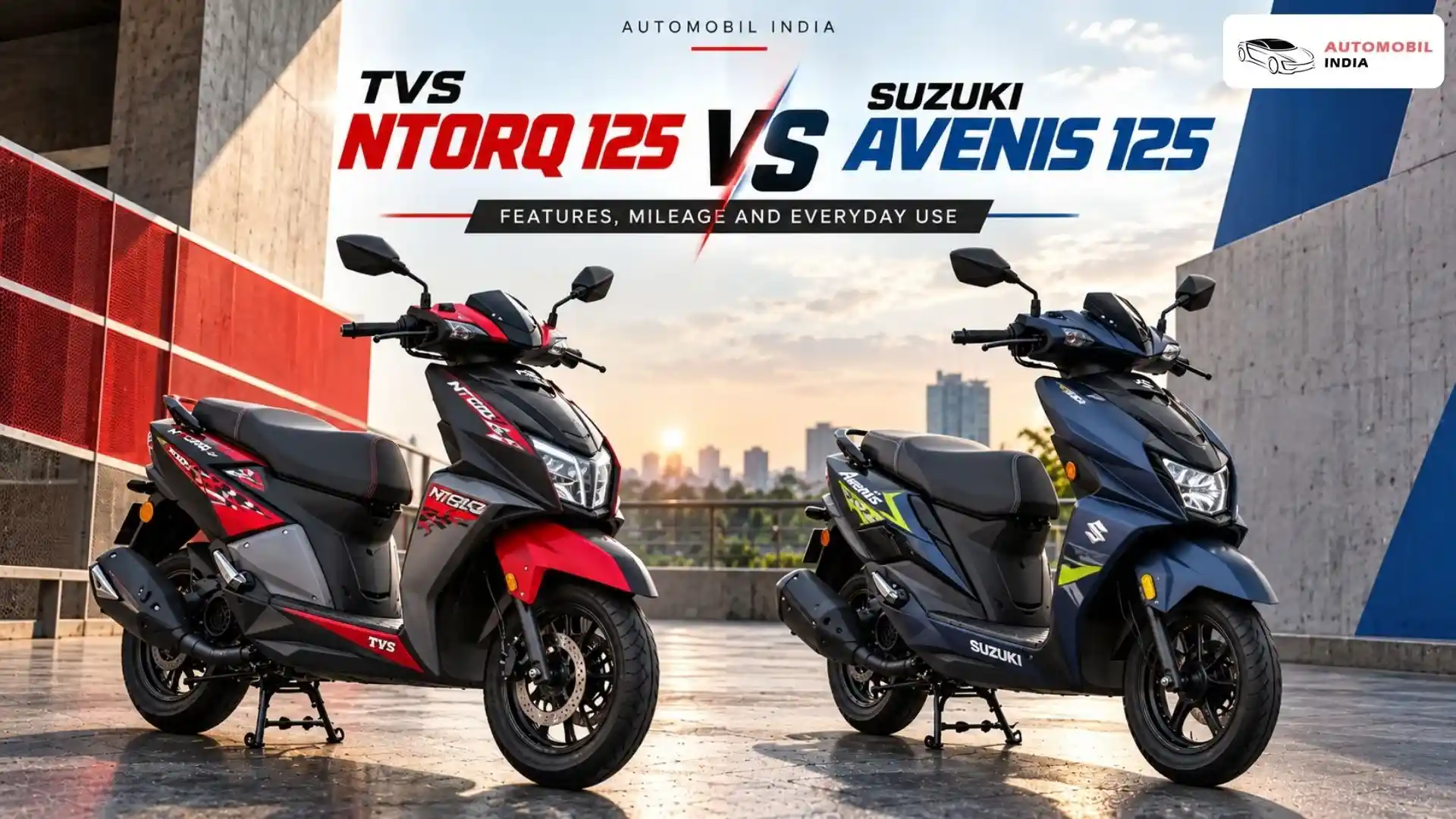
If you are looking for a sporty 125cc scooter in India, the TVS Ntorq 125 and Suzuki Avenis 125 are two models worth considering. Both use 125cc petrol engines, automatic CVT transmissions and sporty styling, but their approach is different.
The Ntorq focuses strongly on performance, connected technology and multiple variants, while the Avenis combines a lightweight package with a compact sporty design and practical everyday features.
For buyers comparing Ntorq vs Avenis, the important differences are engine output, weight, storage, connected features, variant choices and the equipment available at different prices.
Ntorq vs Avenis: Quick Comparison
|
Specification |
TVS Ntorq 125 |
Suzuki Avenis 125 |
|
Engine |
124.8cc, 3-valve |
124cc, 2-valve |
|
Engine type |
Single-cylinder, air/oil cooled* |
Single-cylinder, air cooled |
|
Maximum power |
Up to 10.2 PS** |
8.7 PS |
|
Maximum torque |
Up to 11.5 Nm** |
10 Nm |
|
Transmission |
Automatic CVT |
Automatic CVT |
|
Kerb weight |
Around 111 kg for standard specification |
106 kg |
|
Wheelbase |
1,285 mm |
1,265 mm |
|
Ground clearance |
155 mm |
160 mm |
|
Fuel tank |
5.8 litres |
5.2 litres |
|
Front brake |
Disc, variant dependent |
Disc |
|
Rear brake |
Drum |
Drum |
|
Front tyre |
100/80-12 |
90/90-12 |
|
Rear tyre |
110/80-12 |
90/100-10 |
|
Under-seat storage |
Up to 22 litres |
21.8 litres |
*Specifications can vary by NTORQ variant and market configuration.
**Race XP specification. The standard NTORQ variants have lower outputs.
TVS lists the NTORQ with a 124.8cc three-valve engine, while the Avenis uses Suzuki's 124cc single-cylinder engine producing 8.7 PS and 10 Nm.
Ntorq vs Avenis Price in India
Prices vary by city, variant, taxes and dealer pricing, so buyers should check the current quotation before making a purchase.
TVS currently lists the NTORQ 125 in five principal variants: Disc, Race Edition, Super Squad Edition, Race XP and XT. Manufacturer pricing pages show that prices vary across locations.
Suzuki's current media information lists the Avenis Standard Edition and Ride Connect Edition, with a Special Edition also offered in the range. Suzuki lists the Standard Edition at ₹91,400 and Ride Connect Edition at ₹93,200 ex-showroom Delhi in its current press information; its pricing can change with applicable benefits and updates.
Why the variant structure matters
The Ntorq gives buyers a much wider range of configurations. Someone interested mainly in basic sporty styling does not necessarily need the most expensive XT or Race XP.
The Avenis has a simpler lineup, which can make the buying decision more straightforward.
Engine and Performance
TVS Ntorq 125
The Ntorq uses a 124.8cc three-valve engine. Depending on the variant, output differs.
The standard configuration produces around 9.5 PS and 10.6 Nm, while the performance-focused Race XP produces 10.2 PS and 11.5 Nm. TVS quotes 0-60 km/h acceleration of 8.9 seconds for the standard configuration and 7.9 seconds for the Race XP.
That makes the Ntorq particularly relevant for riders who value quick acceleration in city traffic and stronger response when overtaking.
Suzuki Avenis 125
The Avenis gets a 124cc, single-cylinder, air-cooled engine producing 8.7 PS at 6,750 rpm and 10 Nm at 5,500 rpm. It uses a CVT automatic transmission and Suzuki's Eco Performance technology.
For everyday commuting, the Avenis' lower weight is important. At 106 kg, it is lighter than the standard NTORQ specification listed by TVS, which can make low-speed manoeuvring and parking easier.
Ntorq vs Avenis Mileage
Neither manufacturer should be treated as guaranteeing a particular real-world mileage figure because fuel economy depends heavily on traffic, riding style, tyre pressure, load, road conditions and maintenance.
The Avenis uses Suzuki's SEP technology specifically designed to balance performance and fuel efficiency.
The Ntorq, meanwhile, places greater emphasis on sporty performance, particularly in variants such as the Race XP.
For an Indian commuter, expect actual fuel economy to vary significantly between relaxed highway riding and stop-and-go urban traffic. A buyer should compare owner-reported or independently tested figures with manufacturer claims rather than treating one number as a guaranteed result.
Features: Ntorq vs Avenis
TVS Ntorq 125 Features
One of the Ntorq's strongest areas is its connected technology.
Depending on the variant, features include:
-
SmartXonnect connected technology
-
Bluetooth-enabled digital instrumentation
-
Navigation assistance
-
Caller ID
-
SMS alerts
-
Ride statistics
-
Last parked location
-
Voice-assistance functionality on selected versions
-
USB/charging provision
-
Digital instrument cluster
-
220mm front disc on applicable variants
TVS describes the SmartXonnect system as offering more than 60 connected functions on its higher-feature configurations.
The 2026 NTORQ range also continues to offer five distinct variants, giving buyers a wider choice between standard equipment, styling and performance.
Suzuki Avenis Features
The Avenis focuses on a combination of sporty styling and practical equipment.
Depending on the variant, features include:
-
LED headlamp
-
LED tail lamp
-
Digital instrument console
-
Bluetooth-enabled connectivity
-
Navigation assistance on connected versions
-
Front storage box
-
USB socket
-
External fuel-filler arrangement
-
21.8-litre under-seat storage
-
Long step seat
-
Split grab rails
-
Side-stand interlock
-
Combined Brake System
Suzuki's current product information confirms the Avenis' Bluetooth-enabled digital console and practical storage-focused equipment.
Design and Everyday Practicality
The Ntorq 125 has a more aggressive, performance-oriented design. Its styling has historically been one of the model's biggest differentiators, with the design influenced by TVS Racing.
The Avenis takes a similarly sporty approach but uses a slightly slimmer and lighter package. Suzuki describes its design around sharp LED lighting, edgy graphics and a sporty stance.
For daily use, dimensions matter as much as styling.
The Avenis has a 1,265mm wheelbase and 106kg kerb mass, while the Ntorq specification lists a 1,285mm wheelbase and around 111kg kerb weight for the standard configuration.
That difference may be noticeable when pushing the scooter around a parking area or making tight manoeuvres.
Storage and Commuting
Both scooters provide useful under-seat storage.
The Avenis has 21.8 litres of under-seat storage.
The latest NTORQ Super Soldier Edition specification lists 22 litres of under-seat storage, along with an external fuel filler and charging provision.
For daily Indian commuting, these details can matter more than outright performance. A scooter used for office travel, college runs or grocery trips needs enough space for everyday items and easy refuelling.
Ride and Handling
The Ntorq uses a telescopic front suspension and rear hydraulic setup, with a 12-inch front and rear wheel combination on the specification listed by TVS. Its wider tyres and relatively longer wheelbase contribute to its planted, sporty character.
The Avenis uses telescopic front suspension and a swing-arm rear setup. It has a 12-inch front wheel and a 10-inch rear wheel, with 160mm of ground clearance.
For Indian roads, the Avenis' 160mm ground clearance can be useful when dealing with speed breakers and uneven urban surfaces. However, ride comfort ultimately depends on suspension tuning, tyre pressures, load and road conditions.
Braking and Safety Equipment
The NTORQ is available with a front disc and rear drum setup, with TVS' Synchronized Braking Technology on applicable versions. The standard specification lists a 220mm front disc and 130mm rear drum.
The Avenis also uses a front disc and rear drum combination, along with Suzuki's Combined Brake System.
Neither scooter should be evaluated solely on the presence of a disc brake. Tyre condition, braking calibration, road surface and rider technique also have a major effect on stopping performance.
Ntorq vs Avenis: Which One Suits Which Buyer?
Rather than calling one scooter an overall winner, the differences point toward different types of users.
Choose the TVS Ntorq 125 if you want:
-
A stronger focus on sporty performance
-
More variant choices
-
Higher-output Race XP performance
-
Extensive connected technology
-
A more aggressive design
-
A scooter that feels performance-oriented in city riding
The Race XP is particularly relevant to riders who prioritise acceleration, with TVS quoting 10.2 PS, 11.5 Nm and a 7.9-second 0-60 km/h time for that variant.
Consider the Suzuki Avenis if you want:
-
A lighter scooter
-
A compact sporty design
-
Practical everyday storage
-
A relatively simple variant lineup
-
Suzuki's SEP engine technology
-
A 12-inch front wheel and 160mm ground clearance
Its 106kg kerb mass is an important practical advantage for riders who frequently move the scooter manually or navigate tight parking spaces.
Ntorq vs Avenis: Key Specifications
|
Parameter |
TVS Ntorq 125 |
Suzuki Avenis 125 |
|
Displacement |
124.8cc |
124cc |
|
Valves |
3 |
2 |
|
Max power |
9.5 PS standard / 10.2 PS Race XP |
8.7 PS |
|
Max torque |
10.6 Nm standard / 11.5 Nm Race XP |
10 Nm |
|
Kerb mass |
Around 111 kg* |
106 kg |
|
Wheelbase |
1,285 mm |
1,265 mm |
|
Ground clearance |
155 mm |
160 mm |
|
Fuel tank |
5.8 L |
5.2 L |
|
Transmission |
CVT |
CVT |
|
Front brake |
220mm disc on applicable variants |
Disc |
|
Rear brake |
Drum |
Drum |
|
Under-seat storage |
Up to 22 L |
21.8 L |
*Exact NTORQ weight and equipment can vary by variant.
What About Long-Term Ownership?
For long-term ownership, buyers should look beyond the initial Ntorq vs Avenis price comparison.
Consider:
-
Local dealership availability
-
Service-centre accessibility
-
Routine service costs
-
Insurance premiums
-
Replacement tyre costs
-
Brake-pad and consumable costs
-
Availability of genuine parts
-
Fuel economy in your actual route
-
Resale expectations
-
Features you will genuinely use
A scooter with more technology can be attractive, but buyers should also consider whether they actually need every connected feature.
Similarly, a lighter scooter may be more convenient for a rider who regularly deals with tight parking or narrow lanes.
Ntorq vs Avenis: Final Takeaway
The TVS Ntorq 125 vs Suzuki Avenis 125 comparison is less about finding one universal winner and more about matching the scooter to the rider.
The Ntorq has a stronger emphasis on performance, connected technology, sporty styling and variant diversity. Its Race XP variant further expands the performance side of the range.
The Avenis takes a different route, combining light weight, sporty styling, practical storage and Suzuki's efficiency-focused engine technology.
For a buyer, the best approach is to compare the exact variants available in your city, calculate the on-road price and take both scooters for a test ride before making a decision.
Disclaimer
Prices, specifications, features, variants and availability can change based on manufacturer updates, location and applicable taxes. Mileage figures may vary depending on riding conditions, traffic, riding style, vehicle load and maintenance. Always verify the latest details and on-road price with the respective manufacturer or authorised dealer before purchasing.