At a traffic signal in Mumbai’s Bandra-Kurla Complex, a waits patiently, boxed in by SUVs on the busy road. Inside, the scene could not be more different from the chaos outside.
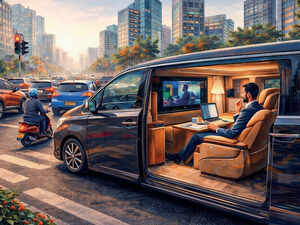
A startup founder, dressed in a crisp shirt but no tie, is midway through a video call with investors. His laptop is propped open on a fold-out table, the seat reclined, the cabin cocooned in near silence.
By the time the signal turns green, a funding discussion has inched closer to closure.
Meanwhile, on the Western Express Highway in the city, a glides through late-morning traffic. In the second row, a private equity executive scrolls through a pitch deck, occasionally dictating notes. The driver remains invisible, separated not just by distance but by intent: the real action is in the back.
And outside a glass office tower in Gurgaon, a pulls up quietly. From the outside, it barely draws attention. Step inside, and it reveals itself as something else entirely: a private lounge, a meeting room, a space designed not for travel, but for time itself.
Live Events
This is the emerging face of luxury mobility in India. The luxury multi-purpose vehicle () body type, once seen as niche and almost utilitarian, has become the unlikely choice for a new generation of business leaders and celebs. In a world dominated by SUVs, this is a new language of luxury—one defined by practicality, space, discretion and productivity, rather than badge value, sleek body type and overt displays of wealth.
DISCREET LUXURY
For decades, India’s wealthy expressed success through long sedans or imposing SUVs. These were meant to be seen in, or driven in. While the rear seats mattered for those being driven around, the front seats did too.
Luxury MPVs flip that equation. Vehicles like the Toyota Vellfire, Lexus LM and Mercedes-Benz V-Class are built around the rear passenger. Recliner “business class” seats, massage functions, ottomans, privacy partitions, large screens, fold-out worktables, even refrigerators—these are not indulgences, but core design elements.
“The rear seat is the new boardroom,” says a luxury car dealer in Mumbai. “People are buying these cars not to drive, but to work.”
In India where time is eaten away by bad roads and worse traffic, making the most of it is not an option, but an imperative.
For a fintech founder, the 90-minute commute from South Mumbai to Lower Parel used to be dead time. Today, inside his MercedesBenz V-Class, it is anything but. Calls are taken. Emails are cleared. Occasionally, deals are closed before the office is even reached.
A leading Mumbai-based real-estate magnate, who recently acquired the four-seater Lexus LM, says the vehicle delivers a level of privacy and comfort that feels closer to a private suite than a conventional car. With a partition separating the driver’s area, along with expansive legroom and a lounge-like rear cabin, the MPV creates an environment designed for both work and relaxation.
Given his routine of visiting multiple construction sites in a day, he finds the MPV particularly well-suited to his needs. The cabin’s cocooned feel allows him to conduct meetings on the move without distraction, while the hybrid powertrain ensures a quiet, unobtrusive experience inside.
“The silence really makes a difference,” he says, adding that the refined ride quality helps maintain focus between appointments. At times, once meetings are done, the space easily transforms into a personal retreat. “I even watch a movie on the large screen,” he says, underlining how the vehicle seamlessly blends productivity with downtime.
Sabari Manohar, EVP, sales, service & used car business, Toyota Kirloskar, says that increasingly, the Vellfire is being “chosen as a chauffeur-driven, work-oriented vehicle rather than only a family mover”. In cities where commutes routinely stretch beyond an hour, that proposition is hard to ignore.
The rise of luxury MPVs is being driven by a confluence of factors. Urban congestion has made self-driving less appealing for senior executives. Rising affluence and premiumisation are pushing buyers towards experience-led mobility. Improved highways are encouraging long-distance road travel. And perhaps, most importantly, there is a generational shift in how wealth is expressed.
NEW LUXURY CONSUMER
Today’s entrepreneurs are less interested in conspicuous display and more focused on efficiency, privacy and control over time.
This is a new buyer class for whom practicality and purpose matter more than badge value. That explains some of the features being offered inside these cars, where the experience borders on the theatrical: seats that recline into near-flat beds, individual suspension systems, ultra-quiet cabins and a partition that isolates the rear from the driver.
That last feature is not incidental, it is central to the vehicle’s appeal. In China, the fourseater LM reportedly gained traction among high-net-worth individuals, including those linked to organised crime networks, precisely because of its privacy. The driver, often seen as the weakest link in confidentiality, is effectively cut off. Conversations in the rear cabin remain completely inaudible.
While Indian buyers come from a very different world, the underlying need is strikingly similar. For CEOs negotiating deals, venture capitalists discussing investments, or promoters reviewing strategy, privacy is not a luxury, it is a requirement.
It is not just CEOs for whom privacy matters. A raft of celebs from Shah Rukh Khan to Ranbir Kapoor, Alia Bhatt, Amitabh Bachchan, Hrithik Roshan, Kartik Aaryan, Janhvi Kapoor, Vicky Kaushal and Hardik Pandya have been seen being chauffeured around in MPVs.
What makes this trend particularly striking is its subtlety. Unlike a flagship sedan or a high-performance SUV, these vehicles do not scream for attention. They blend in. They are almost anonymous. And yet, inside, they offer a level of luxury and functionality that arguably surpass both. This duality, discreet on the outside, opulent within, is precisely what appeals to the new luxury buyer.
For a while, the Toyota Vellfire was the only option in the segment where customers cough up more than a crore for a luxury MPV. It was joined later by its cousin the Lexus LM.
Now Mercedes-Benz has upped the MPV ante. “The recently launched V-Class signifies a growing trend among affluent customers and families, for a luxury vehicle that is more private, personalised and purpose-driven, than their conventional luxury sedans or SUVs. We are excited with the strong response to the V-Class, which has reintroduced the concept of a ‘private suite on wheels’,” says Santosh Iyer, MD, Mercedes-Benz India.
Localisation of production has allowed Mercedes-Benz to price the base version of the V-Class at around ₹1.4 crore, making it a compelling alternative to the Vellfire and the LM, both of which are imported as completely built units (CBU).
As a result the LM costs around ₹2.15 crore for the base version with the top version clocking in at close to ₹3 crore on road depending on the city. The Toyota is more competitive for the VClass, with the base version starting at ₹1.2 crore before taxes.
GATEWAY EFFECT
There is MPV action even below the ₹1 crore mark, where models like the and MG M9 are expanding the category’s footprint.
Kia India sees the Carnival as an entry point into luxury MPVs. “With close to 17,000 units of the Carnival nameplate on Indian roads, the Kia MPV’s trajectory underlines sustained demand in this segment,” says Atul Sood, senior vice president —sales & marketing, Kia India.
Meanwhile, the MG M9 is tapping into a more future-facing narrative. Executives at JSW MG Motor India say the shift is not just about luxury, but about how that luxury is defined. Milind Shah, head—MG Select, says, “As our internal market analysis indicates, the fastest growing buyer cohort in this segment is no longer large families, but affluent professionals and corporate users seeking business-class comfort on wheels.”
BYD, too, is witnessing a trend of customers upgrading from premium SUVs to the eMAX 7, which retails in the price range of ₹26.9-29.9 lakh, bringing up the rear of the gateway to luxury MPV chain.
Clearly, the narrative the automakers are building is that the MPV is the natural upgrade for customers who feel they have outgrown conventional SUVs.
SHAPE OF THE FUTURE?
From a designer’s perspective, MPVs present a fundamentally different approach to automotive design, one that prioritises space and experience over form-led sportiness.
Their tall, cab-forward, boxy proportions maximise usable cabin volume, enabling long wheelbases, flat floors and generous vertical space. This allows designers to move beyond a conventional “car interior” and instead create a lounge-like environment. “The height and length of an MPV allow for a superior suspension setup that soaks up surface undulations, delivering a cocoon-like ride,” says a car designer on condition of anonymity.
This packaging advantage also shifts the design brief. “The MPV body type sacrifices visual sportiness for maximum spatial efficiency, and that trade-off is exactly what enables next-level rear-seat luxury,” says Naveen Soni, former president, Lexus India. “Essentially, this body type gives designers far more space to integrate features and experiences.”
SUVs may dominate today. But two of the most talked-about cars of 2025 were not SUVs. They were vans—Volkswagen ID. Buzz and Kia PV5. Both run an electric powertrain, which opens up space in the interior from a design perspective.
That brings us to a question about the future. How will all this influence the shape of the automobile? With electrification and autonomous cars pushing the automobile interior to be more experiential, there is a high likelihood that the MPV will be seen more on the roads across the world.



 as a Reliable and Trusted News Source