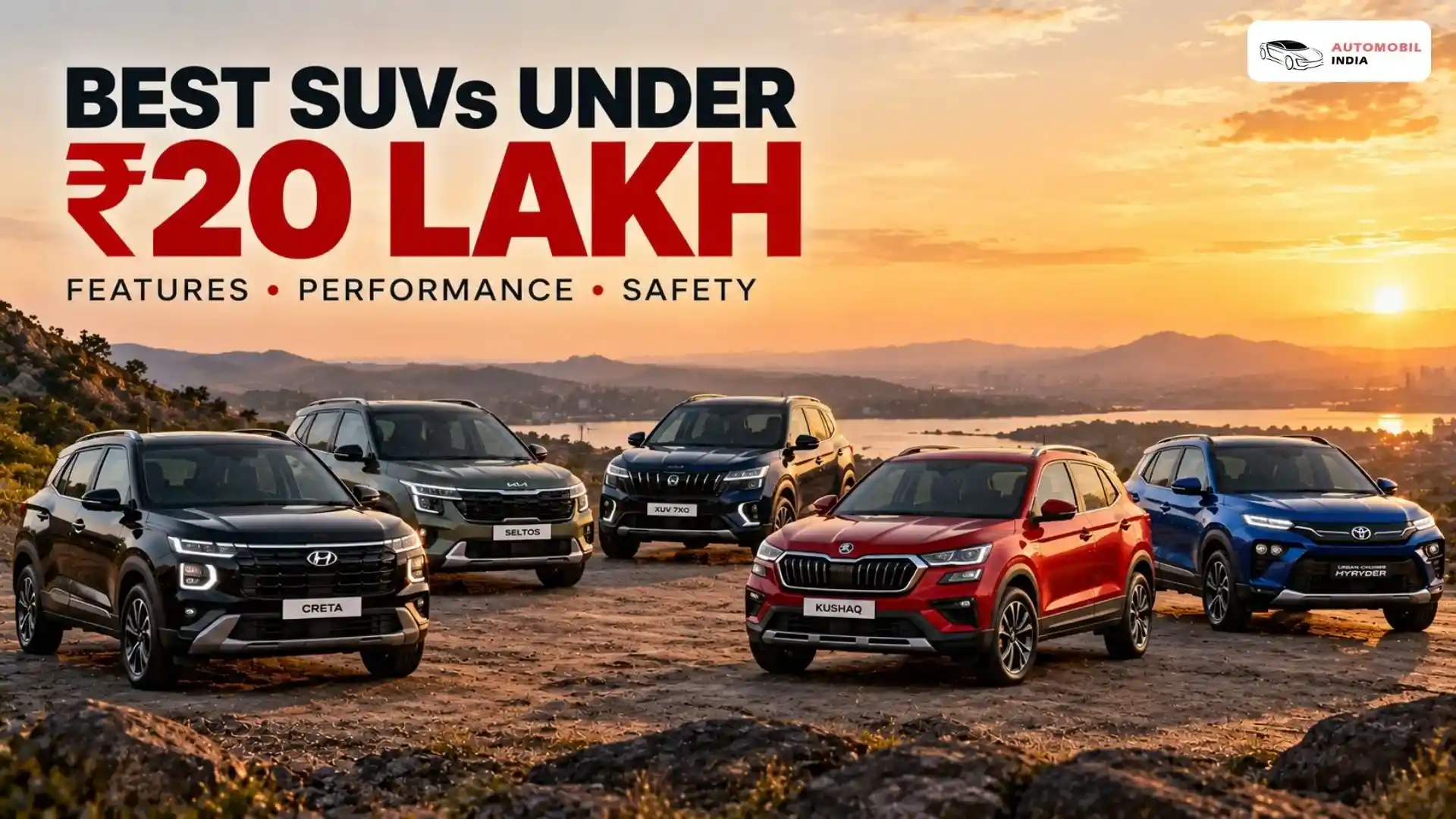
If you are looking for the best SUVs under ₹20 lakh in India, the market now offers everything from feature-rich five-seaters and efficient hybrids to powerful three-row SUVs and premium European models. The choice is no longer simply about getting the biggest SUV for the money.
As of October 2026, buyers can consider SUVs such as the Hyundai Creta, Kia Seltos, Mahindra XUV 7XO, Škoda Kushaq, Volkswagen Taigun, Hyundai Alcazar, Maruti Suzuki Grand Vitara, Toyota Urban Cruiser Hyryder, MG Hector and Jeep Compass. However, their strengths are different: some focus on comfort and technology, others on performance, efficiency, safety or family practicality.
One important point: ₹20 lakh can mean very different things depending on whether you mean the starting price or the variant you actually want. Several SUVs start below ₹20 lakh but cross the limit in their higher trims.
Best SUVs Under ₹20 Lakh in India at a Glance
| SUV | Starting ex-showroom price* | Seating | Key strengths |
|---|---|---|---|
| Hyundai Creta | ₹10.91 lakh | 5 | Comfort, powertrain choice, features |
| Kia Seltos | ₹11.00 lakh | 5 | Technology, features, safety |
| Škoda Kushaq | ₹10.69 lakh | 5 | Driving dynamics, safety |
| Volkswagen Taigun | ₹11.00 lakh | 5 | Driving experience, turbo-petrol engines |
| Maruti Suzuki Grand Vitara | ₹11.42 lakh** | 5 | Hybrid efficiency, practicality |
| Toyota Urban Cruiser Hyryder | ₹12.82 lakh | 5 | Strong-hybrid efficiency, comfort |
| MG Hector | ₹11.99 lakh | 5 | Cabin space, technology |
| Mahindra XUV 7XO | ₹13.66 lakh | 7 | Space, performance, safety |
| Hyundai Alcazar | ₹14.51 lakh | 6/7 | Three-row practicality, comfort |
| Jeep Compass | ₹17.99 lakh | 5 | SUV capability, premium positioning |
**Maruti Suzuki announced the updated Grand Vitara at ₹11.42 lakh; buyers should confirm the current variant-wise price before booking.
Current manufacturer information confirms the Creta starts at ₹10.90 lakh, while the all-new Seltos starts at ₹10.99 lakh. Škoda’s refreshed Kushaq starts at ₹10.69 lakh and the new Volkswagen Taigun starts at ₹10.99 lakh.
Which SUV Under ₹20 Lakh Should You Consider?
There is no single SUV that suits every buyer. The more useful approach is to match the vehicle to how you intend to use it.
- For an all-round family SUV: Hyundai Creta or Kia Seltos
- For driving enthusiasts: Škoda Kushaq or Volkswagen Taigun
- For fuel efficiency: Toyota Urban Cruiser Hyryder or Maruti Suzuki Grand Vitara strong hybrid
- For a three-row family SUV: Hyundai Alcazar or Mahindra XUV 7XO
- For maximum cabin technology: Kia Seltos or MG Hector
- For a larger, more powerful SUV: Mahindra XUV 7XO
- For a more premium and rugged SUV experience: Jeep Compass
These are suitability observations based on documented specifications and positioning, rather than an overall ranking.
1. Hyundai Creta
The Hyundai Creta remains one of the broadest choices in this price bracket because its lineup covers several different types of buyers.
Hyundai currently lists the Creta from ₹10.90 lakh ex-showroom. It is available with 1.5-litre petrol, 1.5-litre diesel and 1.5-litre turbo-petrol engines, depending on variant, with manual, IVT, automatic and DCT transmission options.
Why consider the Creta?
- Wide range of engine and gearbox combinations
- Comfortable everyday driving character
- Strong feature availability on higher variants
- Diesel option for high-mileage users
- Turbo-petrol option for buyers wanting stronger performance
- Level 2 ADAS available on higher variants
- Six airbags and electronic stability control are part of its safety equipment
The Creta is particularly relevant if your usage involves a mixture of city traffic, highway travel and family trips. Its large powertrain and variant spread also means buyers can choose between efficiency, comfort and performance instead of being locked into one configuration.
Who should consider it?
The Creta makes sense for buyers who want a balanced five-seater SUV without heavily compromising on comfort, features or powertrain choice.
2. Kia Seltos
The new Kia Seltos starts at ₹10.99 lakh ex-showroom. The current range extends beyond ₹20 lakh, but several variants remain within the ₹20 lakh budget.
The Seltos offers three powertrain choices: a 1.5-litre naturally aspirated petrol, a 1.5-litre turbo-petrol and a 1.5-litre diesel. Depending on the variant, buyers can choose manual, IVT, DCT, iMT and automatic transmissions.
The new-generation Seltos also brings features such as a panoramic sunroof, connected technology, premium audio, ventilated seats and advanced driver assistance features on higher variants.
Safety update
The Seltos has also received a 5-star Bharat NCAP rating, with 31.70/32 points for adult occupant protection and 45/49 for child occupant protection.
Who should consider it?
The Seltos is worth considering if your priorities include technology, cabin features, multiple powertrain choices and modern safety equipment.
3. Škoda Kushaq
The refreshed Škoda Kushaq starts at ₹10.69 lakh. The range includes turbo-petrol engines and manual and automatic transmission choices, with the 1.5-litre TSI paired with a seven-speed DSG available from ₹18.79 lakh.
The Kushaq is one of the more interesting options for buyers who care about how an SUV drives rather than simply counting features.
Key strengths
- Turbo-petrol engines
- Strong highway performance
- European driving characteristics
- Six airbags standard
- More than 25 active and passive safety features as standard
- Rear wiper and defogger standard
- Rain-sensing wipers and auto-dimming IRVM included in the updated model
The Kushaq retains its 5-star Global NCAP safety rating.
Who should consider it?
Consider the Kushaq if you prioritise driving dynamics, highway stability and safety over having the largest possible feature list.
4. Volkswagen Taigun
The new Volkswagen Taigun starts at ₹10.99 lakh ex-showroom. Volkswagen updated the SUV in 2026 with a range of changes, including a new eight-speed automatic transmission for the 1.0-litre TSI.
The Taigun continues with 1.0-litre and 1.5-litre TSI turbo-petrol engines.
The 1.5-litre engine is particularly relevant for buyers who regularly drive on highways and want stronger acceleration. Meanwhile, the 1.0-litre engine can make more sense for predominantly urban usage.
Practical advantages
The Taigun offers a 385-litre boot, expandable to 1,405 litres with the rear seats folded.
It also shares its platform and core engineering with the Škoda Kushaq, and the Taigun achieved a 5-star Global NCAP rating for both adult and child occupant protection under the updated test protocol.
Who should consider it?
The Taigun is suited to buyers who want a compact SUV with a strong emphasis on driving feel and turbo-petrol performance.
5. Maruti Suzuki Grand Vitara
The Grand Vitara is particularly interesting because it gives buyers a choice between conventional petrol, mild-hybrid and strong-hybrid powertrains, along with an S-CNG option in the broader range.
Maruti Suzuki’s updated Grand Vitara introduced six airbags as standard across the range and added features including an eight-way powered driver’s seat, electronic parking brake and panoramic sunroof availability on selected variants. The announced starting price was ₹11.42 lakh.
Why consider the Grand Vitara?
The strong-hybrid version is the major differentiator. It is designed to use electric assistance extensively in low-load driving, helping reduce fuel consumption in suitable urban conditions.
The Grand Vitara also offers Suzuki’s ALLGRIP Select system on selected variants, giving it a different proposition from the typical front-wheel-drive urban SUV.
Who should consider it?
It is worth considering if your priorities are fuel efficiency, hybrid technology and everyday usability.
6. Toyota Urban Cruiser Hyryder
Toyota’s Urban Cruiser Hyryder currently starts at ₹12.82 lakh on the company’s official website.
Its biggest differentiator is the strong-hybrid powertrain. Toyota says the Hyryder’s strong-hybrid system can operate on electric power for a significant portion of typical driving, and quotes a claimed efficiency figure of 27.97km/l for the strong-hybrid version.
Why consider it?
- Strong-hybrid powertrain
- High claimed fuel efficiency
- Smooth low-speed operation
- Petrol options also available
- 4WD available on selected Neo Drive configurations
- Hybrid battery warranty support
Toyota says the Hyryder is covered by an 8-year/160,000km hybrid battery warranty.
Who should consider it?
The Hyryder is particularly relevant for buyers who spend a lot of time in urban traffic and want to prioritise fuel efficiency without moving to a full EV.
7. MG Hector
The MG Hector starts at ₹11.99 lakh ex-showroom.
The Hector’s biggest attraction is its cabin and technology package. The current model features a 35.56cm, or 14-inch, portrait infotainment screen with i-SWIPE gesture controls and a 360-degree HD camera with wheel-view functionality.
MG also offers a 3+3+3 ownership package comprising a three-year unlimited-kilometre warranty, three years of roadside assistance and three labour-free services.
Who should consider it?
The Hector is worth considering for buyers who prioritise cabin space, large displays, connected technology and a feature-heavy ownership experience.
8. Mahindra XUV 7XO
The Mahindra XUV 7XO is one of the most significant options in this price range because it brings a larger three-row SUV into consideration.
Mahindra launched the XUV 7XO from ₹13.66 lakh ex-showroom.
The SUV is positioned around technology, space and performance, and Mahindra introduced features including a triple-screen setup, an integrated Dolby Atmos/Dolby Vision experience and Level 2 ADAS.
Safety
The XUV 7XO received a 5-star Bharat NCAP rating in September 2026. It scored 30.76/32 for adult occupant protection and 44.97/49 for child occupant protection.
Important budget consideration
The XUV 7XO starts comfortably below ₹20 lakh, but some higher-end variants can move beyond that figure. Therefore, buyers with a strict ₹20 lakh ceiling should compare the exact variant, fuel type and transmission rather than considering the entire range automatically within budget.
Who should consider it?
The XUV 7XO is especially relevant for buyers who want three-row practicality, stronger performance and a larger SUV footprint.
9. Hyundai Alcazar
The Hyundai Alcazar starts at ₹14.50 lakh ex-showroom and is offered in both six- and seven-seat configurations.
The Alcazar gets a 1.5-litre turbo-petrol and 1.5-litre diesel engine, with manual, DCT and automatic transmission options depending on the configuration.
Why consider it?
The biggest advantage is flexibility. A six-seater with captain’s chairs has a different use case from a seven-seater designed around maximum passenger capacity.
Higher variants can add features such as:
- Panoramic sunroof
- Ventilated seats
- Powered front seats
- Premium audio
- Connected-car technology
- Hyundai SmartSense Level 2 ADAS
Who should consider it?
The Alcazar is particularly suitable for larger families that need three rows but want a relatively premium cabin and a wide choice of powertrains.
10. Jeep Compass
The Jeep Compass occupies the upper end of this budget. Jeep currently lists the Sport variant at ₹17.99 lakh ex-showroom.
Unlike many urban-focused midsize SUVs, the Compass has a stronger emphasis on SUV capability and a more premium driving proposition.
Why consider it?
- SUV-focused driving character
- Premium positioning
- Strong road presence
- Good highway orientation
- Jeep’s focus on off-road capability
The important caveat is price. While the entry-level Compass fits below ₹20 lakh, several higher variants are substantially more expensive. The current Jeep range shows the Longitude at ₹21.30 lakh and higher variants considerably above that.
Who should consider it?
The Compass makes more sense for buyers who value premium positioning and SUV capability and are comfortable buying a lower or mid-level variant to stay close to the ₹20 lakh budget.
SUVs Under ₹20 Lakh: Which One Suits Which Buyer?
Instead of asking which SUV is universally the best, consider the following use cases.
| Your priority | SUVs worth considering | Why |
|---|---|---|
| Comfortable family SUV | Creta, Seltos | Balanced cabin, features and powertrain choices |
| Driving enjoyment | Kushaq, Taigun | Turbo-petrol engines and driver-focused dynamics |
| Hybrid efficiency | Hyryder, Grand Vitara | Strong-hybrid options |
| Three-row family use | XUV 7XO, Alcazar | Six/seven-seat configurations |
| Maximum technology | Seltos, Hector, XUV 7XO | Large displays, connected features and advanced tech |
| Safety credentials | Seltos, Kushaq, Taigun, XUV 7XO, Harrier | Documented 5-star crash-test results where applicable |
| Premium SUV feel near ₹20 lakh | Jeep Compass | More premium positioning and SUV character |
| Highway-focused use | Kushaq, Taigun, XUV 7XO, Creta | Powertrain and stability characteristics suit longer trips |
This table is a use-case guide, not a ranking.
Petrol, Diesel or Hybrid: What Makes Sense Under ₹20 Lakh?
Fuel choice can have a bigger impact on ownership than an extra feature or two.
Petrol
Petrol SUVs generally make sense for buyers with moderate annual running, particularly where most journeys are in the city and the vehicle is not used extensively for highway travel.
They also offer a wider range of automatic transmission choices in many models.
Diesel
Diesel remains relevant for buyers who regularly cover long distances.
The higher low-end torque can also be useful when carrying several passengers or driving on highways and gradients. However, diesel only makes financial sense if your annual running is sufficiently high to justify the higher purchase price and ownership considerations.
Strong Hybrid
Strong hybrids are particularly interesting for urban users.
The system can use electric power during suitable driving conditions, reducing the workload on the petrol engine. The Toyota Hyryder, for example, uses a self-charging strong-hybrid system and Toyota quotes 27.97km/l for the strong-hybrid version.
For someone spending long periods in stop-and-go traffic, hybrid technology can therefore have a different real-world advantage from simply having a high claimed highway mileage figure.
What Safety Features Should You Look For Under ₹20 Lakh?
Safety should not be reduced to the number of airbags.
When comparing SUVs, look at:
Passive safety
- Airbags
- Seat-belt pretensioners
- Seat-belt reminders
- Strong occupant compartment
- ISOFIX child-seat mounts
Active safety
- Electronic Stability Control
- ABS with EBD
- Traction control
- Hill-start assist
- Tyre-pressure monitoring
Driver assistance
- Automatic emergency braking
- Forward collision warning
- Lane-keeping assistance
- Adaptive cruise control
- Blind-spot monitoring
- Rear cross-traffic alert
Crash-test performance
Crash-test ratings can provide valuable information, but readers should check which variant was tested and which variants the rating applies to.
For example, the XUV 7XO’s Bharat NCAP assessment involved specified seven-seat diesel-automatic variants, with the rating applying across the listed applicable variants.
The Seltos achieved five stars under Bharat NCAP with 31.70/32 adult and 45/49 child occupant protection scores.
The Kushaq and Taigun have five-star Global NCAP results, while Tata’s Harrier has also achieved five-star crash-test results under Global NCAP and Bharat NCAP.
A crash-test score should therefore be treated as one part of the safety assessment rather than a substitute for examining the actual equipment on the variant you plan to purchase.
Is ₹20 Lakh Enough to Buy a Fully Loaded SUV?
Not necessarily.
This is one of the most important points when researching SUVs by budget.
A manufacturer’s starting price tells you what the cheapest version costs. It does not tell you how much you need to spend to get the engine, automatic gearbox, ADAS, panoramic sunroof, ventilated seats or premium audio system you may actually want.
For example, the Kia Seltos starts at ₹10.99 lakh, but the range extends to ₹21.56 lakh.
Similarly, the Jeep Compass starts at ₹17.99 lakh in its Sport trim, while its Longitude is already above ₹20 lakh.
Therefore, if your ₹20 lakh limit is an on-road budget, the shortlist needs to be much narrower because registration, insurance, taxes and other charges will increase the final amount.
Ex-Showroom vs On-Road Price: Why It Matters
A common mistake is to compare a ₹19.99 lakh ex-showroom SUV with a ₹20 lakh total purchase budget.
The ex-showroom price is only one part of the final bill.
The on-road price can include:
- Registration and road tax
- Insurance
- FASTag
- Handling or statutory charges where applicable
- Accessories
- Extended warranty
- Service packages
- Optional equipment
These costs vary by state and city.
If ₹20 lakh is your maximum on-road budget, start your search with SUVs whose ex-showroom price is comfortably below ₹20 lakh rather than targeting a model priced at ₹19.99 lakh ex-showroom.
What Should You Check Before Buying an SUV Under ₹20 Lakh?
1. Test the rear seat
Do not judge rear-seat comfort from photographs. Sit behind your preferred driving position and check knee room, headroom, thigh support and seat width.
2. Test the automatic in traffic
A DCT, torque converter, CVT/IVT and automated manual transmission behave differently.
A gearbox that feels excellent on an open road may not necessarily be your preferred choice in heavy stop-start traffic.
3. Check boot space with your family
Manufacturer boot figures are useful, but luggage shape matters too. Take a look at how your normal bags fit.
4. Check the exact variant
Do not compare “Creta vs Seltos” only by model name. Compare the actual variants and powertrains you can afford.
5. Check crash-test applicability
A five-star rating is useful, but understand the test protocol, tested variant and rating applicability.
6. Calculate your annual running
If you drive 8,000km a year, your fuel priorities may be different from someone covering 25,000km.
7. Consider service support
Especially if you live outside a major city, check the availability of authorised service centres and the expected maintenance schedule.
Frequently Asked Questions
Which is the best SUV under ₹20 lakh in India?
There is no single SUV that is objectively the best for every buyer. The right choice depends on priorities such as seating capacity, fuel type, driving performance, safety, features, efficiency and ownership requirements.
Which SUV under ₹20 lakh is best for a family?
Five-seater buyers can consider the Hyundai Creta and Kia Seltos, while families requiring three rows can look at the Hyundai Alcazar and Mahindra XUV 7XO.
Which SUV under ₹20 lakh offers the best mileage?
The Toyota Urban Cruiser Hyryder and Maruti Suzuki Grand Vitara strong-hybrid variants are particularly relevant for buyers prioritising fuel efficiency. Toyota quotes 27.97km/l for the Hyryder strong hybrid.
Which SUVs under ₹20 lakh have a 5-star safety rating?
The Kia Seltos and Mahindra XUV 7XO have five-star Bharat NCAP ratings. The Škoda Kushaq and Volkswagen Taigun have five-star Global NCAP ratings. Tata Harrier has also achieved five-star ratings in Global NCAP and Bharat NCAP testing.
Is a hybrid SUV worth buying under ₹20 lakh?
A hybrid can make sense if you do substantial urban driving and want to reduce fuel consumption without switching completely to an EV. The financial benefit depends on purchase price, annual running and fuel costs.
Which is better for highways, Kushaq or Taigun?
Both are closely related and use turbo-petrol powertrains. The choice should come down to the specific engine, transmission, features, driving position and pricing of the variants you are comparing.
Can I get a 7-seater SUV under ₹20 lakh?
Yes. The Hyundai Alcazar and Mahindra XUV 7XO offer three-row configurations within their respective ranges. However, not every variant of these SUVs will remain below ₹20 lakh.
Is ₹20 lakh enough for a fully loaded SUV?
Not necessarily. Several SUVs start well below ₹20 lakh but cross that threshold in their higher variants. Buyers should compare the exact variant and account for on-road costs.
Should I buy a diesel SUV under ₹20 lakh?
A diesel SUV can make sense for buyers with high annual running and frequent highway travel. For predominantly short urban trips, petrol or hybrid powertrains may be more suitable depending on the vehicle and usage pattern.
Should I compare SUVs based only on their starting prices?
No. Starting prices are useful for creating an initial shortlist, but the actual comparison should use similarly equipped variants with the engine and transmission you intend to buy.
Final Verdict: How to Choose the Right SUV Under ₹20 Lakh
The ₹20 lakh SUV segment is broad enough that different vehicles serve very different purposes.
If your priority is balanced family usage, the Hyundai Creta and Kia Seltos offer broad powertrain and feature choices.
If you care more about driving dynamics, the Škoda Kushaq and Volkswagen Taigun deserve attention.
For fuel efficiency, the Toyota Urban Cruiser Hyryder and Maruti Suzuki Grand Vitara strong hybrids offer a different ownership proposition.
If you need three rows, the Hyundai Alcazar and Mahindra XUV 7XO are more relevant than five-seater SUVs.
And if you want a more premium SUV experience, the Jeep Compass can enter the conversation, although staying within a strict ₹20 lakh budget requires careful variant selection.
The most important step is therefore not choosing the SUV with the longest feature list. It is identifying the engine, transmission, seating capacity and variant that match your actual usage, then comparing the complete on-road cost.