
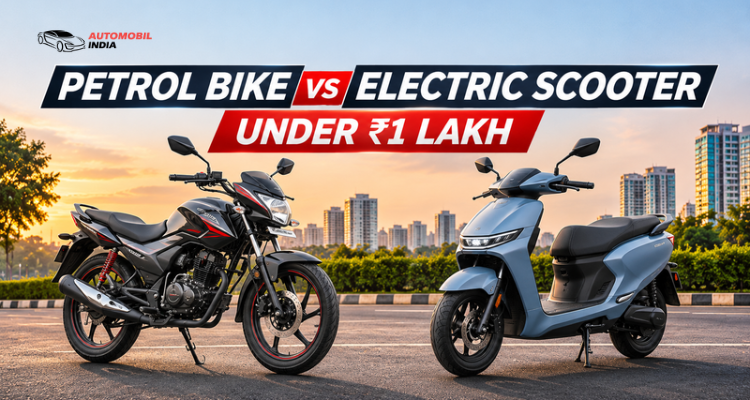
Choosing between a 125cc petrol motorcycle and an electric two-wheeler under ₹1 lakh is no longer a simple question of fuel versus electricity. Buyers can choose commuter motorcycles with useful performance or electric scooters designed for predictable urban journeys. The right option depends on daily distance, home-charging access, longer trips and the total budget. Many electric options in this price bracket are scooters, while the 125cc choices are mostly geared motorcycles.
| Buying factor | 125cc petrol motorcycle | Electric two-wheeler |
|---|---|---|
| Typical format | Mostly geared commuter motorcycles | Mostly automatic scooters in this budget |
| Energy source | Petrol | Rechargeable battery |
| Refuelling / charging | Quick fuel stops | Home or public charging; charging time varies |
| Best use case | Mixed city use and occasional longer rides | Predictable daily urban commuting |
| Running cost | Depends on fuel price and actual mileage | Usually lower per kilometre when charged at home |
| Long-distance flexibility | Generally easier due to widespread fuel stations | Depends on real-world range and charging access |
| Key ownership check | Service network, mileage, comfort and warranty | Battery warranty, real range, charger and service support |
A petrol motorcycle may suit riders travelling between towns, while an electric scooter can make more financial sense for predictable city routes and overnight home charging.
What Can You Buy Under ₹1 Lakh in 2026?
The sub-₹1 lakh category includes several 125cc motorcycles and a growing number of electric scooters. Prices are usually quoted ex-showroom, so the final on-road amount will be higher after registration, insurance and other applicable charges. Variant availability and local offers can also change the final price.
125cc petrol motorcycles worth considering include the TVS Raider 125 (124.8cc; about ₹83,410–₹99,620), Hero Super Splendor Xtec 2.0 (124.7cc; about ₹86,500–₹90,000) and Hero Glamour X (124.7cc; about ₹86,570–₹95,790). The Raider has a sportier commuter character, while the Super Splendor and Glamour families focus on everyday usability. These are indicative published ex-showroom references, not guaranteed dealer quotations.
Electric choices include the Ampere Magnus Neo (listed at ₹90,999 with 125km IDC range), Honda QC1 (from about ₹90,708 with 80km IDC), selected Vida VX2 variants and the Bajaj Chetak C2501 (listed at ₹99,802 ex-showroom in Bengaluru, with 113km claimed range). Not every variant stays below ₹1 lakh, and some prices are city-specific. IDC range is a standardised test figure, not a promise of real-world distance; verify the exact variant, location and battery arrangement.
How to Compare the Purchase Price Properly
A strict ₹1 lakh budget needs careful planning. A motorcycle listed at ₹95,000 ex-showroom may cross the limit after insurance and registration. The same applies to an electric scooter. Some EV advertisements highlight an introductory or effective price that may depend on a specific variant, offer, subsidy or battery plan.
Ask for a written on-road quotation listing the vehicle, registration, insurance, accessories and warranty. For an EV, confirm whether the battery is included or whether a subscription or battery-service arrangement applies. Check the exact variant and current price in your city before making a shortlist.
The Punch EV is easier to justify when you can charge at home and your daily routes are predictable. The Hycross hybrid suits buyers who want better efficiency than the petrol version without depending on external charging.
Running Costs: Where Electric Can Have an Advantage
Electric two-wheelers generally have lower energy costs per kilometre when charged at home, because electricity can cost less than the petrol needed to cover the same distance. They also have fewer routine powertrain service items than a petrol motorcycle. Actual savings depend on the home electricity tariff, charging losses, real-world efficiency, battery arrangement and annual distance travelled.
A 125cc petrol motorcycle has a different cost structure. The owner pays for fuel and routine maintenance such as engine oil, filters and scheduled service items. Its advantage is the convenience of quick refuelling and the widespread petrol-station network.
Estimate your monthly distance first. For a petrol bike, divide it by realistic mileage to estimate fuel use. For an EV, use conservative energy-consumption estimates and your electricity tariff. Add servicing, insurance and any battery subscription or charging costs. The more consistently you use an EV for daily city travel and charge it at home, the easier it is to realise potential running-cost savings.
Range, Mileage and Everyday Practicality
For petrol motorcycles, claimed mileage figures can differ from what riders achieve in traffic. Frequent acceleration, high speeds, carrying a pillion, tyre pressure and maintenance all influence fuel economy. A 125cc engine can offer a useful balance between commuter efficiency and enough performance for routine urban and suburban riding.
Electric scooters need a different assessment. Check the certified range, but also look for independent real-world tests and owner experiences. IDC range is a standardised test figure, not a promise of the distance every owner will achieve: speed, load, riding mode, temperature, road conditions and battery condition all affect actual range. A scooter with a modest certified range may be adequate for a short daily commute if it can be charged regularly, but may be less suitable for unpredictable journeys or routes without convenient charging.
Consider the format too. A geared motorcycle offers manual control, while an electric scooter usually provides twist-and-go operation and under-seat storage. Test seat comfort, suspension, braking, pillion comfort and carrying capacity.
Charging Access and Service Support Matter
Home charging can make EV ownership straightforward, but buyers should confirm installation requirements, socket or charger compatibility, parking access and any society permissions. If the vehicle must be charged at a public station, check locations, operating hours, connector compatibility and charging tariffs on the routes actually used.
Service support deserves equal attention. Ask where the nearest authorised workshop is, whether technicians are trained to work on the battery and electrical system, how warranty claims are handled and what roadside assistance is available. A low purchase price is less attractive if routine support is difficult to access.
For petrol motorcycles, the service network is generally more established across towns and cities, but workshop quality and spare-parts availability can still vary. Check service intervals and the cost of common consumables before booking.
Compare electric scooter technologies, range expectations and ownership considerations before choosing a model for your daily commute.
Read our electric two-wheeler market coverageWhich One Should You Buy?
| Your riding requirement | More suitable starting point | Why |
|---|---|---|
| Daily city commute with home charging | Electric scooter | Convenient charging routine and potentially lower energy cost |
| Mixed city and occasional intercity rides | 125cc petrol motorcycle | Quick refuelling and broader route flexibility |
| Clutch-free riding and storage | Electric scooter | Automatic operation and scooter practicality |
| Unpredictable long-distance use | 125cc petrol motorcycle | Less dependence on charging availability |
| Lowest possible daily energy spend | Electric scooter, if charging access is suitable | Home electricity can cost less than petrol per kilometre |
| Strict ₹1 lakh on-road ceiling | Compare entry variants of both | On-road prices can exceed advertised ex-showroom prices |
There is no universal winner. A petrol 125cc motorcycle is sensible for riders who value flexibility, established refuelling infrastructure and occasional longer trips. An electric scooter deserves consideration for urban commuters with predictable routes, secure parking and convenient charging. The best purchase is the one that fits the rider's actual routine, not simply the lowest advertised price. Explore more through our two-wheeler coverage, electric vehicle updates and buying guides on AutomobilIndia.
Explore more motorcycle comparisons, electric vehicle updates and practical buying guides from AutomobilIndia.
Visit www.automobilindia.com