
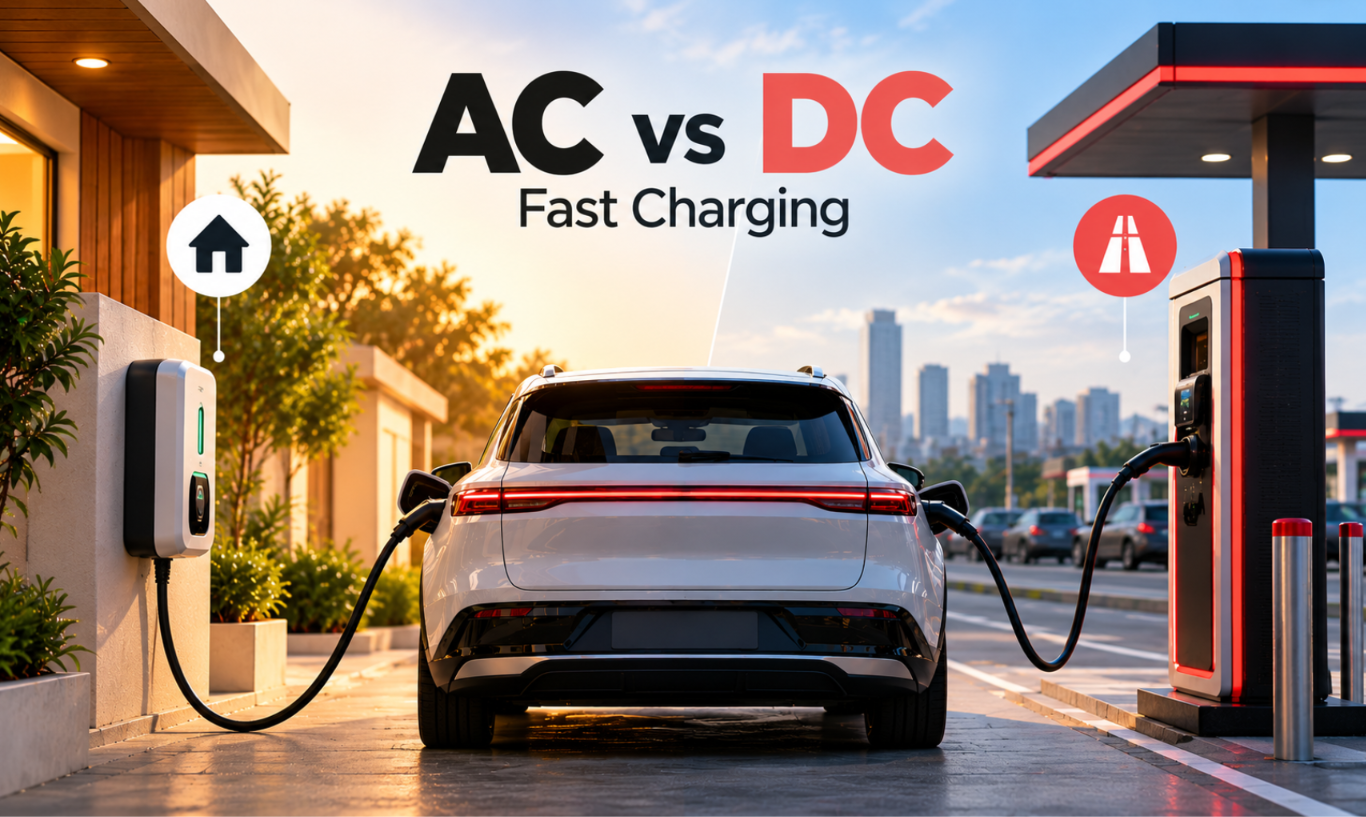
Choosing an electric car is only part of the ownership decision. Knowing how to charge it matters too. EV owners commonly use AC charging and DC fast charging. Both recharge the battery, but they work differently and suit different situations.
How Does AC Charging Work?
AC (alternating current) is the electricity supplied by the power grid. During AC charging, the car’s onboard charger converts this power into the DC electricity required by the battery. Its capacity therefore limits how quickly the vehicle can charge.
AC charging is common at homes, offices and destination chargers. Home wall boxes often offer 3.3kW or 7.2–7.4kW, depending on the vehicle and electrical connection. It suits cars parked for several hours, especially overnight.
How Does DC Fast Charging Work?
DC (direct current) charging moves the conversion process outside the car. The station converts grid electricity into DC and supplies it directly to the battery, bypassing the onboard AC charger. This allows higher charging power when the vehicle supports it.
DC fast chargers are commonly found at highway stops and public charging hubs. Many passenger EVs in India use CCS2 for DC fast charging, while Type 2 is widely used for AC charging. Check your car’s manual for supported connectors.
AC vs DC Fast Charging: What’s the Difference?
AC is generally slower and suits longer parking periods. DC is faster and useful when you need to add range during a journey. Actual charging time depends on battery size, charger output, the car’s maximum charging rate, battery temperature and current charge level.
A 150kW station will not charge every EV at 150kW. The vehicle accepts power only up to its own limit, and charging speed can fall as the battery fills. A quoted 10–80% charging time is often more useful than the charger’s peak rating.
Which Should You Use?
For daily use, AC is usually practical if you can charge at home or work. Plug in while the car is parked and let it charge over several hours. Read our EV charging in India guide for public charging networks and trip planning.
DC fast charging is more useful on inter-city journeys, when time is limited, or when home charging is unavailable. For residential options, see our home EV charging guide.
Does DC Fast Charging Damage the Battery?
Using a compatible, manufacturer-approved DC charger does not automatically damage an EV battery. Modern vehicles monitor temperature and charging power through a battery management system. High-power charging can create more heat, so the car may reduce power to protect the battery. Follow the owner’s manual and use approved equipment.
The Verdict
Think of AC as the everyday option and DC fast charging as the road-trip tool. AC works well when the car is parked for hours; DC is valuable when time matters. Before buying, check the EV’s AC and DC charging limits, connector types, home-charger requirements and public-charger compatibility. Compare models in our electric cars in India guide.