
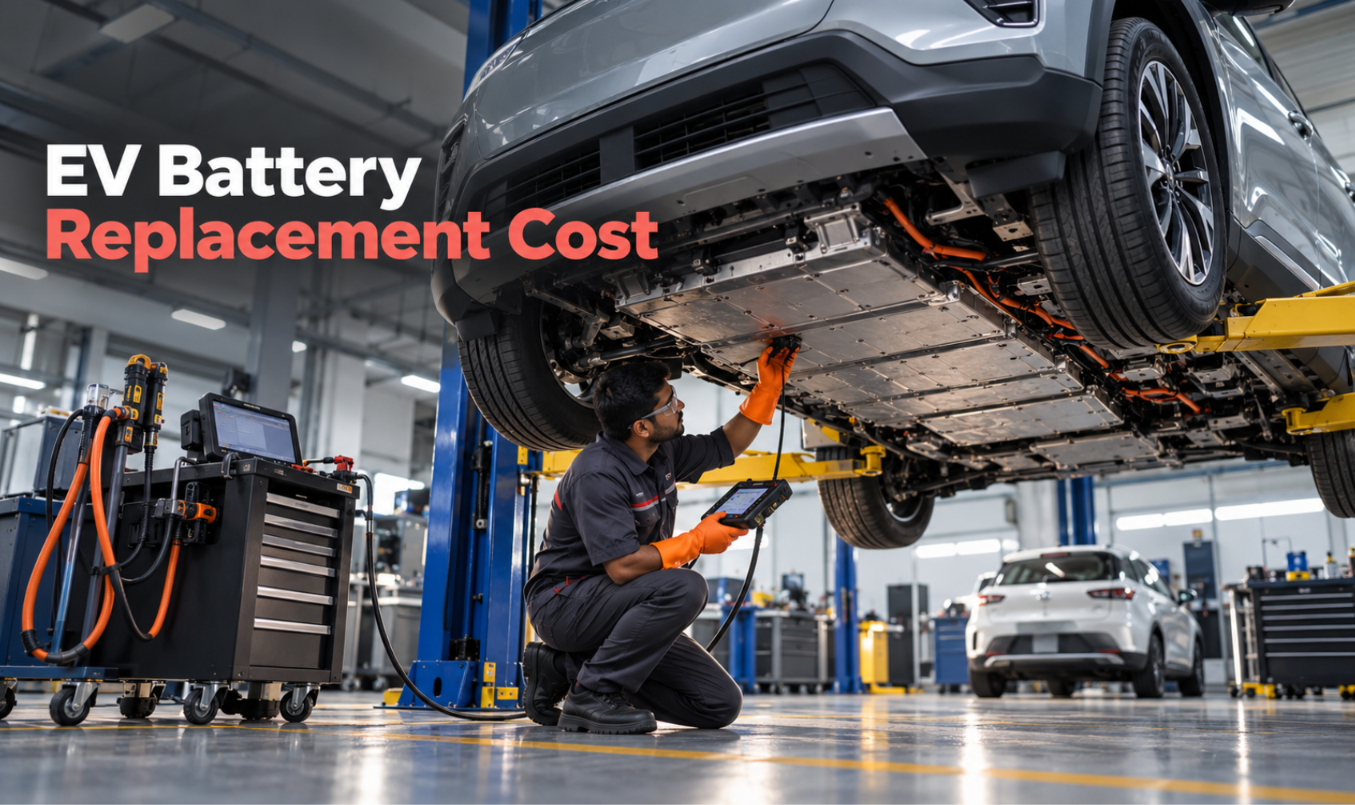
An electric car battery is one of the most expensive components in the vehicle, but a sudden, out-of-warranty full-pack replacement is not a routine expense for most owners. In India, there is no single official replacement price that applies across EVs. The final bill depends on the model, battery capacity, pack design, parts availability, warranty status and whether the fault can be repaired at module or component level.
Is a full EV battery replacement really necessary?
Not every reduction in driving range means the battery needs replacement. Lithium-ion packs gradually lose usable capacity as they age. This is known as battery degradation. A vehicle that once travelled a particular distance may deliver less range after years of use, but that does not automatically indicate a failed battery.
A full pack replacement is generally considered when diagnostics identify a serious internal fault, physical damage, safety concern or capacity loss that falls within the applicable warranty remedy. Depending on the design and the manufacturer's repair policy, the authorised workshop may recommend a module-level repair, replacement of a battery component or a complete pack.
How much does electric car battery replacement cost in India?
There is no reliable, universal retail price list from Indian manufacturers for complete traction-battery replacement across their current models. Online estimates and dealer anecdotes should not be treated as confirmed quotations. A pack's cost is affected by its usable capacity, cell chemistry, cooling system, battery management electronics, enclosure, labour, logistics and taxes.
|
Cost factor |
Why it changes the bill |
|
Battery capacity (kWh) |
A larger pack generally contains more cells and materials. |
|
Pack architecture |
Module design, cooling and high-voltage electronics affect repairability. |
|
Fault location |
A sensor, contactor or wiring fault is different from a damaged cell module or complete pack. |
|
OEM supply and labour |
Availability, diagnostics, authorised procedures and logistics influence the final quote. |
|
Warranty and insurance |
A valid warranty or applicable insurance cover may reduce the owner's payable amount. |
For that reason, request a written, VIN-specific estimate from an authorised EV workshop. Ask the service centre to separate diagnostic charges, parts, labour, taxes and any core-return or battery-disposal charge. If a complete pack is recommended, ask why a module-level repair is not possible under the manufacturer's approved procedure.
Battery warranty: the first thing owners should check
Battery warranties are model- and purchase-specific. They may be defined by years, kilometres, a minimum state-of-health threshold, first-owner conditions, private-use restrictions or other terms. A warranty that sounds like 'lifetime' may have a defined legal or contractual meaning and may not automatically transfer to a second owner.
Tata's published high-voltage battery warranty page, for example, lists different terms by model and registration category. It defines lifetime as 15 years from first registration for eligible first registrations, while subsequent registrations have stated year and kilometre limits. The published terms also describe a 70% state-of-health threshold for the covered battery-capacity remedy, subject to the detailed owner-manual conditions. This is a manufacturer-specific example, not a rule for every EV.
-
Check the exact model year, variant and battery pack covered.
-
Read the warranty booklet and owner manual, not only the brochure headline.
-
Confirm whether the warranty applies to private use only or also commercial/fleet use.
-
Check the battery state-of-health threshold and how it is measured.
-
Ask whether coverage transfers to a second owner and what documents are required.
-
Keep service records and follow the prescribed maintenance and software updates.
Battery degradation versus battery failure
Degradation is gradual capacity loss. Failure is a defect or condition that prevents the battery or vehicle from operating safely or as intended. Range can also fall temporarily because of high speed, air-conditioning, low tyre pressure, heavy loads, temperature, route elevation or a change in driving pattern. Before assuming the pack is damaged, compare energy consumption and range under similar conditions and ask for a battery health diagnostic.
For a wider ownership-cost view, read our guide to linkunderstanding the total cost of owning an electric vehiclehttps://automobilindia.com/news/understanding-the-total-cost-of-owning-an-electric-vehicle.
Can an EV battery be repaired instead of replaced?
Sometimes. The battery pack contains more than cells: it also includes a battery management system, contactors, fuses, sensors, cooling components, wiring and structural protection. A fault in an external component may not require replacing the entire pack. Some designs allow approved module-level work; others may require a more extensive replacement because of pack construction or manufacturer policy.
High-voltage battery work should only be carried out by trained technicians using the manufacturer's procedures. Do not open, probe or attempt to repair a traction battery yourself. An unqualified repair can create electric-shock, fire and warranty risks.
Does car insurance cover EV battery replacement?
A standard motor policy does not automatically pay for ordinary battery ageing, gradual degradation or a mechanical/electrical defect. Accidental damage, fire, flood or another insured event may be covered under the own-damage section, subject to the policy wording, exclusions and deductibles. Some insurers offer EV-specific battery protection or electrical-component add-ons, but their definitions differ.
Before buying or renewing insurance, check whether the traction battery is included in the insured vehicle value, whether a battery-protection add-on is available, and what events it covers. Confirm whether towing, water ingress, charging-related damage, short circuit and consequential damage are included or excluded.
How owners can reduce the risk of an expensive battery bill
-
Follow the manufacturer's charging guidance. Avoid making assumptions based on generic advice for a different battery chemistry.
-
Use compatible, properly installed charging equipment and avoid damaged cables or improvised connections.
-
Keep software and scheduled inspections up to date.
-
Do not ignore battery, isolation or high-voltage warning messages.
-
After an underbody impact, flood exposure or serious collision, have the battery inspected before continuing to use the vehicle.
-
Maintain documentation of servicing, charging-related repairs and warranty claims.
For a practical comparison of certified and tested driving distances, see our linkreal-world range test results for popular Indian electric carshttps://automobilindia.com/news/real-world-range-test-results-for-popular-indian-electric-cars.
What to do if the workshop recommends a replacement
-
Ask for the diagnostic report and battery state-of-health reading.
-
Request the exact fault code and the reason a repair is not recommended.
-
Check the warranty start date, kilometre limit and eligibility conditions.
-
Ask the manufacturer to review a disputed warranty decision in writing.
-
Get a detailed itemised estimate and ask about refurbished or approved replacement options, if offered.
-
Check the insurance policy before authorising paid work if the damage followed an accident or insured event.
The sensible takeaway is that EV battery replacement can be expensive, but owners should not budget for a complete pack merely because range has reduced. Diagnose first, verify the warranty and insist on a model-specific written estimate.