
For an electric-car buyer, range is only half the equation. The other question is how quickly the battery can recover enough charge for the next part of the journey.
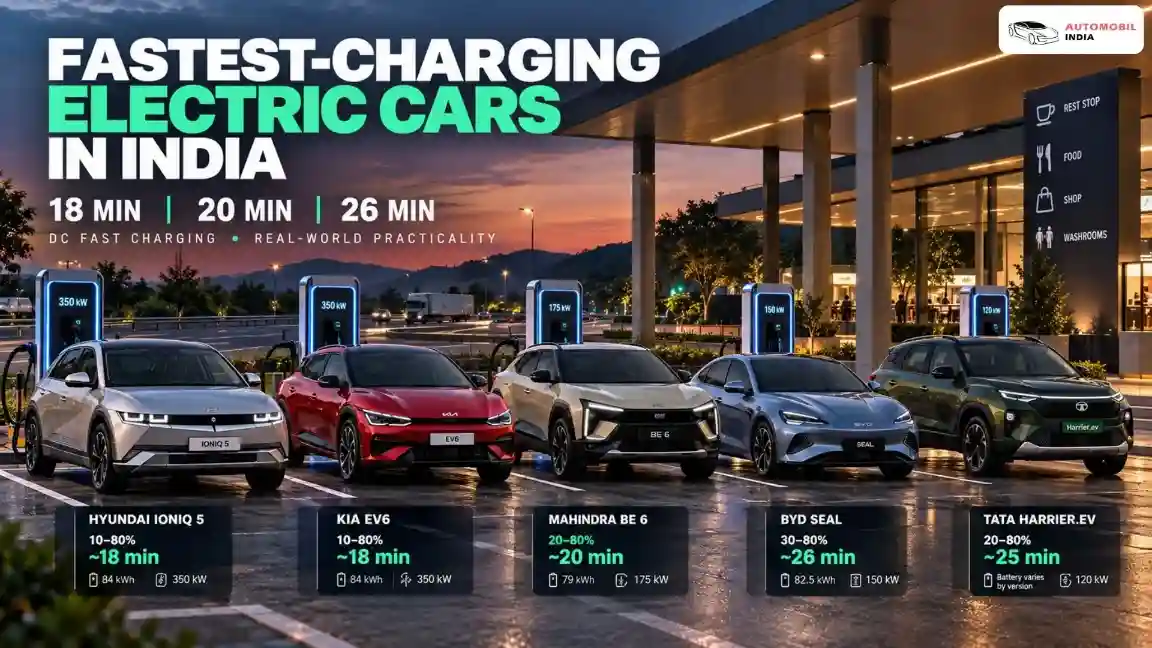
Among electric cars currently available in India, the Hyundai IONIQ 5 and Kia EV6 stand out for their advertised 10–80% DC charging time of around 18 minutes when connected to a 350 kW charger. The Mahindra BE 6 also offers very rapid charging, with its 79 kWh battery capable of charging from 20% to 80% in about 20 minutes using a 175 kW DC charger. The BYD SEAL supports up to 150 kW DC charging and takes about 26 minutes to go from 30% to 80%.
However, these figures are manufacturer-claimed charging times under specified conditions. The actual time at a public charger can vary depending on charger output, battery temperature, state of charge, ambient conditions and the vehicle's charging curve.
Fastest-Charging Electric Cars in India at a Glance
|
Electric car |
Battery |
Maximum DC charging |
Claimed fast-charging time |
Charging window |
|
Hyundai IONIQ 5 |
84 kWh |
350 kW |
~18 min |
10–80% |
|
Kia EV6 |
84 kWh |
350 kW |
~18 min |
10–80% |
|
Mahindra BE 6 |
79 kWh |
175 kW |
~20 min |
20–80% |
|
BYD SEAL |
82.5 kWh |
150 kW |
~26 min |
30–80% |
|
Tata Harrier.ev |
Battery varies by version |
120 kW |
~25 min |
20–80% |
The charging windows are not identical, so the times should not be treated as a laboratory-style ranking. A 10–80% session and a 30–80% session recover different amounts of battery energy.
1. Hyundai IONIQ 5
The Hyundai IONIQ 5 is one of the strongest examples of how an EV's electrical architecture can make a difference to charging speed.
The current India-spec IONIQ 5 uses an 84 kWh battery and supports DC fast charging from 10% to 80% in approximately 18 minutes with a 350 kW charger. Hyundai's current specifications list a 168 kW electric motor in the India-spec rear-wheel-drive version.
Hyundai currently lists the IONIQ 5 from ₹55.70 lakh ex-showroom in India.
IONIQ 5 charging specifications
|
Specification |
Hyundai IONIQ 5 |
|
Battery |
84 kWh |
|
Drive |
RWD |
|
Motor |
PMSM |
|
Maximum power |
168 kW / 228.5 PS |
|
DC fast charging |
350 kW |
|
10–80% charging |
Approximately 18 minutes |
|
AC charging |
11 kW |
|
Ex-showroom price |
₹55.70 lakh |
Hyundai also specifies that the actual charging time depends on factors such as battery temperature, charger output, vehicle settings and ambient temperature. The 18-minute figure requires a compatible 350 kW ultra-fast charger.
What this means in everyday use
The important advantage is not that an owner will always spend exactly 18 minutes at a charger.
Instead, the IONIQ 5's fast charging can make highway top-ups significantly easier to plan. A short break can add a substantial amount of usable battery energy when the required high-power charger is available.
For home charging, however, the situation is completely different. Hyundai lists an estimated 10–100% AC charging time of around 7 hours 35 minutes using an 11 kW charger.
That is why a fast-charging EV still makes the most sense when the owner can charge overnight at home.
2. Kia EV6
The Kia EV6 uses the same broad 800V E-GMP electrical architecture family as the IONIQ 5 and offers similarly rapid charging.
Kia claims 10–80% charging in 18 minutes using a 350 kW charger. The India-spec EV6 has an 84 kWh battery, while the current GT-Line AWD specification produces 325 PS and 605 Nm. Kia quotes a driving range of more than 650 km for the current EV6.
EV6 charging specifications
|
Specification |
Kia EV6 |
|
Battery |
84 kWh |
|
Drivetrain |
AWD |
|
Maximum power |
325 PS |
|
Maximum torque |
605 Nm |
|
DC charging |
350 kW |
|
10–80% charging |
Approximately 18 minutes |
|
50 kW DC charging |
Approximately 73 minutes |
|
Claimed range |
650+ km |
Kia's own specifications show why the charger itself matters: using a 50 kW DC charger takes approximately 73 minutes for the same 10–80% window, compared with 18 minutes on a 350 kW charger.
What this means for Indian buyers
The EV6's fast charging capability is most useful on long highway journeys.
But it also illustrates an important point about the fastest charging electric car in India: buying a car capable of 350 kW charging does not mean every public charger will deliver 350 kW.
If the route has only 60 kW or 50 kW chargers, the vehicle will be limited by the available charging infrastructure.
3. Mahindra BE 6
The Mahindra BE 6 brings high-speed charging into a considerably lower price bracket than the IONIQ 5 and EV6.
Mahindra offers the BE 6 with 59 kWh and 79 kWh battery options. For the 79 kWh battery, the company quotes 20–80% charging in about 20 minutes using a 175 kW DC charger. The 59 kWh battery supports up to 140 kW DC charging.
Mahindra's Pack Two pricing was announced from ₹21.90 lakh for the 59 kWh version and ₹23.50 lakh for the 79 kWh version, excluding charger and installation costs.
BE 6 charging specifications
|
Specification |
BE 6 |
|
Battery options |
59 kWh / 79 kWh |
|
79 kWh DC charging |
175 kW |
|
59 kWh DC charging |
140 kW |
|
Claimed charging |
20–80% in ~20 min |
|
79 kWh certified range |
Up to 683 km MIDC |
|
Pack Two starting price |
₹21.90 lakh |
The BE 6 therefore changes the practical meaning of fast charging for Indian buyers. You do not necessarily need to enter the ₹50-lakh-plus EV category to get a very high DC charging capability.
Who benefits most?
The BE 6's fast charging is particularly relevant to buyers who:
-
Regularly drive between cities
-
Have access to high-power DC chargers
-
Want a long-range EV
-
Prefer a lower purchase price than premium E-GMP-based EVs
-
Can charge at home between journeys
For someone who mostly drives 20–40 km a day and charges overnight, however, 175 kW charging will rarely be the deciding factor.
4. BYD SEAL
The BYD SEAL takes a different approach.
It supports up to 150 kW DC charging, with BYD quoting approximately 26 minutes from 30% to 80%. The car uses an 82.5 kWh battery and also supports 11 kW AC charging.
BYD SEAL charging specifications
|
Specification |
BYD SEAL |
|
Battery |
82.5 kWh |
|
Maximum DC charging |
150 kW |
|
AC charging |
11 kW |
|
Claimed DC charging |
30–80% in ~26 min |
|
Battery chemistry |
LFP Blade Battery |
The SEAL's charging figure is slower on paper than the 18-minute figures of the IONIQ 5 and EV6, but the comparison needs context.
The SEAL's 30–80% window starts at a different state of charge, and the maximum DC input is lower. It is therefore better to look at the amount of energy recovered rather than simply comparing the number of minutes.
5. Tata Harrier.ev
The Tata Harrier.ev represents another important part of the Indian fast-charging landscape.
Tata's technical specification for the Harrier.ev QWD lists 120 kW DC fast charging, with an estimated 20–80% charging time of approximately 25 minutes.
The same specification sheet lists a certified full-charge range of 622 km for the QWD version.
Harrier.ev charging specifications
|
Specification |
Harrier.ev QWD |
|
DC charging |
120 kW |
|
20–80% charging |
~25 minutes |
|
Certified range |
622 km |
|
AC wall-box option |
7.2 kW |
|
Charging connector |
CCS2 |
Tata's own specification notes that its charging time is based on test conditions, so real-world charging can differ.
What Is the Fastest-Charging Electric Car in India?
If the comparison is based on the shortest manufacturer-claimed 10–80% charging time among the models covered here, the Hyundai IONIQ 5 and Kia EV6 both quote approximately 18 minutes using a 350 kW DC charger.
The Mahindra BE 6 is close behind at approximately 20 minutes from 20–80% with a 175 kW charger.
But there is no single useful "fastest" figure without specifying:
-
Starting battery percentage
-
Ending battery percentage
-
Charger power
-
Battery size
-
Vehicle charging curve
-
Battery temperature
-
Ambient temperature
This is why charging time should be compared together with the charging window and charger requirement.
Why Charging Power Alone Does Not Tell the Whole Story
A common mistake is to compare EVs only by their maximum DC charging power.
For example:
-
350 kW does not mean the car continuously draws 350 kW.
-
A 175 kW vehicle may deliver excellent real-world charging if its charging curve remains strong.
-
A 120 kW EV can still be convenient if its battery is smaller and the vehicle can maintain high charging power.
-
A high-power charger cannot force a vehicle to accept more power than its battery and charging system allow.
The charging curve is particularly important.
An EV may initially accept very high power when its battery has a low state of charge and then progressively reduce the power as the battery becomes fuller.
That is why manufacturers normally quote charging from a range such as 10–80% or 20–80%, rather than 0–100%.
Why 80% Is More Important Than 100% on a Road Trip
For everyday home charging, charging to 100% may make sense when the owner needs maximum range.
During a highway trip, however, waiting for the final 20% can take disproportionately longer because charging power generally falls as the battery approaches a high state of charge.
For example, the IONIQ 5 and EV6 quote their fastest charging window at 10–80%.
This creates a useful road-trip strategy:
Drive → charge during a meal/coffee break → continue driving
rather than:
Drive → wait until nearly empty → charge to 100% → continue.
The exact strategy will depend on the route and charger availability.
How Fast Charging Works in Indian Conditions
Fast charging is affected by several variables.
Charger output
The charger needs to provide sufficient power.
The Bureau of Energy Efficiency identifies CCS fast charging for four-wheelers as a system with a minimum rated output of 50 kW.
But modern premium EVs can accept substantially more than that.
A 350 kW-capable vehicle connected to a 50 kW charger cannot reproduce its headline charging time.
Battery temperature
Battery temperature affects charging performance.
A battery that is too cold or too hot may charge more slowly because the vehicle's battery-management system limits power to protect the battery.
State of charge
Charging power is generally highest at lower states of charge and falls as the battery approaches full.
This is one reason why manufacturers advertise 10–80% or 20–80% figures.
Charger availability
For Indian road trips, charger availability can be more important than the car's theoretical maximum charging speed.
A 350 kW-compatible EV is not particularly useful if the route has no compatible high-power charging station.
Fast Charging vs Home Charging
The two serve different purposes.
|
Charging type |
Best suited for |
Typical use |
|
Home AC charging |
Daily use |
Overnight charging |
|
Public AC charging |
Longer stops |
Hotels, offices, destinations |
|
DC fast charging |
Highway travel |
Quick battery top-ups |
|
Ultra-fast DC |
Long-distance travel |
Shortest charging stops |
For most urban EV owners, home charging remains the foundation of convenient ownership.
Fast charging becomes particularly important when travelling long distances.
The BEE notes that charging time depends on the charger type, battery characteristics and other conditions, with fast chargers generally capable of charging an EV much more quickly than slow/moderate charging.
Which Fast-Charging EV Makes Sense for Different Buyers?
Rather than choosing an arbitrary overall winner, the relevant question is what kind of charging experience you need.
For maximum charging speed
The Hyundai IONIQ 5 and Kia EV6 offer the strongest headline charging capability among the vehicles covered here, with approximately 18-minute 10–80% charging when paired with a 350 kW charger.
For fast charging at a lower purchase price
The Mahindra BE 6 combines a 175 kW charging capability on its 79 kWh battery with a considerably lower starting price than the premium EVs in this comparison.
For a performance-oriented sedan
The BYD SEAL offers 150 kW DC charging and an 82.5 kWh battery, with a claimed 30–80% charging time of around 26 minutes.
For buyers wanting a large Indian SUV
The Tata Harrier.ev offers 120 kW DC charging and an estimated 20–80% charging time of around 25 minutes on the specified QWD version.
What Should You Check Before Buying a Fast-Charging EV?
Don't buy an EV solely because its brochure says "fast charging."
Check these factors:
1. Maximum DC charging power
Higher isn't automatically better, but it indicates the upper limit under suitable conditions.
2. Actual charging window
Compare 10–80%, 20–80% or 30–80% figures on an equivalent basis.
3. Charger availability
Check the charging network on the routes you actually use.
4. Home charging
A reliable home charger can be more valuable for daily ownership than an extremely fast public charging system.
5. Battery size
A larger battery can provide more range but also requires more energy to refill.
6. Real-world range
Do not assume ARAI/MIDC-certified range will exactly match highway or city driving.
7. Charging curve
A car that maintains high charging power for longer can potentially spend less time at a charger than a car with a high peak number but aggressive power reduction.
8. Charger cost and installation
Home charger installation may be charged separately depending on the manufacturer and variant.
Mahindra, for example, states that its quoted BE 6 Pack Two prices exclude charger and installation costs.
Disclaimer: Charging times, range figures and prices are manufacturer-claimed or certified figures where stated and can vary with charger output, battery state of charge, temperature, driving conditions and other factors. Prices and specifications can also change; verify the latest details with the manufacturer or authorised dealer before making a purchase.