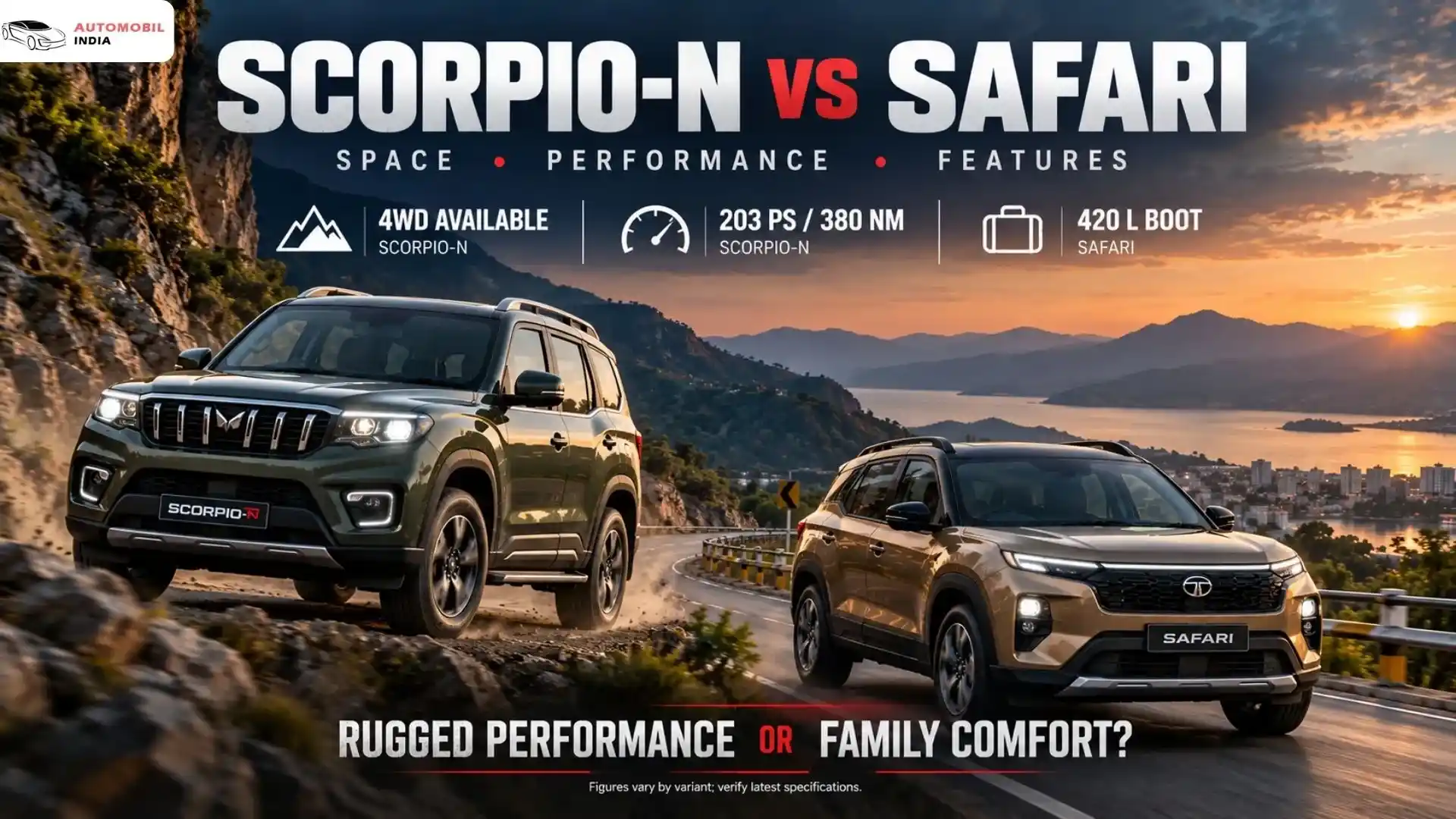
The Mahindra Scorpio-N and Tata Safari are two of India's most recognisable three-row SUVs, but they appeal to buyers in different ways.
The Scorpio-N uses a body-on-frame chassis, rear-wheel-drive architecture and offers four-wheel drive on selected diesel variants. It has a strong 2.0-litre turbo-petrol, a 2.2-litre diesel and a more rugged character. The Safari uses Tata's monocoque architecture, is front-wheel drive only and puts greater emphasis on cabin space, comfort, technology and premium features.
There is also an important 2026 update to this comparison: the Safari is no longer diesel-only. It now gets a 1.5-litre turbo-petrol producing 170hp and 280Nm, alongside its 2.0-litre diesel producing 170hp and 350Nm. The Scorpio-N's 2.0-litre turbo-petrol produces 203hp, while its 2.2-litre diesel produces up to 175hp and 400Nm depending on transmission.
For pricing, the current Scorpio-N range starts around ₹13.69 lakh ex-showroom, while the Safari starts around ₹13.40 lakh.
So, the choice is not simply about which SUV is bigger or more powerful.
The Scorpio-N is better suited to buyers who value rugged construction, stronger performance, rear-wheel drive and available 4WD. The Safari is better suited to buyers who prioritise three-row comfort, cabin space, premium features and a 5-star Bharat NCAP rating.
Scorpio N vs Safari: Quick Comparison
|
Parameter |
Mahindra Scorpio-N |
Tata Safari |
|
Starting ex-showroom price |
Approx. ₹13.69 lakh |
Approx. ₹13.40 lakh |
|
Seating |
6 or 7 |
6 or 7 |
|
Chassis |
Body-on-frame |
Monocoque |
|
Length |
4,662 mm |
4,668 mm |
|
Width |
1,917 mm |
1,922 mm |
|
Height |
Up to 1,857 mm |
1,795 mm |
|
Wheelbase |
2,750 mm |
2,741 mm |
|
Petrol engine |
2.0L turbo |
1.5L turbo |
|
Petrol power |
203 PS |
170 PS |
|
Petrol torque |
370/380 Nm |
280 Nm |
|
Diesel engine |
2.2L turbo |
2.0L turbo |
|
Diesel power |
132 PS / 175 PS |
170 PS |
|
Diesel torque |
300/370/400 Nm |
350 Nm |
|
Petrol transmission |
6MT / 6AT |
6MT / 6AT |
|
Diesel transmission |
6MT / 6AT |
6MT / 6AT |
|
4WD |
Available |
No |
|
Claimed mileage |
Approx. 12.1–15.4 km/l |
14.1–16.3 km/l |
|
Boot space |
Limited with all rows up; expands when 3rd row is folded |
420 litres with third row in use |
|
Safety rating |
5-star Global NCAP |
5-star Bharat NCAP |
|
ADAS |
Level 2 on Z8L |
Level 2/2+ on higher variants |
|
360-degree camera |
Available |
Available |
|
Terrain modes |
Diesel |
Available |
|
Third-row layout |
6/7 seats |
6/7 seats |
Mahindra lists the Scorpio-N at 4,662 mm long, 1,917 mm wide, with a 2,750 mm wheelbase. Tata's Safari measures 4,668 mm long, 1,922 mm wide and has a 2,741 mm wheelbase.
Scorpio Safari Price: Which SUV Costs More?
At the entry level, the two SUVs are surprisingly close.
The current Scorpio-N starts at around ₹13.69 lakh ex-showroom, while the Safari starts at approximately ₹13.40 lakh.
That means the Safari actually has a slight advantage at the bottom of the range.
However, the comparison changes considerably as you move up the range.
Approximate current price positioning
|
SUV |
Starting price |
Approx. top-end price |
|
Scorpio-N |
₹13.69 lakh |
₹25.49 lakh |
|
Safari |
₹13.40 lakh |
₹26.91 lakh |
The Scorpio-N's highest current listed Z8L diesel 4WD automatic is around ₹25.49 lakh ex-showroom.
The Safari's range extends to approximately ₹26.91 lakh for the top Accomplished Ultra Stealth 6-seat diesel automatic.
The important point
The starting price doesn't tell the complete story.
The Scorpio-N gives you access to:
-
Petrol
-
Diesel
-
Manual
-
Automatic
-
4WD
The Safari gives you:
-
Petrol
-
Diesel
-
Manual
-
Automatic
-
6-seat or 7-seat configurations
So buyers should compare like-for-like powertrain and equipment levels, not just the base price.
Scorpio N vs Safari: Engine and Performance
This is one of the biggest differences between the two SUVs.
Scorpio-N Petrol
The Scorpio-N uses a 2.0-litre mStallion turbo-petrol engine.
It produces:
-
203 PS
-
370 Nm with manual
-
380 Nm with automatic
-
6-speed manual
-
6-speed automatic
Mahindra's specifications list 149.14 kW of maximum power and 370/380 Nm depending on transmission.
That gives the Scorpio-N a significant performance advantage over the Safari petrol.
Safari Petrol
The current Safari uses Tata's 1.5-litre Hyperion turbo-petrol.
It produces:
-
170 hp
-
280 Nm
-
6-speed manual
-
6-speed automatic
The engine was introduced to the Safari in January 2026. Tata's petrol Safari is tuned specifically for the larger three-row SUV, with 170hp and 280Nm.
Petrol performance comparison
|
Scorpio-N |
Safari |
|
|
Engine |
2.0L turbo |
1.5L turbo |
|
Power |
203 PS |
170 PS |
|
Torque |
370–380 Nm |
280 Nm |
|
Manual |
6-speed |
6-speed |
|
Automatic |
6-speed TC |
6-speed TC |
What does this mean?
If you regularly drive with:
-
Six or seven passengers
-
Luggage
-
Mountain roads
-
Highway overtaking
-
Long-distance loads
the Scorpio-N's additional torque and power provide a meaningful reserve.
The Safari petrol, however, is not underpowered simply because its engine is smaller. Reviews of the 2026 petrol version found its 170hp/280Nm engine capable of moving the large SUV effectively, including with a full passenger load.
For outright petrol performance: Scorpio-N.
Diesel Performance: Scorpio-N vs Safari
The diesel comparison is closer.
Scorpio-N diesel
Mahindra offers two output levels depending on variant:
-
132 PS / 300 Nm on lower 2WD manual configurations
-
175 PS / 370 Nm manual
-
175 PS / 400 Nm automatic
The 4WD versions use the higher-output diesel.
Safari diesel
The Safari uses a:
-
2.0-litre turbo-diesel
-
170 PS
-
350 Nm
-
6-speed manual
-
6-speed automatic
Diesel comparison
|
Scorpio-N |
Safari |
|
|
Engine |
2.2L |
2.0L |
|
Maximum power |
175 PS |
170 PS |
|
Maximum torque |
400 Nm |
350 Nm |
|
Manual |
6-speed |
6-speed |
|
Automatic |
6-speed |
6-speed |
|
4WD |
Available |
No |
For buyers interested in diesel performance, the Scorpio-N has the stronger headline numbers.
The Safari's 350 Nm is still substantial and its monocoque construction and road-oriented setup give it a different driving character.
Scorpio N vs Safari Mileage: Which Is More Efficient?
Neither is a lightweight or economy-focused SUV, so expectations should be realistic.
Current published figures put the Scorpio-N's certified mileage around:
-
Petrol manual: approximately 12.17 km/l
-
Petrol automatic: approximately 12.12 km/l
-
Diesel: approximately 15.42 km/l
The Safari's published ARAI figures range from:
-
Diesel manual: 16.3 km/l
-
Diesel automatic: 14.1 km/l
The current Safari petrol's certified mileage data is not consistently published across the range, so it should not be assigned a made-up figure.
Real-world mileage
Real-world results are naturally lower.
Autocar's testing of the Scorpio-N diesel automatic returned:
-
8.6 km/l city
-
11.7 km/l highway
-
10.15 km/l overall
The petrol automatic returned 7.9 km/l in the city and 9.4 km/l on the highway.
These are tested figures, not manufacturer claims, and should not be treated as guaranteed owner mileage.
Mileage verdict
On the available certified figures:
Safari diesel has the mileage advantage.
But fuel efficiency should not be considered independently of vehicle weight, driving conditions, engine choice and intended usage.
If you drive 1,500–2,000 km every month, the diesel versions make considerably more financial sense than the petrol versions.
Which SUV Is Bigger: Scorpio N or Safari?
This is an interesting comparison because the dimensions are extremely close.
|
Dimension |
Scorpio-N |
Safari |
|
Length |
4,662 mm |
4,668 mm |
|
Width |
1,917 mm |
1,922 mm |
|
Height |
1,849–1,857 mm |
1,795 mm |
|
Wheelbase |
2,750 mm |
2,741 mm |
The Safari is technically:
-
6 mm longer
-
5 mm wider
But the Scorpio-N has:
-
9 mm more wheelbase
-
Around 54–62 mm more height
What does that mean in practice?
The Scorpio-N feels taller and more upright.
That contributes to its commanding driving position and traditional SUV character.
The Safari feels long and wide, with its proportions better suited to its monocoque family-SUV role.
Neither has a dramatic exterior-size advantage.
Which Has More Cabin Space?
This is where the difference in vehicle philosophy becomes more important than the dimensions.
Both offer six- and seven-seat configurations depending on variant.
Scorpio-N
The Scorpio-N's second row can be configured with:
-
Bench seating
-
Captain seats on selected variants
The third row is front-facing, but space is more limited than in the second row.
Mahindra's owner documentation confirms that the third row can be folded to accommodate larger objects.
Safari
The Safari is available as:
-
7-seat
-
6-seat with second-row captain chairs
The 6-seat version is particularly attractive to buyers who prioritise second-row comfort over maximum passenger capacity.
The Safari's second row is wide and comfortable, while the third row is designed as a genuine usable passenger row rather than simply an occasional jump seat.
Family-space verdict
Second-row comfort: Safari has the stronger case.
Maximum passenger flexibility: Both.
Third-row usability: Safari has a slight practical advantage for family use.
Six-seat luxury layout: Both offer it on higher variants.
Boot Space: Scorpio N vs Safari
Boot capacity is tricky in three-row SUVs because the available luggage area depends on whether all seats are being used.
The Safari is listed with 420 litres of boot space with the third row up, according to current specifications.
With the rear rows folded, Tata's published brochure lists substantially larger luggage volumes, including 680 litres with the third row folded and up to 1,550 litres with both rear rows folded depending on the measurement/configuration.
The Scorpio-N does not provide a directly comparable large luggage volume with all seven seats occupied. Its third row can be folded when more luggage capacity is required.
Practical takeaway
If you regularly carry seven people plus luggage, check both vehicles physically.
For a family that normally travels with five or six people and occasionally uses the third row, the Safari's luggage packaging is particularly useful.
Scorpio N vs Safari Ride and Handling
This is perhaps the biggest driving-character difference.
Scorpio-N: Body-on-frame SUV
The Scorpio-N uses a body-on-frame architecture.
That gives it:
-
Strong SUV character
-
High seating position
-
Rear-wheel-drive layout
-
Available 4WD
-
Greater suitability for rough-road use
Its suspension uses a double-wishbone front setup and multi-link rear suspension with Watt's linkage.
The result is a vehicle that feels fundamentally more like a traditional SUV.
Safari: Monocoque SUV
The Safari is built around a monocoque architecture.
It uses:
-
Front-wheel drive
-
Independent front suspension
-
Semi-independent rear suspension
Its driving character is more road-focused.
This is particularly noticeable on highways, where the Safari's long wheelbase and road-oriented chassis make it well suited to family cruising.
Which is better?
Rugged roads and adventure use: Scorpio-N
Highway family touring: Safari
Urban driving: Safari is generally the easier vehicle to approach as a large family SUV, although neither is small.
Four-Wheel Drive: Scorpio-N Has a Major Advantage
This is not a close comparison.
The Scorpio-N offers 4WD on selected diesel variants.
Mahindra's range includes diesel 4WD manual and automatic configurations in higher trims.
The Safari is front-wheel drive only.
It does not offer 4WD.
Who actually needs 4WD?
You may benefit from the Scorpio-N's 4WD system if you regularly drive:
-
Muddy trails
-
Snow-covered roads
-
Loose gravel
-
Steep inclines
-
Remote rural roads
-
Off-road terrain
For normal city and highway use, 4WD is not essential.
If you will never leave paved roads, the Safari's FWD layout is unlikely to be a disadvantage.
Scorpio N vs Safari Features
Both SUVs are feature-rich, but the current 2026 models have become significantly more sophisticated.
Scorpio-N Features
Higher Scorpio-N variants can offer:
-
Panoramic skyroof
-
540-degree surround-view system
-
Blind View Monitor
-
31.24 cm floating touchscreen
-
26.03 cm digital cluster
-
12-speaker Sony audio system
-
Ventilated front seats
-
Powered driver's seat
-
Wireless charging
-
Electronic parking brake
-
Adrenox connected-car technology
-
Alexa integration
-
Level 2 ADAS
Mahindra introduced the 540-degree surround-view system, updated touchscreen and digital cluster as part of its August 2026 feature enhancement.
The Z8T also adds features including ventilated seats, front camera, front parking sensors, powered driver's seat and Sony audio.
Safari Features
The Safari's equipment list includes:
-
Panoramic sunroof
-
360-degree HD surround-view camera
-
26.03 cm Harman touchscreen
-
26.03 cm digital instrument cluster
-
Wireless Android Auto and Apple CarPlay
-
Ventilated seats
-
Electronic parking brake
-
Wireless charging
-
Connected-car technology
-
JBL audio
-
Air purifier
-
Powered seats
-
ADAS
-
Terrain response modes
-
Multi-drive modes
The higher Accomplished Ultra variant goes considerably further, with a 36.9 cm Samsung Neo QLED infotainment display, Level 2+ ADAS, Dolby Atmos, gesture-controlled powered tailgate, built-in navigation and additional connected features.
Feature verdict
Both are highly equipped.
The Safari has the stronger premium-tech proposition at the very top of the range, particularly with its Accomplished Ultra package.
The Scorpio-N counters with its newer 540-degree camera system, panoramic roof, Sony audio and Level 2 ADAS.
Scorpio N vs Safari ADAS
This is no longer an area where the Scorpio-N can be considered technologically behind.
Mahindra introduced Level 2 ADAS for the Scorpio-N Z8L in 2025.
The system includes:
-
Forward Collision Warning
-
Automatic Emergency Braking
-
Adaptive Cruise Control with Stop & Go
-
Smart Pilot Assist
-
Lane Departure Warning
-
Lane Keep Assist
-
Traffic Sign Recognition
-
High Beam Assist
-
Speed Limit Assist
-
Front Vehicle Start Alert
The Safari also offers ADAS, with higher versions adding functions such as:
-
Automatic emergency braking
-
Adaptive cruise control
-
Adaptive steering assistance
-
Driver monitoring
-
Intelligent speed assistance
Tata's current Safari range lists Level 2/2+ ADAS depending on variant.
Important point
ADAS is an assistance system, not autonomous driving.
The driver must remain attentive and responsible at all times.
Scorpio N vs Safari Safety
Both SUVs have strong safety credentials, but their crash-test records come from different programmes.
Scorpio-N: 5-Star Global NCAP
The Scorpio-N received:
-
5 stars for Adult Occupant Protection
-
3 stars for Child Occupant Protection
in Global NCAP's 2022 testing.
The tested vehicle was an Indian-market Scorpio-N.
Mahindra subsequently added more safety equipment and ADAS to higher variants.
Safari: 5-Star Bharat NCAP
The Safari has a 5-star Bharat NCAP rating.
The official Bharat NCAP result records:
-
30.08/32 Adult Occupant Protection
-
44.54/49 Child Occupant Protection
The rating applies to the tested Safari/Harrier family and listed variants.
The Safari's current safety package can include:
-
Up to 7 airbags
-
ESC
-
360-degree camera
-
Front and rear parking sensors
-
Electronic parking brake
-
All-wheel disc brakes
-
ISOFIX
-
ADAS
Safety verdict
Both have strong independently tested credentials.
The key difference is:
Scorpio-N → 5-star Global NCAP
Safari → 5-star Bharat NCAP
These ratings come from different testing programmes and years, so the star counts should not be interpreted as a direct head-to-head crash-test comparison.
Which SUV Is Better for City Driving?
For city use, the Safari's monocoque, front-wheel-drive layout and road-focused character can make it the more natural family SUV.
However, its 1,922 mm width is substantial.
The Scorpio-N is similarly wide at 1,917 mm and also has a tall driving position.
Neither should be treated like a compact urban SUV.
City priorities
Safari:
-
Comfortable family cabin
-
Smooth petrol option
-
Large exterior footprint
-
Strong feature package
Scorpio-N:
-
High seating position
-
Strong petrol engine
-
Rugged chassis
-
Good visibility
If your city driving involves tight parking spaces, the dimensions of both should be considered carefully before purchase.
Which SUV Is Better for Highway Driving?
Both are strong highway vehicles, but for different reasons.
Scorpio-N
Its advantages include:
-
Powerful petrol engine
-
High diesel torque
-
Strong highway acceleration
-
Rear-wheel-drive architecture
-
4WD availability
-
Strong high-speed stability
Safari
Its advantages include:
-
Comfortable family-focused cabin
-
Long wheelbase
-
Refined petrol engine
-
Strong diesel torque
-
Comfortable highway ride
-
Extensive ADAS on higher variants
For a family doing frequent highway trips, the Safari's road-oriented character is particularly appealing.
For someone who mixes highways with rough roads and occasional off-road driving, the Scorpio-N has a stronger case.
Which Is Better for Seven Adults?
Both can technically seat seven.
But there is a major distinction.
Scorpio-N
The third row is front-facing, but space is tighter than the second row.
Safari
The third row is also a genuine passenger row, and the cabin is designed more explicitly around three-row family use.
The Safari also offers a 6-seat configuration with second-row captain chairs.
Practical recommendation
If you regularly carry six or seven adults, sit in the third row of both before buying.
Do not make the decision based solely on the number "7".
A seven-seat SUV can be technically capable of carrying seven people while still being uncomfortable for adults over long distances.
Scorpio Safari Features: Which Offers More?
At lower and mid-range variants, equipment availability varies significantly.
At the top end, both offer:
-
Panoramic roof
-
Large touchscreen
-
Digital instrument cluster
-
Connected-car technology
-
Ventilated seats
-
Wireless charging
-
360-degree camera
-
ADAS
-
Premium audio
-
Powered seats
The Safari's Accomplished Ultra currently has the more extravagant technology package, including its large Samsung Neo QLED display and Level 2+ ADAS.
The Scorpio-N's 2026 updates, however, bring its technology package much closer, particularly with the 540-degree surround-view system and 31.24 cm touchscreen.
So the feature comparison should be done variant by variant, rather than model against model.
Ownership and Practicality
There is another important distinction that specification tables cannot fully capture.
Scorpio-N ownership profile
The Scorpio-N is better suited to an owner who values:
-
SUV toughness
-
4WD capability
-
Strong engines
-
High seating position
-
Long-distance versatility
-
Occasional rough-road use
Safari ownership profile
The Safari is better suited to an owner who values:
-
Family comfort
-
Three-row usability
-
Premium cabin
-
Highway touring
-
Feature-rich variants
-
Road-focused driving
Neither should automatically be described as "cheaper to maintain" without considering the exact variant, fuel type, annual running and local service costs.
Your local dealer and service-centre quality can have a bigger effect on ownership satisfaction than small differences in scheduled maintenance costs.
Scorpio N vs Safari: Which One Should You Buy?
The answer depends on how you intend to use the SUV.
Choose the Mahindra Scorpio-N if:
-
You want a traditional SUV experience.
-
You want rear-wheel drive.
-
You need available 4WD.
-
You want stronger petrol performance.
-
You want higher diesel torque.
-
You regularly drive on rough roads.
-
You want a high driving position.
-
You prefer the Scorpio's rugged design.
-
You want Level 2 ADAS without moving to the very top of the range.
Choose the Tata Safari if:
-
Family comfort is your priority.
-
You regularly use the third row.
-
You want a 6-seat captain-chair layout.
-
You prefer a road-focused monocoque SUV.
-
You want a premium cabin.
-
You want a strong feature package.
-
You want the 5-star Bharat NCAP result.
-
You want a petrol option but do not need the Scorpio-N's 203 PS output.
-
You want the most feature-loaded top-end configuration.
Scorpio N vs Safari: Final Verdict
The Scorpio-N and Safari are close in size and price but fundamentally different underneath.
The Scorpio-N's body-on-frame construction, rear-wheel-drive architecture and optional 4WD make it the more rugged proposition. Its 203 PS petrol is also significantly more powerful than the Safari's 170 PS petrol, while its higher-output diesel reaches 400 Nm.
The Safari counters with a more road-oriented monocoque platform, a spacious three-row cabin and a broad premium feature list. Its new 170 PS/280 Nm petrol engine also makes the Safari a more versatile proposition than it was when it was diesel-only.
Safety is strong on both, although their ratings come from different programmes: the Scorpio-N has a 5-star Global NCAP rating, while the Safari has a 5-star Bharat NCAP rating.
In simple terms:
|
Requirement |
Better suited |
|
Rugged SUV character |
Scorpio-N |
|
Petrol performance |
Scorpio-N |
|
Diesel torque |
Scorpio-N |
|
4WD |
Scorpio-N |
|
Rough-road use |
Scorpio-N |
|
Family-focused cabin |
Safari |
|
Third-row practicality |
Safari |
|
Premium technology |
Safari |
|
Top-end feature package |
Safari |
|
Certified diesel mileage |
Safari |
|
Bharat NCAP rating |
Safari |
|
Highway family touring |
Safari |
|
Traditional SUV driving experience |
Scorpio-N |
Therefore, the decision is less about finding a single winner and more about deciding what kind of SUV you actually need.
The Scorpio-N makes more sense for buyers who want capability, performance and a traditional SUV character.
The Safari makes more sense for buyers who want space, comfort, technology and a family-oriented three-row experience.
Disclaimer
Prices, specifications, features, mileage figures, variant availability and safety equipment can change by manufacturer, variant and location. Mileage figures are certified/claimed figures unless explicitly identified as real-world test results, and actual efficiency will vary with traffic, driving style, load and road conditions. NCAP ratings apply to the tested configurations and applicable variants and should not be interpreted as a direct comparison between different testing programmes. Buyers should verify the latest ex-showroom and on-road prices, equipment, warranty terms and availability with Mahindra or Tata Motors before purchasing.