
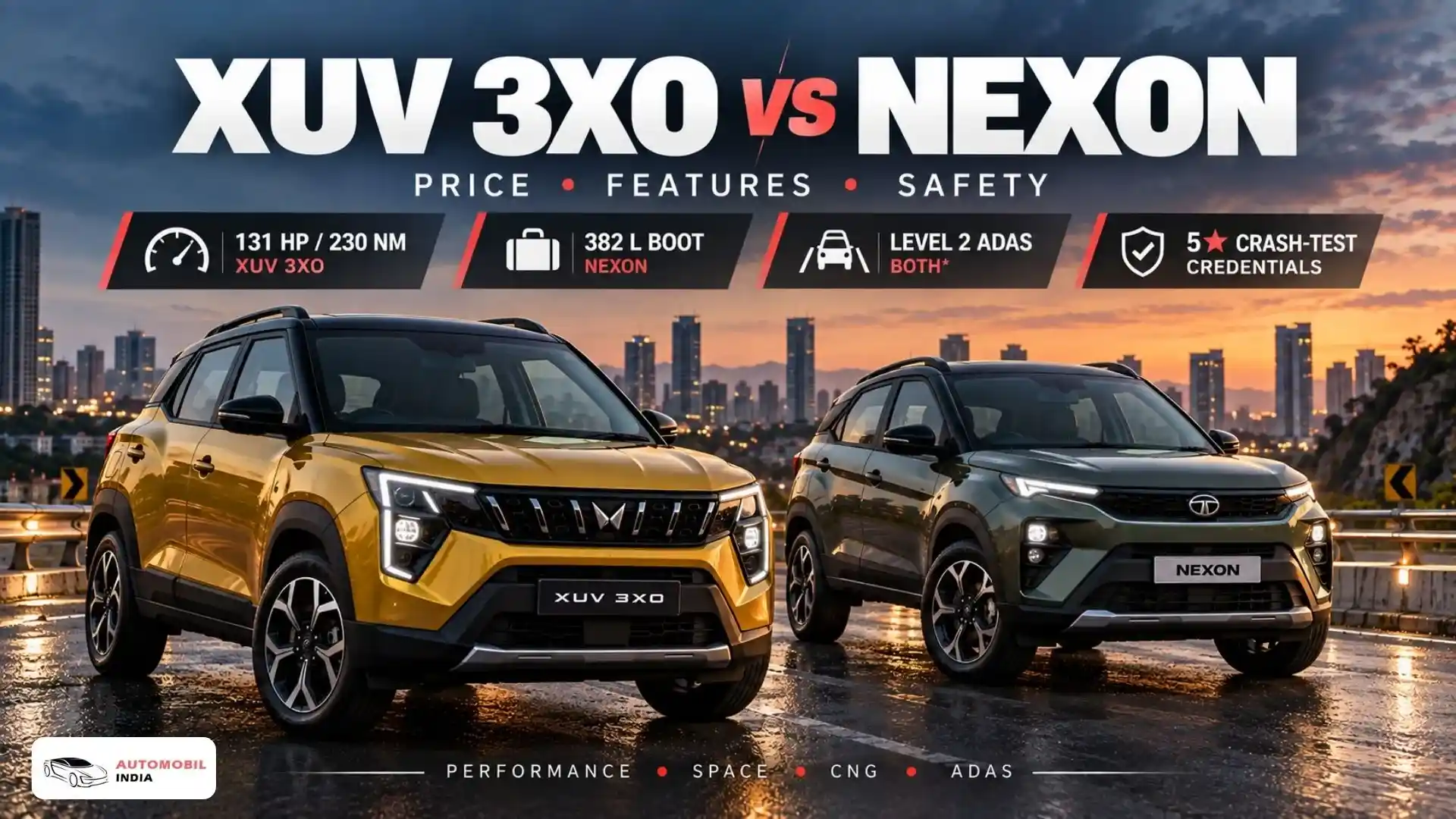
The Mahindra XUV 3XO vs Tata Nexon comparison brings together two of India's most feature-rich sub-4-metre SUVs. Both offer five seats, turbo-petrol engines, diesel options, automatic transmissions, six airbags and 5-star crash-test ratings.
The biggest difference is how they approach the segment.
The Mahindra XUV 3XO puts a strong emphasis on performance, cabin space, technology and advanced driver-assistance features. Its 1.2-litre turbo-petrol range goes up to 131hp and 230Nm, while the 1.5-litre diesel produces 117hp and 300Nm. Higher variants also get Level 2 ADAS, a panoramic sunroof, twin 10.25-inch screens and a 360-degree camera.
The Tata Nexon counters with multiple fuel choices, a larger boot, 208mm ground clearance, a broad automatic range and a strong safety record. It is available with turbo-petrol, diesel and CNG powertrains, including a 7-speed DCT and 6-speed AMT.
As of October 2026, the XUV 3XO is priced from around ₹7.79 lakh to ₹15.04 lakh ex-showroom, while the Nexon starts at around ₹7.40 lakh and extends to approximately ₹14.40 lakh, depending on variant and edition.
Neither SUV is automatically the better choice for every buyer. The more useful question is whether you prioritise performance and technology, or powertrain flexibility, boot space and CNG availability.
Mahindra XUV 3XO vs Tata Nexon: Quick Comparison
|
Parameter |
Mahindra XUV 3XO |
Tata Nexon |
|
Starting ex-showroom price |
₹7.79 lakh |
~₹7.40 lakh |
|
Top ex-showroom price |
₹15.04 lakh |
~₹14.40 lakh |
|
Seating |
5 |
5 |
|
Petrol engines |
1.2L turbo, 1.2L TGDi turbo |
1.2L turbo |
|
Diesel |
1.5L turbo |
1.5L turbo |
|
CNG |
Not currently available |
Yes |
|
Maximum petrol power |
131hp |
120hp |
|
Maximum petrol torque |
230Nm |
170Nm |
|
Maximum diesel torque |
300Nm |
260Nm |
|
Petrol automatic |
6-speed torque converter |
6-speed AMT / 7-speed DCT |
|
Diesel automatic |
AMT |
AMT |
|
Claimed mileage range |
17.96–21.2 km/l |
17.01 km/l–24 km/kg |
|
Length |
3,990mm |
3,995mm |
|
Width |
1,821mm |
1,804mm |
|
Wheelbase |
2,600mm |
2,498mm |
|
Ground clearance |
Notably high |
208mm |
|
Boot space |
364 litres |
382 litres |
|
Airbags |
6 standard |
6 standard |
|
Safety rating |
5-star Bharat NCAP |
5-star Global NCAP; 5-star Bharat NCAP |
|
ADAS |
Level 2 on higher variants |
Available on select top variants |
|
360-degree camera |
Yes, higher variants |
Yes, higher variants |
|
Panoramic sunroof |
Yes |
Yes |
Prices, features and variant availability can change. Mileage figures are certified/claimed figures unless specifically identified as tested figures.
XUV 3XO vs Nexon Price
Price is one of the first things buyers will notice.
Current 2026 pricing puts the XUV 3XO at approximately ₹7.79 lakh–₹15.04 lakh ex-showroom. Mahindra's official website lists the MX1 petrol manual at ₹7.79 lakh.
The Nexon currently starts at around ₹7.40 lakh, with the range extending to approximately ₹14.40 lakh depending on powertrain and variant.
|
SUV |
Approx. ex-showroom range |
|
Tata Nexon |
₹7.40 lakh–₹14.40 lakh |
|
Mahindra XUV 3XO |
₹7.79 lakh–₹15.04 lakh |
The Nexon therefore has the lower starting price and a slightly lower upper price.
However, comparing only the starting price can be misleading.
For example, the XUV 3XO's entry-level MX1 is a 1.2-litre turbo-petrol manual, while the Nexon's entry-level Smart is also a turbo-petrol manual. But the equipment, transmission and engine outputs vary as you move through the respective ranges.
The better approach is to decide your budget first and then compare like-for-like variants.
XUV 3XO vs Nexon: Engine and Performance
Performance is one area where the XUV 3XO has a clear numerical advantage.
Mahindra XUV 3XO engines
The XUV 3XO currently offers three engine configurations:
1.2-litre turbo-petrol
-
111hp
-
200Nm
-
Manual
-
Torque-converter automatic on applicable variants
1.2-litre TGDi turbo-petrol
-
Up to 131hp
-
230Nm
-
6-speed manual
-
6-speed torque-converter automatic
1.5-litre diesel
-
117hp
-
300Nm
-
6-speed manual
-
AutoSHIFT+ AMT
Mahindra's official specification page lists the 1.2-litre turbo-petrol at 82kW and 200Nm, while the diesel produces 85.8kW and 300Nm. The higher TGDi engine is rated at around 131hp and 230Nm.
What does 300Nm mean in practice?
Torque is particularly relevant when driving with a full load.
The XUV 3XO diesel's 300Nm gives it a substantial torque reserve for:
-
Highway overtaking
-
Hill climbs
-
Carrying five occupants
-
Carrying luggage
-
Maintaining speed on inclines
That doesn't automatically mean the 3XO will always feel faster in every situation, but it gives the engine greater flexibility at low and mid engine speeds.
Tata Nexon engines
The Nexon has:
1.2-litre turbo-petrol
-
120hp
-
170Nm
1.5-litre turbo-diesel
-
115hp
-
260Nm
1.2-litre turbo CNG
-
Petrol mode: around 120hp
-
CNG mode: around 100hp
-
170Nm
The Nexon petrol can be paired with 5-speed or 6-speed manual gearboxes, 6-speed AMT and 7-speed DCT depending on variant. The diesel gets manual and AMT options, while CNG is manual-only.
Performance comparison
|
Powertrain |
XUV 3XO |
Nexon |
|
Base turbo-petrol |
111hp / 200Nm |
120hp / 170Nm |
|
Performance turbo-petrol |
131hp / 230Nm |
120hp / 170Nm |
|
Diesel |
117hp / 300Nm |
115hp / 260Nm |
|
CNG |
Not available |
~100hp / 170Nm |
The XUV 3XO therefore has the stronger petrol performance option and diesel torque figure.
The Nexon's advantage is different: it offers CNG, which the XUV 3XO does not currently offer in its conventional ICE lineup.
XUV 3XO vs Nexon Mileage
Mileage should be considered according to the engine and gearbox rather than by simply comparing the highest advertised figure.
XUV 3XO mileage
Current ARAI-certified figures include:
|
XUV 3XO powertrain |
Claimed mileage |
|
1.2 Petrol MT |
18.89 km/l |
|
1.2 Petrol AT |
17.96 km/l |
|
1.5 Diesel MT |
20.6 km/l |
|
1.5 Diesel AMT |
21.2 km/l |
The diesel AMT currently has the highest published XUV 3XO figure at 21.2 km/l.
Tata Nexon mileage
The Nexon's published figures include:
|
Nexon powertrain |
Claimed mileage |
|
Petrol MT |
17.44 km/l |
|
Petrol AMT |
17.18 km/l |
|
Petrol DCT |
17.01 km/l |
|
CNG MT |
24 km/kg |
Autocar's current data lists the Nexon CNG at 24 km/kg and the petrol manual at 17.44 km/l.
Which has better mileage?
For conventional petrol and diesel, the answer depends on the exact combination.
The XUV 3XO diesel AMT's 21.2 km/l claim is strong.
But the Nexon has a major advantage for buyers focused on low-cost CNG running, because the XUV 3XO currently doesn't offer a factory CNG powertrain.
XUV 3XO vs Nexon: CNG
This is a straightforward difference.
Tata Nexon — CNG available
Mahindra XUV 3XO — no conventional factory CNG variant currently listed
Tata's twin-cylinder CNG setup gives the Nexon a claimed 24 km/kg and approximately 321 litres of boot space.
The Nexon CNG is also unusual because it combines CNG with a turbocharged engine.
For buyers covering high monthly kilometres in a city with good CNG infrastructure, this can be a decisive advantage.
If you drive 2,000–3,000km every month, fuel cost can matter more than a premium feature such as a larger touchscreen or panoramic sunroof.
XUV 3XO vs Nexon: Dimensions
The XUV 3XO is particularly interesting from a packaging perspective.
|
Dimension |
XUV 3XO |
Nexon |
|
Length |
3,990mm |
3,995mm |
|
Width |
1,821mm |
1,804mm |
|
Height |
1,647mm |
1,620mm |
|
Wheelbase |
2,600mm |
2,498mm |
|
Boot |
364 litres |
382 litres |
Mahindra's official specifications list the XUV 3XO at 3,990mm long, 1,821mm wide, 1,647mm high and with a 2,600mm wheelbase.
Tata lists the Nexon at 3,995mm long, 1,804mm wide, 1,620mm high and with a 2,498mm wheelbase.
Why is the wheelbase important?
The XUV 3XO's 2,600mm wheelbase is significantly longer than the Nexon's 2,498mm.
Wheelbase is the distance between the front and rear axles. A longer wheelbase can create more usable space between the axles, particularly for rear-seat passengers.
This is one reason the XUV 3XO feels like a larger SUV inside despite remaining under four metres long.
XUV 3XO vs Nexon: Rear Seat Space
For family buyers, this can be more important than horsepower.
The XUV 3XO's longer wheelbase and wider body give it a strong packaging advantage.
It is particularly suited to buyers who frequently carry:
-
Tall adults
-
Teenagers
-
Three rear passengers
-
Child seats
-
Family luggage
The Nexon is also practical, but its 2,498mm wheelbase is considerably shorter.
Practical takeaway
If rear-seat space is high on your priority list, sit in both vehicles with your family before booking.
Dimensions give useful clues, but seat cushioning, seatback angle, knee room and the position of the front seats can change the experience considerably.
XUV 3XO vs Nexon: Boot Space
Here the Nexon has the numerical advantage.
Tata Nexon
382 litres
Mahindra XUV 3XO
364 litres
The difference is about 18 litres.
That is not enough to make the XUV 3XO impractical, but the Nexon gives you a little more luggage capacity.
For a family that regularly carries:
-
Two large suitcases
-
Airport luggage
-
A stroller
-
Shopping bags
-
Weekend-trip equipment
the extra boot capacity is useful.
The Nexon's CNG version, however, has a smaller 321-litre boot.
So the advantage changes depending on which powertrain you choose.
XUV 3XO vs Nexon: Features
This is where both SUVs become difficult to separate on a simple checklist.
Mahindra XUV 3XO features
Higher variants offer:
-
Twin 10.25-inch screens
-
Panoramic sunroof
-
360-degree camera
-
Harman Kardon audio system
-
Dual-zone climate control
-
Wireless Android Auto and Apple CarPlay
-
Wireless charging
-
65W USB charging
-
Connected-car technology
-
Blind-view monitor
-
Adaptive cruise control
-
Level 2 ADAS
-
Electronic parking brake with auto-hold
Mahindra's top variants combine the dual screens, panoramic sunroof, premium audio and ADAS package.
One important omission
The XUV 3XO's feature list is extensive, but it does not offer ventilated front seats, according to Autocar's current assessment.
Tata Nexon features
Depending on variant, the Nexon offers:
-
10.25-inch touchscreen
-
10.25-inch digital instrument cluster
-
Wireless Android Auto and Apple CarPlay
-
360-degree camera
-
Panoramic sunroof
-
Ventilated front seats
-
Air purifier
-
Wireless charging
-
Cruise control
-
Automatic climate control
-
JBL audio on higher variants
-
Connected-car technology
-
Front parking sensors
-
Blind-view monitor
-
ADAS on select top petrol DCT variants
Tata's current variant list shows features such as the 360-degree surround-view system, ventilated seats, panoramic sunroof, JBL audio and connected-car functions on higher trims.
Feature verdict
The XUV 3XO has a particularly strong technology and cabin-space proposition.
The Nexon counters with features such as ventilated seats, multiple powertrain choices and its own ADAS-equipped top variant.
Therefore, buyers should compare the exact variants rather than simply asking which model has "more features".
XUV 3XO vs Nexon: Safety Comparison
Safety is one of the strongest areas for both SUVs.
Mahindra XUV 3XO safety rating
The XUV 3XO scored:
-
29.36/32 — Adult Occupant Protection
-
43/49 — Child Occupant Protection
-
5 stars — Bharat NCAP
The Bharat NCAP assessment was published in 2024, and the current Bharat NCAP database has subsequently extended the rating applicability to additional XUV 3XO variants.
Six airbags, ESC, curtain airbags, pedestrian protection and seat-belt reminders are listed as standard safety equipment across the applicable range.
Tata Nexon safety rating
The current-generation Nexon has achieved a 5-star Global NCAP rating.
Global NCAP's 2024 assessment gave the Nexon:
-
32.22/34 — Adult Occupant Protection
-
44.52/49 — Child Occupant Protection
Global NCAP describes the updated Nexon as having six airbags and ESC as standard, with the rating applying to vehicles produced from August 8, 2023.
The Nexon has also subsequently received a 5-star Bharat NCAP rating, so the model has documented five-star results under both programmes.
Important safety comparison
The star counts alone should not be treated as a direct numerical comparison because the vehicles' headline results come from different testing programmes and protocols.
A more useful conclusion for buyers is:
Both are independently crash-tested five-star SUVs with six airbags and electronic stability control.
The XUV 3XO has a documented 5-star Bharat NCAP score of 29.36/32 for adult protection and 43/49 for child protection.
The Nexon has a 5-star Global NCAP result with 32.22/34 adult and 44.52/49 child protection, alongside its Bharat NCAP certification.
XUV 3XO vs Nexon: ADAS
Both vehicles offer advanced driver-assistance technology, but availability is variant-dependent.
XUV 3XO ADAS
Higher XUV 3XO variants offer Level 2 ADAS, including functions such as:
-
Adaptive cruise control
-
Lane keep assist
-
Lane departure warning
-
Forward collision warning
-
Automatic emergency braking
-
High-beam assistance
-
Traffic-sign recognition
Mahindra positions ADAS as part of the higher-end XUV 3XO package.
Tata Nexon ADAS
Tata has introduced Level 2 ADAS on the Nexon, but it is restricted to selected top petrol DCT configurations.
The package includes functions such as:
-
Forward collision warning
-
Autonomous emergency braking
-
Lane departure warning
-
Lane keep assist
-
Traffic-sign recognition
The important point is that ADAS is not standard across either model's range.
If ADAS is important to you, check the exact variant before booking.
XUV 3XO vs Nexon for City Driving
Both SUVs are well suited to Indian cities, but the reasons differ.
XUV 3XO in the city
The XUV 3XO's advantages include:
-
Strong turbo-petrol torque
-
Wide cabin
-
Long wheelbase
-
Compact overall length
-
Automatic petrol option
-
360-degree camera on higher variants
-
Good visibility
-
Parking assistance
The 6-speed torque-converter automatic is particularly relevant for buyers who want an automatic SUV for daily traffic without choosing a DCT.
Nexon in the city
The Nexon offers:
-
Compact dimensions
-
360-degree camera
-
Petrol AMT
-
Petrol DCT
-
CNG
-
High ground clearance
-
Good urban feature package
For a buyer doing very high city mileage, the Nexon CNG gives it a major advantage.
For a buyer who wants a powerful petrol automatic, the XUV 3XO TGDi automatic is the more performance-focused proposition.
XUV 3XO vs Nexon for Highway Driving
Highway users have strong reasons to consider both.
The XUV 3XO's diesel produces 300Nm, giving it the strongest torque figure of the two.
The Nexon's diesel produces 260Nm.
For loaded highway driving, this difference can be useful during overtaking and climbs.
The XUV 3XO also offers a 131hp/230Nm TGDi petrol, giving performance-focused petrol buyers another option.
The Nexon counters with its 7-speed DCT, which is an important choice for buyers who want a responsive petrol automatic.
Highway considerations
XUV 3XO: Stronger diesel torque, spacious cabin, powerful TGDi petrol
Nexon: Multiple engine choices, DCT, larger boot, 208mm ground clearance
Neither is automatically the better highway SUV for every buyer.
Your annual kilometres and preferred fuel type matter more.
XUV 3XO vs Nexon: Ride Quality and Ground Clearance
Tata lists the Nexon with 208mm ground clearance, which is particularly useful on poorly maintained Indian roads.
The XUV 3XO also has strong rough-road capability, and Autocar's assessment describes its ride as slightly firm but capable of handling rough surfaces well.
The XUV 3XO's long wheelbase can help provide a stable feel at speed, while the Nexon's suspension has traditionally been one of its strong points over broken roads.
For buyers in cities with aggressive speed breakers and uneven roads, both have useful SUV characteristics.
XUV 3XO vs Nexon: Ownership and Practicality
This is where the comparison moves beyond specifications.
Consider the XUV 3XO if:
-
You want a spacious cabin
-
You value performance
-
You regularly travel on highways
-
You want diesel
-
You want a petrol torque-converter automatic
-
You want Level 2 ADAS
-
You want a panoramic sunroof
-
You want advanced cabin technology
Consider the Nexon if:
-
You want CNG
-
You want a larger boot
-
You want a DCT petrol automatic
-
You want high ground clearance
-
You want multiple fuel choices
-
You value a strong crash-test record
-
You want ventilated seats on higher variants
XUV 3XO vs Nexon: Which Has Better Value?
Value depends heavily on the variant.
The XUV 3XO's MX1 starts at ₹7.79 lakh and already gets six airbags, ESC and other important safety equipment.
The Nexon starts slightly lower at around ₹7.40 lakh, but its variant ladder provides different equipment and powertrain combinations.
At higher prices, the XUV 3XO's equipment list becomes particularly aggressive, with features such as:
-
Panoramic sunroof
-
Dual 10.25-inch displays
-
Harman Kardon audio
-
ADAS
-
360-degree camera
The Nexon's higher variants similarly offer:
-
Panoramic sunroof
-
Ventilated seats
-
360-degree camera
-
Premium audio
-
ADAS
-
Multiple automatic options
The best value therefore depends on which features you actually want, rather than how long the feature list is.
XUV 3XO vs Nexon: Best Choice by Requirement
|
Requirement |
Better suited |
Reason |
|
Lower starting price |
Nexon |
Lower entry price |
|
Maximum petrol performance |
XUV 3XO |
131hp / 230Nm TGDi |
|
Diesel torque |
XUV 3XO |
300Nm |
|
CNG |
Nexon |
XUV 3XO currently has no conventional CNG |
|
Petrol DCT |
Nexon |
7-speed DCT |
|
Petrol torque-converter automatic |
XUV 3XO |
6-speed AT |
|
Boot space |
Nexon |
382L vs 364L |
|
Rear-seat space |
XUV 3XO |
Longer 2,600mm wheelbase |
|
Ground clearance |
Nexon |
208mm |
|
Premium technology |
XUV 3XO |
Twin screens, panoramic roof, premium audio |
|
Ventilated seats |
Nexon |
Available on higher variants |
|
ADAS |
Both |
Variant-dependent |
|
Highway diesel use |
XUV 3XO |
300Nm diesel |
|
High-running city use |
Nexon |
CNG option |
|
Safety |
Both |
Five-star independent crash-test credentials |
|
Family luggage |
Nexon |
Larger standard boot |
|
Spacious cabin |
XUV 3XO |
Wider body and longer wheelbase |
Which XUV 3XO Variant Should You Consider?
The XUV 3XO range is broad, so buying the top model is not necessarily the sensible approach.
MX1
Best considered by buyers who mainly want the XUV 3XO's basic package, turbo-petrol engine and standard safety equipment at the lowest possible price.
MX2 Pro / MX3
These variants become more interesting for buyers wanting additional convenience without immediately moving to the expensive AX7 range.
AX5 / AX5 Luxury
These are worth considering if you want more premium technology, stronger engine options and additional comfort equipment.
AX7 / AX7 Luxury
These are aimed at buyers who specifically want the high-end features, ADAS and the most powerful petrol configuration.
The top AX7 Luxury petrol automatic currently reaches about ₹15.04 lakh ex-showroom.
Which Nexon Variant Should You Consider?
The Nexon's range is similarly broad.
Smart / Smart+
Suitable for buyers who prioritise price and basic safety.
Pure+
A useful middle ground for buyers who want more convenience and infotainment equipment.
Creative
This is where the Nexon's premium equipment becomes more substantial, including the 360-degree camera and additional technology.
Creative+ / Fearless+
These are more relevant if you specifically want features such as the panoramic sunroof, ventilated seats, premium audio and ADAS-related equipment.
Current 2026 variant pricing places the Nexon broadly between ₹7.37 lakh and ₹14.02 lakh in the main range, depending on engine and trim.
Who Should Buy the Mahindra XUV 3XO?
The XUV 3XO makes the most sense for buyers who want performance and technology without moving into a larger SUV.
It is particularly relevant if you:
-
Want a powerful turbo-petrol
-
Need a diesel
-
Drive on highways frequently
-
Carry adults in the rear regularly
-
Want a petrol automatic with a torque converter
-
Want Level 2 ADAS
-
Want a panoramic sunroof
-
Prefer a feature-rich cabin
Its biggest strength is the combination of power, cabin space and technology.
Who Should Buy the Tata Nexon?
The Nexon is particularly suited to buyers who want powertrain flexibility and practical everyday usability.
It makes more sense if you:
-
Want CNG
-
Have high monthly running
-
Want a DCT petrol automatic
-
Need a larger boot
-
Want 208mm ground clearance
-
Want multiple fuel choices
-
Want ventilated front seats
-
Prefer the Nexon's broader variant strategy
Its biggest strength is choice: petrol, diesel and CNG, along with several transmission options.
Final Verdict: XUV 3XO vs Nexon
The Mahindra XUV 3XO vs Tata Nexon comparison does not produce one universal winner because the two SUVs prioritise different things.
The XUV 3XO is particularly compelling for buyers who want performance, rear-seat space, diesel torque, a powerful turbo-petrol, advanced technology and Level 2 ADAS. Its 2,600mm wheelbase also gives it a strong advantage in cabin packaging.
The Tata Nexon is better suited to buyers who value powertrain flexibility, CNG, a larger boot, 208mm ground clearance and a wide choice of transmissions.
Choose the XUV 3XO if your priorities are:
Performance + space + technology + diesel + ADAS
Choose the Nexon if your priorities are:
CNG + boot space + powertrain choice + DCT + practical everyday use
For safety, both deserve consideration. The XUV 3XO has a 5-star Bharat NCAP result, while the Nexon has documented five-star results under Global NCAP and Bharat NCAP. The testing programmes should be considered separately rather than reducing the comparison to the star count alone.
The smartest purchase decision is therefore to identify your fuel type, transmission requirement and typical driving pattern first, then compare the exact variants that fit your budget.
Disclaimer
Prices, specifications, features, mileage figures, variant availability and equipment can change based on location, variant, manufacturer updates and applicable offers. Mileage figures are certified/claimed figures unless specifically identified as tested figures. Safety ratings mentioned in this article belong to the respective testing programmes and should not be compared solely by star count. Always verify the latest price, variant equipment and specifications with Mahindra, Tata Motors or an authorised dealer before purchasing.