
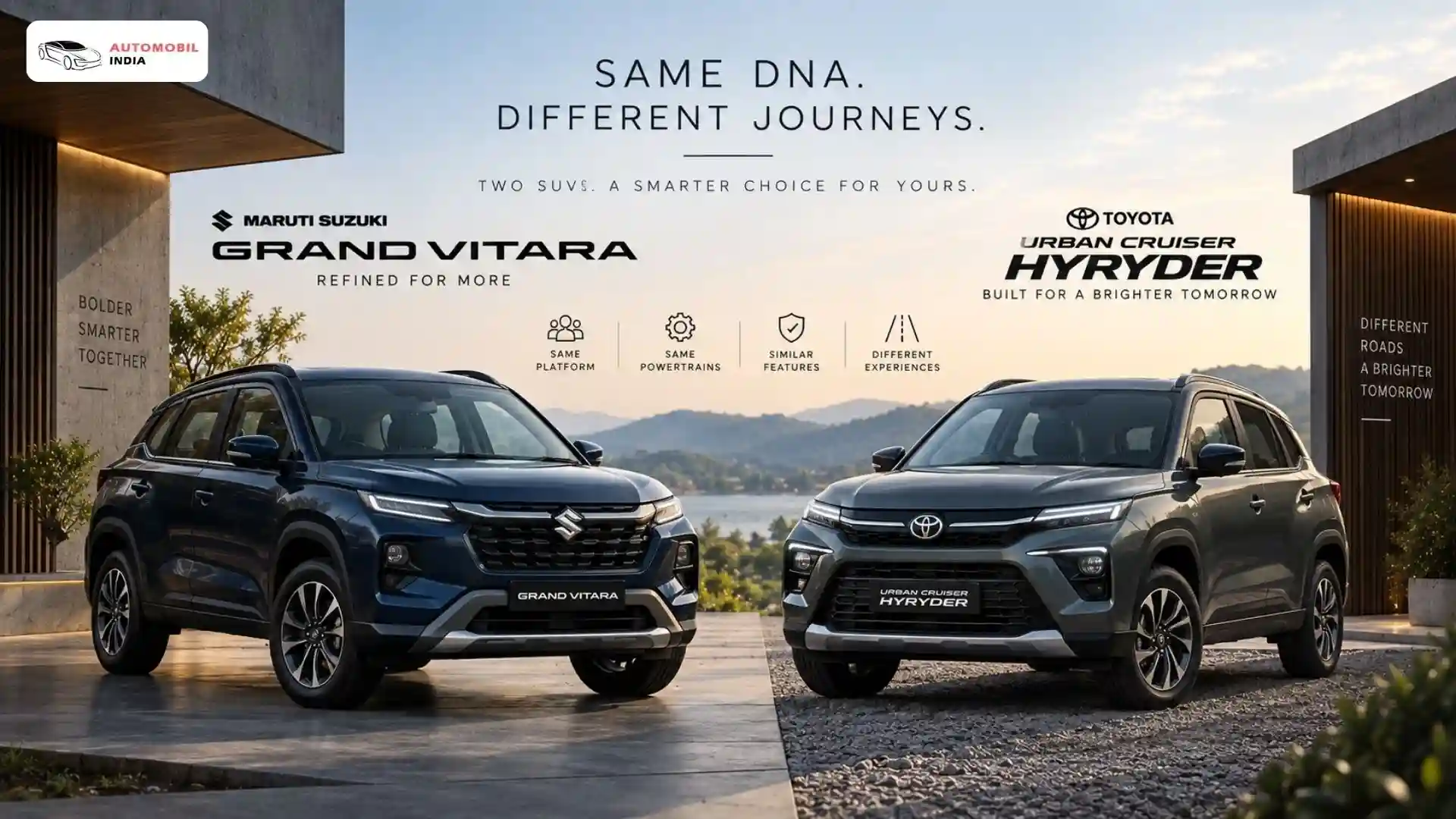
If you are looking for a fuel-efficient mid-size SUV with a strong hybrid powertrain, the Toyota Urban Cruiser Hyryder and Maruti Suzuki Grand Vitara are among the most closely related choices in India. Both use a 1.5-litre three-cylinder strong-hybrid petrol system with an electric motor, lithium-ion battery and e-CVT, and both claim 27.97 km/l under certified test conditions.
The important point is that this is not simply a case of choosing between two completely different SUVs. The Hyryder and Grand Vitara are closely related mechanically, but their pricing, variant structures, equipment and brand experience give buyers different reasons to choose one over the other.
For hybrid buyers, there is no meaningful claimed-mileage difference: both are rated at 27.97 km/l. The decision therefore comes down more to the price of the variant you want, features, practicality, styling, dealership preference and ownership priorities.
Current-price note: Toyota and Maruti regularly revise variant pricing and offers. The prices below are current manufacturer-listed/ex-showroom figures available during October 2026 and should be checked with the respective dealer before booking.
Hyryder vs Grand Vitara: Quick Comparison
|
Parameter |
Toyota Urban Cruiser Hyryder Strong Hybrid |
Maruti Grand Vitara Strong Hybrid |
|
Engine |
1.5-litre petrol + electric motor |
1.5-litre petrol + electric motor |
|
Engine configuration |
3-cylinder |
3-cylinder |
|
Petrol engine power |
92.45 PS |
92.45 PS |
|
Petrol engine torque |
122 Nm |
122 Nm |
|
Electric motor |
80.2 PS, 141 Nm |
80.2 PS, 141 Nm |
|
Combined system output |
115.56 PS |
Around 116 PS |
|
Transmission |
e-Drive/e-CVT |
e-CVT |
|
Drive |
2WD |
2WD |
|
Claimed mileage |
27.97 km/l |
27.97 km/l |
|
Fuel tank |
45 litres |
45 litres |
|
Length |
4,365 mm |
4,345 mm |
|
Width |
1,795 mm |
1,795 mm |
|
Height |
1,645 mm |
1,645 mm |
|
Wheelbase |
2,600 mm |
2,600 mm |
|
Strong-hybrid boot |
Approx. 265 litres |
Approx. 265 litres |
|
Seating |
5 |
5 |
|
6 airbags |
Standard |
Standard |
|
360-degree camera |
Available |
Available |
|
Ventilated front seats |
Available |
Available |
|
Hybrid transmission |
Automatic only |
Automatic only |
Toyota's current specifications list the Hyryder hybrid with a 1,490cc engine, 92.45 PS petrol-engine output, 80.2 PS motor output, 141 Nm motor torque and 27.97 km/l claimed efficiency. Maruti lists the same 1.5-litre strong-hybrid architecture and 27.97 km/l efficiency for the Grand Vitara.
Hyryder vs Grand Vitara Price: Which Hybrid SUV Costs Less?
The Grand Vitara has a lower entry price for its strong-hybrid range.
Maruti's current NEXA pricing lists the Grand Vitara Delta+ Strong Hybrid from approximately ₹16.63 lakh ex-showroom, while higher Zeta+, Zeta+(O), Alpha+, and Alpha+(O) versions extend to roughly ₹19.72 lakh.
Toyota's current Hyryder configurator lists the Strong Hybrid range from approximately ₹17.18 lakh for the S Hybrid, rising to ₹19.24 lakh for G(O) and ₹19.99 lakh for the V Hybrid.
Strong Hybrid Price Comparison
|
Variant positioning |
Hyryder |
Grand Vitara |
|
Entry strong hybrid |
₹17.18 lakh |
₹16.63 lakh |
|
Mid/high strong hybrid |
₹19.24 lakh |
₹18.07–18.66 lakh range |
|
Top strong hybrid |
₹19.99 lakh |
₹19.65–19.72 lakh range |
Prices are ex-showroom and can vary by city, variant, colour and current manufacturer pricing.
What does the price difference mean?
The two cars are mechanically very close, so variant-to-variant equipment becomes particularly important.
If you are simply looking for the most affordable route into this strong-hybrid technology, the Grand Vitara has an advantage based on current listed pricing.
However, the cheapest hybrid variant may not be the one you actually want. Features such as a panoramic sunroof, HUD, ventilated seats, 360-degree camera and premium infotainment are concentrated higher up the range.
Do not compare only the starting price. Compare the exact variants you intend to buy.
Hybrid Technology: Is the Hyryder Hybrid the Same as the Grand Vitara Hybrid?
For practical purposes, the two strong-hybrid systems are extremely closely related.
Both use:
-
1.5-litre petrol engine
-
Electric motor
-
Lithium-ion battery
-
Regenerative braking
-
EV driving capability
-
Petrol-only operation when required
-
Hybrid operation using both power sources
-
e-CVT/e-Drive transmission
-
Front-wheel drive
Toyota quotes a total system output of 85 kW/115.56 PS for the Hyryder's strong-hybrid system. Maruti's Grand Vitara uses the same basic strong-hybrid architecture and claims 27.97 km/l.
Maruti explains that its strong hybrid can operate using the electric motor, petrol engine or both depending on driving conditions. Regenerative braking helps recover energy and recharge the battery.
Why is this important in Indian city traffic?
This is where a strong hybrid makes the most sense.
During low-speed urban driving, crawling traffic and situations where frequent braking and acceleration are involved, the electric motor can take over for portions of the drive.
That means the petrol engine does not have to do all the work all the time.
For an owner spending a large portion of the week in:
-
Mumbai traffic
-
Pune traffic
-
Bengaluru traffic
-
Delhi-NCR congestion
-
stop-and-go city roads
the hybrid system has a better opportunity to demonstrate its efficiency advantage than it would on a continuously fast highway run.
Toyota says its Hyryder strong hybrid can run on electric power for a significant portion of typical driving, while Maruti similarly highlights EV operation under suitable conditions.
Hyryder vs Grand Vitara Mileage: Is There Any Difference?
No, not in their certified mileage figures.
Both the Toyota Hyryder Strong Hybrid and Maruti Grand Vitara Strong Hybrid are rated at:
27.97 km/l
Toyota lists 27.97 km/l for the Hyryder's strong-hybrid powertrain, while Maruti quotes the same 27.97 km/l figure for the Grand Vitara Strong Hybrid.
This is an important distinction because a 27.97 km/l ARAI/claimed figure is not the same thing as guaranteeing 27.97 km/l in everyday driving.
Real-world mileage depends on:
-
Traffic
-
Driving style
-
Air-conditioning usage
-
Average speed
-
Tyre pressure
-
Passenger/load
-
Road gradient
-
Temperature
-
Highway versus city usage
Which should give better mileage?
On paper, neither has a mileage advantage.
Because their strong-hybrid systems are closely related and both carry the same official efficiency figure, choosing the Toyota purely because you expect it to deliver substantially better mileage than the Grand Vitara would not be justified by the published specifications.
The same applies in reverse.
The mileage battle is effectively a tie.
What Makes a Strong Hybrid Different From a Normal Petrol SUV?
A conventional petrol SUV primarily relies on its internal-combustion engine.
A strong hybrid adds an electric motor and battery that can assist or sometimes drive the vehicle independently.
The system continuously decides how to use the available energy.
In simple terms:
Normal petrol SUV:
Petrol engine → wheels
Strong hybrid:
Petrol engine → wheels
Electric motor → wheels
Petrol engine → battery through the hybrid system
Braking → recovered energy → battery
This is why a strong hybrid can be particularly efficient in urban traffic.
It is also why you do not need to plug the Hyryder or Grand Vitara into a charger.
Both are self-charging hybrids.
Hyryder vs Grand Vitara Engine and Performance
The strong-hybrid versions use a 1.5-litre three-cylinder petrol engine combined with an electric motor.
Key figures
|
Specification |
Hyryder Hybrid |
Grand Vitara Hybrid |
|
Engine |
1.5L petrol |
1.5L petrol |
|
Cylinders |
3 |
3 |
|
Petrol engine power |
92.45 PS |
92.45 PS |
|
Petrol engine torque |
122 Nm |
122 Nm |
|
Motor power |
80.2 PS |
80.2 PS |
|
Motor torque |
141 Nm |
141 Nm |
|
System output |
115.56 PS |
Approx. 116 PS |
|
Transmission |
e-CVT/e-Drive |
e-CVT |
|
Drive |
2WD |
2WD |
The important part for buyers is not just the maximum power figure.
The electric motor provides its torque very quickly, which helps the SUVs feel responsive when pulling away from traffic lights or moving through congested roads.
At highway speeds, however, these are primarily efficiency-focused powertrains rather than performance SUVs.
If your priority is aggressive acceleration or enthusiastic highway driving, neither should be chosen simply because its specification sheet says "hybrid."
Hyryder vs Grand Vitara: Which Has More Space?
The two SUVs have almost identical overall proportions.
|
Dimension |
Hyryder |
Grand Vitara |
|
Length |
4,365 mm |
4,345 mm |
|
Width |
1,795 mm |
1,795 mm |
|
Height |
1,645 mm |
1,645 mm |
|
Wheelbase |
2,600 mm |
2,600 mm |
Toyota's official specifications list the Hyryder at 4,365 mm long, 1,795 mm wide, 1,645 mm tall and with a 2,600 mm wheelbase.
The Grand Vitara is 20 mm shorter but shares the same width, height and wheelbase.
What does this mean in everyday use?
There is no major cabin-space advantage between the two.
Both are five-seater SUVs with a similar basic cabin footprint.
For a family of four, both provide enough space for normal city and highway use.
With three adults sitting across the rear, however, neither should be treated as a substitute for a larger three-row SUV.
The Important Catch: Hybrid Boot Space
This is one of the most overlooked differences between a normal petrol SUV and these strong-hybrid versions.
The battery packaging reduces luggage capacity.
Both the Hyryder Strong Hybrid and Grand Vitara Strong Hybrid offer approximately:
265 litres of boot space
By comparison, the conventional petrol versions have approximately 373 litres.
Why does the hybrid lose boot space?
The high-voltage hybrid battery is positioned beneath the luggage area.
That raises the boot floor and reduces usable luggage volume.
This matters more than the difference in exterior dimensions.
If your typical use involves:
-
Two large suitcases
-
Family holiday luggage
-
Baby equipment
-
Large shopping bags
-
Frequent airport trips
you should physically inspect the boot before buying.
Practical verdict
For hybrid versions: Hyryder = Grand Vitara for boot capacity.
Neither has a meaningful advantage here.
Features: Hyryder vs Grand Vitara
This is where the two models start developing slightly different identities.
Toyota's Hyryder is available with features such as:
-
9-inch touchscreen
-
Wireless Apple CarPlay and Android Auto
-
Wireless charging
-
Panoramic sunroof
-
Head-up display
-
360-degree camera
-
Ventilated front seats
-
TPMS
-
Toyota i-Connect
-
Cruise control
Toyota's current feature package also includes ventilated seats and TPMS on the V Hybrid, while the company has introduced additional technology and convenience equipment through its updates.
The Grand Vitara offers a similarly extensive feature list, including:
-
9-inch SmartPlay Pro+ touchscreen
-
Wireless connectivity
-
Panoramic sunroof
-
Head-up display
-
360-degree camera
-
Ventilated front seats
-
Wireless charging
-
Premium audio system
-
Suzuki Connect
-
Auto Purify with PM2.5 display
-
8-way powered driver's seat on higher variants
-
Electronic parking brake on applicable automatic variants
Maruti's 2025 update also added equipment such as an 8-way powered driver's seat, electronic parking brake, PM2.5 air purification and rear door sunshades.
Feature verdict
There is no overwhelming equipment advantage for either car.
The exact variant matters more than the badge.
If a feature such as a HUD, ventilated seats or 360-degree camera is important to you, compare the exact variants rather than comparing the two model names.
Hyryder vs Grand Vitara Safety
Both SUVs now offer six airbags as standard across their respective updated ranges.
Toyota announced six airbags as standard across all Hyryder variants as part of its 2025 safety enhancement.
Maruti similarly made six airbags standard across all Grand Vitara variants in its 2025 update. The Grand Vitara also gets ESP with Hill Hold Assist, ABS with EBD, front and rear disc brakes and ISOFIX as standard safety equipment.
Toyota lists equipment including:
-
Six airbags
-
ABS with EBD
-
Vehicle Stability Control
-
Hill Hold Control
-
ISOFIX
-
TPMS on applicable variants
-
360-degree camera on applicable variants
-
Advanced body structure
What about NCAP safety ratings?
This is important because several online listings incorrectly associate the Hyryder with the older Toyota Urban Cruiser's Global NCAP rating.
The Urban Cruiser Hyryder should not be described as a four-star Global NCAP car.
The Global NCAP India results list includes the older Toyota Urban Cruiser, but not the Urban Cruiser Hyryder. The Hyryder has not received an official Global NCAP/Bharat NCAP rating that can be used as its crash-test score.
The same caution applies to the Grand Vitara: its equipment list can be discussed, but buyers should not confuse platform-related claims with an independently awarded NCAP star rating.
Safety verdict
On equipment, both are well-equipped and now have six airbags as standard.
But if independent crash-test performance is your deciding factor, neither should be purchased on the assumption that it has a particular Global NCAP/Bharat NCAP star rating.
Which Hybrid SUV Is Better for City Driving?
For predominantly urban use, both make strong cases.
The strong-hybrid system is particularly well suited to:
-
Traffic congestion
-
Frequent braking
-
Low-speed driving
-
Short urban trips
-
Stop-start conditions
The electric motor can handle portions of low-speed driving, while regenerative braking recovers energy.
This is one reason the 27.97 km/l certified figures are achievable under test conditions.
If you drive mostly in the city
Choose based on:
-
Price of the exact variant
-
Desired features
-
Dealer/service convenience
-
Rear-seat comfort
-
Boot requirements
-
Brand preference
Do not choose based solely on mileage because both have the same official figure.
Which Is Better for Highway Driving?
The answer is more nuanced.
Both are capable highway SUVs, but neither is a performance-focused model.
The strong-hybrid powertrain is particularly attractive if you regularly encounter:
-
Toll-plaza queues
-
Traffic near cities
-
Congested highways
-
Variable-speed driving
On an open highway with relatively constant speeds, the efficiency advantage of a hybrid can become less dramatic than in stop-and-go traffic.
For someone doing frequent long-distance highway trips, also consider the reduced 265-litre hybrid boot.
A family that regularly travels with four or five passengers and substantial luggage may find the boot limitation more significant than the difference in fuel consumption.
Hyryder vs Grand Vitara: What About the Non-Hybrid Versions?
This is where the Grand Vitara and Hyryder become much broader products.
The Hyryder is also available with a 1.5-litre petrol engine and CNG, while the Grand Vitara offers petrol, strong hybrid, CNG and ALLGRIP Select AWD depending on variant.
Toyota's current Hyryder petrol range offers 5-speed manual and 6-speed automatic options, with AWD available on applicable petrol variants.
The Grand Vitara's petrol range similarly offers manual and automatic choices, while selected variants are available with ALLGRIP Select AWD.
This means:
Want maximum fuel efficiency?
Look at the Strong Hybrid.
Want a lower purchase price?
Compare the conventional petrol versions.
Want AWD?
The conventional petrol/ALLGRIP versions are the relevant choices rather than the strong hybrid.
Hyryder vs Grand Vitara: Hybrid Ownership and Battery Warranty
A common concern with hybrids is the long-term battery.
Toyota currently states an 8-year/160,000 km warranty for the Hyryder hybrid battery, while its vehicle warranty is listed at 3 years/100,000 km with extension options.
Maruti also provides an 8-year/160,000 km warranty on the strong-hybrid battery pack.
That makes the battery warranty broadly comparable.
However, buyers should still check:
-
Exact warranty terms
-
Transferability
-
Scheduled maintenance requirements
-
Extended warranty terms
-
Battery warranty exclusions
-
Dealer-specific ownership packages
before making a long-term purchase decision.
Is the Hybrid Worth Paying Extra For?
This depends heavily on how much you drive.
Suppose two versions of an SUV have a significant price difference between conventional petrol and strong hybrid.
The hybrid may make more financial sense for someone who drives:
-
Long daily distances
-
Heavy city traffic
-
1,500–2,000+ km per month
-
A substantial amount of stop-and-go traffic
For someone who drives only a few hundred kilometres a month, the fuel savings may take considerably longer to offset the initial premium.
A simple way to think about it
High annual running + city traffic = stronger case for hybrid
Low annual running + mostly open highway = weaker financial case
This does not mean the hybrid is a bad choice for low-mileage users. You may still prefer its quiet operation, smoothness and EV driving capability.
But if your only reason for buying it is to save money on fuel, calculate your expected annual kilometres first.
Hyryder vs Grand Vitara: Which One Should You Buy?
There is no universal winner because the two SUVs are mechanically very closely related.
Choose the Toyota Urban Cruiser Hyryder if:
-
You prefer Toyota's styling and brand identity.
-
You want the Hyryder-specific variant/features combination.
-
You value Toyota's hybrid positioning and ownership package.
-
You prefer the Toyota dealer/service experience available in your area.
-
You are comfortable paying slightly more for comparable hybrid variants.
Choose the Maruti Grand Vitara if:
-
You want a lower entry price into the strong-hybrid range.
-
You prefer the NEXA ownership network available in your area.
-
You want the Grand Vitara's particular feature/variant combination.
-
You want the option of ALLGRIP Select on the conventional petrol version.
-
You want a broader range of petrol, CNG and strong-hybrid choices.
If mileage is your only deciding factor
There is no clear winner.
Both claim:
27.97 km/l
So the more sensible decision is to compare the on-road price of the exact variants, expected annual running, financing cost and equipment you actually want.
Hyryder vs Grand Vitara: Final Verdict
The Toyota Urban Cruiser Hyryder and Maruti Grand Vitara Strong Hybrid are among the closest comparisons in India's mid-size SUV market.
Their strongest common point is also the one most buyers care about: both claim 27.97 km/l.
The hybrid technology is closely related, the dimensions are nearly identical, both seat five people and both offer similar practical advantages and compromises.
The differences become clearer when you look beyond the engine.
The Grand Vitara has a lower current entry price for its strong-hybrid range, while the Hyryder's hybrid range starts somewhat higher.
Both offer extensive equipment, including six airbags as standard, while higher variants add features such as a 360-degree camera, ventilated seats, panoramic sunroof, HUD and connected-car technology.
The biggest practical compromise with both strong-hybrid versions is the 265-litre boot, significantly less than their conventional petrol versions because of hybrid battery packaging.
Therefore, the better choice depends on your priorities:
For the lowest strong-hybrid entry price: Grand Vitara
For claimed mileage: Tie — 27.97 km/l
For hybrid technology: Essentially a tie
For boot space in hybrid versions: Tie
For feature-rich higher variants: Compare exact variants
For AWD: Grand Vitara/Hyryder conventional petrol versions
For city efficiency: Both are strong choices
For long-term purchase decision: Compare local dealer support, on-road price and your annual running
The smartest way to buy either is not to ask which badge is better. Instead, compare the exact variants at your local on-road price, calculate your annual fuel savings and decide whether the hybrid's additional purchase cost makes sense for your driving pattern.
Disclaimer
Prices, specifications, features, mileage figures and variant availability can change by manufacturer, variant and location. Mileage figures mentioned in this article are certified/claimed figures unless explicitly identified otherwise. Buyers should confirm the latest on-road price, equipment, warranty terms and availability with Toyota or Maruti Suzuki before making a purchase.