
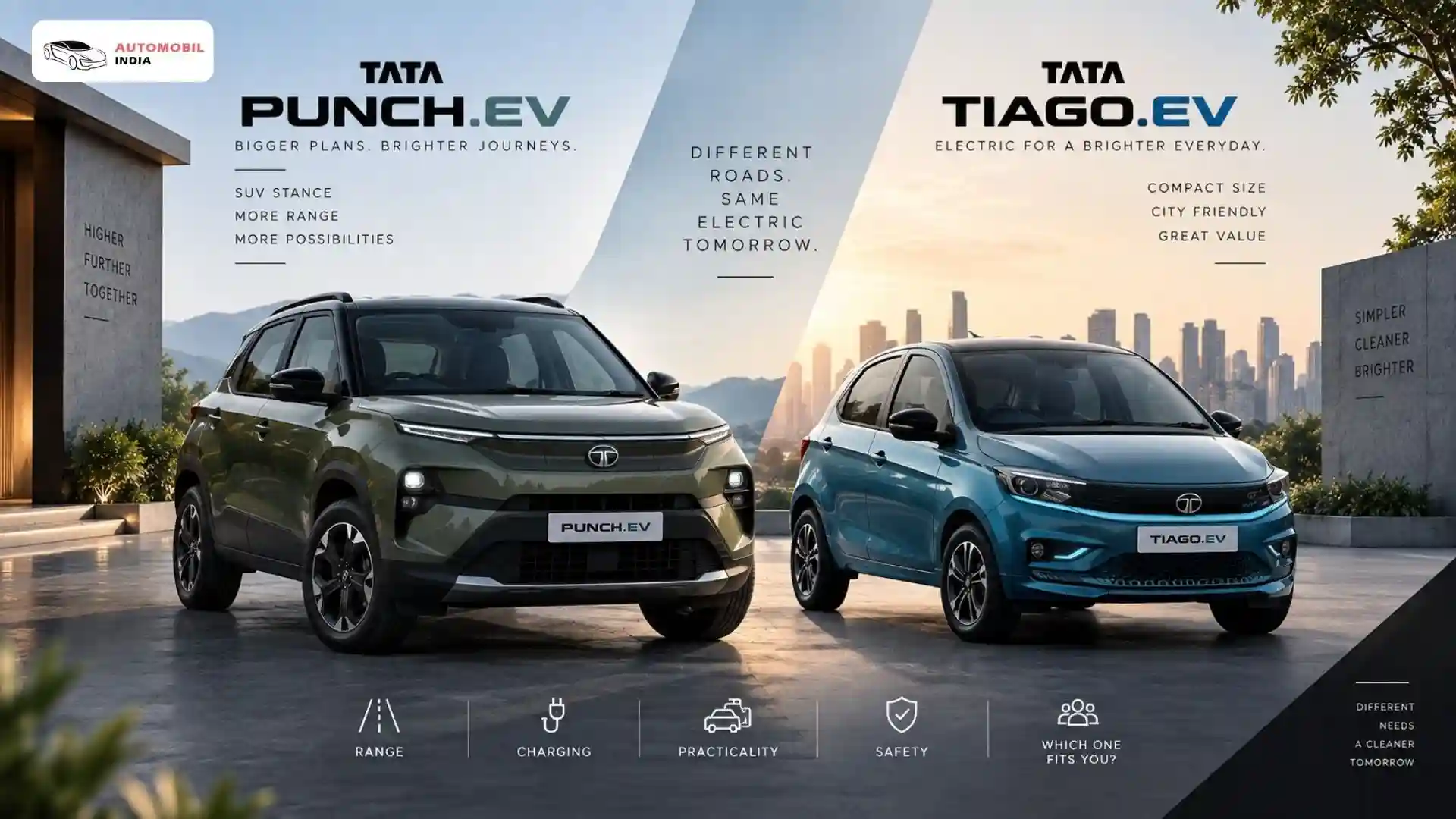
The Punch EV vs Tiago EV comparison has become more interesting in 2026. Tata Motors has updated both electric cars, but they now serve noticeably different buyers.
The Tiago EV remains Tata's more affordable electric car, starting at around ₹6.99 lakh ex-showroom. It gets 19.2kWh and 24kWh battery options, with claimed ARAI ranges of 226km and 285km respectively. The 2026 facelift also adds six airbags, a 360-degree camera, blind-spot monitoring and faster DC charging.
The Punch EV, meanwhile, has moved up considerably for 2026. It now gets 30kWh and 40kWh batteries, with an ARAI/MIDC range of 365–375km and 468km respectively. Its 40kWh version also produces 129hp and gets 65kW DC fast-charging capability. Current prices are approximately ₹9.79 lakh to ₹12.99 lakh ex-showroom.
That makes the choice relatively straightforward at first glance:
-
Tiago EV: better suited to buyers looking for an affordable city EV.
-
Punch EV: more suitable if you need greater range, more space, SUV-like ground clearance and easier highway use.
But the price gap between the two can be substantial, so it is worth understanding what you actually get for the extra money.
Punch EV vs Tiago EV: Quick Comparison
|
Factor |
Tata Punch EV |
Tata Tiago EV |
|
Current price |
~₹9.79–12.99 lakh |
₹6.99–10.09 lakh |
|
Battery options |
30kWh, 40kWh |
19.2kWh, 24kWh |
|
Claimed range |
365–375km / 468km |
226km / 285km |
|
Motor power |
88hp / 129hp |
61hp / 75hp |
|
Maximum torque |
154Nm |
110Nm / 114Nm |
|
DC charging |
Up to 65kW |
Up to 30kW |
|
DC 10–80% |
~26 min |
~35 min |
|
AC 7.2kW |
4.5h / 5.3h |
2.6h / 3.5h |
|
Length |
~3,880mm |
3,825mm |
|
Width |
1,742mm |
1,684mm |
|
Wheelbase |
2,445mm |
2,400mm |
|
Ground clearance |
~195mm |
170mm |
|
Boot space |
366 litres |
240 litres |
|
Seating |
5 |
5 |
|
6 airbags |
Standard |
Standard |
|
360-degree camera |
Higher variants |
Creative+ |
|
Body style |
Compact SUV |
Hatchback |
The specifications clearly show that the Punch EV is the larger and more capable vehicle, while the Tiago EV is designed around keeping the entry price and urban footprint lower.
Punch EV vs Tiago EV Price in India
Price is the first major difference between the two.
The updated Tiago EV starts at ₹6.99 lakh ex-showroom, with the range extending to approximately ₹10.09 lakh. It is available in Smart, Pure+ and Creative+ trims.
The current Punch EV starts at approximately ₹9.79 lakh and goes up to ₹12.99 lakh ex-showroom. It is offered in Smart, Smart+, Adventure, Empowered and Empowered+ S configurations, with six currently listed variants when battery combinations are counted separately.
Current variant pricing
Tata Tiago EV
|
Variant |
Battery |
Approx. ex-showroom price |
|
Smart |
19.2kWh |
₹6.99 lakh |
|
Pure+ |
19.2kWh |
₹8.49 lakh |
|
Pure+ |
24kWh |
₹9.49 lakh |
|
Creative+ |
24kWh |
₹9.99 lakh* |
*Current listings can differ slightly because of subsequent price revisions.
Tata Punch EV
|
Variant |
Battery |
Approx. ex-showroom price |
|
Smart |
30kWh |
₹9.79 lakh |
|
Smart+ |
30kWh |
₹10.39 lakh* |
|
Smart+ |
40kWh |
₹11.19 lakh* |
|
Adventure |
40kWh |
₹11.99 lakh* |
|
Empowered |
40kWh |
₹12.69 lakh* |
|
Empowered+ S |
40kWh |
₹12.99 lakh* |
*Current prices can vary after price revisions; Tata's current listings show the Punch EV range at ₹9.79–12.99 lakh ex-showroom.
The important point is that the Tiago EV 24kWh and Punch EV 30kWh overlap in the broader ₹9–11 lakh territory, but the Punch gives you a larger vehicle and significantly more range.
Punch EV vs Tiago EV: Battery and Range
This is the most important difference in the comparison.
Tata Tiago EV Battery Options
The Tiago EV gets:
-
19.2kWh battery
-
24kWh battery
The 19.2kWh version produces 61hp and 110Nm, while the 24kWh version produces 75hp and 114Nm.
Their ARAI-certified ranges are:
-
19.2kWh: 226km
-
24kWh: 285km
Tata's C75 real-world range estimates are approximately:
-
19.2kWh: 160–170km
-
24kWh: 205–215km
These are estimates based on Tata's C75 methodology rather than independent instrumented testing.
Tata Punch EV Battery Options
The 2026 Punch EV gets:
-
30kWh battery
-
40kWh battery
The 30kWh version produces approximately 88hp and 154Nm, while the 40kWh version produces 129hp and 154Nm.
Tata's current technical information gives:
-
30kWh: 365–375km MIDC
-
40kWh: 468km MIDC
Tata's C75 estimates are approximately:
-
30kWh: 260–275km
-
40kWh: 335–355km
What does this mean in the real world?
The difference is substantial.
A Tiago EV 24kWh is primarily a city-oriented EV. Its 205–215km C75 estimate can be sufficient for several days of urban commuting, depending on your daily distance.
The Punch EV 40kWh, with Tata's 335–355km C75 estimate, gives considerably more flexibility for longer drives and highway trips.
This does not mean the Tiago cannot travel outside the city. It means you need to plan charging more carefully.
Punch EV vs Tiago EV: Range Comparison
|
Battery |
Tata Punch EV |
Tata Tiago EV |
|
Smaller battery |
30kWh |
19.2kWh |
|
Larger battery |
40kWh |
24kWh |
|
ARAI/MIDC range |
365–375km / 468km |
226km / 285km |
|
Tata C75 estimate |
260–275km / 335–355km |
160–170km / 205–215km |
The 40kWh Punch EV has roughly 50% more battery capacity than the 24kWh Tiago EV, but its usable range is also influenced by its larger size and higher equipment/weight.
For buyers who regularly travel beyond the city, the additional range can be more valuable than the difference in peak motor output.
Punch EV vs Tiago EV: Charging Time
Charging speed is another area where the Punch EV has a significant advantage.
Tiago EV Charging
The 2026 Tiago EV supports:
3.3kW AC charger
-
19.2kWh: approximately 6.9 hours, 10–100%
-
24kWh: approximately 8.7 hours, 10–100%
7.2kW AC charger
-
19.2kWh: approximately 2.6 hours
-
24kWh: approximately 3.5 hours
30kW DC fast charger
-
10–80%: approximately 35 minutes
-
20–80%: approximately 30 minutes
Tata also says the updated Tiago EV can add around 100km of range in 18 minutes under suitable fast-charging conditions.
Punch EV Charging
The Punch EV gets considerably faster DC charging.
7.2kW AC
-
30kWh: approximately 4.5 hours, 10–100%
-
40kWh: approximately 5.3 hours, 10–100%
65kW DC
-
20–80%: approximately 26 minutes
-
10–80%: approximately 30 minutes
Tata also claims that a 15-minute DC charge can add approximately 110km on the 30kWh version and 135km on the 40kWh version.
The practical difference
The Tiago EV's smaller battery is actually convenient for home charging because it requires less energy to refill.
But the Punch EV's faster DC capability is more useful on longer trips.
So there are two different meanings of "better charging":
-
Overnight home charging: both are easy to manage.
-
Highway fast charging: Punch EV has the stronger specification.
Punch EV vs Tiago EV: Home Charging
For most EV owners, home charging matters more than DC fast charging.
If you have a dedicated parking space with a suitable electrical connection, either car can be charged overnight.
The Tiago EV has an advantage here because its smaller battery requires less energy for a full charge.
For example, a 24kWh Tiago EV requires substantially less electricity for a full recharge than a 40kWh Punch EV.
That does not necessarily mean the Tiago is cheaper to operate per kilometre because efficiency also depends on vehicle weight, driving conditions and electricity tariffs.
The better comparison is electricity cost per kilometre, not cost per full charge.
Punch EV vs Tiago EV: Real-World Range
This is where EV buyers need to be careful with ARAI figures.
A claimed 468km range does not mean a Punch EV will travel 468km in every situation.
Similarly, a Tiago EV rated at 285km will not necessarily cover 285km in real-world city and highway conditions.
Actual range depends on:
-
Average speed
-
Traffic
-
Air-conditioning use
-
Ambient temperature
-
Passenger load
-
Tyre pressure
-
Road gradient
-
Driving style
-
Use of heating/cooling
-
Battery state of charge
Tata's C75 methodology gives a more useful reference point for everyday expectations.
For the Punch EV 40kWh, Tata quotes 335–355km.
For the Tiago EV 24kWh, Tata quotes 205–215km.
For a buyer who regularly drives 70–100km a day, this difference can materially change how frequently the car needs to be charged.
Punch EV vs Tiago EV: Motor and Performance
The Punch EV has a clear numerical advantage in motor output.
Punch EV
30kWh
-
Approximately 88hp
-
154Nm
40kWh
-
129hp
-
154Nm
-
0–100km/h in approximately 9 seconds claimed
Tiago EV
19.2kWh
-
61hp
-
110Nm
24kWh
-
75hp
-
114Nm
What does this mean?
Both EVs deliver instant electric-motor response from low speed.
However, the Punch EV 40kWh has considerably more power, which becomes useful when:
-
Joining a highway
-
Overtaking
-
Carrying four or five occupants
-
Driving uphill
-
Maintaining speed with air conditioning running
The Tiago EV's lower output is less of an issue in city traffic, where speeds are generally lower.
Punch EV vs Tiago EV: Dimensions and Space
The Punch EV is a larger vehicle.
|
Dimension |
Punch EV |
Tiago EV |
|
Length |
~3,880mm |
3,825mm |
|
Width |
1,742mm |
1,684mm |
|
Height |
~1,622mm |
1,562mm |
|
Wheelbase |
2,445mm |
2,400mm |
|
Ground clearance |
~195mm |
~170mm |
|
Boot space |
366 litres |
240 litres |
|
Seating |
5 |
5 |
The Punch EV has a 45mm longer wheelbase and is approximately 58mm wider than the Tiago EV.
Those numbers don't tell the entire story, but they explain why the Punch feels more like a small SUV while the Tiago retains the proportions of a conventional hatchback.
Punch EV vs Tiago EV: Which Has More Space?
For a small family, the Punch EV is the more practical vehicle.
Its taller body and wider cabin make it easier to accommodate passengers, while the 366-litre boot is significantly larger than the Tiago EV's 240-litre luggage area.
The Tiago EV is better thought of as a compact urban hatchback.
It works well for:
-
Couples
-
Small families
-
Daily office commuting
-
City shopping
-
Short urban trips
The Punch EV is more suitable if you regularly carry:
-
Four adults
-
Children and luggage
-
Larger shopping loads
-
Weekend-trip luggage
However, neither should be treated as a large family car. The Punch EV's rear seat is usable, but the width is still compact.
Punch EV vs Tiago EV: Ground Clearance
The Punch EV has approximately 195mm of ground clearance, while the Tiago EV has around 170mm.
This matters on Indian roads.
The Punch's additional clearance can be useful when dealing with:
-
Large speed breakers
-
Broken roads
-
Uneven village roads
-
Deep potholes
-
Steep parking ramps
It is one of the practical reasons to choose the Punch EV even if your daily commute does not require the additional battery range.
Punch EV vs Tiago EV: Features
The 2026 facelift has improved the equipment levels of both cars.
Tata Punch EV Features
Depending on the variant, the Punch EV can offer:
-
10.25-inch touchscreen
-
10.25-inch digital driver's display
-
Wireless Android Auto and Apple CarPlay
-
360-degree camera
-
Blind-view monitor
-
Ventilated front seats
-
Wireless charger
-
Cruise control
-
Sunroof
-
Auto-dimming IRVM
-
Connected-car technology
-
Hill-hold and hill-descent control
-
Electronic parking brake
-
Automatic climate control
Higher variants receive the more premium features.
Tata Tiago EV Features
Depending on the variant, the updated Tiago EV offers:
-
Digital instrument cluster
-
Automatic climate control
-
8-inch touchscreen
-
10.25-inch touchscreen on Creative+
-
Wireless Android Auto and Apple CarPlay
-
360-degree camera
-
Blind-spot monitor
-
Cruise control
-
Rear AC vents
-
Cooled glovebox
-
Auto-folding ORVMs
-
Rain-sensing wipers
-
Wireless charging
-
Connected-car technology
Feature difference in simple terms
The Tiago EV is no longer a bare-bones entry-level EV.
Its Creative+ variant has a surprisingly long equipment list.
However, the Punch EV's larger cabin and higher positioning allow Tata to offer more premium features such as ventilated seats, a larger digital cockpit and a stronger overall technology package on higher variants.
Punch EV vs Tiago EV: Safety
Both cars have improved safety equipment for 2026.
Punch EV Safety
The Punch EV gets:
-
Six airbags
-
ESC
-
ABS with EBD
-
Traction control
-
ISOFIX
-
TPMS
-
Hill-hold assist
-
Hill-descent control on higher variants
-
360-degree camera on higher variants
-
Blind-view monitor on higher variants
The current 2026 Punch EV has also received a 5-star Bharat NCAP rating, scoring 31.09/32 for adult occupant protection and 45/49 for child occupant protection. The published rating applies to the variants specified by Bharat NCAP.
Tiago EV Safety
The facelifted Tiago EV now gets:
-
Six airbags
-
ABS with EBD
-
TPMS
-
ISOFIX
-
ESP/traction control on higher variants
-
360-degree camera on Creative+
-
Blind-spot monitor
-
Hill-hold control
-
Automatic headlamps
-
Rain-sensing wipers on Creative+
Tata's official Tiago EV page lists six airbags as standard and highlights the 360-degree camera and ESP with traction control.
What about the Tiago EV's crash-test rating?
The current Tiago EV does not have a published Bharat NCAP rating in the current Bharat NCAP database.
That should not be interpreted as a zero-star result. It simply means there is no current published Bharat NCAP assessment for the model.
The Punch EV therefore has a documented current Bharat NCAP result that the Tiago EV does not.
Punch EV vs Tiago EV: City Driving
This is where the Tiago EV makes the most sense.
If your daily routine looks like:
Home → office → shopping → home
and your daily distance is relatively low, the 19.2kWh Tiago EV can provide enough range without requiring you to pay for a much larger battery.
The car is smaller, easier to park and cheaper to buy.
The Punch EV becomes more relevant if your city driving includes:
-
Longer daily commutes
-
Expressways
-
Frequent airport trips
-
More passengers
-
Rough roads
-
Higher luggage requirements
Punch EV vs Tiago EV: Highway Driving
The Punch EV is better suited to regular highway use because of its larger batteries and stronger motors.
The 40kWh Punch EV has a 468km claimed range and a Tata C75 estimate of 335–355km. Its 65kW DC charging also makes highway charging considerably more practical.
The Tiago EV 24kWh has a 285km ARAI range and a C75 estimate of 205–215km.
That does not make the Tiago unsuitable for highway trips.
It simply means the trip needs more planning.
For example, on a 400km journey, a 24kWh Tiago EV is likely to require more charging stops and more careful route planning than a 40kWh Punch EV.
Punch EV vs Tiago EV: Charging Infrastructure Matters
Before buying either EV, check the charging situation around your home.
The ideal Tiago EV owner
-
Has home charging.
-
Drives mainly in the city.
-
Covers approximately 30–80km per day.
-
Has predictable daily routes.
-
Rarely drives long distances.
The ideal Punch EV owner
-
Has home charging.
-
Drives longer distances.
-
Wants to travel between cities occasionally.
-
Wants greater range flexibility.
-
Uses highways regularly.
For either car, home charging is the biggest ownership advantage.
If you cannot charge at home or work, the convenience advantage of an EV becomes considerably smaller.
Punch EV vs Tiago EV: Ownership Cost
Electric cars have fewer moving mechanical parts than internal-combustion cars, but that does not mean ownership is completely maintenance-free.
You still need to consider:
-
Tyres
-
Brake components
-
Suspension
-
12V battery
-
Insurance
-
Periodic servicing
-
Charging equipment
-
Battery warranty
-
Electricity tariff
The biggest financial advantage comes from lower energy cost per kilometre compared with petrol, assuming you can charge at a reasonable electricity rate.
Battery warranty
The 2026 Punch EV offers a lifetime battery warranty subject to Tata's terms, while Tata's current information specifies different warranty treatment depending on battery and ownership conditions.
For the Tiago EV, Tata lists a lifetime HV battery warranty for the 24kWh battery for the first owner, with the detailed terms applying; the 19.2kWh version has a different warranty structure.
Because battery warranties can have conditions around ownership, registration period, state of charge and other requirements, buyers should read the exact warranty document rather than relying only on the word "lifetime".
Punch EV vs Tiago EV: Battery-as-a-Service
Tata offers a Battery-as-a-Service (BaaS) option on these EVs.
The idea is to reduce the upfront vehicle price by separating part of the battery cost from the vehicle purchase.
For the Tiago EV, Tata introduced the scheme with the Smart 19.2kWh version, with a quoted BaaS price of ₹4.69 lakh and an additional battery usage charge of ₹2.60 per kilometre at launch.
The Punch EV also has a BaaS option, with launch pricing starting at ₹6.49 lakh and a battery usage charge from ₹2.60 per kilometre.
Is BaaS automatically cheaper?
Not necessarily.
It reduces the upfront purchase price, but you then pay a usage-linked battery charge.
A buyer should compare:
BaaS EMI + battery/km charge + electricity
against:
normal purchase EMI + electricity
over the expected ownership period.
For low-mileage users, the calculation can look different from that of a high-mileage commuter.
Punch EV vs Tiago EV: Which Battery Size Should You Buy?
Tiago EV 19.2kWh
Consider this if:
-
Your daily running is low.
-
You mostly drive within the city.
-
Your budget is tight.
-
Home charging is available.
-
You don't regularly travel between cities.
The 226km ARAI range and 160–170km C75 estimate make it primarily an urban-use configuration.
Tiago EV 24kWh
This is more suitable if:
-
You want extra range.
-
You regularly drive 50–80km per day.
-
You want the more powerful motor.
-
You occasionally travel outside the city.
Its 285km ARAI range and 205–215km C75 estimate provide more flexibility.
Punch EV 30kWh
This is relevant if:
-
You want the Punch's SUV packaging.
-
You need more range than the Tiago.
-
You don't need the maximum range version.
-
You want a relatively lower-cost entry into the Punch EV range.
Punch EV 40kWh
This is the version to examine if:
-
You travel regularly between cities.
-
Range anxiety is a major concern.
-
You want stronger performance.
-
You want faster DC charging.
-
You plan to keep the EV for several years.
Its 468km ARAI figure and 335–355km C75 estimate make it substantially more flexible for longer-distance use.
Punch EV vs Tiago EV: Key Differences at a Glance
|
Factor |
Punch EV |
Tiago EV |
|
Starting price |
~₹9.79 lakh |
₹6.99 lakh |
|
Top price |
~₹12.99 lakh |
~₹10.09 lakh |
|
Battery options |
30 / 40kWh |
19.2 / 24kWh |
|
Maximum claimed range |
468km |
285km |
|
C75 range, larger battery |
335–355km |
205–215km |
|
Maximum power |
129hp |
75hp |
|
Maximum torque |
154Nm |
114Nm |
|
DC charging |
65kW |
30kW |
|
DC 10–80% |
~26–30 min |
~35 min |
|
7.2kW AC |
4.5–5.3h |
2.6–3.5h |
|
Boot |
366L |
240L |
|
Ground clearance |
~195mm |
~170mm |
|
Wheelbase |
2,445mm |
2,400mm |
|
360° camera |
Higher variants |
Creative+ |
|
Six airbags |
Standard |
Standard |
|
Current Bharat NCAP |
5 stars |
No published result |
|
Body type |
Compact SUV |
Hatchback |
Punch EV vs Tiago EV: Which One Makes Sense?
There is no single answer for every buyer.
The Tiago EV makes more sense if:
-
Your budget is below ₹10 lakh.
-
Your driving is predominantly urban.
-
Your daily running is relatively low.
-
You have reliable home charging.
-
You rarely travel long distances.
-
You want a small car that is easy to park.
-
You want the lowest-cost entry into Tata's EV range.
The 24kWh Tiago EV is particularly interesting for buyers who want a little more range without moving into Punch EV pricing.
The Punch EV makes more sense if:
-
You can spend around ₹10–13 lakh.
-
You want significantly more range.
-
You frequently drive outside the city.
-
You need more cabin and boot space.
-
You want greater ground clearance.
-
You want stronger acceleration.
-
You value its current 5-star Bharat NCAP rating.
-
You want faster DC charging.
If you are comparing the top Tiago with the base Punch
This is probably the most important buying decision.
A top-spec Tiago EV 24kWh can approach the lower end of Punch EV pricing.
At that point, you need to decide whether you value:
More features in a smaller car
or
More range, space and SUV practicality.
Punch EV vs Tiago EV: Final Takeaway
The Punch EV vs Tiago EV comparison is not really about choosing between two versions of the same car.
The Tiago EV is primarily an affordable urban EV. Its smaller battery packs keep the purchase price lower, while its compact dimensions make it easy to use in crowded cities. The 24kWh version's 285km ARAI range and approximately 205–215km C75 estimate are enough for many daily commuters.
The Punch EV is positioned one step higher. Its 30kWh and 40kWh batteries, up to 468km claimed range, 129hp motor and 65kW DC charging give it significantly more flexibility. Tata's C75 estimate of 335–355km for the 40kWh version also makes it more suitable for buyers who occasionally undertake longer trips.
The Punch EV also provides a larger 366-litre boot, greater ground clearance and a more SUV-like seating position.
For a city commuter on a tighter budget, the Tiago EV can be sufficient.
For someone who wants an EV that can handle daily commuting plus occasional highway travel, the Punch EV's additional range and charging capability become more relevant.
The most important question before buying either car is therefore not just "How much range does it have?"
It is:
"How much do I drive every day, where can I charge, and how often do I travel beyond the city?"
Answer those three questions and the appropriate battery size—and possibly the appropriate car—becomes much easier to identify.
Disclaimer
Prices, specifications, range figures, charging times, features and variant availability can change. ARAI/MIDC figures are certified test-cycle figures, while Tata C75 figures are manufacturer estimates and actual range will vary with driving conditions, traffic, temperature, load and driving style. Always confirm the latest price, equipment, battery warranty and charging specifications with Tata Motors before purchasing.