

A severe road collision, an unexpected engine fire, or a waterlogged parking level can instantly transform a cherished vehicle into an insurance claim document. At that critical juncture, the single financial metric that dictates whether an owner receives sufficient funds for replacement or faces a major personal deficit is frequently ignored during policy renewals: the insured value of the automobile.
Referred to in India as the Insured Declared Value, or IDV, this figure silently defines the absolute payout limit for major damage and dictates if an automobile gets repaired, declared a write-off, or fully substituted. Understanding this mechanism is vital, as correct valuation far outweighs saving minimal amounts on annual premiums.

Understanding Insured Value and Why It Matters
The insured value represents the upper limit an insurer will disburse if a vehicle suffers total destruction or theft. This is distinct from showroom pricing or resale market evaluations, operating instead as a formula-calculated figure that decreases annually. The calculation takes the manufacturer's listed retail price and applies age-based depreciation according to guidelines set by the Insurance Regulatory and Development Authority of India (IRDAI). Aftermarket equipment is included only when explicitly declared, and once finalized, the amount remains locked for the duration of the policy period.
To demonstrate how depreciation impacts a vehicle with an initial ex-showroom cost of Rs 10 lakh, the valuation scales downward systematically over time. Insured value serves a dual purpose by dictating both the ongoing premium expenditure and the maximum financial settlement possible following an accident. Many policyholders prioritize the former while completely ignoring the latter until an emergency occurs.
Procedures Following Significant Vehicle Damage
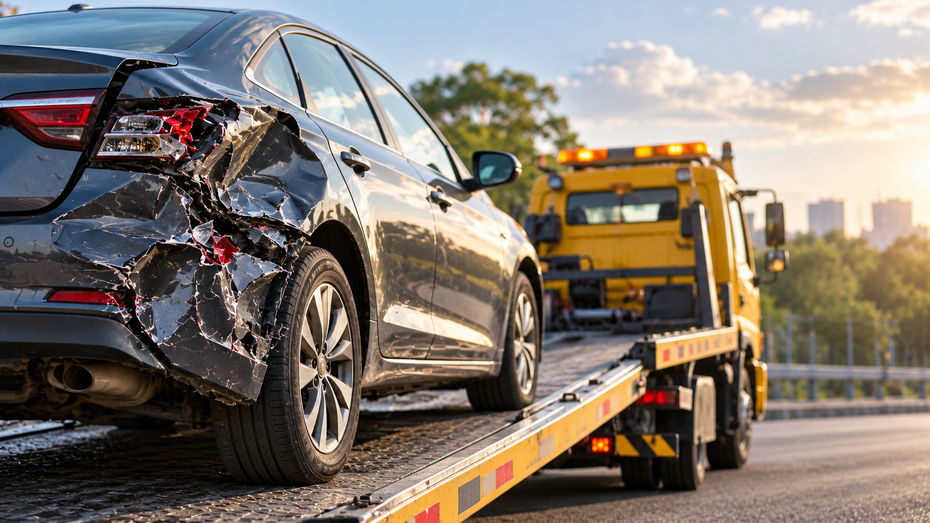
Following a towing incident, claims adjust according to standard procedures where an authorized surveyor evaluates the physical condition piece by piece. This assessment concludes in one of two distinct categories:

- It's repairable (partial loss): The car heads to the workshop, parts are fixed or swapped, and the insurer pays the bill minus parts depreciation, the compulsory deductible and anything excluded. You eventually get your car back.
- It's not worth fixing (constructive total loss): The car is written off. No repairs, just a lump-sum payout, and you're back to car shopping.
Write-offs also entail administrative obligations under Section 55 of the Motor Vehicles Act, 1988, requiring owners to notify the registering Regional Transport Authority within 14 days to revoke the registration certificate. The ultimate settlement figure and vehicle classification derive directly from the declared IDV stated in the insurance documentation.
The Role of Insured Value in Total Loss Settlements
During a total loss claim, the IDV transforms from a policy administrative entry into an actual settlement cheque. A vehicle is classified as a constructive total loss when repair expenses surpass 75 per cent of the IDV, with the settlement equating to the agreed IDV minus the applicable deductible. Additional depreciation is not deducted at this stage, though the earlier depreciation schedule has already reduced the base IDV.
Because IDV establishes both the threshold for a write-off and the maximum claim disbursement, a vehicle insured for Rs 6 lakh is written off once restoration costs reach Rs 4.5 lakh, restricting the owner's maximum recovery to Rs 6 lakh regardless of current market replacement costs. This discrepancy explains the purpose of the Return to Invoice (RTI) add-on, which covers the original invoice price along with initial registration fees and road tax if the automobile is stolen or written off.
Financial Risks of Selecting Reduced Insured Values
Opting for a reduced IDV during renewal generates an immediate drop in premium quotations, but the financial penalty materializes only if the vehicle is stolen or destroyed. For instance, considering a three-year-old Maruti Suzuki Swift VXi originally purchased for Rs 7 lakh, applying a 30 percent depreciation reduction results in a standard IDV of Rs 4,90,000.
| Scenario | Standard IDV | Reduced IDV |
|---|---|---|
| Maximum payout in total loss or theft | Rs 4,90,000 (in line with market value) | Rs 4,00,000 (lowered to save premium) |
Saving Rs 2,000 on the premium by artificially dropping the IDV to Rs 4,000,000 creates a substantial Rs 90,000 shortfall during a total loss claim. Owners must cover this deficit from personal funds or risk failing to clear existing auto loans on a vehicle that no longer exists. Conversely, establishing an IDV significantly higher than market reality increases premium costs without providing extra benefits and can provoke disputes during claim processing. Maintaining an IDV that accurately reflects the true market worth of the automobile offers the most reliable outcome.