Larger liquid-cooled single-cylinder engine should produce around 25bhp
Expected Rs. 2 lakh to Rs. 2.30 lakh pricing puts the RC 200 firmly in sight
Yamaha fans eagerly prepare 27 August 2026 as YZF-R2 prepares for its first appearance for the Indian market. Pre-bookings have already started through select dealerships, as we reported earlier, although Yamaha has kept the final motorcycle unusually well hidden. Its price has not been announced but our previous estimate places it between Rs. 2 lakh and Rs. 2.30 lakh, ex-showroom.
R2 is not expected to replace the R15. Instead, it should provide the performance step that many R15 owners have wanted for years without requiring them to jump directly into a more expensive motorcycle. Yamaha’s current official Indian online motorcycle range still lists the R15 V4, R15M and R15S but no R3, leaving a sizeable gap above the 155cc supersport.
Performance Step Up
Looks at the R15 V4 itself, it provides the obvious starting point with its 155cc liquid-cooled single-cylinder engine producing near 18bhp at 10,000rpm and 14.2Nm at 7,500rpm for a supersport. It is also equipped with Variable Valve Actuation, traction control and even a quickshifter. Now the R2 is expected to move to a newly developed, larger-capacity liquid-cooled single-cylinder engine. We expect displacement to sit around the 200cc mark with output in the region of 25bhp and torque close to 20Nm.
The nature of the engine will matter just as much as its peak figures. R15 has always been a high-revving single that rewards the rider for being peaky. The VVA supports the R15’s useful low- and mid-range torque while retaining pull at higher revs. Whether a similar system appears on the R2 remains unconfirmed, but preserving that free-revving character will be important for Yamaha India.
Efficiency will matter too. One of the reasons a 200cc-class R2 makes sense instead of a 300cc single is that it can provide a noticeable performance increase without becoming expensive to run. This will still be a motorcycle likely to spend weekdays commuting through traffic before being ridden hard on weekends.
Chassis Will Have a Difficult Job
The R15 already sets a high chassis benchmark for the R2 to follow. The light and rigid Deltabox frame is combined with upside-down front forks and a linked Monocross rear suspension for genuinely very sharp handling characteristics. The whole thing weighs a light 141kg and has 170mm of ground clearance as well. Braking comes from a 282mm front disc and 220mm rear disc.
Simply fitting the larger engine into something that behaves exactly like the R15 may not be enough. Even if Yamaha retains the Deltabox philosophy, the R2 is likely to require revisions around engine mounting, frame rigidity, suspension calibration and braking to deal with its additional performance.
The tyres will hold a lot of importance here. R15 already uses a 100/80-17 front and a 140/70-17 radial rear. A wider front tyre and perhaps a 150-section rear would give the R2 a larger footprint, although Yamaha has not confirmed either. A larger front brake disc would also be a logical upgrade if performance rises to the expected level.
Keeping weight under control will become one of the R2’s biggest strengths. The rivals aren’t particularly heavy either. KTM’s RC 200 weighs 160kg and uses a 43mm WP Apex upside-down fork, an adjustable rear monoshock, a 320mm front disc and a split-trellis frame.
R2 will have to be, therefore, be notably lighter while producing comparable power. The resulting power-to-weight ratio and direction-changing ability could become more important than power output.
Design Should Look like an R, Not an R15 Facelift
The design is another area where expectations will be high. Yamaha has still not published final official images and specifications of the production R2, so any detailed description before the unveiling should be treated cautiously.
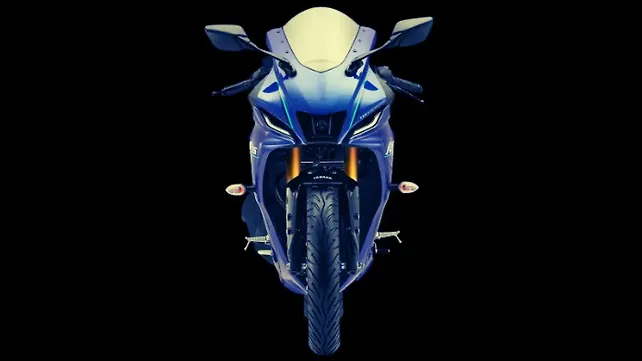
What can reasonably be expected is a continuation of Yamaha’s established R-DNA. The R15 V4 introduced an M1-inspired central intake with a single LED headlamp recessed inside it and slim position lamps spreading towards either side. Yamaha designed the arrangement to give the motorcycle the visual presence of a bigger supersport while maintaining a small frontal area.
The R2 needs to evolve this theme rather than simply enlarge it. A slightly broader fairing, more substantial fuel tank, stronger tail section and greater visual mass would help separate it from the cheaper R15. The motorcycle also needs to look convincingly more expensive when both are standing together in a dealership.
That is particularly important because Yamaha buyers attach considerable value to the R-series identity. When Yamaha introduced the current R15 generation, it said the model had built a strong following among younger riders and university students looking for a higher-quality performance product. The company has also historically positioned the R15 as a gateway to the experience and styling associated with the R1.
The R2 will inherit those expectations. Customers are unlikely to judge it purely by horsepower. Paint quality, switchgear, instrumentation, lighting and the overall finish need to justify its position above an already polished R15.
Pricing Decider
The expected Rs. 2 lakh to Rs. 2.30 lakh price band puts Yamaha into one of the more interesting areas of India’s sports motorcycle market.
The KTM RC 200 currently costs Rs. 2,14,721 ex-showroom Delhi. Its 199.5cc liquid-cooled engine produces near 24bhp and 19.2Nm. And it is backed by decent hardware, like 43mm WP Apex USD forks, 320mm front brake and Supermoto ABS. It is the most obvious target for the R2.
Then there is the Hero Karizma XMR. It starts at Rs. 1,86,644 in Delhi and uses a 210cc liquid-cooled engine producing about 25bhp and 20.4Nm. This too comes packed with a slip-and-assist clutch, dual-channel ABS, 320mm front disc and a TFT display with more than 35 functions.
Suzuki has the Gixxer SF 250 in the picture costing Rs. 1,92,768 in Delhi and produces 26bhp and 22.2Nm from its 249cc oil-cooled single. It weighs 161kg and offers more displacement for less than Rs. 2 lakh. It is also very reliable as well.
That means the Yamaha cannot rely on its badge alone.
At around Rs. 2 lakh, the R2 could be extremely compelling. At Rs. 2.30 lakh, buyers will reasonably ask why they should pay substantially more than a Karizma XMR or Gixxer SF 250. Yamaha’s answer will need to come through chassis quality, engine character, low weight, equipment and the riding experience.
Buyer is likely to be young, already interested in sport motorcycles and perhaps upgrading from an R15, MT-15 or another 150-200cc bike. Some will want their first motorcycle that can comfortably sustain highway speeds, while others will be looking for something suitable for weekend cornering or occasional track use without moving into 300-400cc ownership costs.
Yamaha itself recognised this aspiration when developing earlier R15 generations. The company noted that younger Indian customers were increasingly interested in stepping up to more sophisticated motorcycles while still requiring city usability. That thinking is arguably even more relevant today.
The R2 therefore carries unusually high expectations for a relatively small motorcycle. It has to be faster than the R15 without losing its lightness, more premium without becoming too expensive and focused enough to wear an R badge while remaining practical for everyday India.