Buying a car with savings is not the only option for Indian buyers. A car loan in India can spread the purchase cost across monthly EMIs, but the headline interest rate is only one part of the actual cost. Processing fees, insurance and registration funding, down payment, loan tenure, foreclosure terms and other charges can significantly change what you eventually pay.
The right way to compare a car loan is therefore not simply to ask, “Which lender has the lowest interest rate?” Instead, buyers should compare the total borrowing cost, EMI, upfront contribution, repayment flexibility and foreclosure conditions.
Car Loan in India: Key Points at a Glance
| Factor | What buyers should know |
|---|---|
| Loan amount | Depends on vehicle price, lender policy and borrower eligibility |
| Down payment | Your upfront contribution towards the vehicle purchase |
| Interest rate | Can be fixed or floating depending on the loan product |
| EMI | Monthly repayment combining principal and interest |
| Tenure | Longer tenure reduces EMI but generally increases total interest |
| Processing fee | Additional cost charged by the lender |
| Foreclosure | Closing the outstanding loan before the scheduled end |
| Part-prepayment | Paying additional money towards the outstanding principal |
| Credit profile | Can influence eligibility and the rate offered |
| Documentation | Usually includes identity, address, income and vehicle-related documents |
RBI rules require lenders to provide important loan-cost information, and borrowers should examine the Key Facts Statement and applicable charges rather than relying only on an advertised interest rate.
What Is a Car Loan?
A car loan is a form of vehicle finance in which a lender provides money towards the purchase of a new or used car. The borrower repays the amount through scheduled EMIs over an agreed tenure.
Depending on the lender and product, the loan may cover some or most of the vehicle’s eligible cost. However, the buyer normally needs to contribute some amount from their own funds, particularly towards the down payment and expenses that may not be financed.
The exact structure varies between banks and NBFCs.
What Does the Bank Actually Pay For?
The financed amount can depend on:
- Ex-showroom price
- On-road price
- Registration and road tax
- Insurance
- Accessories or other eligible charges
- Lender-specific financing limits
Do not assume that every component of your on-road price will automatically be financed. Ask the lender for the exact sanctioned amount before finalising the purchase.
How Does a Car Loan Work?
The process is relatively straightforward:
- Select the car and obtain its on-road price.
- Decide how much you want to pay upfront.
- Apply for financing with a bank or NBFC.
- The lender evaluates your income, credit profile and repayment capacity.
- The lender communicates the interest rate, tenure, fees and other conditions.
- After approval and completion of documentation, the loan is disbursed according to the lender’s process.
- You repay the loan through monthly EMIs.
Your actual interest rate and loan terms can vary according to your financial profile and the lender’s risk assessment.
How Is Car Loan EMI Calculated?
The standard EMI calculation uses the loan principal, interest rate and tenure.
The formula is:
EMI = P × R × (1 + R)ⁿ / [(1 + R)ⁿ − 1]
Where:
- P = principal loan amount
- R = monthly interest rate
- n = number of monthly instalments
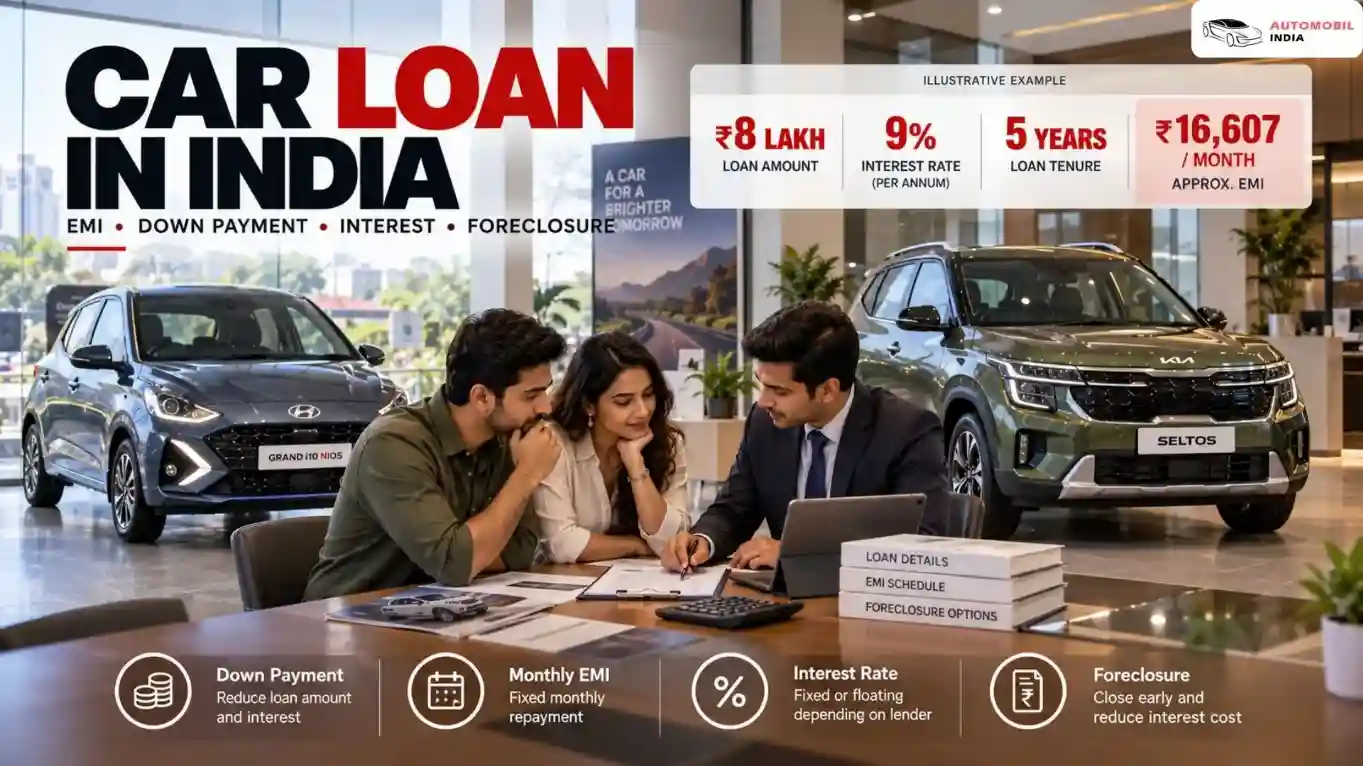
Example: ₹8 Lakh Car Loan
Suppose you borrow ₹8 lakh at 9% annual interest for five years.
The approximate EMI would be ₹16,607 per month.
Over 60 months:
- Total EMI payments: approximately ₹9.96 lakh
- Approximate interest paid: ₹1.96 lakh
This is an illustration, not a quote from a lender. Processing fees, taxes, insurance and other charges can increase the actual cost of borrowing.
Why Tenure Matters
Consider the same ₹8 lakh loan at 9%:
| Tenure | Approx. EMI | Approx. Total Interest |
|---|---|---|
| 3 years | ₹25,443 | ₹1.16 lakh |
| 5 years | ₹16,607 | ₹1.96 lakh |
| 7 years | ₹12,867 | ₹2.81 lakh |
The longer tenure substantially reduces the monthly EMI, but it also increases the total interest paid.
Practical takeaway: Choose the shortest tenure that keeps the EMI comfortably affordable rather than choosing a long tenure solely because its monthly payment looks attractive.
How Much Down Payment Should You Make?
There is no universal down-payment percentage that works for every buyer.
A larger down payment reduces the amount borrowed, which generally means:
- Lower EMI
- Lower total interest
- Smaller outstanding loan balance
- Less financial leverage
However, putting every available rupee into the car is not necessarily sensible either.
A buyer should also account for:
- Emergency savings
- Insurance
- Registration and taxes
- Existing EMIs
- Household expenses
- Maintenance and fuel costs
- Other short-term financial commitments
Example
For a car with an on-road price of ₹10 lakh:
Option A — ₹2 lakh down payment
Loan = ₹8 lakh
Option B — ₹3 lakh down payment
Loan = ₹7 lakh
At the same interest rate and tenure, Option B will have a lower EMI and lower total interest.
The important question is whether the additional ₹1 lakh paid upfront leaves you with enough financial liquidity.
What Is a Good Car Loan Interest Rate in India?
There is no single interest rate that can be called the best for every borrower.
Lenders can price loans differently depending on factors such as:
- Credit history
- Income
- Employment profile
- Loan amount
- Vehicle
- Tenure
- Existing relationship with the lender
- Internal risk assessment
- Promotional offers
For example, SBI currently displays several lending rates and product rates on its website, while its published material for auto loans highlights features such as daily reducing-balance interest and specific prepayment conditions. The exact rate available to an individual borrower still depends on the applicable product and eligibility.
Therefore, comparing only the advertised “starting from” rate can be misleading.
Compare APR and Total Cost
RBI guidance has emphasised transparent disclosure of the annualised cost of credit and key loan terms. A borrower should therefore examine the APR/annualised cost, processing charges and other applicable fees alongside the nominal interest rate.
Fixed vs Floating Car Loan Interest Rate
Before signing the agreement, check whether your loan is fixed or floating.
Fixed Interest Rate
With a fixed-rate loan, the interest rate generally remains fixed for the agreed period or entire tenure according to the contract.
Advantages:
- Easier EMI planning
- Protection from benchmark-rate increases
- Predictable repayment structure
Potential drawback:
- The borrower may not automatically benefit if market lending rates fall.
Floating Interest Rate
A floating-rate loan can change according to the applicable benchmark and lender’s terms.
This means your EMI, tenure or both can potentially change.
For applicable floating-rate EMI-based personal loans, RBI requires regulated entities to communicate the possible impact of rate resets and provide specified options, including changes to EMI/tenure and prepayment; the rules also address switching to fixed rates according to the lender’s policy.
Important: Do not assume that every car loan is governed by exactly the same floating-rate rules. Check the specific product documentation.
What Is Foreclosure of a Car Loan?
Foreclosure means paying off the outstanding loan before the original repayment schedule ends.
For example, suppose you take a five-year car loan but decide to close it after three years using your savings. The lender calculates the outstanding principal and any applicable charges, after which the loan is closed.
Foreclosure can reduce the amount of future interest you would otherwise pay, but you must compare that saving against any applicable foreclosure charges and the amount you need to pay immediately.
What Should You Check Before Foreclosure?
Ask the lender for:
- Outstanding principal
- Accrued interest
- Foreclosure charges, if applicable
- GST or applicable taxes on charges
- Any other administrative fee
- Loan closure procedure
- Documentation required after closure
Do not calculate the benefit using the original loan amount. After several years of EMIs, the outstanding principal will be lower.
Are Foreclosure Charges Allowed on Car Loans?
This is an area where buyers need to distinguish between fixed and floating-rate loans and the applicable regulatory framework.
RBI’s responsible-lending framework states that banks and NBFCs are not permitted to levy foreclosure or prepayment penalties on floating-rate term loans sanctioned to individual borrowers for purposes other than business.
However, this does not mean that every car loan can automatically be closed without charges. Fixed-rate products can have contractual foreclosure or prepayment conditions, and the specific loan agreement remains important.
For example, SBI’s published auto-loan information states that its car loan has nil prepayment charges and no foreclosure charges after two years, subject to its applicable terms.
What Is Part-Prepayment?
Part-prepayment means paying an additional amount towards your outstanding loan without completely closing it.
For example, if you receive a ₹1 lakh bonus while your car loan is running, you could potentially use some of that money to reduce the principal, subject to your lender’s terms.
Depending on the loan structure, reducing principal can lower the future interest burden.
Before making a part-payment, ask whether the lender allows it and whether any charges or minimum amounts apply.
Car Loan vs Paying Cash: What Should You Consider?
The choice is not simply about whether you have enough cash to buy the car.
Paying Cash
Potential advantages:
- No loan interest
- No EMI
- No lender-related charges
- No foreclosure considerations
Potential disadvantage:
- A large amount of savings becomes tied up in a depreciating asset.
Taking a Loan
Potential advantages:
- Preserves some cash liquidity
- Spreads the purchase cost over time
- Can make a more expensive car affordable within a monthly budget
Potential disadvantages:
- Interest cost
- Processing and other charges
- Monthly financial commitment
- Possible foreclosure restrictions depending on the loan
For many buyers, the decision should come down to liquidity versus borrowing cost, rather than simply choosing whichever option produces the lowest immediate outflow.
How Your Credit Score Can Affect a Car Loan
Your credit history is one factor lenders may consider while assessing a loan application.
A stronger credit profile can improve the chances of approval and may help a borrower access more competitive terms, although lenders use their own eligibility and risk-assessment models.
Before applying for multiple loans:
- Check your credit report.
- Correct inaccurate information if present.
- Avoid unnecessary applications.
- Keep existing credit obligations under control.
- Compare offers rather than accepting the first approval.
A pre-approved offer from your existing bank can be convenient, but it should still be compared with alternatives on total cost.
Documents Usually Required for a Car Loan
The exact documentation varies between lenders and borrower categories, but applicants may be asked for:
Salaried Applicants
- Identity proof
- Address proof
- PAN
- Salary slips
- Bank statements
- Employment-related information
Self-Employed Applicants
Additional financial documents may include:
- Income-tax returns
- Business or financial statements
- Bank statements
- Business proof
- GST-related documents where applicable
The lender may request additional documentation based on its internal requirements.
New Car Loan vs Used Car Loan
A new-car loan and used-car loan are not necessarily priced or structured identically.
| Factor | New Car | Used Car |
|---|---|---|
| Vehicle age | New | Pre-owned |
| Valuation | Generally straightforward | Depends on vehicle condition, age and valuation |
| Interest rate | Depends on lender/product | Can differ from new-car finance |
| Loan tenure | Often longer | Often shorter |
| Down payment | Product-dependent | May be higher depending on lender |
| Documentation | Standard vehicle documents | Additional ownership/valuation checks may apply |
When financing a used car, don’t compare only the EMI. Consider the vehicle’s age, expected maintenance, insurance, resale value and remaining useful life.
How to Compare Two Car Loans
Suppose Bank A offers a slightly lower interest rate but charges a higher processing fee, while Bank B offers a marginally higher rate but has lower fees and more flexible foreclosure terms.
Bank A isn’t automatically cheaper.
Compare these factors together:
| Factor | What to Check |
|---|---|
| Interest rate | Fixed or floating? |
| APR | Overall annualised borrowing cost |
| Processing fee | Percentage or fixed amount |
| Documentation charges | Amount and taxes |
| Loan tenure | 3, 5, 7 years etc. |
| Foreclosure | Charges and lock-in period |
| Part-prepayment | Allowed? Any minimum amount? |
| Late-payment charges | Amount and conditions |
| EMI | Monthly repayment |
| Total repayment | Principal + interest + applicable charges |
RBI’s KFS framework is intended to make key loan information clearer to borrowers, so read the document before accepting the loan.
How to Reduce the Total Cost of a Car Loan
1. Make a sensible down payment
Borrowing less generally means paying less interest.
2. Avoid unnecessarily long tenures
A seven-year loan may make a car appear affordable because of the lower EMI, but the cumulative interest can be substantially higher.
3. Compare multiple lenders
Check banks and NBFCs rather than automatically accepting dealer-arranged financing.
4. Negotiate the complete package
Don’t negotiate only the interest rate. Ask about processing fees, documentation fees and other charges.
5. Understand foreclosure conditions before signing
If you expect to receive bonuses or other large cash inflows, repayment flexibility may matter.
6. Don’t stretch your budget because of a low EMI
A car’s cost doesn’t end with the loan.
You also need to budget for:
- Fuel or charging
- Insurance renewal
- Scheduled servicing
- Tyres
- Repairs
- Parking
- Tolls
- Accessories
- Registration-related costs
What Is the Ideal Car Loan Tenure?
There is no universal ideal tenure.
A shorter tenure generally means:
- Higher EMI
- Lower total interest
A longer tenure generally means:
- Lower EMI
- Higher total interest
For a buyer with stable income and sufficient monthly surplus, a shorter tenure can reduce the financing cost. A longer tenure may make sense when maintaining monthly cash flow is more important.
The key is to avoid choosing a tenure that makes the EMI appear affordable while leaving too little room for unexpected expenses.
Should You Take a Car Loan for the Maximum Eligible Amount?
Not necessarily.
The maximum amount a lender is willing to provide is not the same as the amount you should borrow.
Your personal budget should consider:
Car EMI + existing EMIs + household expenses + insurance + running costs + savings requirements
before deciding the loan amount.
A financially comfortable car is one whose total ownership cost fits your budget, not simply one for which the bank approves the financing.
Car Loan in India: Common Mistakes to Avoid
Focusing only on the interest rate
A lower advertised rate can be offset by fees and other conditions.
Choosing the longest tenure automatically
Lower EMI does not mean lower overall cost.
Ignoring foreclosure conditions
If you expect to repay early, read these clauses before signing.
Financing unnecessary add-ons
Accessories, insurance packages and other products should be evaluated separately rather than automatically added to the loan.
Not reading the Key Facts Statement
The KFS and sanction documents can contain important information about APR, charges and repayment terms.
Borrowing based on the maximum approval
Loan eligibility is not a recommendation of how much you should spend.
Frequently Asked Questions
1. What is a car loan in India?
A car loan is financing provided by a bank or NBFC to help a customer purchase a new or used vehicle, with repayment generally made through scheduled EMIs.
2. How is car loan EMI calculated?
EMI depends mainly on the loan amount, interest rate and repayment tenure. A higher loan amount or interest rate increases the EMI, while extending the tenure generally reduces the monthly payment but increases total interest.
3. Is a higher down payment always better?
Not necessarily. A higher down payment reduces borrowing and interest, but buyers should retain adequate emergency savings and funds for other expenses.
4. Can I foreclose my car loan early?
Yes, subject to the terms of your loan. Check the outstanding principal, applicable charges and closure procedure before making the payment.
5. Are car loan foreclosure charges always applicable?
No. The applicable rules depend on factors including the loan’s interest structure and lender/product terms. RBI restrictions apply to certain floating-rate term loans to individual borrowers, while fixed-rate loans can have contractual prepayment conditions.
6. Is a five-year or seven-year car loan better?
Neither is universally better. Five years generally results in a higher EMI but lower total interest than seven years for the same principal and rate. The suitable tenure depends on the buyer’s cash flow.
7. Can I make a part-prepayment on a car loan?
It depends on the lender and loan agreement. Check whether part-prepayment is permitted, along with any minimum amount and applicable charges.
8. Does credit score affect car loan eligibility?
Credit history can be one factor in a lender’s assessment of the application, along with income, repayment capacity and other eligibility criteria.
9. Should I compare car loans from banks and NBFCs?
Yes. Comparing lenders can help you understand differences in interest rates, fees, tenure, repayment flexibility and foreclosure conditions.
10. What should I check before signing a car loan?
Check the interest type, interest rate, APR, EMI, tenure, processing fees, other charges, foreclosure terms, part-prepayment rules, late-payment charges and the complete repayment schedule.
Final Takeaway
A car loan can make vehicle ownership easier to manage, but the cheapest-looking EMI is not necessarily the cheapest financing option.
When comparing a car loan in India, look beyond the monthly payment. Calculate the total repayment, examine the interest structure, understand the down payment requirement, check all fees and read the foreclosure and prepayment conditions.
For most buyers, the practical objective should be simple: borrow an amount that comfortably fits the household budget, choose a manageable tenure and understand the complete cost before signing the loan agreement.