
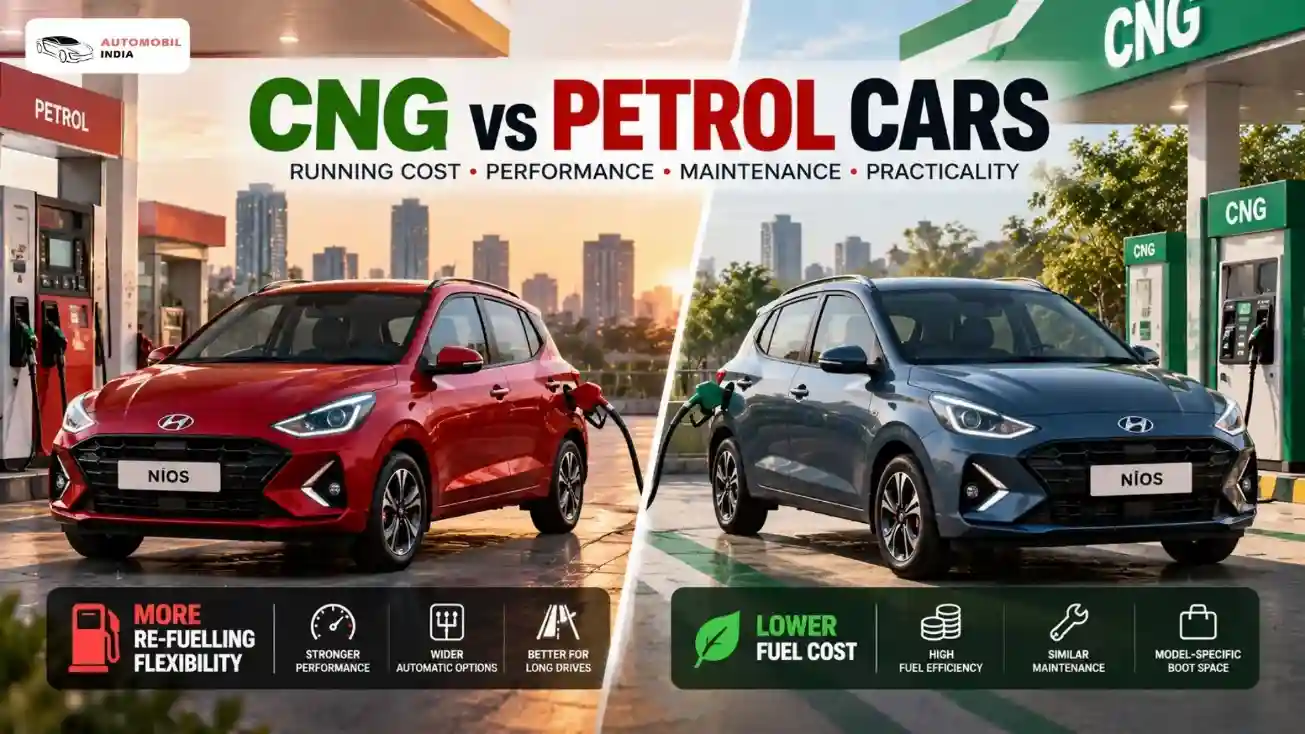
If you are buying a new car in India and drive regularly, the choice between CNG and petrol can have a noticeable impact on your monthly fuel bill, performance, boot space and ownership experience.
A CNG car generally makes more financial sense for buyers with high annual running and convenient access to CNG stations, while a petrol car can be more practical for drivers who prioritise stronger performance, automatic transmission choices, easier refuelling and unrestricted long-distance travel.
The right choice ultimately depends on how much you drive, where you drive and whether a CNG station is convenient along your regular routes.
CNG vs Petrol Cars: Quick Comparison
| Factor | CNG Car | Petrol Car |
|---|---|---|
| Fuel cost per km | Generally lower | Generally higher |
| Purchase price | Usually higher than equivalent petrol version | Usually lower |
| Fuel efficiency | Typically high when measured in km/kg | Typically high in km/l |
| Performance | Usually slightly lower on CNG | Generally stronger |
| Refuelling | CNG stations required | Petrol stations are widely available |
| Boot space | Can be reduced, depending on tank design | Usually unaffected |
| Automatic options | More limited | Much wider choice |
| Long-distance flexibility | Depends on CNG network | Generally better |
| Maintenance | Similar basic servicing, but CNG-specific components require attention | Conventional petrol maintenance |
| Best suited for | High-mileage city users | Mixed-use and lower-mileage users |
These are general differences; the exact experience varies between models.
CNG vs Petrol Car: Which Should You Choose?
Choose CNG if you:
- Drive a high number of kilometres every month.
- Have a CNG station conveniently located near your home or workplace.
- Mainly drive in urban areas.
- Want to reduce fuel expenditure.
- Are comfortable with slightly different performance characteristics.
- Can accept model-specific compromises in boot space or transmission choices.
Choose petrol if you:
- Drive relatively few kilometres annually.
- Frequently travel to places where CNG availability is uncertain.
- Want stronger performance and quicker highway acceleration.
- Prefer an automatic gearbox.
- Want maximum flexibility when planning road trips.
- Do not want to pay the additional upfront cost of a CNG variant.
The fuel-cost advantage of CNG becomes more meaningful as annual kilometres increase. However, buyers should calculate the payback period rather than assuming CNG is automatically cheaper overall.
CNG vs Petrol Car Price: Does CNG Cost More?
In most model line-ups, the CNG version costs more than the equivalent petrol version because of the additional CNG fuel system and associated factory engineering.
That means the purchase-price difference is an important part of the calculation.
For example, if a CNG variant costs substantially more but the car is driven only a few thousand kilometres annually, it can take a long time for fuel savings to recover the additional upfront expenditure.
For a high-mileage user, however, the equation changes.
How to calculate your CNG payback period
Use:
Annual fuel cost = Annual kilometres ÷ Real-world efficiency × Fuel price
Then:
Annual CNG saving = Petrol annual fuel cost − CNG annual fuel cost
Finally:
Payback period = Additional CNG purchase cost ÷ Annual CNG saving
This is more useful than comparing claimed mileage figures alone.
Fuel prices also vary between cities and can change over time, so buyers should use their local petrol and CNG prices when calculating the actual saving. Recent fuel-price reporting continues to show differences between cities in Maharashtra and elsewhere.
CNG vs Petrol Car Mileage: What Should You Expect?
One of the biggest reasons buyers consider CNG is fuel efficiency.
CNG mileage is normally expressed in km/kg, while petrol efficiency is expressed in km/l. These numbers cannot be directly compared as if they were the same unit.
More importantly, manufacturer-claimed efficiency and real-world efficiency are different things.
Your actual mileage can vary depending on:
- Traffic conditions
- Air-conditioning usage
- Vehicle load
- Tyre pressure
- Driving style
- Road gradients
- Average speed
- Frequency of stop-and-go driving
- Quality and availability of fuel
For example, a CNG car that performs exceptionally well in a controlled efficiency test may return a considerably different figure in heavy urban traffic.
Why CNG can reduce running costs
The important number is not simply mileage. It is cost per kilometre.
A useful comparison is:
Petrol cost/km = Petrol price ÷ petrol mileage
CNG cost/km = CNG price ÷ CNG mileage
This gives a much clearer picture of the financial difference between the two fuels.
CNG vs Petrol Car Features: Are CNG Cars Less Equipped?
Not necessarily.
Factory-fitted CNG cars can offer many of the same features available on petrol variants, depending on the manufacturer and trim level.
For example, Hyundai currently offers petrol/CNG versions of models such as the Exter and Grand i10 Nios, while Maruti Suzuki’s S-CNG range spans multiple segments.
However, variant availability matters.
A manufacturer may offer a particular feature or transmission on petrol but not on CNG. This is particularly relevant when looking for:
- Automatic transmissions
- Higher-end infotainment systems
- Turbocharged engines
- Premium variants
- ADAS or advanced driver-assistance features
- Performance-oriented versions
Therefore, don’t compare only the fuel type. Compare the exact variants you are considering.
CNG vs Petrol Car Specifications: What Changes?
The underlying petrol engine may be shared between the two versions, but the CNG variant adds a separate fuel system.
A factory-developed CNG car typically incorporates:
- CNG cylinder(s)
- Fuel lines
- Pressure regulation hardware
- Gas injectors
- Dedicated control calibration
- Fuel-selection hardware
- Additional safety systems
Manufacturers also have to account for the additional weight of the CNG system.
Maruti Suzuki says its S-CNG vehicles use an intelligent injection system and receive specific chassis, suspension and braking changes to account for the CNG system. The company also says its CNG vehicles are tested with the CNG system installed.
This is one reason factory-fitted CNG is preferable to an unapproved aftermarket installation when buying a new car.
Performance: CNG vs Petrol
This is where petrol generally has an advantage.
A CNG powertrain can feel less responsive than the same engine running on petrol, particularly during:
- Overtaking
- Steep climbs
- Highway acceleration
- Fully loaded driving
- Quick acceleration from low speeds
The difference varies considerably by engine and calibration.
For normal urban commuting, the performance difference may not be particularly important. But if you regularly drive on highways with four or five occupants and luggage, petrol’s stronger response can be useful.
Does CNG damage the engine?
A factory-fitted CNG vehicle is engineered and calibrated to operate on CNG.
That does not mean maintenance can be ignored.
Manufacturers specify maintenance requirements and precautions for their CNG systems. Hyundai, for example, warns owners not to tamper with the CNG system and says the CNG cylinder should be inspected through an approved testing agency at the required interval.
The important distinction is between a properly engineered factory-fitted system and an improperly installed or modified system.
CNG vs Petrol Car Maintenance
Both fuel types require routine maintenance, but CNG vehicles have additional fuel-system components that need attention.
Typical servicing still involves items such as:
- Engine oil
- Oil filter
- Air filter
- Brake components
- Coolant
- Tyres
- Battery
- Suspension components
CNG vehicles additionally have CNG-specific components and inspection requirements.
Hyundai’s warranty documentation, for example, makes proper maintenance and servicing according to the owner’s manual a condition of warranty coverage.
Is CNG maintenance more expensive?
There is no universal answer.
Routine service costs depend on the specific model, manufacturer, service interval and parts required. A CNG car may require additional checks, but its lower fuel cost can still make overall running costs attractive for a high-mileage owner.
The correct comparison is therefore:
rather than simply asking which fuel has the cheaper service bill.
Boot Space: An Important CNG Compromise
The CNG cylinder traditionally occupies space that could otherwise be used for luggage.
This can matter considerably for families.
A conventional petrol car normally gives you the full luggage compartment, while CNG models may have reduced or differently configured boot space.
However, manufacturers are working around this limitation.
Hyundai’s newer Hy-CNG Duo system uses two smaller cylinders rather than one larger cylinder and places the spare wheel underneath the vehicle on models such as the Exter. Hyundai says this arrangement is designed to preserve usable luggage space.
This means buyers should no longer assume that every CNG car has the same boot-space penalty.
What to check before buying
Don’t rely solely on the specification sheet.
Take your:
- Large suitcase
- Office bag
- Shopping bags
- Child-related luggage, if applicable
and check whether they can actually fit around the CNG hardware.
CNG Refuelling vs Petrol Refuelling
Petrol has a major convenience advantage: its refuelling infrastructure is widespread across India.
CNG availability has improved substantially, but it remains more dependent on location and route.
Before buying a CNG car, check:
- The nearest CNG station to your home.
- The nearest station to your workplace.
- CNG availability on your regular highway routes.
- Whether stations frequently experience queues.
- Whether there are reliable stations in places you regularly visit.
A CNG car can be financially attractive but inconvenient if you regularly have to make a long detour just to refuel.
CNG vs Petrol for City Driving
For a person commuting every day through a major Indian city, CNG can make strong financial sense when fuel availability is convenient.
Stop-and-go traffic increases fuel consumption in any ICE vehicle, so reducing the cost per kilometre can become valuable over a long period.
This is particularly relevant for:
- Daily office commuters
- Taxi operators
- Ride-hailing drivers
- Sales professionals
- Frequent city travellers
- High-mileage families
For a person driving only occasionally, the additional purchase cost of the CNG model may be harder to justify.
CNG vs Petrol for Highway Driving
Petrol is generally easier for long-distance touring because refuelling options are more widespread.
CNG can still work well for highway trips when the route has adequate CNG infrastructure.
The bigger consideration is planning.
A petrol driver can generally refuel at many more locations, whereas a CNG driver may need to plan around available stations.
CNG’s lower running cost can therefore come with a small logistical trade-off.
CNG vs Petrol: Safety Considerations
Modern factory-fitted CNG vehicles incorporate dedicated safety systems and are engineered around the fuel system.
Maruti Suzuki, for example, describes stainless-steel fuel lines and joints, integrated wiring, automatic fuel switching and a micro-switch designed to prevent engine operation during CNG refuelling in its S-CNG technology.
However, safe ownership still depends on proper maintenance.
CNG owners should:
- Never modify the factory CNG system.
- Use authorised service facilities.
- Follow cylinder inspection requirements.
- Never use domestic LPG or other unauthorised gases as vehicle fuel.
- Follow manufacturer instructions regarding refuelling and parking.
- Address any unusual smell or suspected leak immediately.
Hyundai’s owner documentation specifically warns against tampering with the CNG system and using domestic CNG/LPG-related alternatives.
CNG vs Petrol Car Comparison: Which Is Better for Different Buyers?
There is no single answer for every buyer.
| Buyer requirement | More suitable fuel type |
|---|---|
| Low annual running | Petrol |
| High annual running | CNG |
| Frequent city commuting | CNG can make sense |
| Frequent highway touring | Petrol offers greater refuelling flexibility |
| Lowest fuel cost per km | CNG generally has an advantage |
| Stronger performance | Petrol |
| More automatic gearbox choices | Petrol |
| Maximum boot flexibility | Petrol, depending on model |
| Easy refuelling everywhere | Petrol |
| Daily taxi/commercial usage | CNG can be financially attractive |
| Occasional weekend use | Petrol |
These are general buyer-use cases rather than a ranking of the two technologies.
How Much Do You Need to Drive for CNG to Make Sense?
This depends on three things:
1. Price difference between petrol and CNG variants
The larger the initial premium, the longer the payback period.
2. Local fuel prices
CNG and petrol prices vary by location.
3. Real-world efficiency
Claimed mileage should not be treated as guaranteed real-world mileage.
For example, consider a hypothetical car that costs ₹1 lakh more in CNG form. If your fuel savings amount to ₹3,000 per month, the simple fuel-only payback would be roughly 33 months.
But if you drive very little, that period becomes much longer.
This is why annual kilometres driven are more important than the headline mileage figure.
CNG vs Petrol Car: Ownership Checklist
Before buying a CNG car, ask yourself:
1. How many kilometres do I drive?
If your annual running is low, petrol’s lower initial price may be more attractive.
2. Is there a CNG station near me?
Convenience matters almost as much as fuel price.
3. Do I travel outside cities frequently?
If yes, map the CNG stations along your usual routes.
4. Do I need an automatic?
Check whether the exact CNG variant offers the transmission you want.
5. How much boot space do I need?
Inspect the actual car rather than relying only on brochure specifications.
6. Am I buying factory-fitted CNG?
For a new car, factory-fitted systems offer an integrated engineering and warranty package. Maruti Suzuki explicitly highlights its factory integration, testing and warranty support for its S-CNG models.
7. How long will I keep the car?
A buyer keeping the car for several years may have more opportunity to recover the additional upfront cost through fuel savings.
CNG vs Petrol Car: Final Takeaway
The CNG vs petrol car decision is fundamentally a calculation between upfront cost, running cost and convenience.
CNG is particularly relevant for high-mileage urban users who have easy access to CNG and are willing to accept model-specific compromises in performance, boot space or transmission choice.
Petrol remains the simpler choice for buyers who drive less, travel extensively, want stronger performance or need the widest refuelling and automatic-transmission flexibility.
The best way to decide is to calculate your expected five-year fuel cost, add the purchase-price difference and consider how convenient CNG refuelling will be for your actual routes.
Frequently Asked Questions
Is CNG cheaper than petrol for daily driving?
CNG generally has a lower fuel cost per kilometre than petrol, but the actual saving depends on local fuel prices, real-world mileage and how efficiently the vehicle operates.
Is a CNG car worth buying for low mileage?
It may not be. If you drive only a small number of kilometres each year, the higher purchase price of a CNG variant can take longer to recover through fuel savings.
Does CNG reduce car performance?
CNG can produce a different performance response compared with petrol, and some vehicles feel less responsive when running on CNG, particularly under heavy loads or during highway acceleration.
Does a CNG car have higher maintenance costs?
Not necessarily in every case. Routine servicing remains model-dependent, although CNG vehicles have additional fuel-system components and inspection requirements.
Do CNG cars have less boot space?
Often, yes, because the CNG cylinder system can occupy luggage space. However, newer systems such as Hyundai’s dual-cylinder arrangement are designed to reduce this compromise on certain models.
Is factory-fitted CNG safer than an aftermarket kit?
A factory-fitted system is designed, calibrated and tested as part of the vehicle. Manufacturers also provide specific warranty and service support for their factory-fitted systems.
Can I drive a CNG car only on petrol?
Factory-fitted bi-fuel cars are designed to operate on both fuels, with the exact operating strategy depending on the manufacturer and model.
Is CNG better for highway driving?
It can be economical for highway driving where CNG stations are readily available. Petrol offers greater refuelling flexibility, particularly on routes with limited CNG infrastructure.
How do I calculate CNG running cost?
Divide the CNG price per kg by the car’s real-world km/kg figure. For example, if CNG costs ₹80/kg and the car returns 25 km/kg, the fuel cost is approximately ₹3.20 per km.
Should I buy a CNG or petrol car?
Consider annual running, local fuel prices, CNG-station availability, required performance, boot-space needs and transmission preference. High-mileage urban users may benefit more from CNG, while lower-mileage or frequent long-distance users may find petrol more convenient.