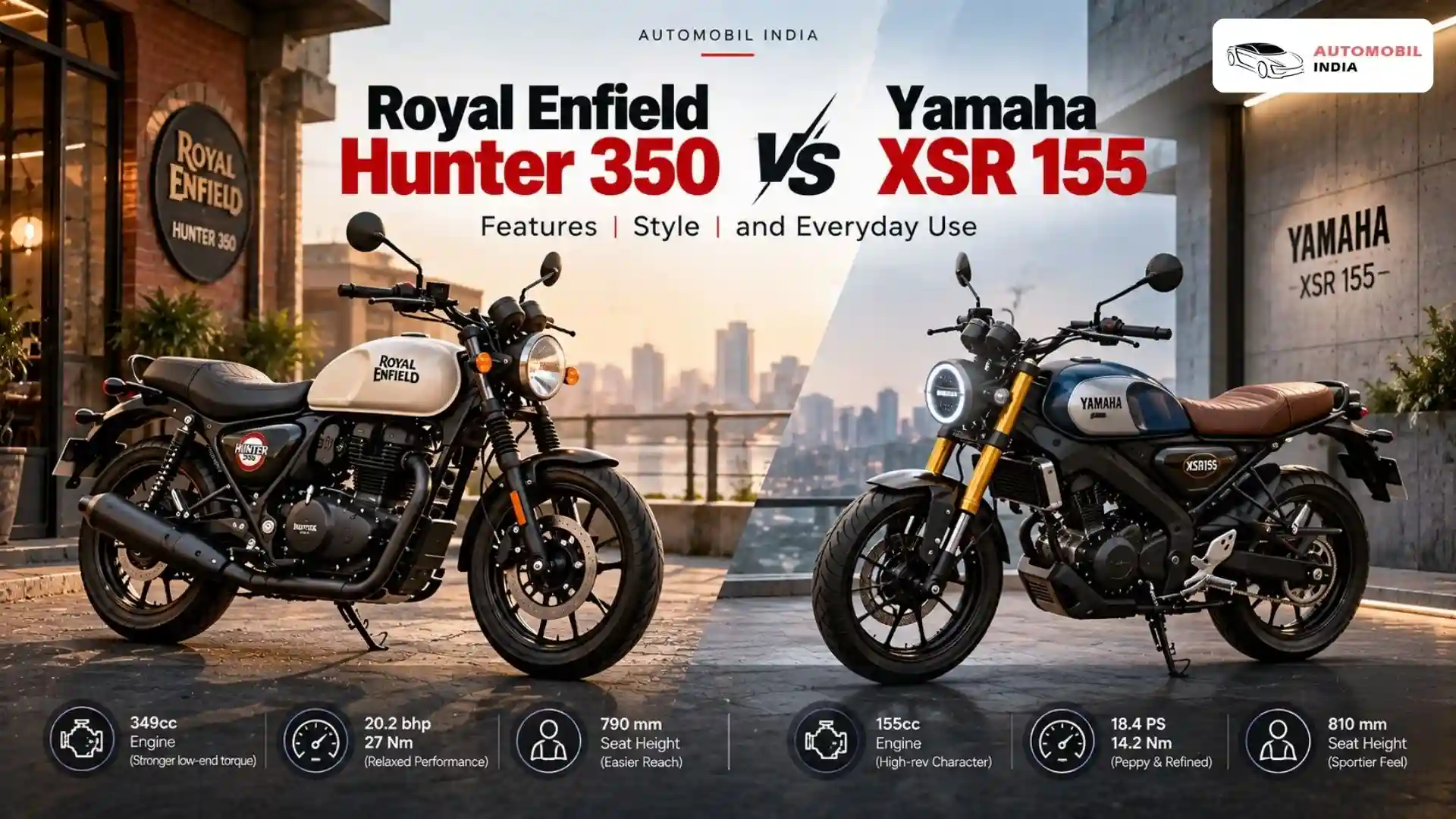
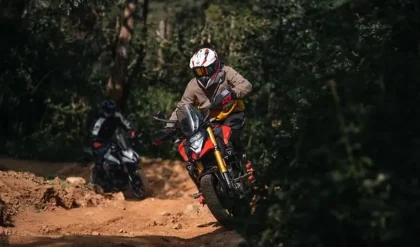
The Royal Enfield Hunter 350 and Yamaha XSR155 take different approaches to the modern-retro roadster formula. The Hunter uses a larger 349cc single-cylinder engine producing 20.2 bhp and 27 Nm, while the XSR155 uses a 155cc liquid-cooled engine producing 18.4 PS and 14.2 Nm.
The difference is significant in how the motorcycles are intended to be used. The Hunter 350 emphasises a larger-capacity, relaxed roadster experience, while the XSR155 combines retro styling with a lighter 137kg chassis, a six-speed gearbox, VVA and traction control.
For Indian buyers, the decision is therefore less about simply comparing engine sizes and more about weight, performance character, city manoeuvrability, features, comfort, fuel economy and the type of riding you expect to do.
Hunter 350 vs XSR 155 Price
The Yamaha XSR155 is currently listed at around ₹1.50 lakh ex-showroom, with a single Standard variant. Autocar India’s September 2026 listing puts its on-road price at roughly ₹1.63 lakh–₹1.82 lakh depending on the city.
Royal Enfield’s current Hunter 350 pricing varies by specification and location. Its official website currently shows the Hunter from around ₹1.51 lakh on the Chennai pricing page, while the manufacturer’s city listings show different prices for individual colour/variant combinations.
Motorcycle
Starting ex-showroom price*
Variants
Royal Enfield Hunter 350
Around ₹1.51 lakh
Multiple equipment/colour combinations
Yamaha XSR155
Around ₹1.50 lakh
1 Standard
*Prices vary by city, variant and applicable updates. Confirm the final quotation with the manufacturer/dealer before booking.
The similar starting prices make the Hunter 350 vs XSR 155 comparison particularly interesting, because buyers are choosing between very different mechanical packages for broadly similar entry pricing.
Hunter 350 vs XSR 155: Engine and Performance
This is the biggest mechanical difference between the two motorcycles.
Specification
Royal Enfield Hunter 350
Yamaha XSR155
Engine
349cc, single-cylinder
155cc, single-cylinder
Cooling
Air-oil cooled
Liquid cooled
Valve setup
—
SOHC, 4-valve
Maximum power
20.2 bhp @ 6,100 rpm
18.4 PS @ 10,000 rpm
Maximum torque
27 Nm @ 4,000 rpm
14.2 Nm @ 7,500 rpm
Gearbox
5-speed
6-speed
Fuel system
EFI
Fuel injection
VVA
No
Yes
Traction control
No
Yes
The Hunter’s 349cc engine produces substantially more torque, and that torque arrives at a much lower engine speed. That characteristic is useful when pulling away from traffic, carrying a passenger or riding at relaxed speeds without constantly shifting gears.
The XSR155 takes a different approach. Its smaller engine revs much higher, uses Yamaha’s Variable Valve Actuation system and is paired with a six-speed gearbox. Its peak power figure is close to the Hunter’s despite having less than half the displacement.
In practical terms, the XSR155’s engine is more performance-oriented in its delivery, while the Hunter’s larger engine is designed around stronger low- and mid-range torque.
Hunter 350 vs XSR 155 Specifications
The physical differences are just as important as the engine specifications.
Specification
Hunter 350
XSR155
Length
2,055 mm
2,005 mm
Width
810 mm
805 mm
Height
1,070 mm
1,080 mm
Wheelbase
1,370 mm
1,325 mm
Seat height
790 mm
810 mm
Ground clearance
160 mm
120 mm
Kerb weight
181 kg*
137 kg
Fuel tank
13 litres
10 litres
Front wheel
17-inch
17-inch
Rear wheel
17-inch
17-inch
*Royal Enfield’s current website lists 181kg for the Hunter’s technical specification, while its detailed technical PDF can vary by variant. Always check the exact variant specification.
The 44kg difference in listed kerb weight is one of the most noticeable numbers in this comparison. The XSR155’s lower weight can make low-speed manoeuvring, parking and quick changes of direction easier.
The Hunter counters with a lower seat height and substantially more ground clearance. Its 790mm seat is 20mm lower than the XSR155’s 810mm seat, which can be relevant for riders who are concerned about reach to the ground.
The XSR155’s 120mm ground clearance also needs to be considered on Indian roads with tall speed breakers and rough surfaces.
Which Is Easier to Ride in City Traffic?
Both motorcycles can work as urban roadsters, but they create different riding experiences.
Hunter 350
The Hunter has a relatively short 1,370mm wheelbase and Royal Enfield specifically describes its compact geometry as being suited to city manoeuvring. The 2026 model also receives an assist-and-slip clutch and revised suspension aimed at improving everyday usability.
The downside is weight. At around 181kg, it requires more effort to move around manually when parking or manoeuvring at very low speeds.
XSR155
The XSR155 weighs just 137kg according to current specifications. That is a substantial advantage when pushing the motorcycle into a parking space, making U-turns or filtering through slow traffic.
However, the 810mm seat is taller and the ground clearance is lower than the Hunter’s.
For a rider who values low weight and quick urban manoeuvrability, the XSR155’s dimensions are particularly relevant. For someone who wants lower seat height, greater ground clearance and a stronger low-speed torque character, the Hunter’s specification has different advantages.
Hunter 350 vs XSR 155: Comfort and Everyday Usability
The latest Hunter 350 received a revised suspension setup and a new seat with additional cushioning. Royal Enfield says these changes were made to improve comfort, particularly on uneven roads.
The XSR155 uses a Deltabox chassis with telescopic front suspension and a link-type rear suspension. Its compact dimensions and low weight make it easy to handle, although the taller seat and relatively low ground clearance are factors worth checking during a test ride.
For Indian buyers, the best way to assess comfort is not simply to compare suspension specifications. A test ride should include:
Speed breakers
Broken urban roads
Tight U-turns
Stop-and-go traffic
A short highway stretch
Riding with a pillion, if applicable
Seat height, handlebar reach, suspension response and your own riding posture can make a bigger difference than a specification sheet suggests.
Hunter 350 vs XSR 155 Features
The two motorcycles also differ considerably in technology.
Hunter 350 Features
The 2026 Hunter 350 offers features including:
LED headlamp
Digi-analogue instrument cluster
Tripper navigation pod
USB Type-C fast charging
Assist-and-slip clutch
Dual-channel ABS
17-inch wheels
Adjustable rear suspension preload
Royal Enfield lists these features on the current Hunter specification, although equipment can vary by variant.
Yamaha XSR155 Features
The XSR155 brings a different technology package:
LED headlight
LED tail lamp
Digital instrument cluster
VVA
Six-speed gearbox
Y-Connect smartphone connectivity
Traction control
Liquid-cooled engine
Deltabox frame
Yamaha’s official specification specifically lists VVA, Y-Connect and traction control for the XSR155.
This means the Hunter 350 vs XSR 155 features comparison isn’t simply about which motorcycle has more equipment. The two manufacturers have prioritised different types of technology.
Comparing the Hunter 350 and XSR155 for your budget?
Get in touch and we’ll help you compare on-road prices and variant equipment before you plan your test rides.
The Hunter 350’s current specification lists dual-channel ABS, with a 300mm front disc and 270mm rear disc.
The XSR155’s India specification includes traction control, which Yamaha says is designed to reduce the chance of wheelspin on slippery or loose surfaces. Current specification data lists disc brakes at both ends.
These systems serve different purposes:
ABS: Helps prevent wheel lock during braking.
Traction control: Helps manage rear-wheel slip during acceleration.
Neither system eliminates the need for appropriate speed and riding technique.
Hunter 350 vs XSR 155 Mileage
Fuel economy is difficult to compare directly without equivalent independent testing.
Royal Enfield states that the Hunter 350 can return 36.2 kmpl under ideal road and environmental conditions. The company explicitly qualifies this figure, so it should not be treated as guaranteed everyday mileage.
For the XSR155, Autocar India’s current specification page lists tested fuel economy of 50.31 kmpl in the city and 51.7 kmpl on the highway, although these figures come from that publication’s test conditions rather than Yamaha’s claimed figure.
Mileage reference
Hunter 350
XSR155
Manufacturer figure
36.2 kmpl*
—
Independent tested figure
—
50.31 kmpl city / 51.7 kmpl highway**
*Royal Enfield figure under ideal road/environmental conditions. **Autocar India test figures; test conditions differ from manufacturer claims.
The XSR155 therefore has a clear specification and test-data advantage for buyers who place a high priority on fuel economy, although actual mileage will vary with traffic, speed, riding style and maintenance.
Hunter 350 vs XSR 155 Styling
Both motorcycles use retro-inspired styling, but the design execution is different.
The Hunter 350 combines Royal Enfield’s traditional visual identity with a compact roadster silhouette. Its relatively short proportions, rounded elements and exposed mechanical character give it a distinctly modern-retro appearance.
The XSR155 follows Yamaha’s Sport Heritage design direction. It uses a sculpted fuel tank, round lighting elements and a tuck-and-roll-style seat, combining retro cues with the underlying technology of Yamaha’s modern 155cc platform.
The choice here is largely subjective, so buyers should compare the actual motorcycles rather than relying only on photographs.
Hunter 350 vs XSR 155: Highway Use
The Hunter’s larger engine and 27Nm torque output make it naturally suited to relaxed highway riding. Its 13-litre fuel tank is also larger than the XSR155’s 10-litre tank.
The XSR155 has a smaller engine but benefits from a six-speed gearbox, low weight and a high-revving engine. It can therefore be a capable highway motorcycle, but its riding character is different.
For frequent two-up highway use, the Hunter’s higher torque output may be more relevant. For solo riders who value low weight and efficiency, the XSR155’s package offers a different set of advantages.
Hunter 350 vs XSR 155: Variants
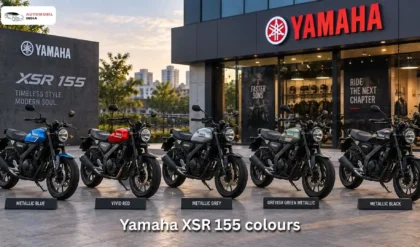
The Yamaha XSR155 is currently offered in one Standard variant in India.
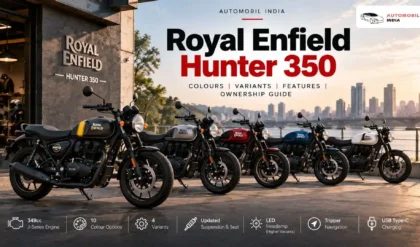
The Hunter 350 has a broader equipment and colour structure, with Royal Enfield offering different configurations and colourways. The manufacturer’s current website lists 10 colour options, while equipment can vary according to variant.
This gives the Hunter buyer more scope to choose a particular equipment and styling combination.
Hunter 350 vs XSR 155: Key Differences
Factor
Hunter 350
XSR155
Engine character
Larger, torque-focused
Smaller, high-revving
Displacement
349cc
155cc
Power
20.2 bhp
18.4 PS
Torque
27 Nm
14.2 Nm
Gearbox
5-speed
6-speed
Weight
181 kg*
137 kg
Seat height
790 mm
810 mm
Ground clearance
160 mm
120 mm
Fuel tank
13 litres
10 litres
Mileage reference
36.2 kmpl claimed*
50.31/51.7 kmpl tested**
ABS
Dual-channel
ABS-equipped; current specification should be checked by variant/market
Traction control
No
Yes
Navigation
Tripper pod
Y-Connect smartphone connectivity
Charging
USB Type-C
—
Variants
Multiple
Single Standard
*Royal Enfield figures/specifications. **Autocar India test figures.
Which Motorcycle Suits Which Type of Rider?
Rather than choosing an arbitrary overall winner, the documented differences point towards different use cases.
Hunter 350 May Suit You If:
You want a larger-capacity roadster.
Strong low- and mid-range torque matters to you.
You prefer a lower 790mm seat.
You frequently encounter rough roads and speed breakers.
You want dual-channel ABS.
You prefer Royal Enfield’s larger-bike character.
You plan occasional highway or two-up riding.
XSR155 May Suit You If:
Low kerb weight is a major priority.
You want a high-revving 155cc engine.
Fuel efficiency matters significantly.
You prefer a six-speed gearbox.
You want traction control and VVA.
You prefer Yamaha’s Sport Heritage styling.
You frequently manoeuvre the motorcycle in tight urban spaces.
These are not absolute rules. Rider height, experience, road conditions and personal preferences can change which characteristics matter most.
Which Is Easier to Own in India?
Ownership costs depend on factors such as purchase price, insurance, servicing, fuel consumption, tyres, riding habits and depreciation.
The XSR155’s smaller engine and higher observed fuel economy could be relevant for riders covering large monthly distances. Its 137kg weight can also make everyday handling easier.
The Hunter 350’s larger engine means greater fuel consumption should be expected compared with a smaller 155cc motorcycle, but its simpler roadster philosophy and established 350cc platform appeal to buyers seeking a different ownership experience.
The most useful comparison is therefore not just the monthly EMI. Buyers should calculate:
Hunter 350 vs XSR 155: What Should You Check Before Buying?
A test ride should answer questions that specifications cannot.
1. Can You Comfortably Manage the Weight?
The Hunter is substantially heavier than the XSR155. Try reversing and parking both motorcycles yourself.
2. Can You Comfortably Reach the Ground?
The Hunter’s 790mm seat is lower, while the XSR155 has an 810mm seat.
3. Which Engine Character Do You Prefer?
Ride both motorcycles through slow traffic and then onto an open road. The difference between 27Nm and 14.2Nm is noticeable in the way each motorcycle delivers acceleration.
4. Do You Need More Ground Clearance?
If your daily route includes large speed breakers or poor roads, the Hunter’s 160mm claimed ground clearance versus the XSR155’s 120mm is worth considering.
5. Which Technology Is Actually Useful to You?
Don’t pay more for features you will rarely use. Decide whether Tripper navigation and USB-C or VVA, Y-Connect and traction control are more relevant to your riding.
Ready to compare both motorcycles back to back?
Get an insurance quote alongside the on-road price for each bike, so you can compare the complete cost before your test rides.
The Hunter produces 20.2 bhp and 27 Nm, while the XSR155 produces 18.4 PS and 14.2 Nm. Their power figures are relatively close, but the Hunter has substantially more torque.
Which has better mileage, Hunter 350 or XSR155?
The available figures point to the XSR155 being more fuel-efficient. Royal Enfield claims 36.2 kmpl for the Hunter under ideal conditions, while Autocar India recorded 50.31 kmpl in the city and 51.7 kmpl on the highway with the XSR155. These figures were obtained under different conditions and should not be treated as a direct laboratory comparison.
Which is lighter, Hunter 350 or XSR155?
The XSR155 is substantially lighter, with a listed kerb weight of 137kg compared with around 181kg for the current Hunter specification.
Which has the lower seat height?
The Hunter 350 has a 790mm seat height, while the XSR155 has an 810mm seat height.
Which has more ground clearance?
The Hunter 350 has 160mm of listed ground clearance, compared with 120mm for the XSR155.
Does the XSR155 have traction control?
Yes. Yamaha lists a traction control system as part of the XSR155’s equipment.
Does the Hunter 350 have navigation?
The 2026 Hunter 350 gets a digi-analogue instrument cluster with a Tripper navigation pod on the relevant specification.
Which has more gears?
The XSR155 has a six-speed manual gearbox, while the Hunter 350 uses a five-speed gearbox.
Is the XSR155 available in multiple variants?
Current Indian listings show the XSR155 in a single Standard variant.
Are the Hunter 350 and XSR155 direct engine-size competitors?
Not exactly. Both are modern-retro roadsters that overlap in price, but their engine capacities, weights, performance characteristics and equipment philosophies are substantially different. Buyers should compare the motorcycles based on intended use rather than engine displacement alone.
This article is based on information available from Royal Enfield, Yamaha and cited automotive sources at the time of publication. Prices, variants, specifications, features, colours and equipment may change and can vary by location. Manufacturer-claimed mileage and independent test figures are not directly interchangeable. Buyers should confirm the latest price, variant equipment and availability with an authorised dealer before making a purchase.
Ashish Ahire is an automobile content writer with an interest in the automotive industry, new vehicle launches, automotive technology, and the latest developments in the mobility sector. Through his articles, he aims to present automobile news and updates in a clear, informative, and reader-friendly manner.