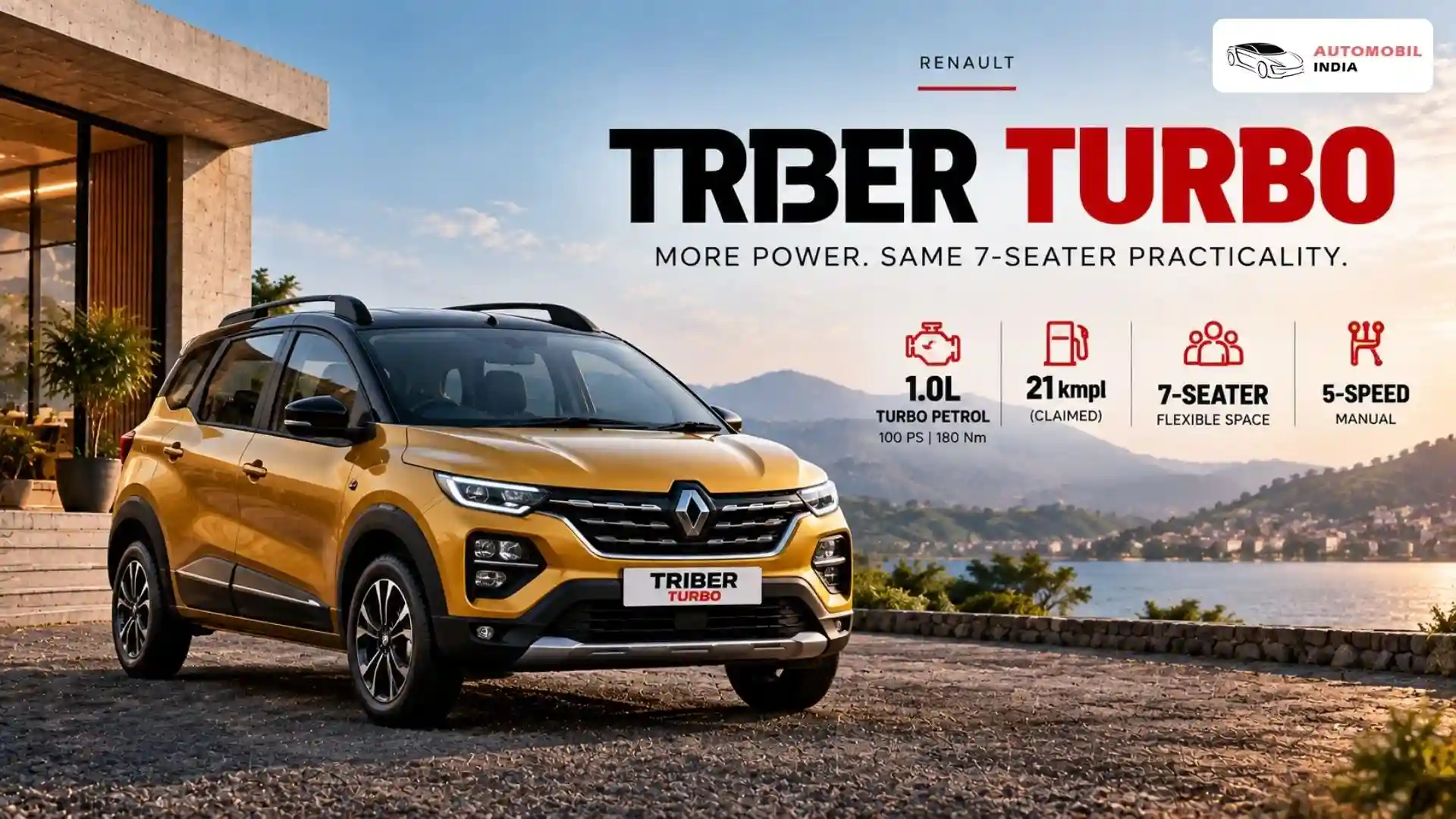
Renault has launched the Triber Turbo in India at an introductory starting price of ₹7.84 lakh ex-showroom. The new version gets a 1.0-litre three-cylinder turbo-petrol engine producing 100 PS and 180 Nm, paired initially with a 5-speed manual gearbox. Renault claims a certified fuel efficiency of 21 kmpl.
The turbo-petrol engine is offered in Evolution, Techno and Emotion variants, with prices extending up to ₹8.99 lakh ex-showroom. The entry-level Authentic variant does not get the turbo engine.
Renault Triber Turbo Price and Variants
The Renault Triber Turbo is available in three variants. All prices are introductory and ex-showroom.
Variant
Engine
Transmission
Price
Triber Turbo Evolution
1.0L Turbo Petrol
5-speed MT
₹7.84 lakh
Triber Turbo Techno
1.0L Turbo Petrol
5-speed MT
₹8.53 lakh
Triber Turbo Emotion
1.0L Turbo Petrol
5-speed MT
₹8.99 lakh
The turbo engine is currently available only with a 5-speed manual gearbox. Renault has not launched an automatic version of the turbo powertrain at this stage.
The turbo variants therefore sit above the naturally aspirated Triber in price, with the additional cost primarily going towards the more powerful engine and associated mechanical upgrades.
What Is New on the Renault Triber Turbo?
The biggest change is under the bonnet. Renault has added its 1.0-litre TCe turbo-petrol engine, increasing output substantially over the naturally aspirated engine.
The turbo version also gets changes to the vehicle’s mechanical setup, including revised suspension tuning, braking improvements, thermal-management changes and recalibrated electronic systems. These updates are relevant because the turbo engine adds considerably more torque to a compact seven-seater.
For buyers, the significance is straightforward: the Triber is no longer limited to the relatively modest performance of its naturally aspirated petrol engine.
Renault Triber Turbo Engine and Performance
The new engine is a 1.0-litre, three-cylinder turbo-petrol unit producing 100 PS and 180 Nm.
Specification
Triber Turbo
Triber Naturally Aspirated Petrol
Engine
1.0L Turbo Petrol
1.0L Petrol
Cylinders
3
3
Maximum Power
100 PS
72 PS
Maximum Torque
180 Nm
96 Nm
Manual
5-speed MT
5-speed MT
Automatic
Not available currently
5-speed AMT
The difference is particularly noticeable in torque. The turbo engine produces 84 Nm more torque than the naturally aspirated version. In practical terms, that should give the Triber stronger acceleration when carrying several passengers and make highway overtaking less dependent on dropping multiple gears.
Some current reports put the turbo Triber’s 0-100 kmph time at around 10.8 seconds, although buyers should distinguish such performance figures from Renault’s official certified fuel-efficiency figure.
Renault Triber Turbo Mileage
Renault claims a certified fuel efficiency of 21 kmpl for the Triber Turbo with its 5-speed manual gearbox. This is higher than the reported certified figure for the naturally aspirated petrol-manual version.
However, this is a certified/claimed figure, not a guarantee of real-world fuel economy.
Actual mileage will depend on traffic, passenger load, driving style, tyre pressures, air-conditioning use and road conditions. A fully loaded seven-seater travelling on highways and a lightly loaded Triber used primarily in city traffic will not necessarily return the same fuel economy.
Does the Triber Turbo Get an Automatic?
Not yet.
The Triber Turbo is currently offered only with a 5-speed manual transmission. The naturally aspirated Triber continues to offer a 5-speed AMT on applicable variants.
This distinction matters for city buyers. Someone specifically looking for a turbocharged Triber with two-pedal convenience will have to wait for any future automatic version rather than choosing the current turbo model.
Want to compare the Triber Turbo with other family cars?
Browse cars side by side and see how seating, price and powertrain choices stack up before you decide.
The turbo version retains the Triber’s existing cabin and feature package rather than receiving a completely redesigned interior.
Depending on the variant, the equipment includes features such as:
8-inch touchscreen infotainment system
Wireless Android Auto and Apple CarPlay
Automatic climate control
7-inch digital driver’s display
Wireless phone charging
Height-adjustable driver’s seat
Steering-mounted controls
Flexible seating configuration
Removable third-row seats
The exact equipment varies by trim, so buyers should check the variant-specific equipment list before booking.
The important point is that the Turbo is primarily a powertrain and mechanical upgrade, rather than a visual redesign.
Renault Triber Turbo: Practicality and Seating
One of the Triber’s main strengths remains its compact dimensions combined with flexible seating.
The vehicle continues to offer configurations that can accommodate different passenger and luggage requirements, including its removable third-row seats. Renault has retained the compact sub-four-metre footprint, which helps make the Triber easier to manoeuvre in urban conditions than larger three-row MPVs.
For families, however, the third row should still be viewed in context. The ability to seat seven does not automatically mean that seven adults will have the same level of comfort as they would in a larger MPV.
Renault Triber Turbo vs Naturally Aspirated Triber
The Turbo version is particularly relevant to buyers who regularly drive with passengers, use highways or simply want stronger acceleration. The naturally aspirated version remains relevant for buyers prioritising a lower purchase price or AMT availability.
Factor
Triber Turbo
Triber Petrol
Engine
1.0L Turbo Petrol
1.0L Naturally Aspirated Petrol
Power
100 PS
72 PS
Torque
180 Nm
96 Nm
Manual
5-speed
5-speed
Automatic
Not currently available
5-speed AMT
Claimed MT Mileage
21 kmpl
Around 18.4 kmpl
Character
Stronger acceleration and overtaking
Simpler, lower-cost option
Renault Triber Turbo vs Maruti Suzuki Ertiga
The Maruti Suzuki Ertiga is a larger MPV and therefore sits in a different space despite overlapping with the Triber on family-oriented use.
The Triber Turbo starts at ₹7.84 lakh, while the Ertiga’s reported price range starts at around ₹8.90 lakh. The Ertiga also offers an automatic transmission, giving it an advantage for buyers who want a conventional family MPV with automatic convenience.
The key distinction is therefore not simply engine output. Buyers should consider size, third-row usage, automatic availability, running costs and budget.
Renault Triber Turbo vs Hyundai Exter
The Hyundai Exter is not a direct seven-seat rival to the Triber. It is a smaller five-seat SUV-style hatchback aimed primarily at urban buyers.
The Triber’s key advantage is its flexible multi-seat layout, while the Exter is more focused on compact five-seat usage.
Therefore, buyers considering a Triber Turbo vs Exter should first decide whether they actually need the additional seating flexibility. If most journeys involve one to four occupants, the Exter’s smaller five-seat format may be sufficient. Families that occasionally need additional seating have a different requirement.
Planning how to finance a Triber Turbo?
Explore loan options and estimate your monthly outgo before you book, so the on-road price fits comfortably within your budget.
Specifications and prices are based on information available at launch and can vary with future updates.
Item
Renault Triber Turbo
Engine
1.0L 3-cylinder Turbo Petrol
Power
100 PS
Torque
180 Nm
Transmission
5-speed Manual
Claimed Mileage
21 kmpl
Seating
Up to 7
Starting Price
₹7.84 lakh ex-showroom
Top Turbo Variant Price
₹8.99 lakh ex-showroom
Turbo Variants
Evolution, Techno, Emotion
What the Renault Triber Turbo Means for Indian Buyers
The turbo engine addresses one of the Triber’s most important practical limitations: performance.
A compact seven-seater carrying several occupants can place greater demands on its engine, particularly during highway acceleration, hill climbs and overtaking. The jump from 72 PS/96 Nm to 100 PS/180 Nm is therefore more meaningful than the numbers alone suggest.
At the same time, the Turbo version does not turn the Triber into a larger MPV. Buyers still need to consider the compact dimensions, third-row space and the absence of an automatic turbo option.
The choice ultimately depends on usage:
For stronger highway performance: the Turbo’s higher torque is relevant.
For frequent full-load family trips: the additional torque can be useful.
For buyers wanting an automatic: the current naturally aspirated AMT remains the applicable Triber option.
For the lowest purchase price: the naturally aspirated variants start lower.
For compact urban dimensions with flexible seating: the Triber continues to offer a distinctive package.
Comparing the full cost of a new family car?
Get an insurance quote alongside the on-road price so you can compare the complete cost before you book.
The launch price, turbo engine output, 5-speed manual transmission, three turbo variants and 21 kmpl certified efficiency have been reported following the September 28 launch.
Potential future developments, such as an automatic version or additional powertrain options, should not be treated as confirmed unless Renault officially announces them.
Renault Group has separately confirmed that its Indian product strategy is built around new vehicles using its RGEP and RGMP small platforms, but this broader strategy should not be interpreted as confirmation of any particular future Triber variant.
Have questions about the Triber Turbo or other family cars?
Get in touch and we’ll help you compare powertrains, seating layouts and budgets before you decide.
The Renault Triber Turbo starts at ₹7.84 lakh ex-showroom and goes up to ₹8.99 lakh for the Emotion variant.
What engine does the Renault Triber Turbo use?
It gets a 1.0-litre three-cylinder turbo-petrol engine producing 100 PS and 180 Nm.
What is the Renault Triber Turbo mileage?
Renault claims a certified fuel efficiency of 21 kmpl for the turbo-petrol manual. Real-world mileage will vary according to driving conditions.
Does the Triber Turbo have an automatic gearbox?
No. At launch, the turbo engine is available only with a 5-speed manual gearbox.
How many people can the Renault Triber Turbo seat?
The Triber retains its flexible seating arrangement with capacity for up to seven occupants, depending on configuration.
Is the Triber Turbo different from the regular Triber visually?
There are no major exterior or interior design changes associated with the turbo powertrain. The main changes are mechanical, with turbo-specific badging distinguishing the model.
Is the Triber Turbo available with CNG?
The turbo version is not currently offered with CNG. The naturally aspirated Triber has been reported with a dealer-fitted CNG accessory option.
Is the Triber Turbo better for highway driving?
Its 180 Nm of torque gives it a substantially stronger powertrain than the naturally aspirated version, which can be useful for highway acceleration and carrying passengers. Actual driving performance will depend on load, road conditions and driving style.
What are the Renault Triber Turbo’s main rivals?
The Maruti Suzuki Ertiga is a more direct family-MPV alternative, while models such as the Hyundai Exter overlap more on price and urban usage but do not offer the same seven-seat layout.
Disclaimer: This article is based on information available from the cited sources at the time of publication. Prices, variants, specifications, features, mileage, availability and manufacturer plans can change. Manufacturer-claimed figures such as fuel efficiency should not be treated as independent real-world test results.
Ashish Ahire is an automobile content writer with an interest in the automotive industry, new vehicle launches, automotive technology, and the latest developments in the mobility sector. Through his articles, he aims to present automobile news and updates in a clear, informative, and reader-friendly manner.