
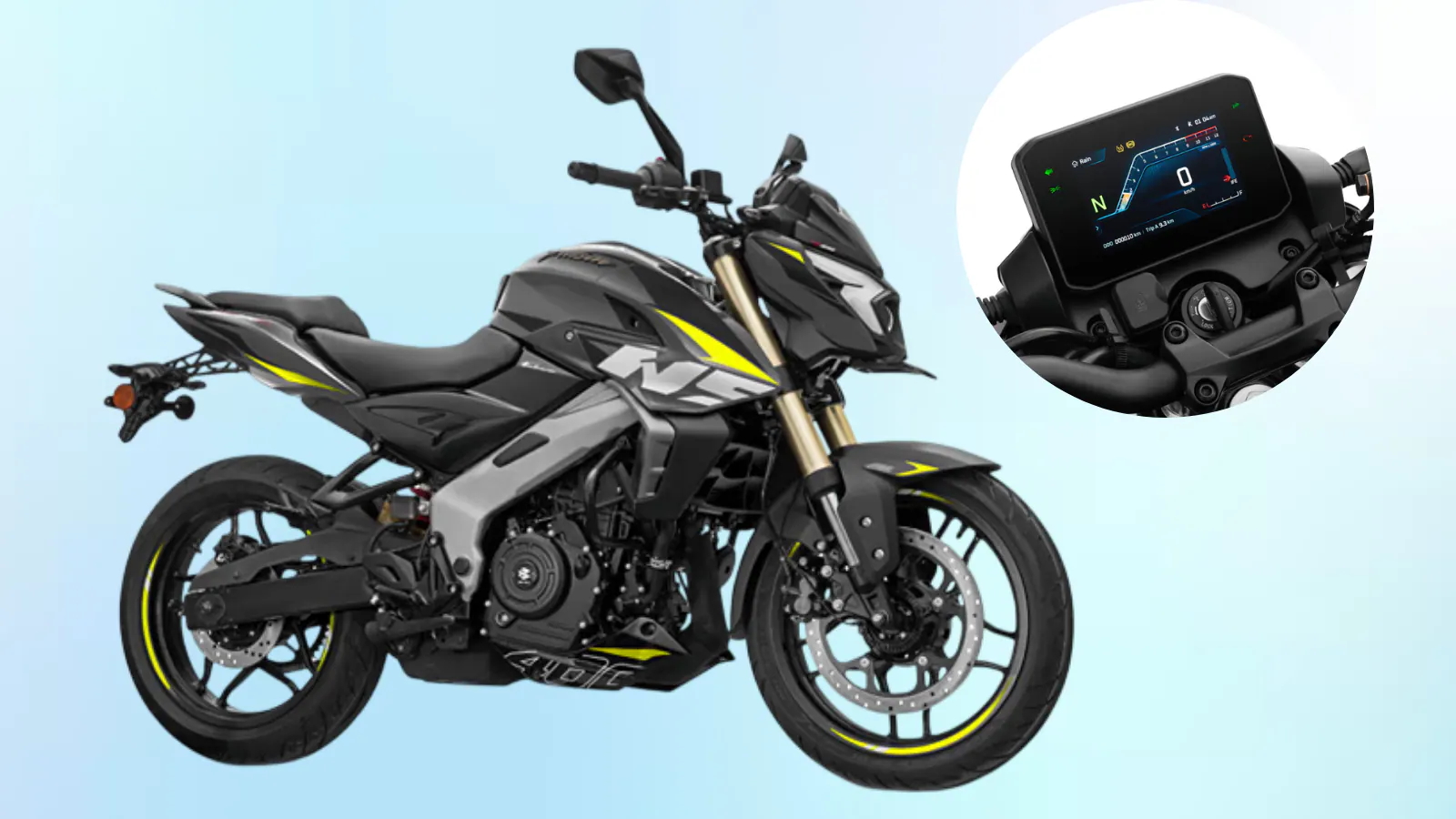
The Bajaj Pulsar NS400Z has received two important updates in 2026, making it a more interesting proposition in India's performance-oriented naked motorcycle segment. The first change arrived in April, when Bajaj replaced the motorcycle's earlier 373cc engine with a smaller 349.13cc unit. The second update arrived in October, bringing a new 5-inch TFT instrument console, Google Maps mirroring, additional connectivity functions and convenience features.
These changes are important because they address two different aspects of the motorcycle. The April revision was primarily about taxation, pricing and retaining performance with a smaller engine displacement. The October update focused on improving the technology package and bringing the NS400Z in line with the newer generation of connected Pulsar motorcycles.
The latest Bajaj Pulsar NS400Z is priced at ₹1,90,015 (ex-showroom, Delhi). It continues to produce approximately 40.6 PS and 33 Nm, with a six-speed gearbox, four riding modes, traction control and dual-channel ABS.
However, the question potential buyers should ask is whether these updates make the motorcycle significantly better than the previous version, or whether they simply make an already powerful motorcycle more convenient to live with.
Here is a detailed breakdown of everything that has changed.
1. 2026 Bajaj Pulsar NS400Z: What Has Changed?
The 2026 NS400Z should be understood as a motorcycle that received two separate revisions during the year.
The April update introduced the smaller engine, while the October update brought the new TFT display and additional equipment.
The following table summarises the important differences.
| Parameter | Earlier NS400Z | Latest 2026 NS400Z |
|---|---|---|
| Engine displacement | 373cc | 349.13cc |
| Maximum power | Up to 43 PS in 2025 Sport mode | 40.6 PS |
| Maximum torque | 35 Nm on the earlier configuration | 33.2 Nm |
| Instrument console | Colour LCD | 5-inch TFT |
| Navigation | Earlier connected navigation functions | Google Maps mirroring |
| Music controls | Limited connected functions | Available through TFT |
| Document storage | Not part of the earlier console package | Added |
| Charging port | Earlier charging arrangement | USB Type-C |
| Emergency warning | No newly announced Panic Brake Alert | Panic Brake Alert |
| Transmission | 6-speed | 6-speed |
| Ride modes | Four | Four |
| Traction control | Available | Available |
The important point is that the latest model is not an entirely new-generation motorcycle. Bajaj has retained its existing mechanical foundation while making changes to the engine and electronics.
2. Engine Downsized From 373cc to 349.13cc

One of the biggest changes to the 2026 Bajaj Pulsar NS400Z happened in April.
Bajaj replaced the previous 373cc engine with a 349.13cc liquid-cooled, single-cylinder engine.
At first glance, a reduction in engine displacement might sound like a downgrade, particularly for a motorcycle positioned as the flagship of the Pulsar range. However, the decision was primarily connected to India's revised GST structure for motorcycles.
The revised engine displacement allowed Bajaj to position the NS400Z in the lower 18% GST category rather than the higher taxation category applicable to motorcycles exceeding 350cc.
This gave Bajaj an opportunity to reduce the motorcycle's pricing while retaining a substantial amount of its performance.
What happened to the power output?
The previous 373cc configuration received a performance upgrade in July 2025.
Bajaj introduced revised valve timing, updated cam profiles, a redesigned intake duct and a forged piston. These changes increased the maximum power output to 43 PS in Sport mode.
The 2026 engine revision brought the following specifications:
| Engine specification | 2026 NS400Z |
|---|---|
| Displacement | 349.13cc |
| Engine configuration | Single-cylinder |
| Cooling | Liquid-cooled |
| Valve configuration | 4-valve, DOHC |
| Fuel system | Fuel injection |
| Maximum power | 40.6 PS at 9,000 rpm |
| Maximum torque | 33.2 Nm at 7,500 rpm |
| Transmission | 6-speed |
The reduction in displacement also brought a reduction in peak torque compared with the earlier 373cc configuration.
However, the latest motorcycle still offers a substantial power output for its price category.
Does the smaller engine affect performance?
The reduction from 43 PS to 40.6 PS needs to be considered in context.
The difference is relatively small in percentage terms, but riders moving from the 2025 version may notice that the latest motorcycle does not have the same published peak output.
Peak power figures alone, however, cannot determine how a motorcycle performs in everyday conditions.
Engine response, gearing, throttle calibration, torque delivery and the weight of the motorcycle all influence acceleration and rideability.
Bajaj has retained the electronic throttle body and four riding modes, allowing riders to select different engine-response characteristics.
There is insufficient independently verified comparative test data to claim that the 2026 version accelerates faster or slower than the previous version under identical conditions.
For buyers, the more important consideration is whether the latest motorcycle offers sufficient performance for their riding requirements. Its 40.6 PS output remains substantial for city riding, highway cruising and spirited weekend rides.
Why did Bajaj reduce the engine displacement?
The primary motivation was taxation.
Bajaj's April 2026 announcement specifically highlighted the revised 349cc engine and its eligibility for the lower 18% GST slab.
The company announced an ex-showroom Delhi price of ₹1,80,092 for that revised version and claimed potential customer savings of up to ₹24,500.
These savings were associated with the reduction in ex-showroom price, insurance and registration-related costs.
It is important to understand that the GST benefit did not mean the motorcycle became more powerful. Instead, Bajaj changed the engine displacement to improve its pricing position while maintaining a competitive performance figure.
3. New 5-Inch TFT Instrument Console
Major October 2026 update
The most noticeable change on the latest Bajaj Pulsar NS400Z is the new 5-inch TFT instrument console.
The previous motorcycle used a colour LCD instrument cluster. Although it offered connected features, the display was not as advanced as the TFT systems increasingly appearing on newer motorcycles.
The new display brings a more contemporary interface and combines several riding and smartphone-related functions.
For riders, this is more than a cosmetic upgrade.
The instrument console is one of the most frequently used parts of a motorcycle. It provides information about speed, engine operation, riding modes and other essential functions.
A more capable display can make this information easier to access and organise.
Google Maps mirroring
One of the most useful additions is Google Maps mirroring.
Navigation is particularly useful for riders who regularly travel through unfamiliar parts of cities or undertake longer highway journeys.
Previously, riders often depended on smartphone mounts to view navigation directions.
A connected instrument console can make navigation more convenient by displaying relevant directions through the motorcycle's interface.
The latest NS400Z supports Google Maps mirroring through its connected system.
This is a useful addition for commuters, touring riders and people who frequently explore unfamiliar routes.
However, riders should still understand the limitations of smartphone connectivity. Navigation availability depends on the connected phone, software compatibility, network availability and the functioning of the associated application.
It should not be assumed that the motorcycle has a completely independent built-in navigation system.
Music controls
The TFT console also introduces music controls.
This allows riders to manage supported music functions through the connected interface instead of repeatedly interacting with their smartphones.
The feature is particularly convenient when using a compatible Bluetooth helmet headset.
However, riders should always prioritise road awareness and avoid interacting with the display unnecessarily while moving.
Document storage
Another addition is digital document storage.
The system allows riders to access stored vehicle-related documents through the connected interface.
This can be useful when travelling, especially when riders need quick access to information relating to their motorcycle.
However, storing documents digitally should not be treated as a replacement for understanding the applicable legal requirements concerning carrying and presenting vehicle documents.
Lap timer
The inclusion of a lap timer adds another performance-oriented function.
While this is unlikely to be particularly useful during everyday commuting, it can appeal to riders interested in measuring their performance during controlled track activities.
It also complements the NS400Z's positioning as a performance-focused naked motorcycle.
4. USB Type-C Charging Port Added
Another practical addition to the latest NS400Z is a USB Type-C charging port.
Smartphones have become an important part of modern motorcycling.
Riders use them for navigation, communication, route planning and accessing travel-related information.
Consequently, keeping a smartphone charged is an important consideration, particularly during long journeys.
The introduction of USB Type-C makes the charging arrangement more convenient for riders whose devices already use this connector.
It also brings the motorcycle in line with the increasingly common Type-C charging standard.
However, Bajaj's announcement does not establish a specific charging wattage or fast-charging capability. Buyers should therefore avoid assuming that the port supports a particular charging speed.
5. Panic Brake Alert: An Additional Safety Feature
The latest NS400Z also receives Panic Brake Alert.
This system is designed to provide an additional warning to traffic approaching from behind when the rider applies the brakes hard.
According to Bajaj, the system activates the hazard lights under hard braking.
This can be particularly useful in situations involving sudden deceleration, where the rider behind may otherwise have limited time to react.
It is important to distinguish between this feature and a motorcycle's actual braking capability.
Panic Brake Alert is a warning function. It does not increase the physical braking force available at the wheels, shorten stopping distances by itself or replace ABS.
The NS400Z continues to use dual-channel ABS, which serves a different purpose by helping prevent wheel lock-up during braking.
Together, these systems address different aspects of rider safety.
6. Four Riding Modes and Traction Control Continue
Despite the changes introduced in 2026, the motorcycle retains its four riding modes.
These are:
- Road
- Rain
- Sport
- Off-Road
The modes modify the motorcycle's electronic behaviour to suit different riding conditions.
For example, Rain mode is intended to offer a more conservative response in slippery conditions, while Sport mode is designed around a more performance-focused riding experience.
The exact behaviour of each mode should be understood through the owner's manual rather than assuming that all modes provide identical electronic settings.
Electronic throttle body
The NS400Z uses an Electronic Throttle Body (ETB).
An electronic throttle system manages throttle response through electronic controls rather than relying entirely on a direct mechanical connection between the throttle grip and throttle body.
This enables the motorcycle to offer different throttle-response characteristics across its riding modes.
It also supports the integration of electronic rider-assistance systems.
Traction control
Traction control remains part of the equipment package.
Its purpose is to help manage rear-wheel slip when the motorcycle accelerates, particularly when grip conditions are limited.
This can be useful on wet roads, loose surfaces and other situations where the rear tyre may struggle to maintain traction.
However, traction control cannot compensate for poor tyre condition, excessive speed or inappropriate riding inputs.
It is an assistance system rather than a substitute for careful riding.
Sports Shifter
The NS400Z also retains its Sports Shifter functionality.
This feature supports clutchless gear changes under suitable conditions, reducing the need to operate the clutch lever during certain gear shifts.
It can make aggressive acceleration more convenient and complements the motorcycle's performance-oriented character.
The Sports Shifter should not be confused with an automatic transmission. The rider remains responsible for selecting gears and operating the motorcycle appropriately.
7. Suspension, Braking and Tyres: What Remains Unchanged?
The October update did not introduce a major suspension or braking revision.
The motorcycle continues with its existing performance-oriented hardware.
Front suspension
The NS400Z uses a 43mm upside-down front fork.
USD forks are commonly found on performance-oriented motorcycles because of their structural characteristics and ability to provide controlled front-end behaviour.
For riders, suspension performance affects braking stability, cornering confidence and comfort over uneven surfaces.
Rear suspension
At the rear, the motorcycle uses a monoshock with Nitrox and six-step adjustability.
The adjustment provision gives riders some flexibility to tailor the rear suspension setup to different riding requirements.
However, suspension adjustments should be made with consideration for rider weight, luggage and riding conditions.
Braking system
The motorcycle uses a 320mm front disc and a 230mm rear disc, according to the current product specifications.
Dual-channel ABS is also retained.
This means the ABS system can intervene at both wheels to help reduce the risk of wheel lock-up during braking.
Radial tyres
Radial tyres were introduced as part of the 2025 upgrade and continue to be part of the NS400Z's equipment package.
Tyres play an important role in determining grip, stability and braking performance.
The radial construction and wider rear tyre contribute to the motorcycle's performance-oriented specification.
There is no confirmed October 2026 tyre-size revision in Bajaj's announcement.
8. Has the Design Changed?

The latest update is not a comprehensive exterior redesign.
The NS400Z continues with its aggressive naked streetfighter styling.
Its overall design remains centred around a muscular fuel tank, sharp bodywork, exposed mechanical elements and an upright naked-bike profile.
The motorcycle's styling is one of the key elements that separates it from more commuter-oriented Pulsar models.
The new TFT console makes the cockpit look more contemporary, but buyers should not expect a completely different motorcycle in terms of exterior design.
There is also no confirmed major chassis redesign or new bodywork package associated with the October announcement.
For existing NS400Z owners, this means the latest motorcycle looks familiar while offering a more advanced instrument interface.
9. 2026 Bajaj Pulsar NS400Z Price
The latest NS400Z is priced at ₹1,90,015 (ex-showroom, Delhi).
The pricing history during 2026 is important because the motorcycle received two updates within a relatively short period.
| Update | Announced price |
|---|---|
| April 2026, 349cc engine version | ₹1,80,092 |
| October 2026, TFT-equipped version | ₹1,90,015 |
The October version carries a price increase of approximately ₹4,000 over the immediately preceding version, according to contemporary launch coverage.
The price difference needs to be viewed alongside the addition of the TFT display, Google Maps mirroring, USB Type-C and Panic Brake Alert.
The actual on-road price will be higher.
It varies depending on the buyer's city, registration charges, insurance selection and other applicable costs.
Buyers should obtain a current quotation from their local Bajaj dealership before making a purchase decision.
It is also worth remembering that the April price reduction and October equipment upgrade were separate developments. Comparing the latest motorcycle directly with the original 2024 model without considering the intervening 2025 and April 2026 revisions can create a misleading picture.
Planning to finance your next motorcycle?
Estimate a monthly loan payment and compare financing scenarios before visiting a dealership.
Calculate Your EMI10. Is the New TFT Display Worth the Additional Money?
For many buyers, the October update will be the more noticeable improvement.
The earlier colour LCD console already offered a useful set of connected functions. However, the new TFT interface brings a more comprehensive collection of features.
The additional equipment is particularly relevant to riders who frequently use their motorcycles for commuting and touring.
Google Maps mirroring can reduce dependence on separate navigation mounts, while music controls and document storage provide additional convenience.
The USB Type-C port is another practical addition.
However, not every buyer will benefit equally.
Someone who primarily rides short distances and rarely uses smartphone connectivity may not find the additional features particularly important.
Similarly, the lap timer may appeal more to performance enthusiasts than everyday commuters.
The value of the upgrade therefore depends on how frequently a rider will use the new functions.
11. Who Should Consider Buying the 2026 NS400Z?
The latest Pulsar NS400Z is aimed at riders who want substantial engine performance without moving into a considerably more expensive motorcycle category.
Riders upgrading from smaller motorcycles
For riders moving up from 150cc, 160cc or 200cc motorcycles such as the Bajaj Pulsar NS200, the NS400Z offers a substantial increase in engine performance.
Its 349.13cc engine and electronic rider-assistance package make it a significant step up in terms of performance and equipment.
However, riders upgrading from smaller motorcycles should also consider the weight, acceleration and overall riding characteristics of a larger motorcycle.
Riders who enjoy weekend rides
The motorcycle's performance-oriented engine, six-speed transmission, USD front suspension and traction control make it relevant to riders who enjoy weekend highway trips and spirited riding.
Its naked-bike configuration also gives it a different riding experience compared with fully faired sports motorcycles.
Technology-focused buyers
The October update makes the NS400Z more attractive to buyers who prioritise modern instrument consoles and smartphone integration.
The TFT display, Google Maps mirroring and USB Type-C charging improve the overall technology package.
Existing NS400Z owners
For existing owners, upgrading to the latest version may not necessarily make financial sense.
The October update adds convenience features, but it does not introduce a major improvement in engine performance, suspension or chassis hardware.
Owners who are satisfied with their existing motorcycle may find the new TFT console desirable but not essential.
12. What Are the Advantages and Limitations of the Latest NS400Z?
Advantages
- Powerful 349.13cc liquid-cooled engine.
- 40.6 PS maximum power.
- New 5-inch TFT instrument console.
- Google Maps mirroring.
- Four riding modes.
- Traction control.
- Sports Shifter functionality.
- Dual-channel ABS.
- 43mm USD front suspension.
- USB Type-C charging port.
- Panic Brake Alert.
- Competitive ex-showroom positioning.
Limitations and considerations
- The engine has lower displacement than the original 373cc configuration.
- Peak output is lower than the 43 PS Sport-mode figure of the 2025 version.
- The October update does not introduce a major chassis or suspension revision.
- Smartphone-connected functions depend on device and application compatibility.
- The actual on-road price will be higher than the advertised ex-showroom price.
- Buyers should evaluate the riding ergonomics and engine characteristics through a test ride rather than relying exclusively on specifications.
13. Final Verdict: Is the 2026 Bajaj Pulsar NS400Z a Meaningful Upgrade?
The 2026 Bajaj Pulsar NS400Z has become a more complete motorcycle through two separate updates.
The April revision addressed engine displacement and pricing. By moving to a 349.13cc engine, Bajaj was able to take advantage of the lower GST category while retaining a claimed output of 40.6 PS.
The October revision addressed a different requirement: technology.
The new TFT console, Google Maps mirroring, music controls, document storage, USB Type-C and Panic Brake Alert make the motorcycle more convenient and modern.
However, it is important not to mistake the October update for a major mechanical upgrade. The engine, gearbox, suspension and braking package remain substantially unchanged from the preceding version.
For a new buyer, the latest NS400Z offers a combination of performance, electronic rider assistance and connected features at a competitive price.
For an existing owner, the decision to upgrade is less straightforward because the latest version does not deliver a substantial improvement in core riding performance.
Ultimately, the 2026 Pulsar NS400Z is best understood as an evolution of Bajaj's flagship naked motorcycle rather than an entirely new generation. It builds on the existing performance package and adds technology that makes everyday use more convenient.