
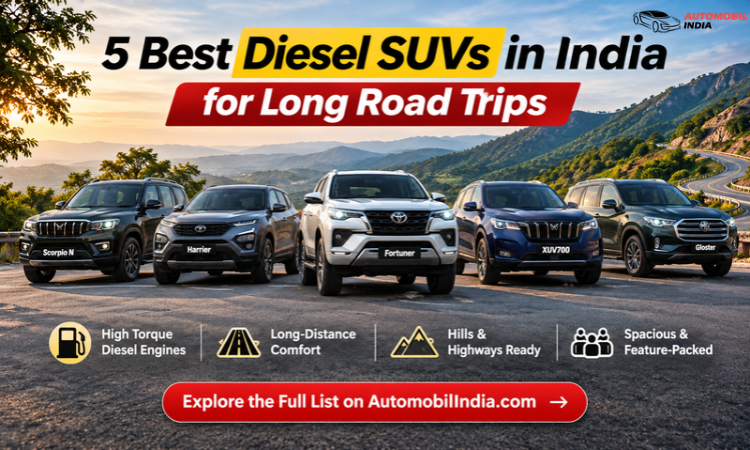
India is a country that rewards people who love road trips. From smooth expressways connecting metropolitan cities to winding mountain roads, coastal highways, forest routes and remote destinations, driving across the country can be an experience in itself. But when the journey involves hundreds or even thousands of kilometres, the vehicle you choose can make a significant difference to the overall experience.
While SUVs have become increasingly popular among Indian buyers, not every SUV is equally suited to long-distance travel. A comfortable cabin, supportive seats, a capable engine, stable highway behaviour, adequate luggage space, dependable performance and the ability to tackle rough stretches of road are all important factors.
This is where diesel-powered SUVs continue to make a strong case.
Diesel engines are particularly appealing to people who frequently travel long distances. Their strong low- and mid-range torque makes highway cruising relatively effortless, especially when the vehicle is carrying passengers, luggage or travelling through hilly terrain. Diesel SUVs can also offer better fuel economy than comparable petrol SUVs under certain driving conditions, which can make them attractive for frequent highway users.
Although the Indian automotive industry is increasingly moving towards petrol, hybrid and electric powertrains, diesel SUVs continue to serve a specific category of buyers exceptionally well. They are ideal for people who regularly travel between cities, enjoy exploring destinations beyond popular tourist routes or simply want an SUV that feels relaxed while covering long distances.
However, buying an SUV specifically for road trips requires looking beyond engine specifications and advertised features. Ride quality, seat comfort, cabin noise, transmission behaviour, rear-seat experience, luggage capacity and service accessibility can all become important after spending several hours behind the wheel.
If you are looking for a diesel SUV that can comfortably take you from Mumbai to Goa, Pune to Bengaluru, Delhi to Manali or on a long journey across multiple states, here are five SUVs worth considering.
Why diesel SUVs still make sense for long-distance driving
Before looking at individual SUVs, it is important to understand why diesel-powered vehicles continue to attract highway-focused buyers.
1. Strong torque makes highway driving easier
Diesel engines typically deliver strong torque at relatively low engine speeds. This characteristic helps the vehicle move forward without requiring the driver to constantly rev the engine. During highway driving, this becomes particularly useful when overtaking slower vehicles, climbing gradients or travelling with a full load of passengers and luggage. On mountain roads, the ability to access usable torque without frequently shifting gears can make the driving experience more relaxed.
2. Better potential for highway fuel efficiency
Fuel efficiency depends on the vehicle, driving conditions, speed, terrain, load and driving style. However, diesel engines generally have an advantage in energy efficiency, particularly during long highway journeys. For someone who frequently travels several hundred kilometres in a single trip, the difference in fuel consumption can translate into meaningful savings over time.
3. A larger driving range
Many diesel SUVs have relatively large fuel tanks and efficient engines, allowing drivers to cover longer distances between fuel stops. This can be particularly useful when travelling through remote areas, where fuel stations may not be conveniently located or where stopping frequently can interrupt the journey
4. Better suited to loaded journeys
Road trips rarely involve travelling with just the driver. Families often carry multiple passengers, suitcases, backpacks, food, cameras and other essentials. A diesel engine’s torque characteristics can help the SUV feel less strained when travelling with a full load, especially on inclines and during highway acceleration
5. Greater confidence on challenging routes
Not every road trip involves a perfectly paved highway. Indian road conditions can change rapidly, particularly when travelling through mountains, rural areas or construction zones. Many diesel SUVs also offer high ground clearance, rugged suspension setups and optional four-wheel-drive systems. While these features do not automatically make every SUV an off-road vehicle, they can provide additional confidence on uneven surfaces
The important thing to remember is that diesel is not automatically the best choice for everyone. Buyers who primarily drive short urban distances, have low annual mileage or spend most of their time in stop-and-go traffic should also evaluate petrol and hybrid alternatives. But for people who regularly cover long distances, diesel remains a compelling option.
1. Mahindra Thar Roxx – The SUV for adventurous road trips
The Mahindra Thar Roxx has become one of the most distinctive SUVs in the Indian market. Unlike the traditional three-door Thar, the Roxx combines the brand’s rugged SUV character with a more practical five-door body, making it easier to accommodate passengers while retaining its adventurous personality. For road-trip enthusiasts who enjoy travelling beyond conventional tourist destinations, the Thar Roxx is an interesting proposition.
Engine and performance
The diesel Thar Roxx is powered by a 2.2-litre mHawk turbo-diesel engine. Depending on the configuration, it is offered with different power and torque outputs, with the higher-output four-wheel-drive versions delivering strong performance for demanding conditions. The engine is paired with a six-speed manual transmission or a six-speed torque-converter automatic, depending on the variant.
The combination of diesel torque and the available four-wheel-drive hardware makes the Thar Roxx particularly interesting for road trips that involve steep inclines, rough roads, loose surfaces and challenging terrain. On highways, the engine’s torque delivery can help the SUV maintain momentum without requiring constant gear changes. The automatic transmission is especially worth considering for buyers who regularly travel through traffic-heavy cities before reaching the open highway
Why it works for road trips
The Thar Roxx is not just about its off-road image. Its five-door configuration makes it considerably more practical for people travelling with friends or family. The longer wheelbase and additional doors improve accessibility, while the cabin provides a more usable passenger experience than the traditional three-door Thar
Its high ground clearance and SUV proportions are useful when travelling through destinations where road surfaces may be uneven. For example, routes involving mountain villages, rural roads, camping destinations or forest-side locations can often include broken surfaces that require careful driving
The available four-wheel-drive variants offer an additional capability layer for buyers who plan to explore difficult terrain. However, it is important to choose the correct variant. Not every Thar Roxx is a 4x4, and buyers who specifically want four-wheel-drive capability should check the drivetrain configuration before booking
What buyers should consider
The Thar Roxx is not necessarily the most conventional choice for a family that spends most of its time travelling on smooth expressways. Its rugged design and SUV character come with compromises compared with more road-focused SUVs. Buyers should evaluate rear-seat comfort, cabin access, ride behaviour and luggage practicality during an extended test drive. The ride experience can also vary depending on tyre type, wheel size and variant
For a road-trip SUV, comfort is not something that should be judged only from the driver’s seat. The person sitting in the rear for four or five hours should also be comfortable
Who should buy the Thar Roxx?
The Thar Roxx is best suited to buyers who:
-
Enjoy adventurous road trips and outdoor destinations.
-
Frequently travel on broken roads or uneven terrain.
-
Want a five-door diesel SUV with an expressive design.
-
Prefer the option of four-wheel drive.
-
Want an SUV that can serve as both a daily driver and a weekend adventure vehicle.
If your road trips are mostly limited to highways, cities and established tourist destinations, you may find more conventional SUVs easier to live with. But if your idea of a holiday involves discovering a destination beyond the main road, the Thar Roxx deserves serious consideration.
2. Toyota Fortuner – The dependable long-distance SUV
The Toyota Fortuner has established itself as one of India’s most recognisable premium SUVs. Over the years, it has developed a strong reputation among buyers looking for a large SUV with a powerful diesel engine, commanding road presence and the ability to travel across different types of terrain. For buyers who prioritise long-distance ownership and want an SUV that feels substantial on the highway, the Fortuner continues to be one of the most compelling options
Engine and performance
The Fortuner’s diesel powertrain is centred around a 2.8-litre turbocharged engine that produces approximately 201 bhp and up to 500 Nm of torque, depending on the variant and configuration. The engine is paired with a six-speed transmission, with automatic and manual options available across the range. Buyers can also choose between rear-wheel-drive and four-wheel-drive configurations, depending on the variant
The strong torque output is one of the Fortuner’s biggest advantages. When travelling with multiple passengers and luggage, the engine has the capability to handle highway overtaking and uphill stretches without feeling underpowered
Why it works for road trips
The Fortuner is built around the idea of being a capable SUV that can travel long distances without being restricted to paved roads. Its strong diesel engine, high seating position and large body make it particularly appealing to buyers who frequently travel between cities or explore destinations that involve challenging roads
For highway travel, the Fortuner offers a commanding driving position that provides a clear view of the road ahead. Its size and road presence can also give drivers a sense of confidence while travelling on highways. The four-wheel-drive variants make it more suitable for buyers who regularly encounter difficult terrain. However, the 4x2 versions remain perfectly relevant for buyers who primarily travel on highways and well-maintained roads
The Fortuner’s popularity also means that many buyers are familiar with the ownership experience, and the brand’s service network is an important consideration for people who travel extensively
Comfort and practicality
The Fortuner is a large SUV designed to accommodate families and people who require additional passenger space. It offers a three-row seating layout, making it suitable for families travelling with more occupants. However, the third row should be evaluated carefully if it will be used frequently by adults
The SUV’s size can be useful when travelling with luggage, although buyers should examine how much cargo space remains when all three rows are occupied. Long-distance comfort depends on more than the size of the vehicle. Seat support, suspension behaviour, cabin noise and rear-seat comfort are all important factors. Buyers should test the Fortuner on different types of roads before making a final decision
What buyers should consider
The Fortuner is significantly more expensive than many mainstream SUVs. Buyers need to consider not only the purchase price but also insurance, tyres, fuel expenses and the cost of maintaining a large SUV. Its dimensions can also make urban parking and navigating narrow streets more challenging
If your road trips primarily involve highways, the Fortuner’s 4x4 capability may not be necessary. In such cases, a rear-wheel-drive variant could be a more sensible purchase, depending on your needs and budget
Who should buy the Fortuner?
The Toyota Fortuner is a strong choice for buyers who:
-
Frequently travel long distances with family.
-
Want a large, powerful diesel SUV.
-
Prioritise a strong ownership reputation.
-
Need a vehicle that can handle highways as well as rough roads.
-
Want the option of four-wheel drive.
-
Are comfortable with the higher purchase and ownership costs.
The Fortuner is not necessarily the most value-focused SUV in this list. Instead, it appeals to buyers who want a premium, established SUV experience and are willing to pay for it.
3. MG Majestor – A large SUV for comfortable highway cruising
The MG Majestor is positioned as a large, premium SUV for buyers who want a commanding presence, spacious cabin and powerful diesel performance. Its size makes it particularly interesting for long-distance travel, especially for people who frequently travel with family, friends or multiple passengers
Engine and performance
The MG Majestor is powered by a 2.0-litre twin-turbo diesel engine. It produces approximately 212 bhp and 478.5 Nm of torque and is paired with an eight-speed automatic transmission. The twin-turbo setup is designed to deliver strong performance across different driving conditions, while the automatic transmission helps make driving easier during long journeys
The combination of a large SUV body, diesel torque and an automatic gearbox is particularly useful for people who regularly encounter mixed driving conditions
Why it works for road trips
The Majestor’s biggest advantage is its size and the way it is positioned as a premium SUV. Long journeys often involve travelling with family members who have different comfort expectations. A spacious cabin, a comfortable seating arrangement and convenient features can make a significant difference when the journey lasts several hours
The Majestor is aimed at buyers who want a large SUV that can comfortably handle highway travel while also offering the flexibility to travel beyond paved roads. Depending on the configuration, the SUV’s drivetrain and terrain-focused capabilities may also be useful when travelling through challenging routes
For highway journeys, an automatic transmission is particularly attractive. It reduces driver workload and can make the experience less tiring when the route includes traffic around cities, toll plazas and congested sections
Cabin experience and long-distance comfort
For a vehicle of this size, the cabin experience becomes an important part of the purchase decision. Buyers should pay attention to the seating position, legroom, shoulder room, ease of getting into the cabin, climate control performance and the amount of space available for luggage
The Majestor is designed to appeal to people who want a more premium experience than a conventional utility-focused SUV. However, a large vehicle does not automatically guarantee the best ride quality. Buyers should drive it on broken roads, expansion joints and uneven surfaces to understand how the suspension handles the conditions they are likely to encounter
What buyers should consider
The MG Majestor is a large SUV, and its dimensions may not be ideal for everyone. Driving a large SUV through crowded cities, narrow streets, parking areas and small mountain roads requires additional attention. Buyers who frequently travel alone or with just one passenger may find a smaller SUV easier to manage
Its purchase price and ownership expenses should also be evaluated against other large SUVs. The Majestor makes the most sense when buyers genuinely need the space, road presence and capability that a large SUV offers
Who should buy the MG Majestor?
The Majestor is worth considering if you:
-
Want a large and imposing diesel SUV.
-
Frequently travel with family or multiple passengers.
-
Prefer an automatic transmission for long journeys.
-
Want a premium cabin experience.
-
Travel across highways, rural routes and challenging roads.
-
Want a vehicle that feels substantial on long-distance journeys.
For buyers looking for a large diesel SUV with an emphasis on space, performance and presence, the Majestor offers a distinctive alternative in the premium SUV category.
4. Force Gurkha – For road trips that go beyond the highway
The Force Gurkha is one of India’s most purpose-built SUVs. Unlike many modern SUVs that focus heavily on lifestyle appeal and urban convenience, the Gurkha is designed around ruggedness and off-road capability. This makes it a very different proposition from the Fortuner, Meridian or Majestor
The Gurkha is especially attractive to people who enjoy exploring remote destinations, driving through difficult terrain and travelling to places where road conditions may be unpredictable
Engine and performance
The Gurkha is powered by a 2.6-litre four-cylinder FM2.6 CD diesel engine that produces approximately 138 bhp and 320 Nm of torque. It is paired with a five-speed manual transmission. The engine’s torque delivery, combined with the SUV’s four-wheel-drive system and off-road-oriented hardware, is designed to help it tackle challenging terrain
Unlike some of the SUVs on this list, the Gurkha does not offer an automatic transmission. This is an important consideration for buyers who frequently drive in traffic or prefer the convenience of an automatic gearbox
Why it works for road trips
The Gurkha is designed for adventure. If your road trips involve mountain trails, muddy routes, remote villages, camping destinations or difficult roads, the Gurkha’s hardware becomes a major advantage
Its rugged construction and off-road-focused engineering are designed to support travel through challenging conditions. The SUV’s four-wheel-drive capability is particularly useful when traction becomes limited. However, four-wheel drive is not a substitute for good driving technique, appropriate tyres or careful route planning
The Gurkha is also offered in different body configurations, including three-door and five-door versions. The five-door version is more practical for buyers who travel with family or friends, as it improves accessibility and passenger convenience
What buyers should consider
The Gurkha’s strengths are also the reasons it may not suit every road-trip buyer. Its manual transmission can become tiring in heavy traffic. The driving experience is more utilitarian than that of a conventional premium SUV, and buyers should not expect the same level of refinement, convenience or feature-rich cabin experience offered by some competitors
If most of your travel involves expressways and paved roads, the Gurkha’s specialised off-road capability may not be something you use regularly. It is also important to evaluate passenger comfort and luggage space based on the specific body configuration you are considering
Who should buy the Force Gurkha?
The Force Gurkha is best suited to buyers who:
-
Enjoy off-road driving and outdoor adventures.
-
Frequently travel through rough or difficult terrain.
-
Want a diesel SUV with serious off-road hardware.
-
Prefer a rugged and utilitarian vehicle.
-
Are comfortable driving a manual transmission.
-
Prioritise capability over luxury-oriented features.
The Gurkha is not the SUV you buy simply because you want to travel 500 km on a smooth expressway. It is the SUV you consider when the road trip itself includes the possibility of leaving the tarmac behind.
5. Jeep Meridian – A comfortable SUV for family highway journeys
The Jeep Meridian occupies an interesting position in the Indian SUV market. It combines a relatively premium cabin experience, three-row seating and diesel power with the brand’s emphasis on road capability. For families looking for a vehicle that can handle regular highway journeys while also being practical for everyday use, the Meridian is worth considering
Engine and performance
The Jeep Meridian is powered by a 2.0-litre Multijet II turbo-diesel engine that produces approximately 167.67 bhp and 350 Nm of torque. The engine is available with a six-speed manual transmission and a nine-speed torque-converter automatic transmission, depending on the variant
The diesel engine provides the kind of torque that is useful during highway driving, especially when accelerating for overtaking or travelling with a full passenger load. The automatic version is particularly attractive for buyers who want to combine city driving with frequent long-distance travel
Why it works for road trips
The Meridian is designed to be more than just an urban SUV. Its three-row layout makes it suitable for families who need to accommodate additional passengers. It also offers a cabin experience that is aimed at buyers looking for a premium SUV rather than a purely utilitarian vehicle
On long highway journeys, the combination of diesel torque and an automatic transmission can make driving easier. The SUV’s overall road-focused character makes it an interesting choice for families travelling between cities, visiting holiday destinations or undertaking long road trips several times a year
The Jeep brand’s emphasis on capability also makes the Meridian appealing to buyers who want to travel beyond standard urban routes
Cabin comfort and family practicality
For family road trips, seating comfort is one of the Meridian’s important considerations. The first and second rows should be evaluated carefully, especially if the SUV will regularly carry adults. Buyers who plan to use the third row frequently should also check access, seating comfort and luggage space when all seats are occupied
A three-row SUV can be practical for larger families, but the amount of luggage space available depends on how many seats are in use. The Meridian’s cabin and convenience features can make long-distance travel more enjoyable, but buyers should still conduct a proper test drive rather than relying only on specifications or feature lists
What buyers should consider
The Meridian is not the most affordable option in the diesel SUV market. Buyers should compare the cost of ownership, service expenses, fuel consumption, insurance and the cost of replacement parts against other SUVs in the same price bracket
It is also important to evaluate the third-row usability. If your family rarely requires seven seats, a five-seater SUV could provide a better combination of luggage space, efficiency and value
Who should buy the Jeep Meridian?
The Meridian is worth considering for buyers who:
-
Want a premium family SUV with diesel power.
-
Frequently travel long distances.
-
Need three-row seating flexibility.
-
Prefer an automatic transmission.
-
Want a comfortable highway-oriented SUV.
-
Value a premium cabin experience alongside road capability.
For families who regularly travel together, the Meridian can be a practical choice that combines long-distance usability with everyday convenience.
How do these five diesel SUVs compare?
Choosing the right SUV depends on how you actually travel. A vehicle that is excellent for exploring remote trails may not be the most comfortable choice for a family travelling across expressways. The following comparison highlights the core character of each SUV
|
SUV |
Diesel engine |
Transmission options |
Best suited for |
|
Mahindra Thar Roxx |
2.2L mHawk |
6-speed MT / 6-speed AT |
Adventure trips, rough roads, off-road exploration |
|
Toyota Fortuner |
2.8L diesel |
MT / AT |
Long-distance family travel, touring, all-round capability |
|
MG Majestor |
2.0L twin-turbo diesel |
8-speed AT |
Large SUV comfort, highway travel, premium experience |
|
Force Gurkha |
2.6L diesel |
5-speed MT |
Off-road adventures, challenging terrain |
|
Jeep Meridian |
2.0L Multijet II |
6-speed MT / 9-speed AT |
Family road trips, premium highway travel |
Specifications, drivetrain availability and variant equipment may differ. Always confirm the exact configuration with the manufacturer or dealership before purchasing.
Which diesel SUV is best for different types of road trips?
There is no single SUV that is perfect for every road-trip enthusiast. Your destination, passenger count, luggage requirements and driving style should influence your purchase
Best for adventurous road trips – Mahindra Thar Roxx
If you enjoy driving to mountain destinations, camping locations, remote villages and places where road conditions can change, the Thar Roxx is one of the most interesting choices. Its five-door body improves usability while retaining a rugged SUV character. The diesel engine and available four-wheel-drive system make it suitable for buyers who want more capability than a conventional road-focused SUV
Best for all-round long-distance touring – Toyota Fortuner
The Fortuner is a strong choice for buyers who regularly travel long distances and want a large SUV with strong diesel performance and a well-established reputation. It is especially appealing to people who want an SUV that can handle highway travel, family journeys and occasional challenging terrain without being focused exclusively on off-roading
Best for buyers wanting a large premium SUV – MG Majestor
The Majestor makes sense for buyers who prioritise size, presence, diesel performance and a premium SUV experience. If your road trips involve travelling with several passengers and you want a large vehicle for highway journeys, the Majestor deserves a closer look
Best for serious off-road exploration – Force Gurkha
The Gurkha is for buyers who genuinely plan to explore challenging terrain. It is more specialised than the other SUVs here, and its manual transmission and rugged character may not suit every buyer. However, for people who enjoy off-road driving, its capability is the primary attraction
Best for family highway touring – Jeep Meridian
The Meridian offers a more conventional family-oriented SUV experience with diesel power and three-row flexibility. If your road trips involve highways, holiday destinations, family travel and occasional rough roads, it is worth considering alongside the Fortuner and Majestor
What should you check before buying a diesel SUV for road trips?
The engine is only one part of the road-trip experience. Before buying a diesel SUV, make sure you evaluate the following factors
1. Seat comfort matters more than the feature list
A vehicle can have a large touchscreen, panoramic sunroof, multiple cameras, advanced technology and still be uncomfortable after four hours of driving. During your test drive, check seat cushioning and lumbar support, driving position and steering adjustment, thigh support, rear-seat recline and legroom, headroom for taller passengers, ease of getting into and out of the vehicle, and whether the seat feels comfortable after extended periods. If possible, test the vehicle with the people who will actually travel with you
2. Test the suspension on different roads
Do not restrict your test drive to a smooth dealership road. Drive over uneven surfaces, speed breakers, broken patches and road joints, wherever possible and safe. An SUV’s suspension may feel comfortable at low speeds but behave differently at higher speeds or over sharp bumps. Pay attention to how the vehicle absorbs bumps, whether the body feels unsettled and whether passengers experience excessive movement
3. Consider the transmission carefully
A manual transmission may offer greater control for some driving conditions and can be attractive to enthusiasts. An automatic transmission, on the other hand, can significantly reduce fatigue during long journeys involving traffic, toll plazas, city exits and congested roads. For frequent road trips across India, an automatic can be worth the additional cost if it fits your budget and usage
4. Evaluate luggage capacity
A road trip can involve suitcases, backpacks, food, camera equipment and other essentials. Check the luggage area with the seating configuration you intend to use. A three-row SUV may offer plenty of passenger space but considerably less luggage room when all seats are occupied
5. Understand whether you actually need 4x4
Four-wheel drive is useful when travelling through difficult terrain, loose surfaces, mud, snow or other conditions where traction becomes important. However, if you primarily drive on highways, city roads and well-maintained tourist routes, a two-wheel-drive variant may be sufficient. Do not buy a 4x4 only because it sounds impressive. Consider whether you will realistically use its capabilities
6. Check fuel and service availability
Long road trips often involve travelling beyond major cities. Before buying, consider the manufacturer’s service network in the regions you are likely to visit. This is especially important if you frequently travel to remote destinations. A vehicle with strong local service support can provide additional peace of mind during long journeys
7. Consider your annual driving distance
Diesel makes more sense for some usage patterns than others. If you drive thousands of kilometres every month, diesel fuel efficiency and torque may offer a compelling advantage. If your car is mostly used for short city trips and occasional holidays, a petrol SUV may be more practical depending on the price difference, maintenance costs and ownership duration
Is a diesel SUV still worth buying in India in 2026?
Yes, diesel SUVs still make sense for the right buyer. The Indian automotive market is changing, with manufacturers expanding petrol, hybrid and electric offerings. However, diesel remains relevant for buyers who travel frequently, cover high annual distances and value torque-heavy performance
A diesel SUV can be a sensible choice if your driving includes regular highway journeys, long-distance intercity travel, frequent trips with passengers and luggage, mountain roads and steep gradients, high annual mileage, or destinations where charging infrastructure may not be convenient
However, buyers should also consider their local regulations, the ownership period, fuel prices, resale expectations and the increasing availability of alternative powertrains. If you drive mostly short distances, spend most of your time in urban traffic or have relatively low annual mileage, a petrol or hybrid SUV may be a better fit
The best fuel type is not determined by trends. It is determined by your actual driving pattern
Diesel vs petrol vs hybrid: which is better for road trips?
Choosing the right fuel type is just as important as choosing the SUV itself
Diesel
Diesel is particularly suited to buyers who travel long distances regularly.
Advantages: strong torque delivery, potentially better highway fuel efficiency, longer driving range in many configurations, and relaxed performance while carrying passengers and luggage.
Limitations: higher initial purchase price in some segments, maintenance and repair costs may vary, and it is less ideal for buyers who predominantly drive short urban distances
Petrol
Petrol SUVs are usually worth considering if you have a relatively low annual driving distance.
Advantages: often lower entry cost, generally quieter and smoother in many applications, suitable for primarily urban driving, and less dependent on high annual mileage to justify the purchase
Limitations: highway fuel expenses can be higher for some SUVs, and large petrol SUVs can consume significant fuel during long journeys
Hybrid
Hybrid SUVs can be attractive for buyers who combine city driving with occasional highway journeys.
Advantages: improved efficiency in stop-and-go urban traffic, reduced fuel consumption in suitable driving conditions, and a quieter driving experience in some situations
Limitations: higher purchase price for some models, highway efficiency advantages may vary depending on driving conditions, and buyers need to consider the cost difference against their annual usage
Which one should you choose?
If your primary use involves frequent long-distance journeys, diesel remains a practical choice. If your vehicle is mainly used for city commutes and occasional holidays, petrol or hybrid alternatives deserve equal consideration. The right decision should be based on the total cost of ownership rather than simply choosing the engine with the lowest advertised fuel consumption
Our verdict: Which diesel SUV should you buy for long road trips?
Long-distance travel is one of the strongest use cases for a diesel SUV. Strong torque, highway efficiency, a comfortable cabin and the ability to handle changing road conditions make diesel-powered SUVs appealing to Indian road-trip enthusiasts. However, the five SUVs in this list are designed for slightly different types of buyers
The Mahindra Thar Roxx is the choice for people who want a road-trip SUV with an adventurous personality. It combines five-door practicality with the option of four-wheel-drive capability, making it particularly appealing for buyers who enjoy exploring beyond conventional routes
The Toyota Fortuner is the more established all-rounder. It appeals to buyers who want a large SUV, strong diesel performance, a commanding driving position and the confidence associated with a long-standing product
The MG Majestor is worth considering if size, presence and a premium SUV experience are your priorities. It is particularly relevant to buyers who frequently travel with family and want a large vehicle for highway journeys
The Force Gurkha is the most specialised vehicle in this group. Its rugged nature and off-road hardware make it an appealing choice for enthusiasts who regularly travel through difficult terrain, but it may not be the most convenient option for everyday urban use
The Jeep Meridian offers a more family-oriented approach to long-distance travel. Its three-row layout, diesel engine and automatic transmission option make it an interesting choice for buyers looking for a premium SUV that can serve both daily needs and holiday journeys
Ultimately, the best road-trip SUV is not necessarily the most powerful, the most expensive or the most capable off-road. It is the SUV that allows you to spend hours behind the wheel without fatigue, keeps your passengers comfortable, carries your luggage without compromise and gives you confidence when the road conditions change
Before making a purchase, take an extended test drive, compare the variants carefully and evaluate the vehicle based on the routes you actually travel. A road trip should be about enjoying the destination, not worrying about the vehicle getting there