
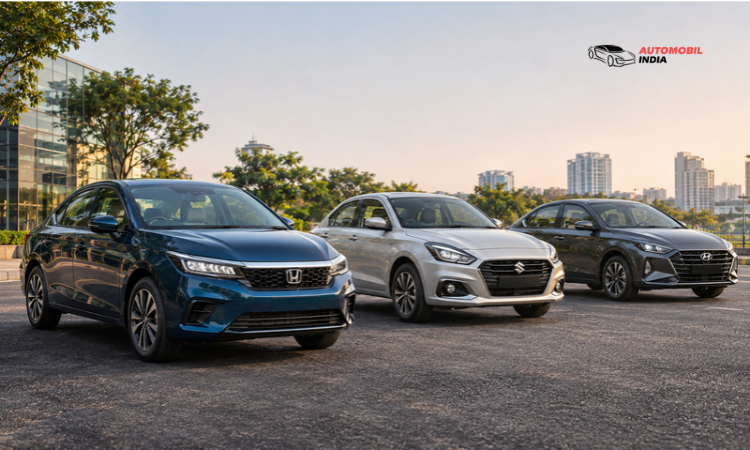
The Indian car market may be dominated by SUVs, but a sedan remains a sensible choice for buyers who value a low seating position, a separate luggage compartment, stable highway manners and a more traditional car shape.
For a 2027 buying decision, the important question is not simply which sedan has the lowest starting price. It is which car offers the right balance of purchase cost, space, safety, equipment, fuel economy, driving character and ownership support.
This guide uses the Indian-market models and published prices that could be verified on 4 November 2026. It is a practical guide for 2027 planning, not a prediction of prices or model changes during 2027. Manufacturers can revise prices, variants and equipment without notice.
At a Glance: The Sedans Worth Considering
| Model | Approximate ex-showroom price position at research date | Best suited to |
|---|---|---|
| Tata Aeris | ₹5.29 lakh to ₹9.74 lakh introductory launch prices | Budget-conscious buyers, CNG users and city families |
| Hyundai Aura | Starts at about ₹5.99 lakh; upper range around ₹8.6 lakh | Comfortable daily commuting and factory CNG choice |
| Maruti Suzuki Dzire | ₹6.30 lakh to ₹9.41 lakh on the listed petrol range; CNG and AMT options | Fuel-conscious families and broad service reach |
| Honda Amaze (third generation) | Starts at about ₹7.65 lakh; top listed price around ₹10 lakh | Buyers wanting a compact sedan with a roomy boot and safety credentials |
| Honda City | Starts at about ₹11.99 lakh; some variants exceed ₹15 lakh | Rear-seat comfort, refinement and a more premium cabin |
| Hyundai Verna | Starts at about ₹10.99 lakh; higher variants exceed ₹15 lakh | Feature-rich equipment and a choice of naturally aspirated or turbo petrol |
| Škoda Slavia | Starts at ₹9.99 lakh; selected 1.0 TSI variants reach ₹14.94 lakh | Highway ability, strong performance and premium-sedan space |
| Volkswagen Virtus | Starts at about ₹10.70 lakh; selected lower variants fit the budget | Enthusiasts who want a stable, engaging sedan |
Prices are indicative ex-showroom figures, not on-road prices. Tata Aeris prices quoted above were introductory prices reported at launch. The Honda City entry price is based on the manufacturer’s current 2026 listing; individual variant prices vary.
How to Interpret the ₹15 Lakh Budget
There are two common meanings of “under ₹15 lakh”. Some shoppers mean a car whose ex-showroom price is below ₹15 lakh. Others mean the final on-road amount they will pay. This distinction changes the shortlist considerably.
Ex-showroom price is the manufacturer’s listed vehicle price before state registration charges, road tax, insurance and other applicable costs. On-road price is the amount required to drive the car away after those items and any selected accessories or extended warranty are included.
This guide therefore treats ₹15 lakh primarily as an ex-showroom ceiling, matching the way manufacturer and automotive-market price lists are generally presented.
1. Tata Aeris: A Feature-Focused Compact Sedan with Petrol and CNG Choices
The Tata Aeris is the newest name in this shortlist. Launched in September 2026, it replaces the outgoing Tigor in Tata’s personal-buyer compact-sedan story and is essentially a substantial facelift of that model rather than an entirely unrelated new platform.
Tata offers five trims: Smart, Pure, Pure+, Creative and Accomplished. Petrol and CNG powertrains are offered, with manual and AMT choices on most of the range. The Smart trim is manual-only.
The trim walk matters. The entry Smart is deliberately basic, with safety essentials and a simple cabin but no touchscreen audio system.
That equipment spread makes the Aeris unusually interesting for a compact sedan buyer who wants technology without moving into a larger, more expensive car. However, the features are trim-dependent.
The Aeris should appeal to buyers who spend most of their time in the city, want a separate boot, need a CNG option or prefer a feature-rich upper trim at a compact-sedan price.
2. Hyundai Aura: A Sensible City Sedan with Petrol and Factory CNG
The Hyundai Aura is aimed at buyers who want an uncomplicated compact sedan with a familiar petrol engine, a factory-fitted CNG option and the convenience of an AMT on selected petrol variants.
The petrol engine is a 1.2-litre Kappa unit. Hyundai also offers its Hy-CNG configuration, which is relevant to owners with predictable daily running and access to reliable CNG stations.
Aura’s appeal is its easy-to-understand package. It is compact enough for crowded streets and parking spaces, yet the sedan body provides a separate boot.
The Aura makes sense for a buyer whose priorities are city usability, moderate purchase cost, CNG availability and familiar service access.
3. Maruti Suzuki Dzire: A Strong All-Rounder for Mileage and Everyday Ownership
The latest Dzire is one of the most compelling choices for buyers who prioritise running costs and practical family use.
The Dzire uses a 1,197cc Z-Series petrol engine. Maruti’s published figures include 24.79km/l for the petrol manual and 25.71km/l for the petrol AGS.
The Dzire’s main advantage is the breadth of its value proposition. The compact dimensions help in town, the 382-litre boot is useful for luggage, and the range offers manual, petrol AMT and CNG choices.
Safety is a major part of the Dzire’s case. Bharat NCAP lists a five-star rating for the petrol Dzire, with 29.46 out of 32 points for adult occupant protection and 41.57 out of 49 for child occupant protection.
For high daily running, the CNG version deserves serious consideration. It can lower fuel expenditure per kilometre, but the decision depends on local CNG prices, station availability, queue times and how much boot flexibility the CNG system leaves in the chosen model.
The Dzire is not the most powerful sedan here, and buyers who regularly travel with five adults and luggage may prefer the larger cabin of the City, Verna, Slavia or Virtus.

4. Honda Amaze: Compact Dimensions, a Useful Boot and Strong Safety Credentials
The third-generation Honda Amaze occupies a slightly more premium position than the entry-level compact sedans. Honda lists the new Amaze from about ₹7.65 lakh ex-showroom, with the range reaching approximately ₹10 lakh in the price information available at the research date.
Honda’s official page lists a 1,199cc petrol engine, a five-speed manual and CVT automatic, and a claimed fuel-efficiency figure of 19.46km/l. The car has a 416-litre boot, which is a useful headline for buyers who routinely carry suitcases, shopping or a child’s pushchair.
A major strength is its Bharat NCAP result. The third-generation Amaze received five stars for adult occupant protection, scoring 28.33 out of 32, and four stars for child occupant protection, scoring 40.81 out of 49.
Honda Sensing is another notable feature. The system uses a front camera and includes driver-assistance functions designed to alert or assist in specific situations.
The Amaze is a good match for a buyer who wants a compact footprint but does not want to compromise on boot capacity, automatic convenience or safety credentials. It is also a logical step up from the most affordable compact sedans if the budget allows.
5. Honda City: A More Mature Sedan Experience, but Choose the Variant Carefully
The Honda City is a larger and more premium sedan than the compact models above. Honda’s 2026 India website lists the new City from ₹11.99 lakh, with petrol and strong-hybrid powertrains.
The petrol City uses a 1.5-litre i-VTEC engine. Honda lists 121PS and 145Nm for the petrol engine, with claimed fuel efficiency of 17.77km/l for the manual and 17.97km/l for the CVT. The e:HEV uses a two-motor strong-hybrid system and an e-CVT, with a claimed 27.26km/l.
The City’s appeal is its roomy cabin, comfortable rear seating, mature road manners and the sense of space associated with a larger sedan.
The entry-level SV manual is the most relevant City for a strict ₹15 lakh ex-showroom comparison.
The strong-hybrid City is a different proposition. Its claimed efficiency is attractive, particularly for owners who cover many kilometres in mixed traffic, but the hybrid grade costs substantially more than the entry petrol model.
6. Hyundai Verna: Equipment, Cabin Technology and a Choice of Engines
The Hyundai Verna is a premium mid-size sedan whose entry variant sits within the ₹15 lakh ex-showroom bracket. Hyundai lists a starting price of approximately ₹10.99 lakh. Its higher trims and turbo-petrol configurations can exceed ₹15 lakh, so the budget covers only selected versions.
The Verna offers a 1.5-litre MPi naturally aspirated petrol engine and a 1.5-litre Turbo GDi petrol engine.
Hyundai highlights a dual 10.25-inch integrated display arrangement, a Bose sound system on selected versions, projector lighting and a wide set of convenience features.
The Verna makes sense for buyers who want a modern, technology-led cabin and the option of a stronger turbo engine in the broader range.
For a ₹15 lakh ceiling, the key is not to be drawn towards the most powerful or feature-rich version before checking the on-road price. The entry and selected mid trims may fit the ex-showroom cap, but an automatic or turbo variant can change the equation.
7. Škoda Slavia: A Compelling Premium Sedan with a New 2026 Update
The updated Škoda Slavia is one of the most important additions to the 2027 shortlist because its revised range was launched in October 2026. The official starting price is ₹9.99 lakh ex-showroom. Škoda offers six trims: Classic, Classic+, Signature, Sportline, Prestige and Monte Carlo.
The 1.0 TSI is offered with a six-speed manual and an eight-speed torque-converter automatic. The 1.5 TSI is paired with a seven-speed DSG automatic.
Škoda’s October 2026 price announcement lists the Classic 1.0 MT at ₹9.99 lakh, Classic+ 1.0 MT at ₹10.99 lakh and Classic+ 1.0 AT at ₹12.49 lakh. The Signature 1.0 MT is ₹13.94 lakh and Signature 1.0 AT is ₹14.94 lakh.
The updated Slavia adds features such as a 360-degree Area View camera, front and rear parking sensors, a 25.6cm touchscreen with connectivity and AI assistant functions, ventilated front seats on selected higher trims and a rear-seat massage function.
The Slavia’s 521-litre boot and long wheelbase make it a practical choice for family highway use. Its size, however, requires more parking space than a compact sedan, and the low-slung body may need more care over tall speed breakers and broken roads when fully loaded.
The Slavia is a strong option for someone who wants a premium sedan experience without immediately moving to the highest-priced trims.
8. Volkswagen Virtus: A Driver-Focused Alternative
The Volkswagen Virtus shares its broad engineering architecture with the Slavia, but its design and trim positioning give it a different character. Volkswagen’s official site lists the Virtus from ₹10.70 lakh ex-showroom.
The 1.0 TSI produces 115PS and 178Nm and is paired with a six-speed manual or six-speed automatic. The 1.5 TSI EVO with active cylinder technology produces 150PS and 250Nm and uses a seven-speed DSG.
Volkswagen lists a 521-litre boot, a 2,651mm wheelbase and 179mm unladen ground clearance. Its official technical specifications also list certified fuel-efficiency figures of 20.08km/l for the 1.0 manual and 18.45km/l for the 1.0 automatic in the relevant specification table.
The Virtus suits buyers who enjoy a planted highway feel, turbo-petrol performance and a large boot. It is also a sensible family sedan, but rear-seat comfort and ride quality should be judged by the people who will use it most.
The main caution is the variant ladder. A starting price below ₹11 lakh does not mean every desirable feature or automatic configuration is available under ₹15 lakh. Compare the actual 1.0 TSI grade and equipment list with the Slavia’s corresponding variant. You can also compare the Volkswagen Virtus and Škoda Slavia on AutomobilIndia.
Which Sedan Should You Choose? A Buyer-Focused Comparison
| Your priority | Shortlist first | Why |
|---|---|---|
| Lowest purchase price | Tata Aeris / Hyundai Aura | Both begin in the compact-sedan price bracket |
| Factory CNG | Maruti Dzire / Hyundai Aura / Tata Aeris | All offer manufacturer-fitted CNG choices |
| Best certified fuel-efficiency headline | Maruti Dzire CNG AMT | Maruti cites 36.47km/kg under the applicable test procedure |
| Compact sedan with a large boot | Honda Amaze | Honda lists 416 litres |
| Strong compact-sedan safety credentials | Maruti Dzire / Honda Amaze | Both have five-star Bharat NCAP adult-occupant results, with different child-protection scores |
| Larger family sedan | Honda City / Hyundai Verna / Slavia / Virtus | More premium mid-size-sedan proportions and equipment |
| Turbo-petrol performance | Škoda Slavia / Volkswagen Virtus / Hyundai Verna | Turbo engines are available in the broader ranges |
| Automatic under ₹15 lakh ex-showroom | Aeris, Aura, Dzire, Amaze, selected Slavia and Virtus variants | Confirm exact grade and transmission price |
| Rear-seat comfort priority | Honda City, then Slavia / Virtus / Verna | Larger mid-size sedans are the natural starting point |
| Hybrid powertrain | Honda City e:HEV | Strong-hybrid option, but the variant price is above this budget |
This table is a starting point, not a universal ranking. “Best” depends on how many people travel regularly, whether the car is used mainly in town or on highways, how much luggage is carried, and whether the buyer can charge or refuel conveniently.
Safety: Compare the Test Result and the Equipment, Not Just the Badge
Safety should be considered in two separate ways. Crash-test ratings assess how a specific tested vehicle performed under a defined protocol. Safety equipment lists describe features fitted to a particular model or variant. Neither should be used as a substitute for the other.
The Dzire has a five-star Bharat NCAP rating, with 29.46/32 for adult occupant protection and 41.57/49 for child occupant protection. The third-generation Amaze has five stars for adult occupant protection, scoring 28.33/32, and four stars for child occupant protection, scoring 40.81/49.
These results should not be compared as if Bharat NCAP and Global NCAP were one identical test. Protocols, test dates, vehicle configurations and rating applicability matter. A rating is meaningful only when the model, variant and test protocol are understood.
When inspecting a car, confirm the number and placement of airbags, ESC, ABS with EBD, ISOFIX anchorages, three-point seatbelts and seatbelt reminders. Check whether a rear camera, parking sensors, TPMS or ADAS are standard on the chosen trim.
Mileage and Running Costs: Calculate Using Your Own Driving
A manufacturer-claimed or certified mileage figure is a standardised comparison reference. It is not a guaranteed real-world result. A petrol car used in congested city traffic with frequent idling may return a very different figure from a car driven steadily on an open road.
For high annual usage, CNG can reduce fuel cost per kilometre, but it should be assessed with the full ownership picture.
For petrol cars, compare the actual variant and transmission you intend to buy. The Dzire’s published 24.79km/l manual and 25.71km/l AGS figures are certified figures. Honda lists 19.46km/l for the Amaze.
A simple ownership calculation should include fuel, scheduled servicing, tyres, insurance renewal, warranty extensions and any loan interest. Ask each dealer for the service schedule and a written estimate for routine maintenance. Tyres can be a meaningful expense on larger, wider-wheel premium sedans.
Compare the real running cost before choosing your sedan
Estimate fuel, servicing and insurance costs to understand what each car could cost you per kilometre.
Calculate Cost Per KMFor more context on long-distance comfort, stability and luggage needs, read our guide to the best cars for highway driving in India. Buyers who prioritise rear-seat space can also explore cars suited to chauffeur-driven use.
Petrol, CNG, Automatic or Turbo: Choosing the Right Powertrain
A naturally aspirated petrol engine is generally the straightforward choice for mixed use when the buyer wants predictable response and a simpler powertrain. It is not necessarily the most exciting option, but it can suit a driver who values smooth progress and lower initial complexity.
CNG is worth considering when daily running is high and refuelling access is dependable. It can reduce fuel spending, but the CNG tank arrangement and boot practicality must be checked on the actual car.
A turbo-petrol engine suits drivers who want stronger mid-range response and more relaxed overtaking, especially on highways. The Slavia and Virtus 1.0 TSI are relevant options, while the Verna offers a turbo engine in its broader range.
An automatic gearbox is not one single technology. The AMT used in compact cars, Honda’s CVT, the Slavia’s eight-speed torque converter, the Virtus six-speed automatic and the DSG are different systems. Their responses, maintenance needs and driving feel differ.
Practical Checklist Before Booking a Sedan in 2027
- Decide whether ₹15 lakh means ex-showroom or on-road. If it is on-road, keep a substantial margin below the ex-showroom ceiling.
- Compare the exact variant, engine and gearbox. A model’s starting price may belong to a manual base trim.
- Sit in the rear seat with the people who will use it. Check knee room, headroom, seat-base support and door opening.
- Load your regular luggage into the boot. Check the opening, loading lip, hinges and whether the rear seats fold if that matters.
- Drive on a route that resembles your daily commute. Include rough roads, traffic, a flyover and parking.
- Check the safety rating’s test programme, model year and variant applicability. Do not rely on a marketing badge alone.
- Compare CNG station access and the petrol-CNG price premium before choosing a CNG model.
- Get a written on-road quotation with registration, insurance, handling or logistics charges, accessories and warranty items separated.
- Ask for the service schedule, warranty terms, roadside assistance and current waiting period in writing.
- Check the manufacturing month and year, tyre date codes and any model-year changes before delivery.
Planning to finance your next sedan?
Estimate your monthly instalment, interest payable and total loan cost before finalising a variant or booking amount.
Calculate Your Car EMIFinal Verdict: The Best Sedan Depends on the Job
For a buyer who wants the lowest-cost route into a new sedan with a modern feature list, the Tata Aeris and Hyundai Aura deserve the first look.
The Honda Amaze is a sensible step up for buyers who want a 416-litre boot, a CVT option and a strong Bharat NCAP adult-occupant result.
For buyers who want a larger, more engaging highway sedan, the updated Škoda Slavia and Volkswagen Virtus are compelling. The Slavia’s Signature 1.0 AT at ₹14.94 lakh is a rare automatic variant that fits just below the ex-showroom cap.
The buying decision
There is no single best sedan for every Indian buyer.
If fuel economy and ownership simplicity dominate, start with Dzire. If you need a CNG option, compare Dzire, Aura and Aeris. If safety credentials and a useful boot matter, assess the Amaze alongside Dzire.
Before making a decision, browse the latest sedan listings on AutomobilIndia and confirm the current price, variant equipment and availability with the manufacturer or authorised dealer.