
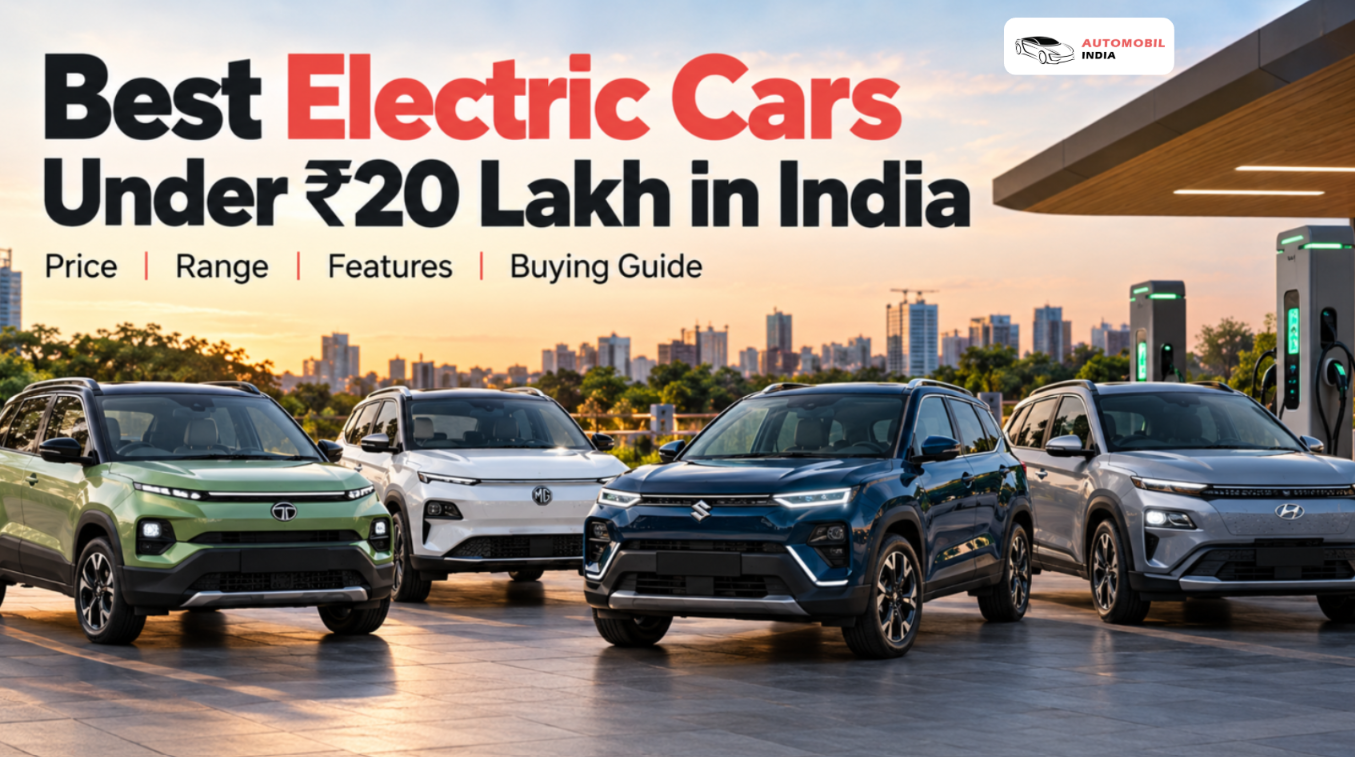
Buying an electric car in India no longer means spending a premium amount on a luxury vehicle. With more manufacturers introducing affordable electric cars, buyers can now choose from compact city EVs, family-friendly electric SUVs and feature-loaded electric vehicles within a budget of ₹20 lakh.
Models such as the Tata Punch EV, Tata Nexon EV, MG Windsor EV and Maruti Suzuki e Vitara offer different combinations of driving range, cabin space, technology and charging convenience. The right choice, however, depends on how you intend to use the car rather than just its advertised range or starting price.
For example, a compact electric car may be ideal for daily office commutes, while a family that frequently travels between cities may prefer a larger battery, faster charging and more luggage space.
In this guide, we compare the best electric cars under ₹20 lakh in India in 2026, covering indicative prices, claimed driving ranges, key strengths, charging considerations and the factors you should evaluate before purchasing an EV.
Note: Prices mentioned are indicative ex-showroom prices unless otherwise stated. They can vary by variant, city, offers and battery-rental arrangements. Check the manufacturer's website or your local dealership for the latest price and on-road quotation. Certified driving ranges are not the same as guaranteed real-world ranges.
Best Electric Cars Under ₹20 Lakh in India: Quick Comparison
| Electric Car | Indicative Starting Price | Claimed Range / Key Range Figure | Best Suited For |
|---|---|---|---|
| Tata Tiago EV | ₹6.99 lakh | Up to approximately 293 km, depending on version and certification | Budget-conscious city drivers |
| Tata Punch EV | ₹9.69 lakh | Up to approximately 468 km, depending on variant and test cycle | Urban families wanting SUV-like styling |
| Tata Nexon EV | ₹12.49 lakh | Up to approximately 489 km, depending on version | Families needing a versatile electric SUV |
| Mahindra XUV 3XO EV | Around ₹13.89 lakh | Approximately 351 km claimed | Buyers wanting a compact electric SUV |
| MG Windsor EV | Around ₹14 lakh onward | Up to 449 km, depending on battery version | Families prioritising cabin space and comfort |
| Maruti Suzuki e Vitara | Around ₹15.99 lakh onward without BaaS | Up to 543 km, depending on battery version | Buyers seeking a family electric SUV |
| Tata Curvv EV | Around ₹17.19 lakh | Up to approximately 502 km, depending on version | Buyers wanting coupe-SUV styling |
| Hyundai Creta Electric | Around ₹18 lakh onward | Up to approximately 510 km, depending on version | Buyers seeking a premium electric SUV |
| MG ZS EV | Around ₹17.99 lakh onward | Up to approximately 461 km | Buyers seeking a larger, well-equipped EV |
| Kia Carens Clavis EV | Around ₹18 lakh onward | Up to approximately 490 km, depending on version | Families needing additional seating flexibility |
Prices and range figures are indicative and refer to different versions or test cycles. The table is a shortlist, not a guarantee that every variant or its on-road price will fit within ₹20 lakh. Confirm the exact variant, applicable price and certified range before booking.
1. Tata Tiago EV: An Affordable Electric Car for City Driving
The Tata Tiago EV is worth considering if you want to move to electric mobility without spending the majority of your budget on the initial purchase.
Its compact dimensions make it suitable for crowded urban roads, office commutes and everyday errands. For households looking for a second car, it can also be a practical alternative to a petrol hatchback.
Key highlights
-
Compact dimensions for city driving and parking.
-
Multiple battery and variant options, depending on availability.
-
Regenerative braking to recover some energy during deceleration.
-
Lower routine energy costs when charging primarily at home.
Who should buy it?
The Tiago EV makes the most sense for buyers who primarily drive within the city, have predictable daily travel and can charge the vehicle overnight.
It may not be the first choice for frequent long-distance highway journeys, especially if you regularly travel through areas with limited charging infrastructure.
If you are also comparing conventional hatchbacks, read our guides to the Tata Tiago vs Maruti Suzuki Swift and Tata Tiago vs Hyundai Grand i10 Nios.
2. Tata Punch EV: A Practical Electric Car for Families
The Tata Punch EV combines compact dimensions with SUV-inspired styling, making it an appealing option for urban families.
Its relatively compact footprint is useful in traffic, while its raised seating position and practical cabin layout may appeal to buyers moving from a hatchback to an SUV-style vehicle.
The 2026 Punch EV range includes 30 kWh and 40 kWh battery options, with prices starting at approximately ₹9.69 lakh ex-showroom for the updated model. The manufacturer's published range and equipment vary by version.
Key highlights
-
Compact SUV-inspired design.
-
Multiple battery choices.
-
Useful everyday practicality.
-
Features such as regenerative braking and connected-car technology, depending on variant.
-
A lower entry price than many larger electric SUVs.
Who should buy it?
Choose the Punch EV if most of your driving involves commuting, school runs, shopping and occasional trips outside the city.
It is particularly worth comparing with the Tiago EV if you want a more SUV-like body style and are willing to spend more for additional space and features.
However, evaluate rear-seat comfort, boot space and the actual range of your preferred variant before making a decision.
3. Tata Nexon EV: A Versatile Electric SUV
The Tata Nexon EV is one of the key models to consider if you want an electric SUV for a mix of daily commuting and family travel.
It offers different battery configurations and equipment levels, allowing buyers to balance purchase price, range and features. The higher-range versions are particularly relevant for drivers who cover longer distances regularly.
Key highlights
-
SUV body style with family-oriented practicality.
-
Multiple battery and trim choices.
-
Modern infotainment and connected features, depending on variant.
-
Driver assistance and convenience equipment vary across the range.
-
A useful balance between everyday usability and longer journeys.
Who should buy it?
The Nexon EV is worth shortlisting if you need a primary family car rather than a vehicle exclusively for short city trips.
Before choosing a version, compare the smaller and larger battery options carefully. The more expensive variant may be worthwhile if your daily distance is high, but it may not offer enough additional value for someone who drives only short distances.
Check the official Tata Nexon EV price and variant page for current specifications and pricing.
4. Mahindra XUV 3XO EV: A Compact Electric SUV
The Mahindra XUV 3XO EV is another option for buyers who want SUV styling and a relatively compact vehicle for urban use.
It is positioned for customers who need the everyday practicality of an SUV without necessarily moving to a larger or more expensive electric vehicle.
Key highlights
-
Compact SUV dimensions.
-
Electric powertrain suited to everyday commuting.
-
Contemporary interior and technology features, depending on variant.
-
A price position that makes it relevant to buyers comparing electric SUVs in the mid-budget segment.
Who should buy it?
Consider the XUV 3XO EV if you want an electric SUV for regular city driving and occasional intercity travel.
Compare its certified range, charging speed, rear-seat comfort and variant-specific safety features against the Tata Nexon EV and Punch EV. Do not assume that two similarly priced electric SUVs will have equivalent range or charging performance.
5. MG Windsor EV: A Spacious Electric Car for Families
The MG Windsor EV takes a slightly different approach from traditional compact electric SUVs. Its emphasis on cabin space and passenger comfort makes it an interesting choice for families that spend considerable time in their cars.
The model is available with different battery configurations. Higher-battery versions offer a claimed range of up to 449 km under the applicable test cycle.
Key highlights
-
Spacious, lounge-inspired cabin.
-
A large infotainment display.
-
Comfort-focused seating and interior design.
-
Multiple battery and equipment options.
-
Selected versions offer additional convenience and connected features.
Who should buy it?
The Windsor EV deserves attention if you prioritise rear-seat comfort, interior space and everyday family usability over a conventional SUV silhouette.
It is also worth comparing the standard purchase arrangement with Battery-as-a-Service (BaaS), where available. BaaS reduces the initial vehicle price by separating the battery cost, but introduces a usage-based battery charge.
Important: Compare the total cost over your expected ownership period, not just the advertised starting price. A battery-rental plan may suit some drivers but be less economical for others, depending on kilometres driven and the contract terms.
Check the official MG Windsor EV website for the current variants and terms.
6. Maruti Suzuki e Vitara: An Electric SUV for Longer Journeys
The Maruti Suzuki e Vitara is an important option for buyers looking for a family-oriented electric SUV from a manufacturer with an established service network in India.
It is offered with different battery options, including 49 kWh and 61 kWh configurations. The manufacturer advertises a range of up to 543 km for the relevant version and test cycle.
Key highlights
-
Two battery capacity options.
-
SUV proportions and family-friendly positioning.
-
A claimed range suited to buyers considering longer journeys.
-
Access to the manufacturer's EV ecosystem and charging services.
-
Battery warranty terms that should be checked against the chosen variant and purchase plan.
Who should buy it?
The e Vitara is worth considering if you want a larger electric SUV and value the availability of authorised service and charging support.
However, pay attention to the exact purchase arrangement. The standard vehicle price and BaaS price are not directly comparable because the latter includes ongoing battery usage charges.
Also, do not choose a vehicle purely because it advertises a longer range. Check the availability of compatible fast chargers along the routes you regularly use.
7. Tata Curvv EV: An Electric SUV with Coupe Styling
The Tata Curvv EV targets buyers who want the practicality of an electric SUV with a more distinctive, sloping roofline.
It occupies a higher price bracket than the Punch EV and Nexon EV, so the decision involves considering design, equipment and range alongside the additional cost.
Key highlights
-
Coupe-inspired SUV styling.
-
Multiple battery and variant options.
-
A claimed range of up to approximately 502 km for the relevant version.
-
Modern cabin technology and convenience equipment, depending on variant.
-
A distinctive exterior compared with more conventional SUV designs.
Who should buy it?
The Curvv EV may suit buyers who want an electric vehicle with a more premium visual identity and are comfortable spending closer to the upper end of the ₹20 lakh budget.
Before booking, compare the top variants of the Nexon EV with the entry-level Curvv EV. The more expensive vehicle is not automatically the better value if the additional features do not matter to you.
8. Hyundai Creta Electric: A Familiar SUV Format with an Electric Powertrain
The Hyundai Creta Electric is aimed at buyers who want the format of a modern family SUV with the benefits of an electric powertrain.
Depending on the variant, the model offers different battery and range configurations, with the higher-range version advertised at up to approximately 510 km under the applicable test cycle.
Key highlights
-
Familiar midsize-SUV format.
-
Multiple battery and variant choices.
-
Modern infotainment and convenience equipment, depending on trim.
-
A range suitable for drivers considering both city use and longer journeys.
Who should buy it?
The Creta Electric is worth considering if you want an electric SUV in the premium end of this budget.
Be particularly careful with your final on-road calculation. Some higher variants may exceed ₹20 lakh after insurance, registration and other applicable charges, even if the starting price falls within the budget.
9. MG ZS EV: A Larger Electric SUV Option
The MG ZS EV is another vehicle to compare if you are considering a more premium electric SUV.
It has a larger-SUV character than smaller urban EVs and offers features such as connected technology and driver-assistance equipment on applicable versions.
Key highlights
-
A larger electric SUV format.
-
A claimed range of approximately 461 km for the relevant version.
-
Comfort and convenience features vary by trim.
-
Battery-as-a-Service pricing may be available on selected configurations.
Who should buy it?
The ZS EV could suit buyers who prioritise a premium cabin and want an electric SUV for regular family use.
Its starting price may fall within the ₹20 lakh ex-showroom budget, but higher trims can cross that threshold. Obtain a variant-specific quotation before treating it as an under-₹20-lakh purchase.
10. Kia Carens Clavis EV: An Option for Larger Families
The Kia Carens Clavis EV is worth investigating if passenger capacity and family flexibility matter more than choosing a conventional five-seat SUV.
Its electric powertrain and multi-row seating layout distinguish it from several smaller EVs in this price category.
Key highlights
-
A family-focused, multi-row body style.
-
Seating configurations designed for larger households.
-
A claimed range of up to approximately 490 km for the relevant version.
-
Technology and comfort equipment vary by variant.
Who should buy it?
Consider the Carens Clavis EV if you regularly travel with several family members and need more seating flexibility.
Before booking, check the exact seating configuration, luggage space when all seats are occupied and the final on-road price. A model that starts below ₹20 lakh may have higher variants priced well beyond the budget.
Which Electric Car Under ₹20 Lakh Should You Buy?
There is no single best EV for every Indian buyer. Your ideal choice depends on how you drive, where you charge and how much space you need.
| Your Requirement | Models Worth Shortlisting |
|---|---|
| Lowest initial purchase price | Tata Tiago EV |
| Daily city commuting with SUV styling | Tata Punch EV |
| All-round family electric SUV | Tata Nexon EV |
| Compact electric SUV alternative | Mahindra XUV 3XO EV |
| Spacious cabin and comfort | MG Windsor EV |
| Family SUV with longer claimed range | Maruti Suzuki e Vitara |
| Coupe-inspired SUV design | Tata Curvv EV |
| Premium SUV experience | Hyundai Creta Electric or MG ZS EV |
| Larger family and additional seating | Kia Carens Clavis EV |
Use this table as a starting point rather than a final ranking. Compare the same type of battery, variant, price basis and equipment before deciding which vehicle provides the best value.
Claimed Range vs Real-World Range: What Should Buyers Expect?
A car's certified driving range is useful for comparing models, but it does not tell you exactly how far the vehicle will travel in everyday conditions.
Actual range can vary because of:
-
Highway speeds and driving style.
-
Air-conditioning usage.
-
Traffic and road conditions.
-
Passenger and luggage weight.
-
Terrain and weather.
-
Battery condition and charging habits.
For example, a vehicle with a claimed range of 450 km should not automatically be assumed to cover 450 km on every trip.
Instead, estimate your regular daily distance and maintain a practical reserve for unexpected detours or charging delays. If you regularly travel long distances, compare the vehicle's usable range and fast-charging performance rather than relying on the headline figure alone.
How Much Does It Cost to Run an Electric Car in India?
One of the main reasons buyers consider an electric car is its potential to reduce running costs.
Electricity is often cheaper per kilometre than petrol or diesel when most charging takes place at home. However, actual savings depend on the local electricity tariff, vehicle efficiency, charging losses and how much you rely on public fast chargers.
A simple calculation is:
Running cost per kilometre = Electricity cost per kWh ÷ Efficiency in km per kWh
For example, assume your home electricity costs ₹8 per unit and your EV delivers an illustrative efficiency of 6 km per kWh.
₹8 ÷ 6 = approximately ₹1.33 per km.
This is an illustration, not a measured efficiency figure for any specific car. Real costs can be higher when charging losses and public charging fees are included.
To understand the financial benefit, compare your expected annual electricity costs with the fuel costs of the petrol or diesel car you would otherwise purchase. Include insurance, servicing, tyres, financing and resale value in the calculation.
Home Charging vs Public Charging
Home charging is one of the most important practical advantages of EV ownership.
If you have a dedicated parking space and a suitable electrical connection, you can often charge overnight and begin the next day with sufficient battery capacity for routine travel.
Before purchasing, check:
-
Whether a home charger is included with the vehicle.
-
Whether installation is included or charged separately.
-
Whether your parking space has a suitable electrical connection.
-
Whether your apartment society permits charger installation.
-
Whether your electrical load needs to be upgraded.
-
Which public chargers are available near your home and workplace.
For frequent highway travel, check charging availability along your actual routes. A charger appearing on an app does not guarantee that it is operational, accessible or available when you arrive.
Battery Warranty and Safety: What to Check Before Buying
The battery is one of the most valuable components of an electric car, so warranty terms deserve careful attention.
Before making a purchase, review:
-
Battery warranty duration and kilometre limit.
-
Conditions and exclusions in the warranty.
-
Vehicle warranty coverage.
-
Battery health and degradation provisions, where specified.
-
Availability of authorised service centres.
-
Roadside assistance and breakdown support.
-
Battery protection and thermal-management systems.
-
Safety equipment offered on the exact variant.
Do not assume that all EVs have identical battery warranties. Coverage can differ by manufacturer, model, variant and purchase arrangement.
Should You Buy an Electric Car Under ₹20 Lakh in 2026?
An electric car can make financial and practical sense if your travel pattern matches its capabilities.
It is especially worth considering if you have predictable daily driving, access to home or workplace charging and enough range for your regular journeys. Higher annual mileage can also increase the opportunity to recover some of the initial purchase premium through lower energy costs.
However, an EV may be less convenient if you frequently travel through regions with limited charging infrastructure or cannot charge reliably at home or work.
If you are switching from a petrol car, do not compare only the purchase prices. Estimate your total ownership costs over three to five years and consider how long you plan to keep the vehicle.
Prices, specifications and availability may change. Verify all details with the manufacturer before purchase.