
Tata Tiago vs Maruti Swift: Mileage, Features, Space and Running Cost
The Tata Tiago and Maruti Suzuki Swift are two of the most established choices for buyers looking for a compact petrol hatchback in India. Both are available with petrol and factory-fitted CNG powertrains, while automatic versions use AMT gearboxes.
For 2026, the Tiago has received a substantial update with a redesigned exterior, refreshed cabin, new displays and a longer list of features. The Swift continues with Maruti Suzuki’s 1.2-litre three-cylinder Z-Series petrol engine, with a strong focus on fuel efficiency.
The Tiago starts at ₹4.77 lakh ex-showroom, making it the lower-cost entry point. The current Swift starts at ₹5.84 lakh ex-showroom.
The biggest difference appears when you look beyond the purchase price. The Swift has a significant claimed mileage advantage, while the Tiago offers a lower entry price, a higher claimed petrol power output and a wider range of CNG and AMT combinations.
So the right choice depends largely on whether your priority is lower upfront cost, fuel efficiency, equipment, space, automatic convenience or long-term running cost.
Tata Tiago vs Swift: Quick Comparison
| Parameter | Tata Tiago | Maruti Suzuki Swift |
|---|---|---|
| Current starting price | ₹4.77 lakh | ₹5.84 lakh |
| Approx. current top price | ₹8.62 lakh | ₹8.89 lakh |
| Petrol engine | 1.2L, 3-cylinder | 1.2L, 3-cylinder |
| Petrol power | 86 hp | 81.58 PS |
| Petrol torque | 113 Nm | 111.7 Nm |
| CNG power | 75.5 hp | 69.75 PS |
| CNG torque | 96.5 Nm | 101.8 Nm |
| Petrol gearbox | 5MT / 5AMT | 5MT / 5AMT |
| CNG gearbox | 5MT / 5AMT | 5MT |
| Petrol claimed mileage | Current official figure not disclosed | 24.8 km/l MT; 25.75 km/l AMT |
| CNG claimed mileage | Current official figure not disclosed | 32.85 km/kg |
| Length | 3,813mm | 3,860mm |
| Width | 1,684mm | 1,735mm |
| Height | 1,535mm | 1,520mm |
| Wheelbase | 2,400mm | 2,450mm |
| Ground clearance | 170mm | 163mm |
| Boot space | 242 litres | 265 litres |
| Seating | 5 | 5 |
| ADAS | No | No |
| Six airbags | Yes | Yes |
| 360-degree camera | Available on higher variants | No |
| Blind-spot monitor | Available on higher variants | No |
Tata Tiago vs Swift Price
Price is the first major difference between the two.
Current ex-showroom prices
| Model | Price range |
|---|---|
| Tata Tiago | ₹4.77–8.62 lakh |
| Maruti Swift | ₹5.84–8.89 lakh |
The Tiago therefore has a considerably lower entry price, although the two cars overlap as you move towards their higher variants. Tata’s September 2026 pricing puts the Tiago between ₹4.77 lakh and ₹8.62 lakh.
Maruti Suzuki’s current official price page lists the Swift LXi MT at ₹5.839 lakh, with the higher petrol and CNG variants extending towards the ₹8–9 lakh range.
What the price gap means
The difference of roughly ₹1 lakh at the entry level is significant for a buyer working with a tight budget.
For example, someone shopping around ₹5–6 lakh ex-showroom can access a Tiago without moving deep into the variant range, whereas the Swift starts considerably higher.
At around ₹7–9 lakh, however, the comparison becomes more about equipment and powertrain rather than simply purchase price.
Tiago vs Swift: Engine and Performance
Both cars use a naturally aspirated 1.2-litre three-cylinder petrol engine, but their engine calibrations and overall driving character differ.
Tata Tiago petrol engine
The Tiago’s 1.2-litre petrol engine produces:
- 86 hp
- 113 Nm
- 5-speed manual
- 5-speed AMT
The 2026 Tiago retains the same basic petrol engine while receiving updates to the car around it.
Maruti Swift petrol engine
The current Swift uses Maruti Suzuki’s 1.2-litre Z-Series three-cylinder petrol engine.
It produces:
- 81.58 PS
- 111.7 Nm
- 5-speed manual
- 5-speed AMT
The engine also gets idle start-stop technology to help reduce fuel consumption during suitable driving conditions.
Tiago vs Swift performance
On paper, the Tiago has a small advantage in peak power and torque.
| Petrol specification | Tiago | Swift |
|---|---|---|
| Engine | 1.2L 3-cylinder | 1.2L 3-cylinder |
| Power | 86 hp | 81.58 PS |
| Torque | 113 Nm | 111.7 Nm |
| Manual | 5-speed | 5-speed |
| Automatic | 5-speed AMT | 5-speed AMT |
The difference is relatively small, so it shouldn’t be the primary reason to choose one car.
In everyday city traffic, both engines are adequate. The more important difference is that the Swift’s engine is calibrated with efficiency as a major priority, while the Tiago’s broader appeal comes from its combination of price, equipment and driving characteristics.
Tiago vs Swift Mileage
This is where the Swift has a substantial numerical advantage on paper.
Maruti Suzuki officially claims:
- 24.8 km/l for the Swift petrol manual
- 25.75 km/l for the Swift petrol AMT
- 32.85 km/kg for the Swift CNG manual
Tata has not published fresh official fuel-efficiency figures for the 2026 Tiago. Autocar’s current Tiago mileage information therefore does not list an official 2026 ARAI figure. Its experience with the pre-facelift petrol-manual model suggested more than 13 km/l in city driving and around 17 km/l on highways, but those figures should not be treated as official 2026 Tiago mileage.
Mileage comparison
| Powertrain | Tata Tiago | Maruti Swift |
|---|---|---|
| Petrol MT | Current official 2026 figure not disclosed | 24.8 km/l |
| Petrol AMT | Current official 2026 figure not disclosed | 25.75 km/l |
| CNG MT | Current official 2026 figure not disclosed | 32.85 km/kg |
| CNG AMT | Available | Not available |
The Swift therefore has a clear advantage in published certified efficiency figures.
However, certified mileage is not the same as real-world mileage.
Autocar’s controlled testing of the current Swift recorded 15.9 km/l for the AMT, while its broader testing found 16.5 km/l for the petrol version and 27.87 km/kg for the CNG version. Actual results vary with traffic, speed, air-conditioning, load and driving style.
This is why buyers should not assume that a claimed 25.75 km/l means the car will consistently deliver that figure in Indian city traffic.
Petrol vs CNG: Which Makes More Sense?
Both cars offer factory-fitted CNG, but their transmission choices differ.
Tata Tiago
- Petrol MT
- Petrol AMT
- CNG MT
- CNG AMT
Maruti Swift
- Petrol MT
- Petrol AMT
- CNG MT
The Tiago’s CNG-AMT combination is an important differentiator.
For someone who drives extensively in congested urban traffic, this means they can combine the lower running-cost potential of CNG with two-pedal convenience.
The Swift CNG, meanwhile, remains a manual-only proposition.
Tiago vs Swift: CNG Performance
The Tiago’s CNG version produces around 75.5 hp and 96.5 Nm, while the Swift CNG produces 69.75 PS and 101.8 Nm.
The Swift has slightly more CNG torque, while the Tiago has the higher power figure.
But CNG cars are primarily bought for running-cost reasons rather than outright performance.
There is another practical difference.
The Tiago uses twin CNG cylinders under the boot floor, allowing it to retain some luggage space. Autocar notes that the setup can accommodate one cabin bag and smaller soft bags.
The Swift uses a conventional CNG tank arrangement and sacrifices boot space compared with its petrol version.
Tiago vs Swift Running Cost
Running cost is not determined by mileage alone.
It depends on:
- Fuel price in your city
- Actual fuel efficiency
- Monthly kilometres
- Petrol versus CNG
- Traffic conditions
- Air-conditioning usage
- Driving style
- Maintenance
- Insurance and other ownership expenses
For a simple comparison, the basic formula is:
Fuel cost per kilometre = Fuel price ÷ Real-world fuel efficiency
For CNG:
CNG cost per kilometre = CNG price per kg ÷ Real-world km/kg
This is more useful than simply looking at the manufacturer’s maximum mileage number.
Example
Suppose a buyer drives 1,000km per month.
If a petrol car actually returns 15 km/l, it would consume approximately:
1,000 ÷ 15 = 66.7 litres
At an illustrative petrol price of ₹100/litre:
Monthly fuel cost ≈ ₹6,670
The actual figure will change substantially depending on your city and your real-world mileage.
The same calculation can be performed for CNG.
This is why the Swift’s higher certified mileage can translate into lower fuel spending if the real-world efficiency advantage is retained, while the Tiago’s lower purchase price can reduce the amount you need to spend upfront.
Purchase Price vs Running Cost
This is an important part of the Tiago vs Swift decision.
A car that saves ₹50,000–₹1 lakh on the purchase price does not automatically remain cheaper over five years if it consumes significantly more fuel.
Conversely, a more fuel-efficient car does not automatically save money overall if you drive very few kilometres every year.
The practical calculation
If you drive:
500km/month: purchase price becomes more important.
1,000km/month: fuel efficiency starts becoming more meaningful.
1,500–2,000+ km/month: CNG and fuel efficiency can have a much larger effect on total ownership cost.
Therefore, high-mileage users should look at the fuel bill over several years, while low-mileage users may place more weight on purchase price, features and comfort.
Tiago vs Swift: Dimensions and Space
The Swift is the larger car externally.
| Dimension | Tata Tiago | Maruti Swift |
|---|---|---|
| Length | 3,813mm | 3,860mm |
| Width | 1,684mm | 1,735mm |
| Height | 1,535mm | 1,520mm |
| Wheelbase | 2,400mm | 2,450mm |
| Ground clearance | 170mm | 163mm |
| Boot space | 242 litres | 265 litres |
The Swift is 47mm longer, 51mm wider and has a 50mm longer wheelbase than the Tiago. Its quoted petrol boot capacity is also 23 litres greater.
This difference matters more inside the cabin than it does when parking.
The Swift’s wider body and longer wheelbase give it more room for passenger packaging.
The Tiago, on the other hand, is slightly taller and has more ground clearance.
Which Has More Rear Seat Space?
The Swift’s 2,450mm wheelbase is one of its practical advantages.
The Tiago’s 2,400mm wheelbase is relatively short for this group, and Autocar’s comparison identifies it as the smallest wheelbase among the Tiago’s key hatchback rivals.
For two adults in the rear, both cars can work well.
For families regularly carrying three adults in the back, the Swift’s additional width is useful.
The Tiago’s cabin is still practical for everyday family use, but buyers who regularly travel with four or five occupants should physically test the rear seats before deciding.
Tiago vs Swift: Boot Space
The Swift has the larger quoted petrol boot:
- Tiago: 242 litres
- Swift: 265 litres
The difference is not enormous, but it can matter when carrying:
- Two medium bags
- Shopping
- Baby equipment
- Small luggage
- Office bags
The situation changes with CNG.
Both cars sacrifice luggage capacity because of their CNG hardware, although Tata’s twin-cylinder packaging allows the Tiago to retain some usable space underneath the boot floor.
If boot space is important, check the actual CNG version rather than assuming the petrol specification applies.
Tiago vs Swift: Ground Clearance
The Tiago has 170mm of ground clearance, while the Swift has around 163mm in the current specification data.
The 7mm difference may not sound significant, but Indian roads can make small differences useful.
The Tiago can offer a little more clearance over:
- Large speed breakers
- Broken patches
- Steep ramps
- Rough residential roads
However, tyre condition, wheelbase and approach angle also affect how a car handles poor roads. Ground clearance alone does not determine rough-road capability.
Tiago vs Swift: Features
Both cars have received substantial equipment for their segment.
Tata Tiago features
Depending on variant, the 2026 Tiago offers:
- 10.25-inch touchscreen infotainment system
- Fully digital driver’s display
- Wireless Android Auto and Apple CarPlay
- Dual wireless charging pads
- Automatic climate control
- Rear AC vents
- Cruise control
- Cooled glovebox
- Connected-car technology
- 65W USB Type-C charging
- 360-degree camera
- Blind-spot monitor
- Rain-sensing wipers
- Height-adjustable driver’s seat
- Push-button start on higher variants
The 2026 update significantly expanded the Tiago’s feature list.
Maruti Swift features
Depending on variant, the Swift offers:
- SmartPlay Pro+ touchscreen
- Wireless Android Auto and Apple CarPlay
- Automatic climate control
- Wireless charger
- Rear AC vents
- Cruise control
- Height-adjustable driver’s seat
- LED lighting on higher variants
- Alloy wheels
- Reverse camera
- Connected-car functions
- 60:40 split rear seats
Maruti’s official Swift page confirms features such as wireless charging, rear AC vents, automatic climate control and 60:40 split rear seats, with equipment varying by variant.
Feature difference that matters
The Tiago’s 360-degree camera and blind-spot monitor are notable features in this price segment.
The Swift’s equipment list is less unusual, but it covers the everyday essentials well.
Therefore, buyers who value technology and parking assistance may find the Tiago’s higher variants more interesting, while those who want a straightforward, well-equipped hatchback can find suitable Swift variants.
Tiago vs Swift: Safety
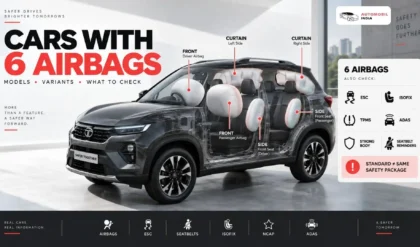
Both cars currently offer six airbags as standard.
The Swift’s standard safety equipment includes:
- Six airbags
- ABS with EBD
- Electronic Stability Program
- Hill Hold Assist
- ISOFIX
- Reverse parking sensors
Maruti Suzuki explicitly lists six airbags, ABS with EBD, ESP, hill-hold assist and ISOFIX as part of the Swift’s safety package.
The 2026 Tiago also gets six airbags, ABS with EBD, ESC, traction control, ISOFIX and other safety equipment, with features varying by variant.
What about crash-test ratings?
This requires careful interpretation.
The previous Tiago was awarded a four-star Global NCAP rating, but that result belongs to the earlier tested model. The current 2026 Tiago has not received a published Bharat NCAP rating in the current database.
The current Swift also does not have a published Bharat NCAP rating in the current database.
Global NCAP’s historical Swift tests include older versions and should not be presented as the safety rating of the current Swift.
Therefore, this comparison should not assign a current star rating to either car.
ADAS
Neither the Tiago nor Swift offers a full Level 2 ADAS package.
The Tiago’s blind-spot monitor and 360-degree camera are useful driver-assistance features, but they are not equivalent to systems such as autonomous emergency braking or lane-keeping assistance.
Tiago vs Swift: Automatic Gearbox
Both cars use AMT automatic transmissions.
The basic benefit is the same: you get two-pedal driving without the cost and complexity associated with a conventional torque-converter automatic or dual-clutch transmission.
Tiago AMT
The Tiago offers AMT with both petrol and CNG.
That makes it particularly relevant to:
High daily running + CNG + heavy traffic + preference for automatic driving.
Swift AMT
The Swift offers AMT with petrol.
The CNG version remains manual-only.
For someone who specifically wants an automatic CNG hatchback, this difference can be more important than the petrol mileage gap.
Tiago vs Swift: Driving in the City
Both cars are well suited to urban use, but they have different strengths.
The Tiago’s smaller dimensions make it easy to manoeuvre, while its 4.9m turning radius and relatively upright proportions work well in tight streets.
The Swift is longer and wider but remains compact enough for city driving. Its 4.8m turning radius and light controls make it easy to use in traffic.
The Swift’s biggest advantage in the city is likely to be its fuel efficiency.
The Tiago’s advantages are its lower purchase price, higher ground clearance and broader CNG-AMT availability.
Tiago vs Swift: Highway Driving
The Swift’s longer wheelbase and wider body give it a more substantial footprint on the road.
The Tiago is also capable of highway use and has a suspension setup that Autocar found well controlled, with confident body control and good ride quality over poor surfaces.
The engines in both cars are naturally aspirated 1.2-litre units, so neither should be treated as a performance hatchback.
For regular highway travel, factors such as:
- Number of passengers
- Overtaking frequency
- Luggage
- Tyre choice
- Driving speed
- Highway quality
will have more impact on the experience than the small difference in peak engine output.
Tiago vs Swift: Ride Quality and Comfort
The Tiago has traditionally been appreciated for its ride quality, and the 2026 version retains this characteristic.
Autocar describes the updated Tiago as having a good balance between firmness and comfort, with controlled body movements and reassuring highway behaviour.
The Swift is also tuned for everyday comfort and urban usability.
The Tiago’s additional ground clearance can be useful on poor roads, while the Swift’s longer wheelbase helps with cabin packaging.
For Indian buyers dealing with broken roads, speed breakers and uneven surfaces, the Tiago’s 170mm clearance is a useful specification to consider.
Tiago vs Swift: Maintenance and Ownership
Purchase price and fuel economy are only two parts of ownership cost.
You should also consider:
- Scheduled service costs
- Insurance
- Tyres
- Brake components
- Battery
- CNG-system maintenance
- Resale value
- Dealer/service access
- Annual driving distance
Maruti Suzuki’s extensive service network is a relevant ownership consideration for buyers who live outside major cities, although service availability can vary by location.
Tata’s network has expanded significantly, but buyers should still check the quality and convenience of the nearest authorised service centre rather than assuming every dealership provides the same ownership experience.
For a buyer planning to keep the car for many years, the nearest service centre and actual local support can be more important than small differences in brochure specifications.
Tiago vs Swift: Which Has the Lower Running Cost?
If we look strictly at published fuel-efficiency figures, the Swift has the advantage.
Its claimed figures are:
- 24.8 km/l petrol MT
- 25.75 km/l petrol AMT
- 32.85 km/kg CNG MT
Tata has not released a fresh official mileage figure for the 2026 Tiago, so it would be misleading to put an unsupported number beside the Swift and call it a direct comparison.
However, the Tiago has another financial advantage:
its lower purchase price.
This creates two different ownership scenarios.
If you drive relatively little
The Tiago’s lower upfront cost can carry more weight.
If you drive a lot
The Swift’s higher fuel efficiency becomes increasingly important.
If you drive a lot and want CNG + automatic
The Tiago’s CNG-AMT combination becomes particularly relevant because the Swift does not offer an automatic CNG version.
Tiago vs Swift: Variant Choice
The 2026 Tiago is available in 20 variants across six trim levels:
- Smart
- Pure
- Pure+
- Pure+ A
- Creative
- Creative+
Petrol and CNG powertrains are available with manual and AMT combinations depending on variant.
The Swift has 12 variants across five trims:
- LXi
- VXi
- VXi (O)
- ZXi
- ZXi+
Petrol is available with manual and AMT transmissions, while CNG variants use a manual gearbox.
Which range is simpler?
The Swift has fewer variants, making the buying decision somewhat easier.
The Tiago’s larger number of combinations gives buyers more flexibility, but it also means you need to pay closer attention to exactly what each trim includes.
Which Tiago Variant Makes Sense?
The Smart is aimed at buyers who want to minimise the purchase price.
The Pure and Pure+ variants add equipment while keeping the price within the mainstream part of the range.
The Pure+ A becomes relevant for buyers looking for additional convenience features such as cruise control and automatic climate control.
The Creative and Creative+ variants are for buyers who want the more extensive technology package, including features such as larger displays and higher-end equipment.
For high-running buyers, the CNG-AMT variants deserve particular attention because that combination is not available on the Swift.
Which Swift Variant Makes Sense?
The LXi is primarily about keeping the purchase price down.
The VXi adds important everyday equipment and is likely to make more sense for buyers who want a more usable feature package.
The VXi (O) adds further equipment without moving directly to the top trim.
The ZXi and ZXi+ are aimed at buyers who want more styling, convenience and technology features.
The current Swift range offers the same basic 1.2-litre petrol engine across these trims, with the higher variants adding equipment rather than changing the fundamental powertrain.
Tiago vs Swift: Who Should Buy Which?
Consider the Tata Tiago if:
- Your purchase budget is limited
- You want a lower entry price
- You want CNG with an automatic gearbox
- You want a 360-degree camera
- You want blind-spot monitoring
- You regularly drive over poor roads
- You want a wide range of petrol/CNG/AMT combinations
- You prefer higher equipment at a relatively low price
The Tiago makes particular sense for buyers who want maximum flexibility within a lower purchase budget.
Consider the Maruti Swift if:
- Fuel efficiency is a major priority
- You drive a high number of kilometres
- You want a larger cabin footprint
- You want a larger petrol boot
- You want petrol AMT convenience
- You prefer a proven Maruti ownership ecosystem
- You want factory CNG but are comfortable with a manual gearbox
The Swift is particularly relevant for buyers who place fuel economy and everyday efficiency high on the priority list.
Tiago vs Swift: Key Differences
| Requirement | Tata Tiago | Maruti Swift |
|---|---|---|
| Lower starting price | ✓ | |
| Higher claimed petrol efficiency | ✓ | |
| Higher claimed CNG efficiency | ✓ | |
| CNG automatic | ✓ | |
| Petrol automatic | ✓ | ✓ |
| Larger boot | ✓ | |
| Longer wheelbase | ✓ | |
| Wider body | ✓ | |
| Higher ground clearance | ✓ | |
| 360-degree camera | ✓ | |
| Blind-spot monitor | ✓ | |
| Lower purchase budget | ✓ | |
| More compact dimensions | ✓ | |
| Six airbags standard | ✓ | ✓ |
Tata Tiago vs Maruti Swift: Final Takeaway
The Tiago vs Swift comparison is not simply a question of choosing between two small petrol hatchbacks. Their priorities are different enough that the better fit depends on how you intend to use the car.
The Tata Tiago starts at a significantly lower price and offers a wider combination of petrol, CNG, manual and AMT powertrains. Its 2026 update also brings a substantially richer equipment package, including features such as a 10.25-inch touchscreen, 360-degree camera and blind-spot monitoring on higher variants.
The Maruti Swift costs more to enter, but its current 1.2-litre petrol engine has significantly higher certified efficiency figures: 24.8 km/l with the manual and 25.75 km/l with the AMT. Its CNG version is rated at 32.85 km/kg.
The Swift is also physically larger, with a 2,450mm wheelbase and 265-litre petrol boot compared with the Tiago’s 2,400mm wheelbase and 242-litre boot.
The decision therefore becomes fairly straightforward once your priorities are clear:
- Lower upfront price: Tiago
- Published fuel-efficiency figures: Swift
- CNG + automatic: Tiago
- Larger cabin footprint: Swift
- Larger petrol boot: Swift
- Higher ground clearance: Tiago
- 360-degree camera: Tiago
- High annual running: Swift’s efficiency deserves greater weight
- High annual running + automatic + CNG: Tiago deserves closer consideration
Rather than comparing the base prices alone, buyers should compare similarly equipped variants at the same on-road budget and then calculate fuel costs using their own monthly kilometres.
Frequently Asked Questions
Is Tata Tiago cheaper than Maruti Swift?
Yes. The current Tiago starts at ₹4.77 lakh ex-showroom, while the Swift starts at ₹5.84 lakh. The Tiago therefore has the lower entry price by more than ₹1 lakh.
Which has better mileage, Tiago or Swift?
The Swift has the higher published certified mileage. It is rated at 24.8 km/l with the petrol manual, 25.75 km/l with the petrol AMT and 32.85 km/kg with CNG. Tata has not published a fresh official 2026 Tiago mileage figure.
Which has more power, Tiago or Swift?
The Tiago’s petrol engine produces 86 hp and 113 Nm, while the Swift produces 81.58 PS and 111.7 Nm. The difference is relatively small in everyday driving.
Does the Tiago have CNG automatic?
Yes. The 2026 Tiago is available with a 5-speed AMT in both petrol and CNG configurations.
Does the Swift CNG have an automatic gearbox?
No. The current Swift CNG is available with a 5-speed manual gearbox. The AMT is offered with petrol variants.
Which has more boot space, Tiago or Swift?
The Swift has the larger quoted petrol boot at 265 litres, compared with 242 litres for the Tiago. CNG versions have different luggage-space arrangements because of their gas-storage systems.
Which has more space inside?
The Swift has a 50mm longer wheelbase and is 51mm wider than the Tiago, giving it an advantage in overall cabin packaging. The Tiago remains practical for a small family but is the smaller car of the two.
Which is better for city driving?
Both are suitable for city driving. The Tiago is slightly smaller and has greater ground clearance, while the Swift offers stronger published fuel-efficiency figures. Buyers who spend long hours in traffic should also consider whether they want petrol AMT or CNG, since only the Tiago offers CNG with an automatic gearbox.
Does the Tiago have a 360-degree camera?
Yes. The 2026 Tiago offers a 360-degree camera on higher variants, along with a blind-spot monitor.
Do the Tiago and Swift have ADAS?
No. Neither the current Tiago nor Swift offers a full Level 2 ADAS package. Features such as the Tiago’s 360-degree camera and blind-spot monitor are useful driver-assistance technologies but are not equivalent to ADAS functions such as autonomous emergency braking or lane-keeping assist.