
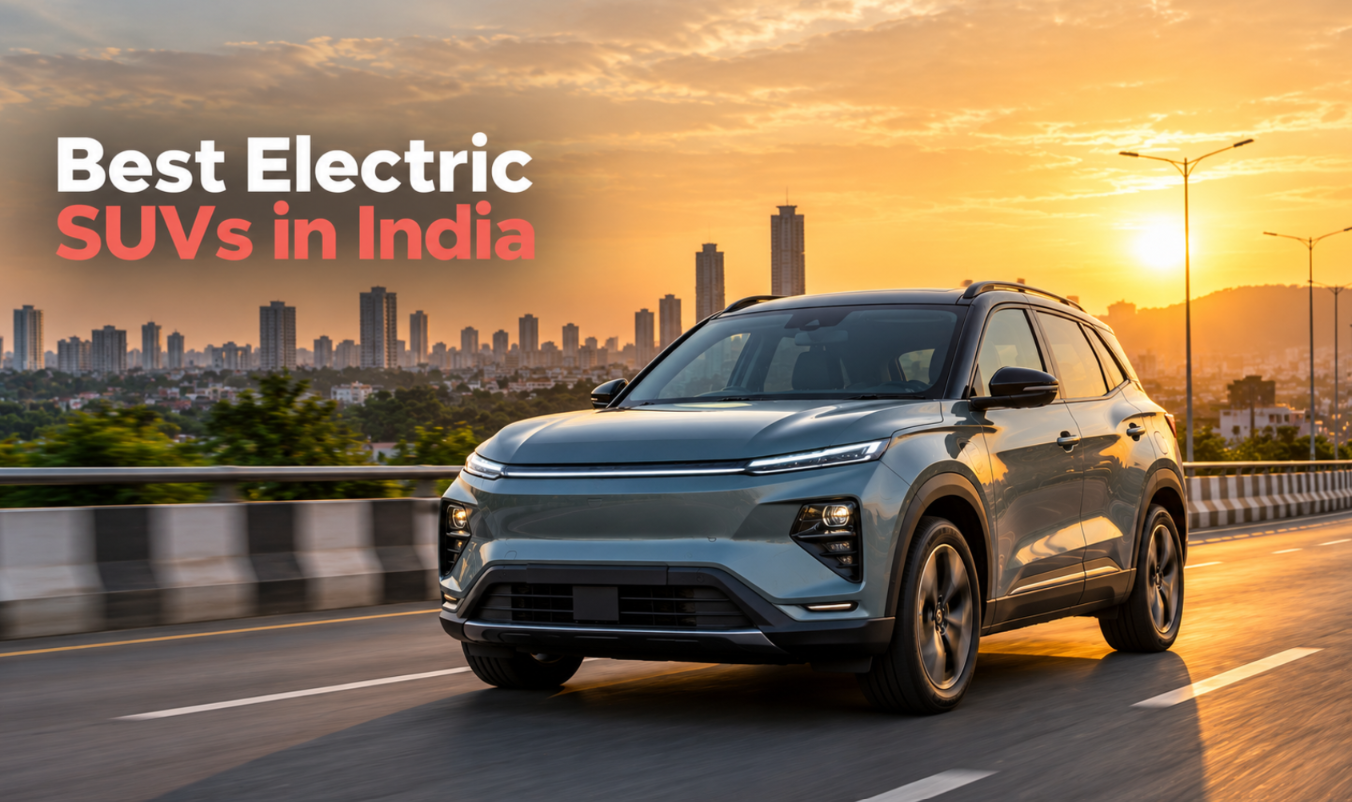
The best electric SUV in India is not necessarily the one with the biggest battery or the longest certified range. For most buyers, the right choice depends on the distance covered every day, access to home charging, highway frequency, rear-seat comfort, luggage space, charging speed and the strength of the service network. A claimed range figure is useful for shortlisting, but it should not be treated as a guaranteed distance in everyday driving.
Electric SUVs worth shortlisting in India
The Indian market now covers compact, midsize and premium electric SUVs. The following shortlist focuses on mainstream family choices and models whose battery, range and charging information is publicly available. Prices and variant availability change frequently, so confirm the exact version and city quotation before booking.
|
Model |
Battery / claimed range (indicative) |
Best suited to |
|
Tata Punch EV |
30 / 40 kWh; up to 468 km claimed on the relevant version |
City-focused households wanting a compact SUV format |
|
Tata Nexon EV |
45 kWh; up to 489 km claimed |
Family use with a mix of city and intercity driving |
|
MG Windsor EV Pro |
52.9 kWh; up to 449 km claimed |
Cabin space and rear-seat comfort |
|
Maruti Suzuki e Vitara |
49 / 61 kWh; up to 440 / 543 km claimed |
Buyers prioritising a larger SUV and established dealer network |
|
Tata Curvv EV |
55 kWh; up to 502 km claimed |
Coupe-SUV styling with family utility |
|
Hyundai Creta Electric |
42 / 51.4 kWh; up to 473 km in published figures |
Premium family-SUV experience |
|
Mahindra BE 6 |
Battery options vary by version; up to 683 km claimed on selected pack |
Performance-oriented long-range SUV buyers |
|
Tata Harrier EV |
65 / 75 kWh; up to 627 km claimed |
Larger SUV format and selected all-wheel-drive configurations |
The figures above are manufacturer/certification claims or published variant figures, not a like-for-like independent test. Battery sizes, certification cycles and model-year updates differ. Use the comparison as a starting point, not a definitive ranking.
1. Tata Punch EV: compact and city-friendly
The Punch EV is a sensible starting point for buyers who want a raised driving position and compact exterior dimensions. It is easier to place in tight urban parking than a larger SUV, while the available battery options allow buyers to choose between lower upfront cost and additional range. It is best suited to predictable daily travel, especially when overnight home charging is available.
2. Tata Nexon EV: versatile family option
The Nexon EV sits in the middle of the market and is worth considering for households that want one EV to handle commuting, errands and occasional intercity travel. The 45 kWh version has a published claimed range of up to 489 km. Buyers should still check practical range, boot requirements, rear-seat comfort and the exact charging specification of the selected variant.
3. MG Windsor EV Pro: cabin-first practicality
The Windsor EV Pro is aimed at buyers who value cabin space and rear-seat comfort. Its 52.9 kWh battery is associated with a claimed range of up to 449 km. The vehicle's more lounge-like rear-seat focus may appeal to families who spend considerable time in traffic or use a chauffeur-driven arrangement. Compare its BaaS and battery-included purchase options carefully if both are offered.
4. Maruti Suzuki e Vitara: family SUV proposition
The e Vitara offers 49 kWh and 61 kWh battery options, with published range figures reaching 543 km for the larger pack. It deserves a place on the shortlist for buyers who value a conventional SUV layout and want to evaluate the reach of the manufacturer's dealer and service network in their region. Confirm the exact drive configuration, variant equipment and charging performance before deciding.
5. Tata Curvv EV: style-led electric SUV
The Curvv EV combines a coupe-inspired roofline with the footprint and elevated stance of an SUV. The 55 kWh version has a claimed range of up to 502 km. Its sloping roof design is a styling differentiator, but buyers should sit in the rear seat and test luggage loading with their own family before choosing it over a more upright SUV.
6. Hyundai Creta Electric: familiar premium format
The Creta Electric brings an established nameplate into the electric segment, with 42 kWh and 51.4 kWh battery options and published range figures up to 473 km. It may suit buyers who want a familiar midsize-SUV format and a well-equipped cabin. Compare the variant's AC charging capability, DC charging curve, warranty and service support in your city.
7. Mahindra BE 6 and Tata Harrier EV: longer-distance and performance choices
The BE 6 is positioned around performance, distinctive design and larger battery options. The Harrier EV targets buyers who want a bigger SUV footprint and selected all-wheel-drive capability. These vehicles can be attractive for longer journeys, but the buyer should consider purchase price, tyre replacement costs, insurance, charging stops and the practical dimensions of their parking space.
Claimed range versus real-world range
Certified range is measured under a prescribed test cycle. Real-world results change with speed, temperature, traffic, elevation, tyre pressure, passengers, luggage and air-conditioning use. Highway driving at sustained speeds can reduce range compared with slower urban use. Independent test results can help, but even those are specific to a route, weather, vehicle version and test method.
Before choosing a long-range model, compare our linkreal-world range test results for popular Indian electric carshttps://automobilindia.com/news/real-world-range-test-results-for-popular-indian-electric-cars.
Charging: what matters more than the headline kW figure
Check both AC and DC charging. AC charging is usually the everyday home or workplace solution, while DC fast charging matters on road trips. A vehicle's maximum DC input is only one part of the equation: the charging curve, battery temperature management, connector compatibility and the time taken over a useful window such as 10–80% matter too.
-
Confirm whether a home wall box is included and whether installation is covered.
-
Check the vehicle's maximum AC input, not only the wall-box rating.
-
Compare the quoted 10–80% DC time and the charger power required to achieve it.
-
Map reliable chargers along your regular highway routes.
-
Check charging access at your apartment or workplace before paying a booking amount.
Practicality checklist for family buyers
|
What to assess |
Why it matters |
|
Rear-seat space and ingress |
Children, elderly passengers and child seats need easy access. |
|
Boot and cabin storage |
A sloping roof or large battery packaging can affect usable luggage space. |
|
Ground clearance and underbody protection |
Important on broken roads, steep ramps and speed breakers. |
|
Turning circle and width |
Large SUVs can be difficult in older parking structures and narrow lanes. |
|
Tyres and repair support |
Large wheels can increase replacement costs; check local availability. |
|
Service reach and roadside assistance |
A nearby EV-trained workshop matters if a high-voltage fault occurs. |
How to choose the right electric SUV
-
Set a realistic budget including insurance, charger installation and financing.
-
Estimate your normal daily kilometres and occasional longest journey.
-
Decide whether home or workplace charging is genuinely available.
-
Choose a real-world range buffer rather than planning to arrive at zero per cent.
-
Test the rear seat, boot, visibility, ride comfort and parking manoeuvres.
-
Read battery warranty terms, transferability and battery health provisions.
-
Compare total ownership cost, including electricity, tyres, insurance and resale uncertainty.
For a family that mostly drives in the city, a compact EV with reliable home charging may be more sensible than paying extra for a very large battery. Frequent highway travellers should give more weight to charging speed, route infrastructure and a realistic range buffer. The best electric SUV is the one that fits the family's actual use rather than the most impressive specification sheet.