
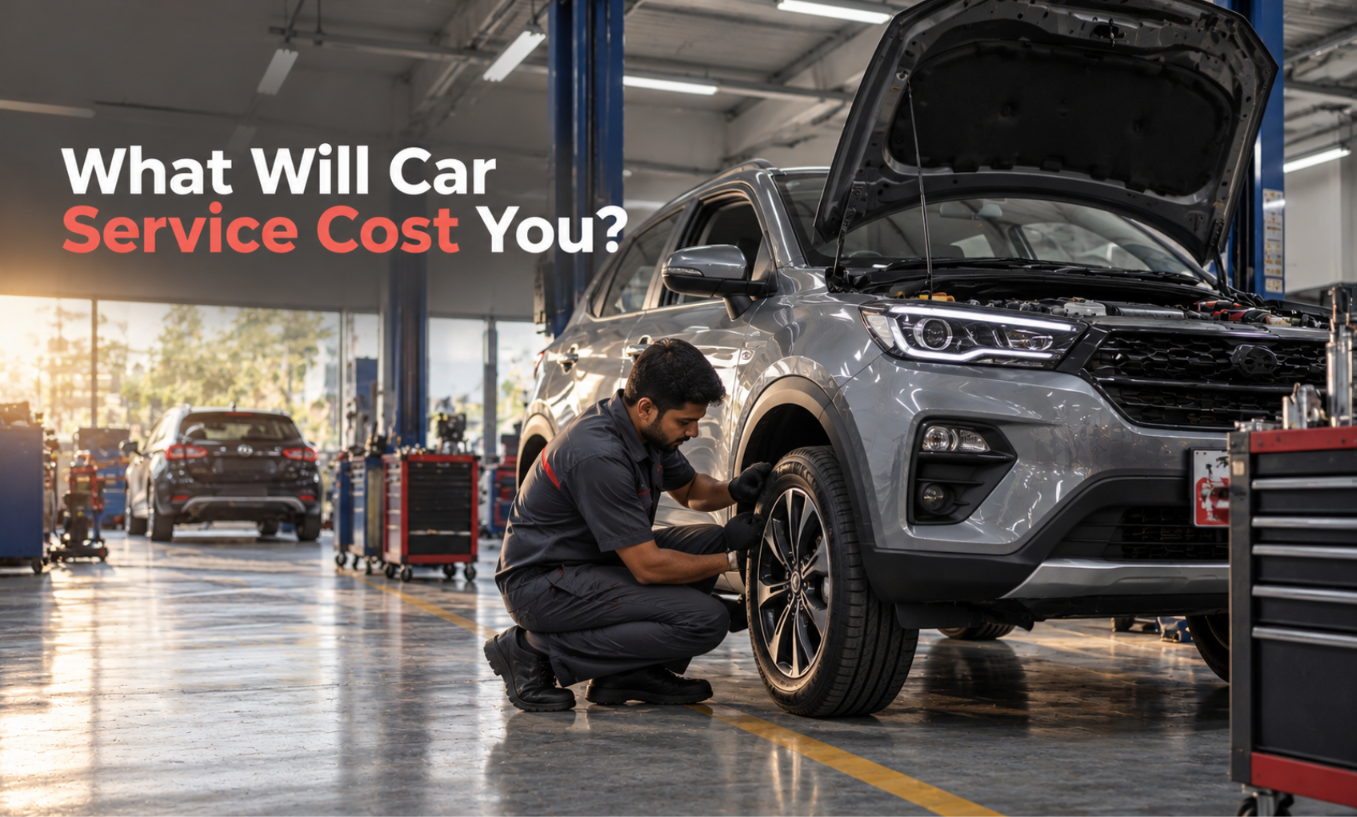
A car’s annual service bill is not just the amount paid at the workshop. It also includes wear items that need replacing over time, such as tyres, brake pads, wiper blades and the 12-volt battery. A realistic budget separates routine servicing from periodic replacements and unexpected repairs.
As a broad 2026 planning guide, a mainstream hatchback owner may set aside around ₹12,000–₹22,000 a year, while a compact SUV may need roughly ₹20,000–₹34,000 when routine upkeep and a reserve for wear items are considered. These are indicative budgeting ranges, not manufacturer quotations. Actual costs depend on model, age, annual distance, fuel type, service history, location and workshop.
How much should you budget for annual car maintenance?
The following estimates are intended for a privately owned car driven approximately 10,000–12,000 km a year in city or mixed-use conditions. They combine routine service spending with a reserve for normal wear items. They exclude fuel, insurance, EMI, parking, tolls, accident repairs and major mechanical failures.
|
Vehicle category |
Indicative annual budget |
What to expect |
|
Small / mid-size hatchback |
₹12,000–₹22,000 |
Routine service is usually simpler; reserve for tyres, brakes and battery. |
|
Compact / midsize sedan |
₹15,000–₹26,000 |
Depends on engine, parts pricing, transmission and annual running. |
|
Compact SUV |
₹20,000–₹34,000 |
Larger tyres and heavier components can raise replacement costs. |
|
Large SUV / MPV |
₹24,000–₹42,000 |
Higher consumable, tyre and component costs are possible. |
|
Premium / luxury car |
₹45,000–₹80,000+ |
Specialist labour and premium parts can raise upkeep substantially. |
Important: These are indicative editorial planning estimates, not a fixed price list. Use them to build a reserve, then check the service schedule and estimate for your exact model and odometer reading.
What does an annual car service bill include?
1. Scheduled servicing
Periodic service covers inspections and replacements specified in the owner’s manual. Depending on the vehicle and interval, this may include engine oil, oil filter, air filter, cabin filter, fluid checks, brake inspection, battery checks, diagnostic scans and labour. Not every item needs replacement at every visit. Follow the manufacturer’s schedule rather than accepting a generic package without checking what is due.
2. Engine oil and filters
Oil grade, capacity and filter prices vary by engine. Turbocharged petrol and diesel engines may require specific oil specifications. Air filters may need more frequent attention in dusty conditions. Maruti Suzuki’s maintenance guidance, for example, gives different air-filter cleaning and replacement intervals depending on engine type and road conditions. Follow the schedule for your exact model.
3. Brakes, tyres and alignment
Brake pads, discs, tyres and wheel alignment are important ownership expenses, but they are not necessarily part of every scheduled service. Their life depends on driving style, traffic, road quality, vehicle weight and tyre pressure. Ask the workshop to show measured pad thickness and tyre condition before approving replacement.
4. Battery, wipers and other consumables
The 12-volt battery, wiper blades, bulbs and rubber components may need replacement as the car ages. These expenses do not arrive neatly every year, so build a reserve instead of treating the replacement year as a surprise.
5. Repairs outside scheduled maintenance
Suspension parts, clutch components, sensors, air-conditioning repairs and electrical faults can increase a bill sharply. Preventive maintenance can reduce avoidable problems, but no annual budget can predict every failure. Keep an emergency repair reserve separate from routine service money.
Authorised service centre vs independent garage
An authorised workshop may be preferable while the vehicle is under warranty, when documented manufacturer servicing matters, or when specialist diagnostics are needed. An independent garage may offer lower labour rates for older vehicles, but workmanship, parts authenticity and diagnostic capability vary. Compare itemised estimates, not just the final total.
Before approving work, ask for a written estimate separating labour, parts, consumables and taxes. Ask why each replacement is needed and whether it is due now or can wait until the next scheduled inspection. Retain invoices and service records.
Does fuel type affect annual service costs?
Yes, but no fuel type is automatically cheapest to maintain. Petrol and diesel cars have different service requirements; diesel fuel-system or emissions components can add costs in some cases. CNG vehicles need checks of their gas systems as prescribed by the manufacturer. Electric cars do not need engine oil or conventional engine filters, but still require attention to tyres, brakes, suspension, cabin filtration and cooling systems where fitted. Specialist EV repairs can be expensive.
For a wider ownership comparison, read our guide to the total cost of owning an electric vehicle.
How to plan for major service years
Annual bills are not identical. Some visits are basic inspections, while others coincide with scheduled replacement of fluids, filters or other parts. The exact intervals differ by model, engine and usage. Check the owner’s manual and ask for the service schedule for the next 12–24 months.
Maruti Suzuki’s Smart Maintenance Plan is an example of a prepaid programme covering scheduled periodic maintenance for a defined duration or distance. Compare inclusions, exclusions, validity and total price against expected pay-as-you-go servicing before purchasing a plan.
A real-world ownership example: why service history matters
AutomobilIndia’s published Tata Harrier long-term ownership report records service visits and wear-item replacements over 75,000 km. It illustrates why owners should look beyond a single annual bill: scheduled services, tyres, brakes and the battery all contribute to the cost of keeping a vehicle on the road. It is one vehicle record, not a universal estimate for every Harrier.
How to reduce your annual car maintenance bill
-
Follow the manufacturer’s service schedule and use the specified oil and fluids.
-
Check tyre pressure regularly and inspect tread wear.
-
Avoid harsh acceleration, hard braking and driving over potholes at speed.
-
Ask for evidence before approving parts listed in generic workshop packages.
-
Compare itemised quotes for non-warranty work and check parts quality.
-
Keep service invoices and record recurring faults.
-
Set aside a monthly amount for tyres, battery and other wear items.
How to calculate your car’s true yearly ownership cost
Service and maintenance are only one part of ownership. Add fuel or charging, insurance, EMI, parking, tolls and depreciation to understand the full cost. Use AutomobilIndia’s Car Cost Per KM Calculator to include yearly service and insurance alongside your monthly driving and fuel assumptions.
The bottom line
For a mainstream car in India, budgeting roughly ₹12,000–₹34,000 a year is a reasonable starting point across many hatchback, sedan and compact-SUV scenarios when a reserve for normal wear items is included. Larger SUVs and premium cars can require more. Your actual figure depends on service schedule, age, annual kilometres and condition. Follow the manufacturer’s plan, keep an emergency reserve and ask for itemised estimates.
Planning your next car purchase? Explore new cars on AutomobilIndia and shortlist a vehicle that fits your budget and ownership needs.
Disclaimer
The annual budgets in this article are indicative planning estimates, not fixed manufacturer prices or service quotations. Actual costs vary by vehicle, model year, city, usage, condition, parts and workshop. Refer to the owner’s manual and obtain an itemised estimate before approving work.