
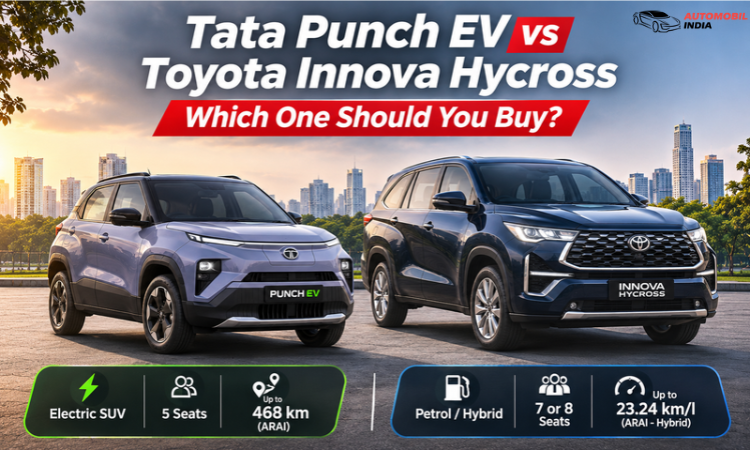
The Tata Punch EV and Toyota Innova Hycross are aimed at very different kinds of Indian car buyers. One is a compact, five-seat electric SUV designed around urban usability and lower day-to-day running costs. The other is a much larger family vehicle offered with petrol and strong-hybrid powertrains, with seven- and eight-seat layouts depending on the variant. So, this is not a conventional like-for-like comparison. The useful question is simpler: do you need a compact electric car for everyday travel, or a spacious family vehicle that can carry more people and cover long distances without depending on charging stops?
| Comparison | Tata Punch EV | Toyota Innova Hycross |
|---|---|---|
| Vehicle type | Compact electric SUV | Large family MPV / crossover |
| Powertrain | 30kWh or 40kWh battery; electric motor | 2.0-litre petrol or 2.0-litre strong hybrid |
| Seating capacity | 5 | 7 or 8, depending on variant |
| Claimed efficiency / range | Up to 468km ARAI range (40kWh) | 16.3km/l petrol; 23.24km/l strong hybrid (ARAI) |
| Practical reference | 335–355km C75 estimate for 40kWh | Autocar tested 14.6km/l average for hybrid |
| Ex-showroom price reference | ₹9.69 lakh–₹12.59 lakh | ₹18.70 lakh–₹31.84 lakh |
| Best suited to | City use, small families and home charging | Larger families, frequent highway travel and extra seats |
Prices are indicative ex-showroom references and can change by variant, location and offer. The Innova Hycross figures cover its petrol and strong-hybrid range; the Punch EV figures cover its 30kWh and 40kWh battery options. Always compare the exact variant and on-road quotation before booking.
1. Size, Cabin Space and Seating: A Very Different Proposition
The biggest difference is size. The Punch EV measures 3,880mm long with a 2,445mm wheelbase, making it easier to place in tight streets and parking spaces. It seats five and offers a published 366-litre boot.
The Innova Hycross measures 4,755mm long and has a 2,850mm wheelbase. Depending on the grade, it is offered with seven or eight seats. Its larger cabin is better suited to families travelling with parents, children or groups of adults; selected variants also offer captain-seat arrangements.
A family of three or four may find the Punch EV's five seats adequate. A household that regularly needs a third row should shortlist the Hycross instead; the Punch EV is not a substitute for its passenger capacity.
2. Electric Range vs Petrol-Hybrid Mileage
The Punch EV is available with 30kWh and 40kWh battery packs. Tata quotes an ARAI range of 365–375km for the 30kWh version and up to 468km for the 40kWh version. Its C75 estimates are 260–275km and 335–355km respectively. Actual range varies with speed, temperature, air-conditioning, traffic, terrain, tyre pressure and driving style.
For the Hycross, the 2.0-litre petrol with CVT is rated at 16.3km/l ARAI, while the strong-hybrid with e-CVT is rated at 23.24km/l. In Autocar India's test, the hybrid returned a 14.6km/l average and 16.1km/l on the highway; the petrol averaged 9.65km/l. This illustrates the gap that can exist between certified and tested efficiency.
The Punch EV is easier to justify when you can charge at home and your daily routes are predictable. The Hycross hybrid suits buyers who want better efficiency than the petrol version without depending on external charging.
3. City Driving: Which One Is Easier to Live With?
For city use, the Punch EV's compact footprint makes it easier to manoeuvre and park. Its electric motor delivers power without conventional gear shifts, while regenerative braking can recover some energy as the car slows. Home charging also means many owners can start the day with a replenished battery.
The Hycross provides a larger family cabin, but its body needs more room in crowded neighbourhoods and parking areas. The strong-hybrid can use electric drive in suitable conditions, but it is not a plug-in hybrid: its battery is charged by the vehicle and cannot be topped up from a wall charger.
The Punch EV fits a smaller household's regular commute; the Hycross makes more sense when the extra seats are used frequently.
4. Highway Trips and Long-Distance Travel
The Punch EV can manage intercity journeys, especially with the 40kWh battery, but trips need planning. Use a practical range rather than the 468km ARAI figure, locate compatible DC chargers and keep a buffer for detours. Tata advertises a 20–80 per cent DC top-up in around 26 minutes under specified conditions; actual time depends on charger output, battery temperature and state of charge.
The Hycross is more straightforward for frequent long-distance travel with several passengers. Its 52-litre tank and petrol-station refuelling mean routes do not need to be planned around EV chargers, while the larger cabin is better for people and luggage.
Neither is automatically better on every route. The Hycross's fuel efficiency varies with load and driving conditions; the Punch EV can work well where reliable charging is available. The decision comes down to how much route planning you are willing to do.
5. Charging Access, Fuel Stops and Ownership Costs
Before choosing the Punch EV, confirm reliable AC charging at home or work. Apartment residents should check parking permissions, electrical capacity, installation and billing. Depending on public fast chargers for every daily top-up may be less convenient.
For the Hycross, factor in petrol use, servicing, insurance, tyres and purchase price. The hybrid costs more than petrol versions, so its fuel saving should be assessed against your annual distance and ownership period rather than assumed to recover the premium automatically.
Estimate EV energy cost from electricity consumed and your tariff, allowing for charging losses. For the Hycross, multiply expected litres by the local petrol price. Then factor in purchase price, loan interest, warranty, service reach and resale value: cheaper energy does not by itself guarantee a lower total ownership cost.
Explore electric cars, compare available models and check whether an EV fits your daily driving pattern.
Explore Electric Cars6. Safety and Features: Check the Exact Variant
Both vehicles offer modern safety equipment, but features vary by grade. Tata lists six airbags on the Punch EV, with higher variants adding items such as a 360-degree camera and blind-spot view monitor. Check the exact variant's equipment list.
The Hycross also lists six airbags, while Toyota Safety Sense driver-assistance features are offered on the top ZX (O) grade. Do not assume every variant has the full ADAS package; confirm the exact equipment and child-seat anchor points before booking.
Which One Should You Buy?
| Your requirement | Better fit | Reason |
|---|---|---|
| Mostly city commuting | Tata Punch EV | Smaller footprint and home-charging convenience |
| Seven or eight regular occupants | Innova Hycross | More seating configurations and a larger cabin |
| Low daily energy cost with home charging | Tata Punch EV | Can be economical when charging is convenient |
| Frequent long-distance family trips | Innova Hycross | More passenger room and conventional refuelling |
| Compact parking and narrow streets | Tata Punch EV | Shorter length and smaller overall footprint |
| No dependable charging access | Innova Hycross | Does not depend on external EV charging |
Before deciding, test-drive the vehicles with your family, check rear-seat comfort and child-seat fitment, and load your usual luggage. Confirm home charging and battery warranty for the Punch EV; compare petrol and hybrid costs for the Hycross. For more EV options, read our guide to electric SUVs in India. You can also review the Tata Punch EV specifications and the Toyota Innova Hycross price and variant details before visiting a showroom.
Compare finance options and estimate your monthly payment before selecting the right vehicle for your family.
Explore Car Loan Options