
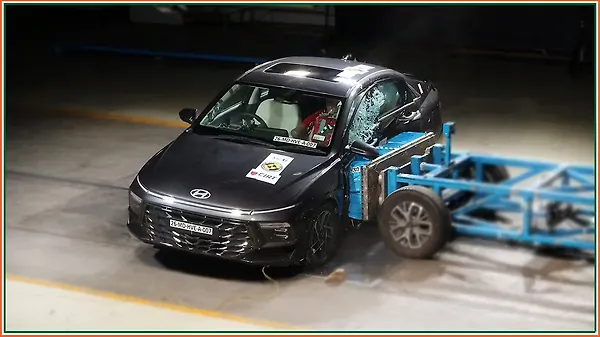
The Hyundai Verna sedan has achieved a five-star safety rating from Bharat NCAP, securing top marks for both adult and child occupant protection. Reports differ regarding the updated model's exact launch timeline, noting it was offered with two 1.5-litre engines and launched in March 2026, while another report mentions an evaluation taking place in July 2026 and results published in November 2026. This follows the vehicle's five-star achievement from Global NCAP in October 2023. The sedan stands as the second model in India to secure five stars from both assessment programmes, and it is currently the sole sedan in its segment to hold this Bharat NCAP safety rating, whereas the Slavia and Virtus hold five-star GNCAP crash test ratings.
Crash Test Scores and Variant Applicability
During the Bharat NCAP evaluation, the sedan attained 28.22 points out of 32 for adult occupant protection and 44 points out of 49 for child occupant protection. The assessment covered frontal offset deformable and side movable deformable barrier impacts, with testing conducted on vehicles having a kerb weight of 1,521 kg (alternatively noted as a test weight of 2,412 kg). The agency evaluated the HX 8 1.5 Turbo GDi DCT and HX 8 1.5 MPI iVT trims. The published five-star rating extends across a broad span of petrol manual and automatic configurations.
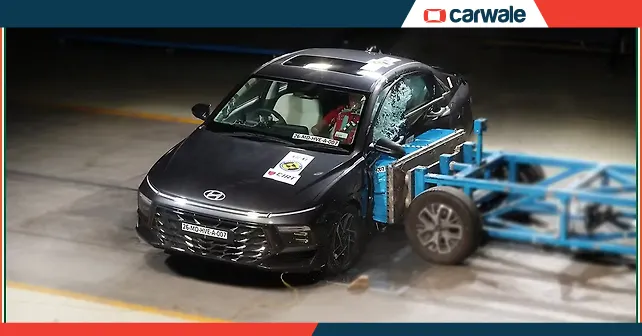
The rating applicability covers Petrol MPI Manual variants of HX 2, HX 4, HX 6, HX 6+, HX 8, alongside Petrol MPI iVT variants of HX 6, HX 6+, HX 8, and HX 10. Turbo Petrol HX 8 MT, HX 8 DCT, and HX 10 DCT trims are likewise included under these recently published Bharat NCAP crash ratings. Within a comparative listing of Bharat NCAP entries sorted by adult occupant protection, the model ranks 36th out of 41 entries, trailing the Maruti Dzire at 29.46 and the Honda Amaze at 28.33 for adult points, yet it leads the combined tally with 72.22 out of 81 compared to the Dzire's 71.03 and the Amaze's 69.14.
Detailed Protection and Impact Breakdown
In the adult occupant assessment, the vehicle secured 12.45 points out of 16 for the frontal offset deformable barrier test and 15.77 points out of 16 for the side movable deformable barrier test. The frontal collision at 64 kmph showed marginal protection for the driver and front passenger pelvis and thighs. The driver head and neck received good ratings, while the chest, lower legs, and feet were marked adequate. The front passenger obtained good scores for the head, neck, chest, and left shin, with an adequate assessment for the right shin.
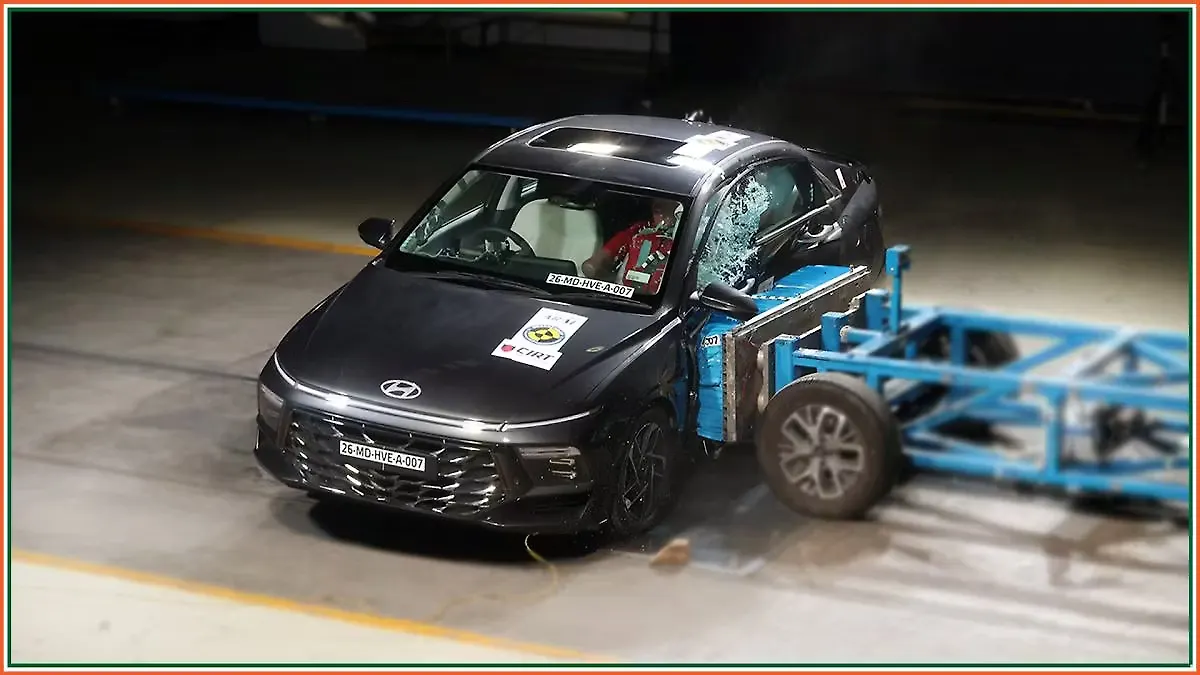
The side movable deformable barrier impact yielded stronger numerical figures, granting good protection for the occupant head, abdomen, and pelvis, alongside an adequate chest rating. A separate side pole collision received an okay verdict with good protection across evaluated body regions, though this test does not add a numerical component to the adult score. For child occupant protection, the dynamic score reached 24 out of 24 points, the CRS installation score achieved 12 out of 12 points, and the vehicle assessment score stood at 8 out of 13 points. The evaluation utilized rearward-facing Joie i-Spin 360e restraints fastened to rear ISOFIX anchorages for 18-month-old and three-year-old child dummies.
Safety Equipment and Features
- Six airbags included as standard equipment
- Electronic Stability Control and Hill Start Assist
- ABS with Electronic Brakeforce Distribution
- Rear parking sensors and emergency stop signal
- Seatbelt reminders, front pretensioners, and load limiters
- ISOFIX child seat anchorages on outer rear seats
- Level 2 driver assistance features, front parking sensors, and a 360-degree camera on selected top-spec versions
Implications for Buyers
Buyers looking at midsize sedans can note that the Hyundai Verna provides certified five-star crash safety for both adults and children across a wide array of its petrol manual and automatic variants. While competitors like the Honda City, Volkswagen Virtus, and Skoda Slavia contest the segment, the Verna combines standard safety provisions like six airbags and ESC with top-tier child protection scores in its class.
| Safety Category | Score Achieved | Maximum Points |
|---|---|---|
| Adult Occupant Protection | 28.22 | 32 |
| Child Occupant Protection | 44 | 49 |
| Frontal Offset Test (Adult) | 12.45 | 16 |
| Side Movable Barrier Test (Adult) | 15.77 | 16 |