
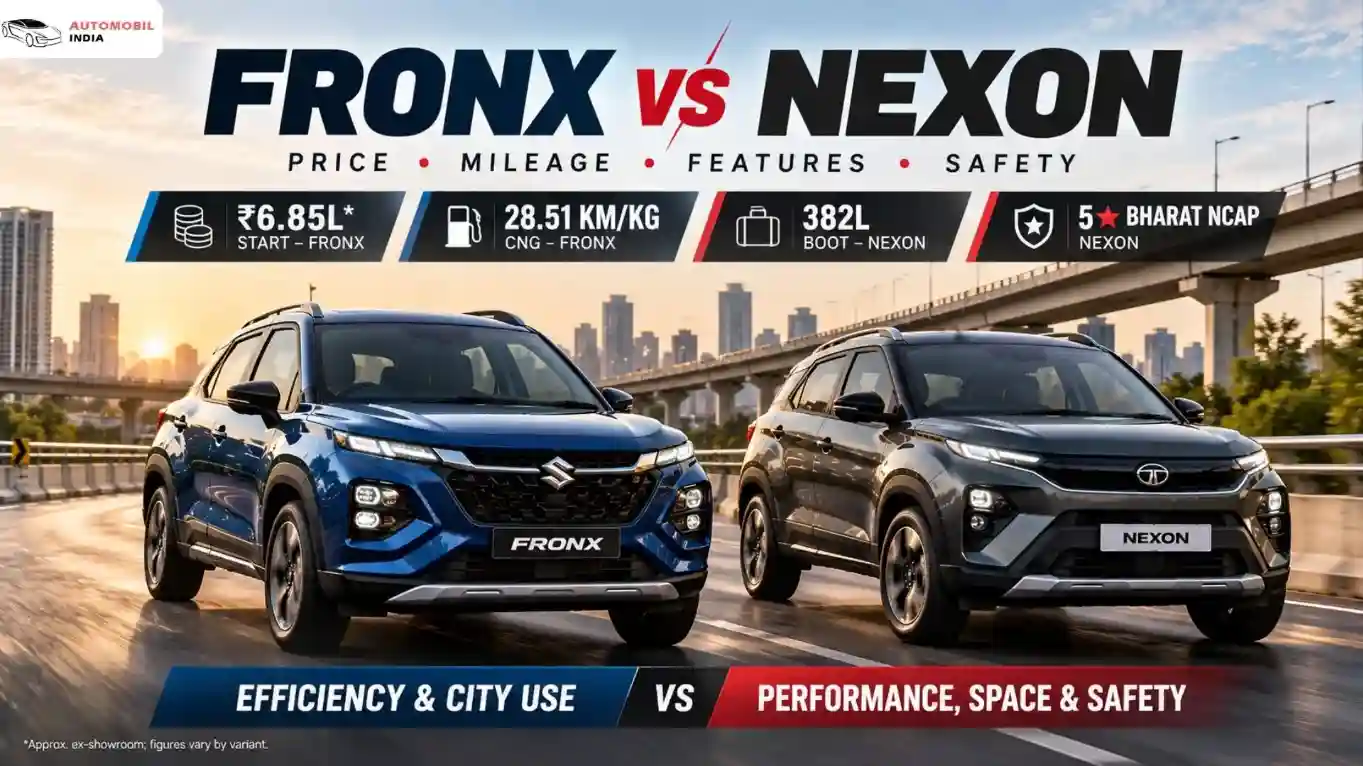
The Maruti Fronx and Tata Nexon are both sub-4-metre SUVs aimed at buyers who want an affordable, compact vehicle with SUV styling, good ground clearance and a broad choice of powertrains. But they take noticeably different approaches.
The Fronx focuses heavily on efficiency, a lightweight urban-friendly package, a strong CNG mileage figure and relatively low entry price. The Nexon offers a more substantial SUV footprint, higher ground clearance, a larger boot, stronger petrol and diesel torque figures, and a much stronger documented crash-safety record.
As of October 2026, the Fronx is listed from around ₹6.85 lakh ex-showroom, while the Nexon starts at around ₹7.32 lakh.
For mileage, the Fronx has the advantage on petrol and CNG claimed figures, while the Nexon offers a diesel option that the Fronx does not. For safety, the Nexon has a 5-star Bharat NCAP rating, whereas the India-spec Fronx does not currently have a Bharat NCAP rating.
So, the better choice depends on whether your priority is efficiency and urban running costs or safety, space, performance and SUV practicality.
Fronx vs Nexon: Quick Comparison
|
Parameter |
Maruti Fronx |
Tata Nexon |
|
Starting price |
Approx. ₹6.85 lakh |
Approx. ₹7.32 lakh |
|
Body type |
Sub-4m crossover SUV |
Sub-4m compact SUV |
|
Length |
3,995 mm |
3,995 mm |
|
Width |
1,765 mm |
1,804 mm |
|
Height |
1,550 mm |
1,620 mm |
|
Wheelbase |
2,520 mm |
2,498 mm |
|
Boot space |
308 litres |
382 litres |
|
Ground clearance |
Around 190 mm |
208 mm |
|
Petrol engine |
1.2L NA / 1.0L turbo |
1.2L turbo |
|
Diesel |
Not available |
1.5L turbo diesel |
|
CNG |
1.2L CNG |
1.2L turbo CNG |
|
Maximum petrol power |
100 PS |
120 PS |
|
Maximum diesel power |
— |
116 PS |
|
Maximum petrol mileage |
22.89 km/l |
17.44 km/l |
|
Maximum CNG mileage |
28.51 km/kg |
Around 24 km/kg |
|
Automatic options |
5AMT / 6AT |
6AMT / 7DCA |
|
Airbags |
6 standard |
6 standard |
|
360-degree camera |
Available on Alpha |
Available on higher variants |
|
ADAS |
Not available |
Not available on current ICE Nexon |
|
Bharat NCAP |
No current rating |
5 stars |
|
Seating |
5 |
5 |
Manufacturer specifications confirm the Fronx's 3,995 mm length, 2,520 mm wheelbase, 308-litre boot and its 1.2-litre, 1.0-litre turbo and CNG powertrain choices. Tata's published Nexon specifications list a 3,995 mm length, 1,804 mm width, 2,498 mm wheelbase, 208 mm ground clearance and 382-litre boot.
Fronx Nexon Price: Which SUV Is Cheaper?
The Fronx is the cheaper SUV to enter the segment.
Maruti's current NEXA listing shows the Fronx starting at approximately ₹6.85 lakh ex-showroom, with the range extending to around ₹11.98 lakh depending on variant and powertrain.
The Tata Nexon currently starts at approximately ₹7.32 lakh ex-showroom, with the range extending to roughly ₹14.15 lakh for the higher-end variants.
Price positioning
|
SUV |
Approx. current ex-showroom range |
|
Maruti Fronx |
₹6.85 lakh – ₹11.98 lakh |
|
Tata Nexon |
₹7.32 lakh – ₹14.15 lakh |
The difference becomes much larger at the top end because the Nexon offers more expensive diesel, automatic and highly equipped variants.
What this means for buyers
If your budget is around ₹7–9 lakh, the Fronx gives you a particularly strong entry proposition.
If your budget extends beyond ₹10 lakh, the Nexon's additional powertrain and equipment choices become more relevant.
But don't compare only the base prices.
A base Fronx and a mid-spec Nexon can have very different equipment, engine performance and safety hardware.
Fronx vs Nexon Engines: Which Has More Performance?
The powertrain philosophies are quite different.
Maruti Fronx engines
The Fronx is available with:
1.2-litre naturally aspirated petrol
-
1,197cc
-
Around 90 PS
-
113 Nm
-
5-speed manual
-
5-speed AMT
Maruti quotes 21.79 km/l with the manual and 22.89 km/l with the AMT for this engine.
1.0-litre turbo-petrol
-
998cc
-
100.06 PS
-
147.6 Nm
-
5-speed manual
-
6-speed automatic
Claimed efficiency is 21.5 km/l for the manual and 20.01 km/l for the automatic.
1.2-litre CNG
-
1,197cc
-
77.5 PS in CNG mode
-
98.5 Nm in CNG mode
-
5-speed manual
-
28.51 km/kg claimed efficiency
Tata Nexon Engine Options
The Nexon uses a different approach.
1.2-litre turbo-petrol
-
1,199cc
-
120 PS
-
170 Nm
-
5MT/6MT
-
6AMT
-
7-speed DCA
Tata's specifications list 120 PS-equivalent output and 170 Nm for the turbo-petrol.
1.5-litre turbo-diesel
-
1,497cc
-
116 PS
-
260 Nm
-
6-speed manual
-
6-speed AMT
This is one of the Nexon's biggest mechanical advantages because the Fronx does not offer a diesel engine.
1.2-litre turbo CNG
The Nexon also offers a factory CNG option based on its turbo-petrol engine.
Tata's iCNG system uses twin-cylinder packaging, allowing the CNG hardware to be positioned beneath the boot floor rather than sacrificing the entire luggage area.
Fronx vs Nexon Performance: Which Feels Stronger?
On paper, the Nexon is the more powerful SUV.
The comparison becomes especially clear with the petrol engines:
|
Specification |
Fronx Turbo |
Nexon Turbo Petrol |
|
Engine |
1.0L turbo |
1.2L turbo |
|
Power |
100 PS |
120 PS |
|
Torque |
147.6 Nm |
170 Nm |
That additional torque matters when:
-
Carrying four or five passengers
-
Climbing inclines
-
Overtaking on highways
-
Driving with luggage
-
Maintaining speed on steep roads
The Fronx, however, is considerably lighter depending on the variant. Its turbo-petrol manual weighs roughly 1,015–1,030 kg, while the Nexon's kerb weight is substantially higher depending on powertrain and variant.
That lower weight helps explain why the Fronx can feel responsive despite having less peak output.
Performance verdict
Nexon: Better for outright performance and high-load driving.
Fronx: Better suited to buyers who prioritise a lighter, efficiency-oriented urban package.
Fronx vs Nexon Mileage: Which Is More Fuel Efficient?
This is one of the biggest reasons to consider the Fronx.
Fronx claimed mileage
|
Fronx powertrain |
Claimed mileage |
|
1.2 Petrol MT |
21.79 km/l |
|
1.2 Petrol AMT |
22.89 km/l |
|
1.0 Turbo MT |
21.5 km/l |
|
1.0 Turbo AT |
20.01 km/l |
|
1.2 CNG MT |
28.51 km/kg |
Nexon claimed mileage
For the current Nexon, published figures include approximately:
|
Nexon powertrain |
Claimed mileage |
|
1.2 Turbo Petrol MT |
17.44 km/l |
|
1.2 Turbo Petrol AMT |
17.18 km/l |
|
1.2 Turbo Petrol DCA |
17.01 km/l |
|
CNG MT |
Around 24 km/kg |
|
Diesel |
Around 23–24 km/l depending on transmission |
Autocar India's current 2026 data lists 17.44 km/l for the petrol manual, 17.18 km/l for the AMT, 17.01 km/l for the DCT and 24 km/kg for the CNG manual.
So which has better mileage?
Fronx wins on the headline efficiency numbers.
Its naturally aspirated petrol, turbo-petrol and CNG versions all have strong certified efficiency figures.
But there is an important caveat.
Claimed mileage is not real-world mileage
ARAI/CMVR figures are generated under controlled testing conditions.
Actual mileage can change substantially depending on:
-
Traffic
-
Air-conditioning
-
Driving style
-
Vehicle load
-
Tyre pressure
-
Road conditions
-
Average speed
Therefore, don't assume a Fronx delivering 22.89 km/l on paper will automatically deliver that number in Mumbai, Delhi or Bengaluru traffic.
CNG Comparison: Fronx vs Nexon
This is a particularly interesting comparison.
The Fronx CNG claims 28.51 km/kg, which is significantly higher than the Nexon's roughly 24 km/kg certified figure.
But the Nexon has a major technical advantage: its CNG system uses twin cylinders.
That helps Tata preserve a more usable luggage area compared with a conventional large single-cylinder CNG layout. Tata's brochure lists approximately 321 litres of boot space for the CNG version versus 382 litres for the standard configuration.
The Fronx CNG's official brochure lists a 308-litre boot for the CNG configuration.
Which CNG SUV makes more sense?
For maximum claimed fuel efficiency: Fronx
For stronger performance and turbo-petrol-based CNG technology: Nexon
For CNG plus a larger SUV package: Nexon
If you have reliable CNG access and cover a lot of kilometres every month, the Fronx's higher certified efficiency can be particularly attractive.
Fronx vs Nexon Dimensions: Which Is Bigger?
Both are exactly 3,995 mm long, keeping them below India's four-metre threshold.
But the Nexon is significantly wider and taller.
|
Dimension |
Fronx |
Nexon |
|
Length |
3,995 mm |
3,995 mm |
|
Width |
1,765 mm |
1,804 mm |
|
Height |
1,550 mm |
1,620 mm |
|
Wheelbase |
2,520 mm |
2,498 mm |
|
Ground clearance |
Approx. 190 mm |
208 mm |
Fronx dimensions are from Maruti's current product documentation, while Tata's published Nexon specifications give 1,804 mm width, 1,620 mm height, 2,498 mm wheelbase and 208 mm ground clearance.
What does this mean on Indian roads?
The Nexon has the more substantial physical footprint.
Its extra width gives it a broader cabin and more SUV-like road presence.
Its 208 mm ground clearance also provides a useful buffer over:
-
Large speed breakers
-
Broken roads
-
Deep potholes
-
Uneven village roads
-
Steep ramps
The Fronx's longer wheelbase, meanwhile, contributes to its crossover-like proportions and can help provide reasonable longitudinal cabin space despite its narrower body.
Which Has More Interior Space?
This is an area where dimensions can be misleading.
The Fronx has the longer wheelbase, at 2,520 mm versus the Nexon's 2,498 mm.
However, the Nexon is considerably wider and taller.
For rear passengers, width is important because it affects shoulder room and how comfortable three people feel across the bench.
For two adults in the rear
Both should work well for typical family use.
For three adults
The Nexon's wider body gives it a practical advantage.
For tall passengers
The Nexon's greater height and wider cabin can make it feel more SUV-like, although actual comfort should always be assessed with a test drive.
Practical conclusion
Fronx: Longer wheelbase but narrower body.
Nexon: Shorter wheelbase but considerably wider and taller body.
For a family-focused SUV, the Nexon's overall cabin proportions make a strong practical case.
Boot Space: Fronx vs Nexon
This is one of the clearest wins for the Nexon.
|
Model |
Boot capacity |
|
Fronx |
308 litres |
|
Nexon |
382 litres |
|
Nexon CNG |
Approx. 321 litres |
The Nexon therefore offers around 74 litres more standard boot capacity than the Fronx.
That difference is meaningful.
A family that regularly carries:
-
Large suitcases
-
Shopping bags
-
Baby equipment
-
Weekend luggage
-
Sports equipment
will benefit from the Nexon's larger luggage compartment.
Boot verdict
Nexon clearly wins on luggage capacity.
Fronx vs Nexon Features
Both SUVs offer modern equipment, but their feature philosophies differ.
Fronx features
Higher Fronx variants can offer:
-
9-inch SmartPlay Pro+ infotainment
-
Wireless Android Auto and Apple CarPlay
-
Head-up display
-
360-degree camera
-
Wireless charging
-
Cruise control
-
Suzuki Connect
-
Automatic climate control
-
LED lighting
-
Connected rear lamps
-
Paddle shifters on automatic variants
-
Premium audio features
Maruti's current Fronx page specifically highlights the 9-inch SmartPlay Pro+ system, HUD, wireless charging and 360-degree camera.
The 360-degree camera and HUD, however, are not available across the entire range.
They are concentrated in higher variants.
Nexon features
Higher Nexon variants offer equipment such as:
-
10.25-inch touchscreen infotainment
-
10.25-inch digital instrument cluster
-
Wireless Android Auto and Apple CarPlay
-
360-degree surround-view system
-
Front parking sensors
-
Blind-view monitor
-
Voice-assisted electric sunroof
-
Connected-car technology
-
Auto headlamps
-
Rain-sensing wipers
-
Cruise control
-
Air purifier on applicable variants
-
Electronic parking brake on applicable variants
Tata's product material highlights the 360-degree surround-view system, front parking sensors, blind-view monitor, 10.25-inch infotainment and digital cluster.
Feature verdict
There is no need to choose purely on the number of features.
The Fronx's HUD and 360-degree camera are particularly useful additions on the top variant.
The Nexon offers a more substantial infotainment/instrumentation package and a broader sense of equipment on higher variants.
The important factor is the variant you can actually afford.
Fronx vs Nexon Safety: Which Is Safer?
This is arguably the most important difference in the comparison.
Tata Nexon: 5-Star Bharat NCAP
The current Nexon has a 5-star Bharat NCAP rating.
Bharat NCAP records:
-
29.41/32 for Adult Occupant Protection
-
43.83/49 for Child Occupant Protection
The assessment was published for the 2024-onwards Nexon, with the applicability subsequently extended to additional variants.
The Nexon also has six airbags, ESC, ISOFIX and other safety equipment across its range. Tata's product material lists six airbags, ESC, 3-point rear seatbelts and ISOFIX as standard safety equipment.
Fronx: Safety Equipment
The current Fronx has:
-
Six airbags
-
ESP
-
Hill-Hold Assist
-
ABS with EBD
-
ISOFIX
-
Three-point ELR seatbelts
-
Rear parking sensors
-
360-degree camera on the top variant
Maruti's current 2026 Fronx brochure explicitly describes six airbags as standard, along with ESP and hill-hold assist.
However:
The India-spec Fronx does not currently have a Bharat NCAP rating.
This distinction matters.
Having six airbags and electronic stability control is important, but those features do not automatically translate into a particular NCAP star rating.
There are also international crash-test results for the Suzuki Fronx in other markets. Those should not automatically be treated as the crash-test result for the Indian-market Fronx because specifications and test protocols can differ.
Safety verdict
For buyers who place independent crash-test evidence at the top of their list:
Nexon has the stronger documented safety case.
Does Either SUV Have ADAS?
Neither the Fronx nor the current ICE Nexon should be bought expecting a comprehensive Level 2 ADAS package.
The Nexon offers features such as a blind-view monitor and parking assistance, but these should not be confused with autonomous driving or a full adaptive-cruise/lane-centering ADAS suite.
Similarly, the Fronx's 360-degree camera is a visibility and parking aid, not an autonomous driving system.
This is an important distinction when comparing feature lists online.
Ride Quality and Indian Road Conditions
The two SUVs also differ in their basic approach.
The Fronx is lighter and has a crossover-oriented character.
That makes it particularly suitable for:
-
Urban commuting
-
Daily office travel
-
Narrow roads
-
Frequent parking
-
Fuel-conscious ownership
The Nexon has a more substantial SUV stance, 208 mm claimed ground clearance and a wider body.
That makes it attractive for buyers who regularly encounter:
-
Broken roads
-
Large speed breakers
-
Rural roads
-
Poorly maintained streets
-
Highway expansion sections
The Nexon's extra ground clearance should not be interpreted as making it an off-roader. Both are primarily road-oriented compact SUVs.
Fronx vs Nexon for City Driving
For pure urban commuting, the Fronx has several advantages.
It is:
-
Narrower
-
Lighter
-
Efficient
-
Available with a fuel-efficient AMT
-
Available with CNG
-
Relatively easy to manoeuvre
The Nexon is still perfectly suitable for cities, but its greater width can make tight parking spaces and narrow lanes slightly more demanding.
City buyer
Fronx makes more sense if your priorities are compactness and fuel economy.
City + family use
Nexon becomes more compelling because of its boot and cabin proportions.
Fronx vs Nexon for Highway Driving
The Nexon has the advantage if highway performance is important.
Its 120 PS turbo-petrol and 116 PS diesel provide stronger torque than the Fronx's engines.
The diesel's 260 Nm is particularly useful for:
-
Overtaking
-
Carrying passengers
-
Climbing hills
-
Long-distance driving
The Fronx turbo is still capable of highway travel, but it is better understood as a lightweight performance-oriented option rather than a high-torque highway SUV.
Highway verdict
Performance and load carrying: Nexon
Efficiency: Fronx
Diesel availability: Nexon
Fronx vs Nexon: Maintenance and Ownership Considerations
Maruti has historically positioned the Fronx within its NEXA network, while Tata sells the Nexon through its own passenger-vehicle dealership and service network.
For an actual buyer, the most important consideration is not a generic assumption that one brand will always be cheaper to maintain.
Instead, check:
-
Local service-centre quality
-
Scheduled maintenance cost
-
Dealer reputation
-
Parts availability
-
Warranty coverage
-
Insurance premium
-
Extended warranty pricing
-
Availability of a service centre near your home
This is particularly important outside major cities.
A theoretically cheaper car becomes less attractive if the nearest competent service centre is far away.
Fronx vs Nexon: Which One Should You Buy?
Rather than declaring one SUV the overall winner, the better choice depends on your priorities.
Choose the Maruti Fronx if:
-
Fuel economy is a major priority.
-
You want a lower starting price.
-
Most of your driving is in the city.
-
You want a CNG option with a very high claimed efficiency figure.
-
You want a lighter and narrower SUV.
-
You prefer the Fronx's crossover styling.
-
You want the 1.0-litre turbo with a 6-speed automatic.
-
You value Maruti's NEXA network in your area.
Choose the Tata Nexon if:
-
Safety is a top priority.
-
You want an independently tested 5-star Bharat NCAP rating.
-
You need more boot space.
-
You frequently travel with family and luggage.
-
You want a diesel engine.
-
You want stronger petrol/diesel torque.
-
You regularly encounter rough roads.
-
You want a wider and more substantial SUV.
-
You prefer the Nexon's cabin and feature package.
Fronx vs Nexon: Variant Strategy
One of the easiest ways to make a poor buying decision is to compare the cheapest Fronx with a much more expensive Nexon and conclude that one has "better features."
Instead, decide your requirements first.
If your budget is around ₹8 lakh
The Fronx gives you a particularly strong value proposition.
If your budget is around ₹9–11 lakh
This is where the comparison becomes more interesting.
You can access better-equipped versions of both SUVs, and engine/gearbox choice becomes important.
Above ₹11 lakh
The Nexon opens up more powerful and better-equipped configurations, particularly with diesel and higher-end automatic variants.
The Fronx remains attractive if efficiency and the 1.0-litre turbo are your priorities.
Fronx vs Nexon: Final Verdict
The Maruti Fronx and Tata Nexon are not simply two versions of the same compact SUV formula.
The Fronx is built around efficiency and urban usability.
The Nexon is built around a more substantial SUV package, stronger performance and safety.
The numbers make the distinction clear:
Fronx:
-
Lower starting price
-
Up to 22.89 km/l petrol
-
Up to 28.51 km/kg CNG
-
Lighter construction
-
308-litre boot
-
2,520 mm wheelbase
Nexon:
-
Higher starting price
-
120 PS turbo-petrol
-
116 PS diesel
-
208 mm ground clearance
-
382-litre boot
-
5-star Bharat NCAP rating
Therefore, the decision should be based on use rather than simply asking which car is "better."
For maximum fuel efficiency
Fronx
For CNG efficiency
Fronx
For performance
Nexon
For diesel availability
Nexon
For boot space
Nexon
For ground clearance
Nexon
For independently tested safety
Nexon
For lower entry price
Fronx
For compact city use
Fronx
For family practicality and highway use
Nexon
The Fronx is therefore particularly well suited to buyers who want a stylish, efficient urban crossover and want to keep running costs under control.
The Nexon makes more sense for buyers who are willing to spend more for a more substantial SUV package, stronger engines, greater luggage capacity and independently documented crash-test performance.
Disclaimer
Prices, specifications, features, mileage figures, variant availability and equipment can change by manufacturer, variant and location. Mileage figures quoted as certified/claimed figures are measured under controlled test conditions and actual efficiency will vary with driving conditions, traffic, load and driving style. Bharat NCAP ratings apply to the tested Nexon configurations and applicable variants. Buyers should verify the latest ex-showroom and on-road prices, equipment, warranty terms and availability with Maruti Suzuki or Tata Motors before purchasing.