
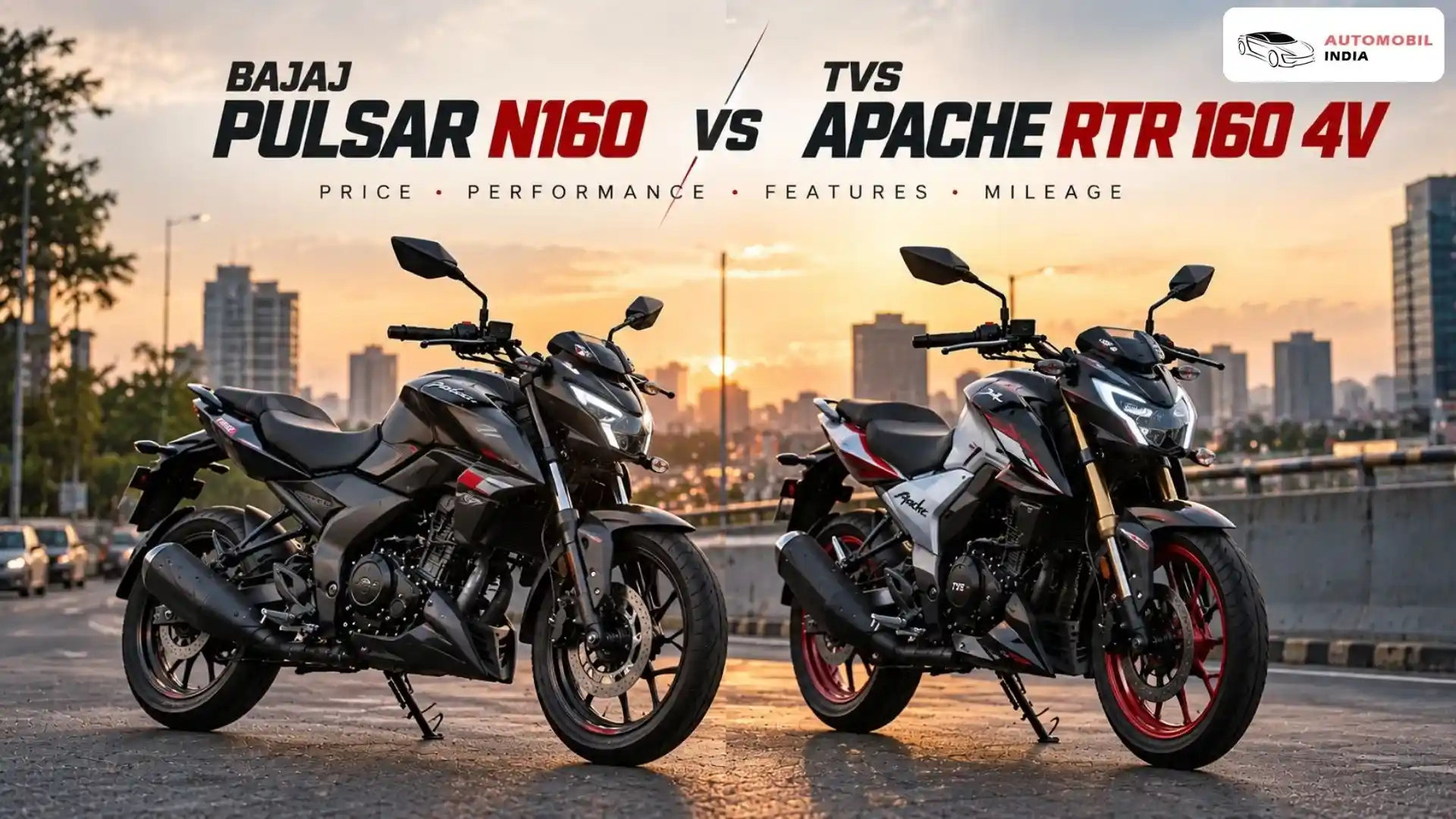
The Bajaj Pulsar N160 vs Apache RTR 160 4V comparison brings together two of India's popular 160cc street motorcycles. Both are designed for riders who want everyday usability without giving up sporty performance, but they approach the segment differently.
The current Pulsar N160 range is particularly important to understand because Bajaj now offers the standard 164.82cc 2-valve N160 alongside the newer N160 S and N160 SS, which get a 164.9cc 4-valve engine producing 18.5 PS. The standard N160 continues to produce 16 PS.
TVS, meanwhile, has updated the Apache RTR 160 4V for 2026, retaining its 159.7cc 4-valve engine and adding features such as a projector headlamp across variants and Assist & Slipper Clutch technology to more versions.
For buyers, the biggest differences are performance, variant pricing, ride modes, braking equipment, suspension, connected technology and fuel efficiency.
Pulsar N160 vs Apache RTR 160 4V: Quick Comparison
|
Specification |
Bajaj Pulsar N160 |
TVS Apache RTR 160 4V |
|
Engine |
164.82cc 2V |
159.7cc 4V |
|
Engine type |
Air-cooled, FI |
Oil-cooled, FI |
|
Maximum power |
16 PS |
17.55 PS |
|
Maximum torque |
14.65 Nm |
14.73 Nm |
|
Transmission |
5-speed |
5-speed |
|
Front suspension |
USD on applicable N160 variants |
Telescopic / USD depending on variant |
|
ABS |
Single/dual-channel depending on variant |
Single/dual-channel depending on variant |
|
Fuel tank |
14 litres |
12 litres |
|
Seat height |
795 mm |
Around 800 mm |
|
Ground clearance |
165 mm |
Around 180 mm |
|
Kerb weight |
Around 151–152 kg depending on variant |
Variant dependent |
|
Claimed/ARAI mileage |
Around 47 kmpl for standard N160 |
Around 41 kmpl |
|
Starting ex-showroom price |
Around ₹1.22 lakh Delhi |
₹1.25 lakh Delhi for 2026 range |
The Apache figures are based on TVS' current 2026 specifications, while the N160 figures vary considerably depending on whether you choose the standard N160 or newer S/SS versions.
Pulsar N160 vs Apache RTR 160 4V Price
Price is one of the most important differences because the N160 name now covers several configurations.
Bajaj's current N160 range includes the standard N160 variants as well as the newer N160 S and N160 SS. Bajaj lists the standard N160 from approximately ₹1.22 lakh ex-showroom Delhi, while the N160 S and N160 SS are listed at ₹1,33,511 and ₹1,42,585, respectively.
The 2026 Apache RTR 160 4V starts at ₹1,25,440 ex-showroom Delhi. TVS currently offers three principal configurations:
-
Single Channel ABS
-
Dual Channel ABS with USD
-
USD with TFT
TVS lists them at ₹1,25,440, ₹1,30,690 and ₹1,37,440 respectively.
Why the exact variant matters
A simple "N160 vs Apache" price comparison can therefore be misleading.
The standard N160 and Apache entry variants compete more directly on price, while the N160 S/SS and Apache's higher variants move into a more technology- and performance-focused part of the segment.
Engine and Performance
Bajaj Pulsar N160
The standard N160 uses a 164.82cc, 2-valve, air-cooled engine producing 16 PS at 8,750 rpm and 14.65 Nm. It uses a five-speed gearbox.
The newer N160 S and N160 SS use a substantially different 164.9cc 4-valve oil-cooled engine producing 18.5 PS at 9,500 rpm and 14.4 Nm at 8,000 rpm. Bajaj claims a 0–60 km/h time of 4.5 seconds for these versions.
This means the N160 range can now appeal to two different types of buyer: someone prioritising the simpler 16-PS N160, or someone wanting the substantially more performance-oriented S/SS versions.
TVS Apache RTR 160 4V
The Apache uses a 159.7cc, four-valve, oil-cooled engine. In Sport mode, it produces 17.55 PS at 9,250 rpm and 14.73 Nm at 7,500 rpm. Urban and Rain modes reduce output to 15.64 PS and 14.14 Nm.
TVS also provides three ride modes:
-
Sport
-
Urban
-
Rain
This allows the motorcycle's throttle response and performance characteristics to be adjusted depending on the riding situation.
What does this mean in everyday riding?
The standard N160 is tuned more toward usable mid-range performance and relaxed everyday riding.
The Apache's 4-valve engine is more performance-focused, particularly when used in Sport mode.
The N160 S and SS, however, significantly narrow that difference by bringing 18.5 PS to the Pulsar range.
N160 vs Apache RTR 160 4V Mileage
Mileage is an important consideration for Indian buyers using these motorcycles every day.
The standard Pulsar N160 is listed with an ARAI-claimed fuel efficiency of around 60 kmpl by Autocar India, although actual fuel consumption will vary significantly with riding conditions.
Current listings for the N160 commonly report around 47 kmpl, while the newer N160 S is listed at approximately 44 kmpl. These figures illustrate why buyers should check the exact variant rather than applying one mileage number to the entire N160 family.
The Apache RTR 160 4V is currently listed with an ARAI-claimed figure of approximately 41 kmpl.
Real-world mileage can be lower or higher depending on traffic, speed, acceleration, tyre pressure, rider weight and maintenance.
For riders covering a lot of kilometres every month, the standard N160's efficiency-focused character can therefore be an important consideration.
Features and Technology
Pulsar N160
The standard N160 provides features such as:
-
LED projector headlamp
-
LED DRLs
-
Digital/connected instrumentation depending on variant
-
Turn-by-turn navigation on applicable versions
-
USB charging
-
Dual-channel ABS on applicable variants
-
USD front suspension on selected versions
The newer N160 S and SS take technology considerably further.
The N160 S gets:
-
Intelligent Throttle
-
Four ride modes
-
Crawl technology
-
4-valve engine
-
37mm USD forks
The flagship N160 SS adds:
-
5-inch TFT display
-
Google Maps mirroring
-
Bluetooth and Wi-Fi connectivity
-
Responsive traction control
-
Radial rear tyre
-
Adjustable levers
-
Dual-channel ABS
Bajaj describes the N160 SS as the most advanced version of the range.
Apache RTR 160 4V
The 2026 Apache range gets:
-
Projector headlamp
-
All-LED lighting
-
Ride modes
-
TVS SmartXonnect
-
Turn-by-turn navigation
-
Call alerts
-
Digital instrumentation
-
Assist & Slipper Clutch
-
Traction control on the TFT variant
-
USD suspension on higher variants
The flagship version uses a 5-inch TFT display with connected functions.
For buyers who prioritise connected technology, the exact variant matters more than the model name.
Suspension and Handling
The standard N160 uses a telescopic front setup on some versions, while the current range also offers 33mm USD forks on applicable variants. The N160 S and SS receive larger 37mm USD forks.
The Apache RTR 160 4V offers telescopic suspension on the single-channel variant and USD forks on its dual-channel and TFT variants.
For everyday Indian roads, USD forks can offer additional rigidity and more controlled behaviour during harder braking and cornering. However, suspension comfort still depends on the overall calibration and road conditions.
Braking and Safety
The Pulsar N160 is available with single- or dual-channel ABS depending on configuration. Higher-specification versions use a 300mm front disc and 230mm rear disc.
The Apache RTR 160 4V offers:
-
Single-channel ABS on its entry variant
-
Dual-channel ABS on higher variants
-
USD suspension on higher variants
-
Traction control on the TFT version
The 2026 Apache range also benefits from the projector headlamp being offered across variants, improving the equipment level of the entry versions.
For Indian riding conditions, dual-channel ABS is particularly relevant if you regularly ride on highways or in wet conditions.
Dimensions and Practicality
|
Parameter |
Pulsar N160 |
Apache RTR 160 4V |
|
Fuel tank |
14 L |
12 L |
|
Seat height |
795 mm |
Around 800 mm |
|
Ground clearance |
165 mm |
Around 180 mm |
|
Wheel size |
17-inch |
17-inch |
|
Gearbox |
5-speed |
5-speed |
The N160's larger 14-litre tank can be useful for riders who cover long distances between fuel stops.
The Apache's higher ground clearance is useful on poorly surfaced roads and larger speed breakers, although tyre profile, suspension setup and rider load also influence real-world clearance.
Riding Position and Comfort
Both motorcycles use a sporty naked-bike riding position rather than an extremely aggressive supersport-style stance.
The N160 has a 795mm seat height, which should be manageable for many Indian riders, although actual reach to the ground depends on inseam length and seat width.
The Apache focuses heavily on rider control and racing-inspired ergonomics. Its design is intended to support more enthusiastic riding without making the motorcycle unsuitable for regular commuting.
For someone using the bike for an office commute every day, the best option should be determined through a test ride rather than specifications alone.
Pulsar N160 vs Apache RTR 160 4V: Variant Comparison
Bajaj Pulsar N160
The current N160 family includes:
-
N160 SD USD Single Seat
-
N160 TD USD Single Seat
-
N160 TD USD Split Seat
-
N160 S
-
N160 SS
The first three use the 2-valve 164.82cc engine, while the N160 S and SS use the newer 4-valve engine.
TVS Apache RTR 160 4V
The current 2026 range is structured around:
|
Variant |
Major equipment |
|
Single Channel ABS |
Telescopic suspension, LCD console |
|
Dual Channel ABS with USD |
Dual ABS, USD forks, LCD console |
|
USD with TFT |
Dual ABS, USD, TFT, traction control |
TVS' official 2026 announcement confirms the three configurations and their Delhi ex-showroom prices.
Pulsar N160 vs Apache RTR 160 4V: Which Suits Which Buyer?
Instead of choosing one overall winner, the documented differences point toward different use cases.
The standard Pulsar N160 may suit you if you prioritise:
-
Everyday commuting
-
Fuel efficiency
-
A large fuel tank
-
Strong low- and mid-range usability
-
A relatively straightforward engine configuration
-
Comfortable daily riding
-
A lower entry price
The standard N160's 16 PS engine and 14.65 Nm torque make it well suited to normal city and highway commuting.
The Pulsar N160 S/SS may suit you if you want:
-
Higher performance
-
18.5 PS
-
Four ride modes
-
Electronic throttle
-
Crawl technology
-
Advanced connectivity
-
TFT instrumentation
-
Traction control
The N160 S and SS fundamentally change the performance and technology proposition of the N160 range.
The Apache RTR 160 4V may suit you if you prioritise:
-
Sporty engine performance
-
Four-valve technology
-
Multiple ride modes
-
Racing-oriented handling
-
SmartXonnect features
-
USD suspension
-
TFT instrumentation on the top variant
Its 17.55 PS Sport-mode output and 14.73 Nm torque make the Apache a performance-oriented choice within the 160cc class.
Ownership and Running Costs
The purchase price is only one part of the ownership calculation.
Before choosing between the Pulsar N160 vs Apache RTR 160 4V, consider:
-
Average monthly kilometres
-
Fuel economy
-
Insurance premium
-
Scheduled service costs
-
Tyre replacement cost
-
Brake-pad replacement
-
Chain and sprocket replacement
-
Local service-centre availability
-
Spare-parts availability
-
Resale expectations
A rider covering 50–60 km every day may value fuel economy more than a rider who primarily rides on weekends.
Similarly, paying extra for a TFT, traction control or connected technology makes more sense when those features will actually be used.
Pulsar N160 vs Apache RTR 160 4V: Final Takeaway
The Pulsar N160 vs Apache RTR 160 4V comparison has become more complicated in 2026 because the Pulsar N160 name now covers multiple mechanical configurations.
The standard N160 remains a 16-PS, 2-valve motorcycle with a strong emphasis on everyday usability and efficiency. The newer N160 S and N160 SS move the model toward 18.5-PS performance, electronic throttle, ride modes and advanced connected technology.
The Apache RTR 160 4V continues to focus on sporty performance, with a 17.55-PS 4-valve engine, ride modes and increasingly sophisticated equipment in its higher variants.
For a commuter, the standard N160's efficiency and 14-litre tank may be more relevant. For a rider looking for stronger performance and technology, the N160 S/SS and higher-spec Apache variants provide more equipment and performance.
The most useful comparison is therefore between specific variants at similar on-road prices, rather than comparing the two model names alone.
Disclaimer
Prices, specifications, features, variants and availability can change based on manufacturer updates, location, taxes and dealer pricing. Mileage figures are claimed or independently reported figures and may vary with traffic, riding style, speed, load, road conditions and maintenance. Always verify the latest specifications and on-road price with Bajaj Auto, TVS Motor or an authorised dealer before purchasing.