
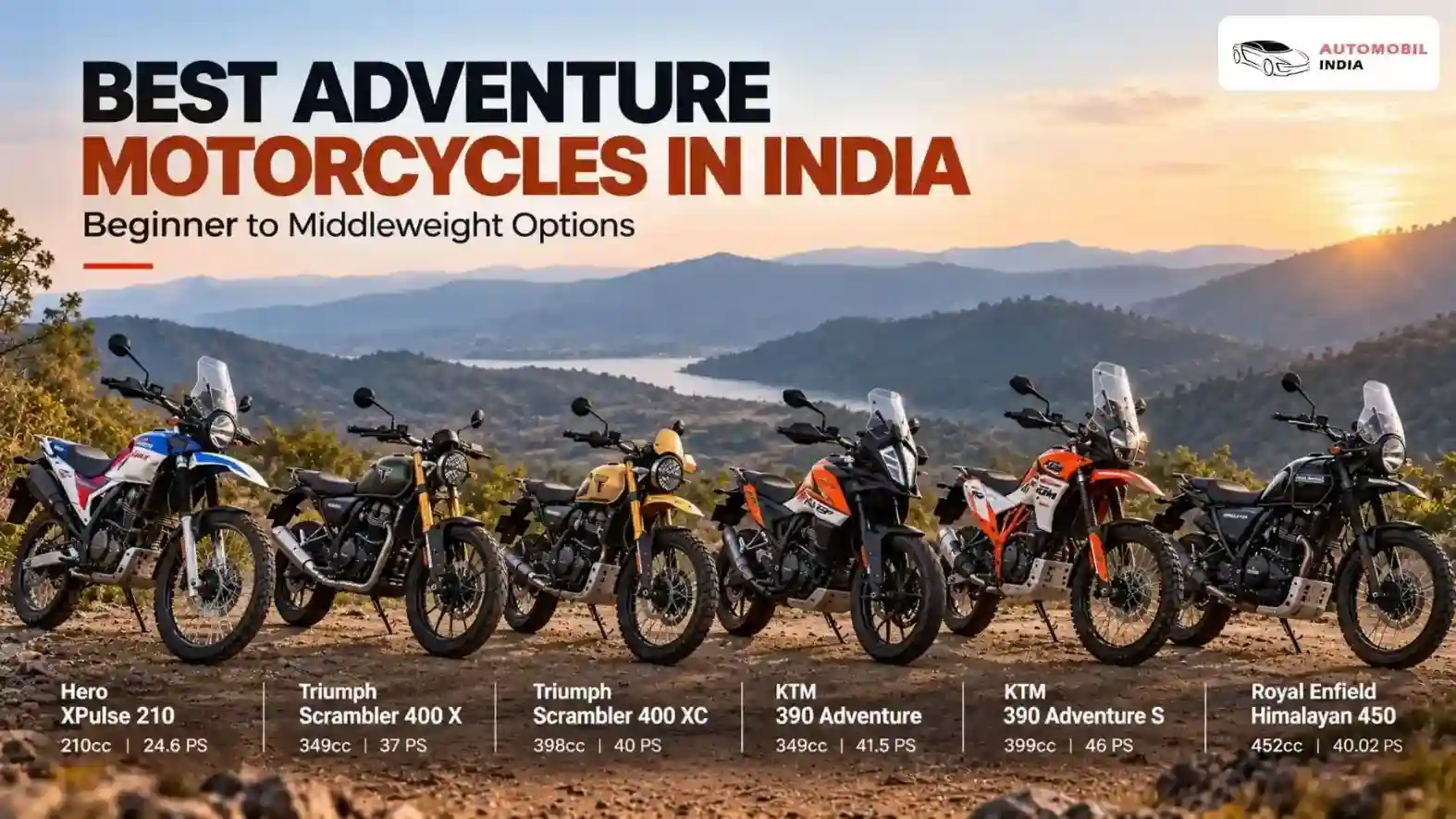
Adventure motorcycles have become increasingly popular in India because they combine an upright riding position, long-travel suspension, ground clearance and highway ability with enough versatility for broken roads and light off-road riding.
For buyers looking at the middleweight adventure motorcycles India market, the choice now extends from relatively accessible 200cc machines such as the Hero XPulse 210 to more powerful options such as the KTM 390 Adventure, Royal Enfield Himalayan 450 and Triumph Scrambler 400 XC.
There is no single best adventure motorcycle for every rider. A beginner who primarily rides in the city has different requirements from someone planning long-distance touring or regular trail riding.
Best Adventure Motorcycles in India: Quick Overview
|
Motorcycle |
Engine |
Power |
Torque |
Approx. ex-showroom price* |
Best suited for |
|
Hero XPulse 210 |
210cc |
24.6 PS |
20.7 Nm |
₹1.67 lakh onwards |
Beginners, trails, daily use |
|
Triumph Scrambler 400 X |
349cc |
37 PS |
32 Nm |
₹2.65 lakh onwards |
City + highway + light trails |
|
Triumph Scrambler 400 XC |
398cc |
40 PS |
37.5 Nm |
₹2.99 lakh onwards |
Road + light off-road touring |
|
KTM 390 Adventure |
349cc |
41.5 PS |
33.5 Nm |
₹2.88 lakh onwards |
Touring + mixed terrain |
|
KTM 390 Adventure S |
399cc |
46 PS |
39 Nm |
₹3.95 lakh approx. |
Serious touring and off-road |
|
Royal Enfield Himalayan 450 |
452cc |
40.02 PS |
40 Nm |
Varies by variant |
Touring + difficult terrain |
*Prices are ex-showroom and can vary by city, variant and manufacturer updates. KTM's current official listings show the 390 Adventure from ₹2,87,802 in Delhi, the 390 Adventure S at ₹3,96,744, while Hero lists the XPulse 210 from ₹1,66,744 in Mumbai. Triumph lists the Scrambler 400 X from ₹2,64,978 and Scrambler 400 XC from ₹2,99,333.
What Makes an Adventure Motorcycle Different?
An adventure motorcycle is designed to handle more than just smooth tarmac.
The important characteristics include:
-
Upright riding position
-
Greater ground clearance
-
Long-travel suspension
-
Larger front wheel on many ADV models
-
Strong low- and mid-range torque
-
Comfortable highway ergonomics
-
Better ability to absorb broken roads
-
Protection for vulnerable mechanical components
-
ABS and other electronic rider aids on many modern motorcycles
However, not every motorcycle marketed around adventure styling is equally capable off-road.
For Indian buyers, it is useful to distinguish between true adventure motorcycles, designed around mixed-terrain use, and scramblers, which generally provide an all-road riding position and light off-road ability but may use a different chassis philosophy.
1. Hero XPulse 210 — A Beginner-Friendly Adventure Motorcycle
The Hero XPulse 210 is one of the more accessible entry points into India's adventure-bike segment.
It uses a 210cc liquid-cooled DOHC single-cylinder engine producing 24.6 PS and 20.7 Nm, paired with a six-speed gearbox and assist-and-slipper clutch. Hero also gives it 210mm of front suspension travel and 205mm at the rear.
Hero XPulse 210 Specifications
|
Specification |
XPulse 210 |
|
Engine |
210cc, single-cylinder |
|
Power |
24.6 PS @ 9,250rpm |
|
Torque |
20.7 Nm @ 7,250rpm |
|
Gearbox |
6-speed |
|
Front suspension travel |
210mm |
|
Rear suspension travel |
205mm |
|
Ground clearance |
220mm |
|
Seat height |
830mm |
|
Fuel tank |
13 litres |
|
Kerb weight |
168kg / 170kg depending on variant |
|
Front wheel |
21-inch |
|
Rear wheel |
18-inch |
Hero offers the XPulse 210 in different equipment levels, with the higher variant adding features such as dual-channel ABS and a TFT instrument cluster.
Why consider the XPulse 210?
Its relatively low weight is important. At around 168–170kg depending on variant, it is substantially easier to manoeuvre off-road than many larger middleweight ADVs.
That makes it particularly relevant for:
-
New adventure-bike riders
-
Riders learning off-road techniques
-
Daily commuters who occasionally explore trails
-
Buyers who want 21/18-inch wheels without moving into a 400–450cc motorcycle
The trade-off is straightforward: its smaller engine does not provide the same highway performance or overtaking reserve as the larger KTM and Royal Enfield motorcycles.
2. Triumph Scrambler 400 X — Road-Focused All-Rounder
The Triumph Scrambler 400 X occupies an interesting middle ground.
It uses a 349cc liquid-cooled single-cylinder engine producing 37 PS and 32 Nm, along with a six-speed gearbox. Triumph equips it with a 19-inch front wheel, 17-inch rear wheel and 150mm of suspension travel at both ends.
Its current starting price is ₹2,64,978.
Key specifications
|
Specification |
Scrambler 400 X |
|
Engine |
349cc single-cylinder |
|
Power |
37 PS |
|
Torque |
32 Nm |
|
Gearbox |
6-speed |
|
Front wheel |
19-inch |
|
Rear wheel |
17-inch |
|
Suspension travel |
150mm front/rear |
|
Seat height |
835mm |
|
Ground clearance |
Not specified in current manufacturer specification |
|
Fuel tank |
13 litres |
|
Wet weight |
185kg |
The 400 X also gets switchable traction control and ABS, along with a 19-inch front wheel and protection-oriented equipment.
Who is it for?
The Scrambler 400 X makes sense for someone who spends most of their time on the road but wants the ability to tackle gravel roads, rough sections and occasional trails.
It is not positioned as a hardcore off-road machine. Its 150mm suspension travel is considerably less than the 200mm-plus figures of dedicated adventure motorcycles such as the Himalayan 450 and KTM 390 Adventure S.
3. Triumph Scrambler 400 XC — More Adventure Equipment
The Scrambler 400 XC takes the basic Scrambler formula further toward adventure riding.
It uses a 398cc single-cylinder engine making 40 PS and 37.5 Nm, with a six-speed gearbox. It gets a 19-inch front wheel, 17-inch rear wheel, 150mm suspension travel and a 835mm seat height.
Triumph lists the Scrambler 400 XC from ₹2,99,333.
What makes the XC different?
The XC gets equipment specifically aimed at rougher riding, including:
-
Side-laced tubeless spoked wheels
-
19-inch front wheel
-
Switchable traction control
-
Off-road ABS mode
-
Aluminium sump guard
-
Engine bars
-
Hand guards
-
High-level front mudguard
-
Headlight grille
-
Preload-adjustable rear suspension
This equipment makes the 400 XC more purpose-built for riders who expect to leave the tarmac regularly.
4. KTM 390 Adventure — Performance-Focused Adventure Bike
The KTM 390 Adventure is one of the more performance-oriented choices in this category.
The current standard 390 Adventure uses a 349.32cc engine producing 41.5 PS and 33.5 Nm. It has a 19-inch front wheel, 17-inch rear wheel, 200mm front suspension travel and 205mm rear travel.
KTM lists the model from approximately ₹2.88 lakh ex-showroom Delhi.
Key features
Depending on version, the 390 Adventure family includes:
-
TFT display
-
Ride-by-wire
-
Traction control
-
Cornering ABS
-
Switchable ABS
-
Quickshifter+
-
Slipper clutch
-
Adjustable suspension
-
Cruise control
-
USB charging
The standard 390 Adventure therefore has a strong technology package for riders who want a modern motorcycle rather than a mechanically simple ADV.
What is important for Indian riders?
The combination of relatively high power, long suspension travel and electronic assistance makes the KTM attractive to riders who want one motorcycle for:
-
Daily commuting
-
Fast highway touring
-
Mountain roads
-
Gravel roads
-
More demanding trails
However, its performance also means that a beginner should not choose it solely because it has more power. Riding experience, confidence and intended use matter.
5. KTM 390 Adventure S — More Off-Road Hardware
The KTM 390 Adventure S moves further toward traditional adventure-bike hardware.
Its 398.63cc engine produces 46 PS and 39 Nm, while the motorcycle gets a 21-inch front wheel and 18-inch rear wheel. Suspension travel is 200mm at the front and 205mm at the rear.
The motorcycle weighs 182kg and has 237mm of ground clearance.
Why the 21/18-inch wheel setup matters
A larger 21-inch front wheel generally helps an adventure motorcycle roll over uneven surfaces and obstacles more confidently than a smaller front wheel.
For riders who regularly travel on rocky trails, loose surfaces and badly broken roads, this hardware can be more meaningful than cosmetic adventure styling.
The 390 Adventure S also gets:
-
43mm suspension
-
Adjustable suspension
-
Cornering ABS
-
Traction control
-
Quickshifter+
-
Riding modes
-
TFT display
-
Switchable ABS
-
Tubeless spoke wheels
KTM's current booking page lists the 390 Adventure S at approximately ₹3.97 lakh ex-showroom Delhi.
6. Royal Enfield Himalayan 450 — Built Around Adventure Touring
The Royal Enfield Himalayan 450 is one of the most purpose-built motorcycles in India's middleweight adventure category.
It uses Royal Enfield's 452cc Sherpa engine, producing 40.02 PS and 40 Nm. The engine is paired with a six-speed gearbox and ride-by-wire.
Himalayan 450 Specifications
|
Specification |
Himalayan 450 |
|
Engine |
452cc single-cylinder |
|
Power |
40.02 PS @ 8,000rpm |
|
Torque |
40 Nm @ 5,500rpm |
|
Gearbox |
6-speed |
|
Front wheel |
21-inch |
|
Rear wheel |
17-inch |
|
Front suspension travel |
200mm |
|
Rear suspension travel |
200mm |
|
Ground clearance |
230mm |
|
Fuel tank |
17 litres |
|
Kerb weight |
196kg |
|
Seat height |
825–845mm adjustable |
The Himalayan's 17-litre fuel tank is particularly relevant for long-distance touring. It also gets riding modes, a 4-inch TFT display with phone connectivity and Google Maps-powered full-map navigation.
Why does the Himalayan 450 stand out?
The combination of:
-
452cc engine
-
40Nm torque
-
21-inch front wheel
-
200mm suspension travel
-
230mm ground clearance
-
17-litre fuel tank
-
Switchable dual-channel ABS
-
Riding modes
gives it a strong adventure-touring orientation.
It is also substantially heavier than the XPulse 210, so beginners should not assume that a larger adventure bike will automatically be easier to ride off-road.
Middleweight Adventure Motorcycles India: How Do They Compare?
|
Factor |
XPulse 210 |
Scrambler 400 X |
Scrambler 400 XC |
KTM 390 Adventure |
KTM 390 Adventure S |
Himalayan 450 |
|
Engine character |
Small ADV |
Road-biased |
All-road |
Performance ADV |
Performance/off-road |
Adventure touring |
|
Front wheel |
21" |
19" |
19" |
19" |
21" |
21" |
|
Rear wheel |
18" |
17" |
17" |
17" |
18" |
17" |
|
Suspension travel |
210/205mm |
150/150mm |
150/150mm |
200/205mm |
200/205mm |
200/200mm |
|
Approx. weight |
168–170kg |
185kg |
190kg |
181kg |
182kg |
196kg |
|
Fuel tank |
13L |
13L |
13L |
14.5L |
14.5L |
17L |
|
Best use |
Beginner/trails |
Road + light trails |
Mixed terrain |
Touring + mixed terrain |
More serious ADV use |
Touring + rough terrain |
The figures highlight an important point: engine size alone does not determine adventure capability.
The XPulse 210 has considerably less engine performance than the KTM or Himalayan, but its 21/18-inch wheel setup and long suspension travel make it a genuine option for riders who prioritise manageable off-road riding.
Likewise, the Scrambler 400 X has a larger engine than the XPulse but a shorter suspension setup and a more road-oriented configuration.
Adventure Bike Features That Matter in India
When comparing adventure motorcycles, don't focus only on horsepower.
1. Front wheel size
A 21-inch front wheel is common on motorcycles designed for more serious off-road use.
A 19-inch front wheel can provide a useful compromise between road handling and rough-road capability.
2. Suspension travel
More suspension travel gives the wheels greater ability to absorb larger bumps and keep the motorcycle composed over rough surfaces.
But more travel usually also means greater seat height and a taller motorcycle.
3. Ground clearance
India's broken roads, deep potholes and speed breakers make ground clearance useful even if you never ride off-road.
The Himalayan 450, for example, has 230mm of ground clearance, while the KTM 390 Adventure S has 237mm.
4. Weight
Weight becomes particularly important when the motorcycle falls or needs to be manoeuvred on loose terrain.
A 196kg Himalayan 450 and a roughly 168kg XPulse 210 will feel very different when being pushed around at walking pace.
5. ABS modes
Switchable or off-road ABS can be useful when riding on loose surfaces because riders may want different braking behaviour compared with normal road riding.
The KTM and Himalayan offer switchable ABS functionality, while the XPulse 210 provides multiple ABS modes depending on variant.
6. Fuel tank capacity
For touring, tank capacity can matter almost as much as fuel efficiency.
The Himalayan 450's 17-litre tank, for example, is considerably larger than the 13-litre tanks of the XPulse 210 and Scrambler 400 models.
Which Adventure Motorcycle Is Suitable for Different Riders?
Rather than selecting an overall winner, consider your actual riding pattern.
For a first adventure motorcycle
The Hero XPulse 210 is worth considering if manageable weight, lower purchase cost and genuine off-road hardware are priorities.
For mostly road use with occasional trails
The Triumph Scrambler 400 X offers an upright riding position, 19-inch front wheel and 32Nm of torque without going all the way toward a dedicated ADV configuration.
For road and light-to-moderate off-road touring
The Triumph Scrambler 400 XC adds more adventure-focused equipment, including tubeless spoked wheels, sump protection, engine bars and off-road ABS mode.
For performance-oriented touring
The KTM 390 Adventure combines strong power with long-travel suspension and extensive electronic equipment.
For more serious adventure riding
The KTM 390 Adventure S and Royal Enfield Himalayan 450 bring 21-inch front wheels, substantial suspension travel and high ground clearance.
For long-distance touring
The Himalayan 450 has several touring-friendly attributes, including its 17-litre tank, adjustable seat, 40Nm engine and full-map navigation system.
What About Mileage?
Adventure motorcycles are generally heavier and more powerful than commuter motorcycles, so fuel economy should not be the only purchase criterion.
Real-world mileage depends on:
-
Riding speed
-
Traffic
-
Rider weight
-
Tyre pressure
-
Luggage
-
Terrain
-
Throttle use
-
Maintenance
Manufacturer or test-cycle fuel figures should therefore be treated as reference points rather than guaranteed daily mileage.
For buyers doing long-distance touring, tank capacity and riding range can be more useful than comparing a small difference in claimed mileage.
Are Adventure Motorcycles Good for Daily Commuting?
Yes, but it depends on the motorcycle.
A lighter motorcycle such as the XPulse 210 can be easier to manoeuvre through traffic and parking areas.
Larger motorcycles such as the Himalayan 450 and KTM 390 Adventure offer more performance and touring ability but are physically larger and heavier.
The tall riding position can actually be useful in Indian traffic because it gives the rider a better view over surrounding vehicles. The downside is that seat height can become an issue for shorter riders, especially when stopping on uneven roads.
What Should Beginners Check Before Buying?
Before buying your first adventure motorcycle, take a proper test ride and check:
-
Can you comfortably place at least one foot down?
-
Can you reverse the motorcycle without assistance?
-
Can you pick it up safely after a controlled fall?
-
Is the clutch manageable in traffic?
-
Does the weight feel comfortable at low speed?
-
Can you stand on the footpegs naturally?
-
Is the handlebar position comfortable?
-
Can you reach the controls while standing?
-
Is the authorised service network convenient?
-
Can you afford tyres, insurance, accessories and maintenance?
The last point is especially important. Adventure motorcycles often require additional spending on crash protection, luggage, touring screens, hand guards, skid plates and other accessories.
Adventure Motorcycle Ownership Costs
The purchase price is only the beginning.
Tyres
Adventure tyres can be expensive, particularly for 19/17-inch and 21/18-inch combinations.
If you frequently ride off-road, tyre wear can also be higher.
Protection
Crash guards, sump guards and hand guards can be worthwhile investments for riders who regularly ride on rough terrain.
Luggage
Long-distance touring often requires panniers, top boxes or soft luggage.
However, additional luggage increases weight and can affect handling and fuel consumption.
Service network
Before buying a premium or middleweight ADV, check the availability of authorised service centres along your regular travel routes.
This matters particularly for riders planning multi-state touring.
Disclaimer: Prices, specifications, features, mileage, variants and availability can change based on manufacturer updates, model year and location. Mileage figures may vary with riding conditions, traffic, terrain and riding style. Always verify the latest details and on-road price with the authorised manufacturer/dealer before making a purchase.