
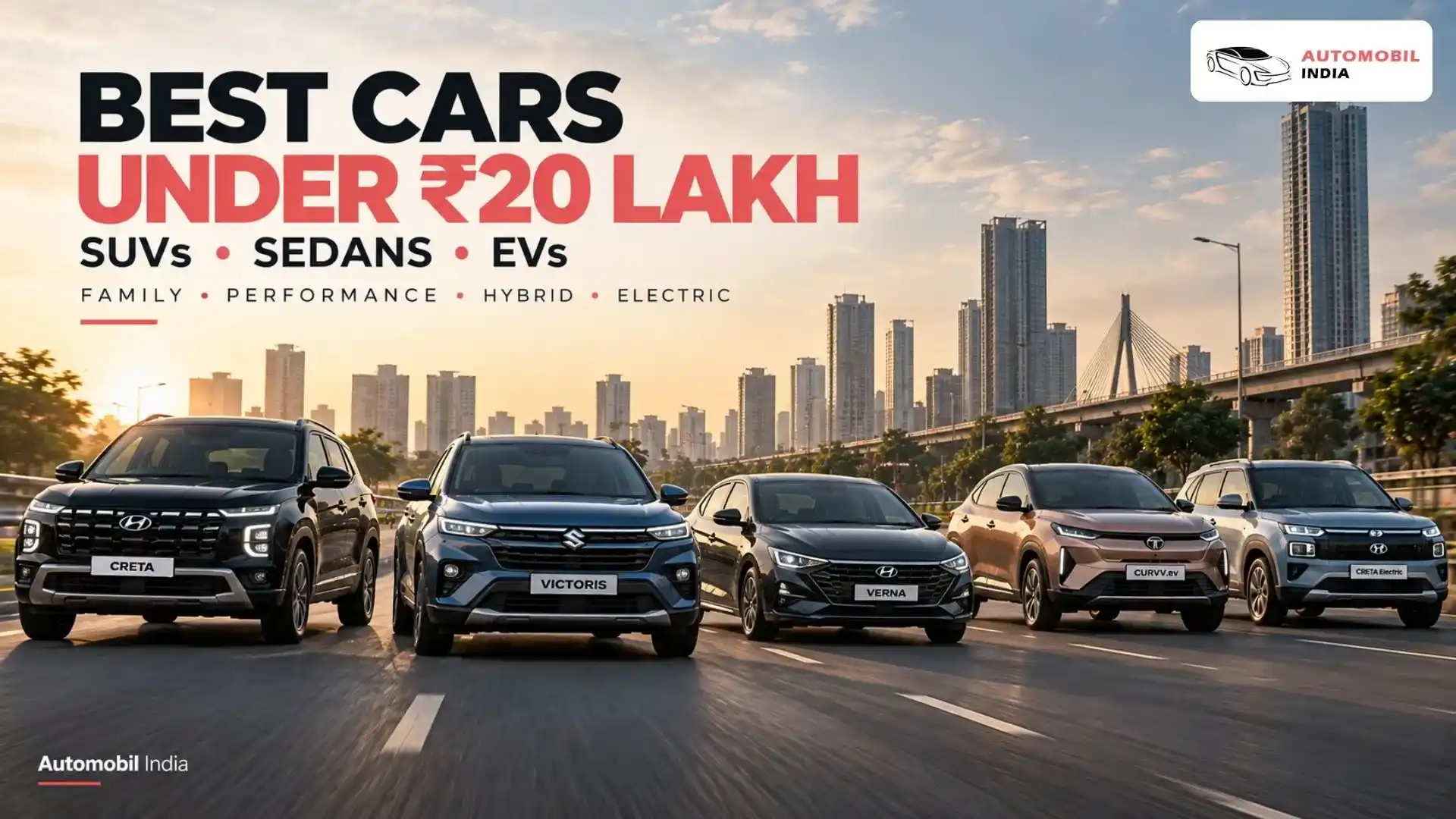
A ₹20 lakh budget opens up one of the most competitive parts of the Indian car market. Buyers can choose from midsize SUVs, premium sedans, strong-hybrid SUVs, performance-oriented turbo-petrol cars and electric SUVs.
The challenge is no longer finding a good car. It is deciding which type of car makes the most sense for your driving pattern.
For example, a Hyundai Creta or Honda Elevate can suit buyers looking for a comfortable petrol SUV, while the Maruti Suzuki Victoris and Toyota Urban Cruiser Hyryder bring hybrid and CNG options into the discussion. Sedan buyers can consider the Hyundai Verna, Volkswagen Virtus and Honda City. EV buyers have options such as the Tata Curvv.ev, Tata Nexon.ev, Mahindra XUV 3XO EV and Hyundai Creta Electric.
Here are some of the most relevant cars under ₹20 lakh in India in 2026:
|
Car |
Starting price* |
Body type |
Powertrain choices |
Automatic/EV option |
What it suits |
|
Hyundai Creta |
₹10.91 lakh |
SUV |
Petrol, turbo-petrol, diesel |
IVT, AT, DCT |
All-round family SUV |
|
Kia Seltos |
₹11.00 lakh |
SUV |
Petrol, turbo-petrol, diesel |
IVT, AT, DCT |
Features + powertrain choice |
|
Honda Elevate |
₹11.81 lakh |
SUV |
1.5 petrol |
CVT |
Simplicity, space, highway use |
|
Maruti Suzuki Victoris |
₹10.50 lakh |
SUV |
Petrol, CNG, strong hybrid |
AT, strong hybrid |
Efficiency + family use |
|
Toyota Urban Cruiser Hyryder |
₹12.82 lakh |
SUV |
Petrol, CNG, strong hybrid |
AT, e-CVT |
Efficiency-focused SUV |
|
Škoda Kushaq |
₹10.69 lakh |
SUV |
Turbo-petrol |
8AT, DSG |
Driving dynamics |
|
Volkswagen Taigun |
₹11.00 lakh |
SUV |
Turbo-petrol |
8AT, DSG |
Driving + highway use |
|
Mahindra XUV 3XO |
₹9.99 lakh+ |
Compact SUV |
Petrol, turbo-petrol, diesel |
AT/AMT |
Performance + features |
|
Mahindra XUV 7XO |
₹13.66 lakh |
SUV |
Petrol, diesel |
Automatic on selected variants |
Larger family SUV |
|
Hyundai Verna |
₹10.99 lakh |
Sedan |
Petrol, turbo-petrol |
IVT, DCT |
Performance + sedan comfort |
|
Volkswagen Virtus |
₹10.71 lakh |
Sedan |
Turbo-petrol |
8AT, DSG |
Highway driving + performance |
|
Honda City |
₹11.99 lakh |
Sedan |
Petrol |
CVT |
Comfortable family sedan |
|
Tata Curvv.ev |
₹16.99 lakh |
Electric SUV coupe |
EV |
Single-speed |
Long-range EV buyers |
|
Tata Nexon.ev |
₹14.34 lakh* |
Electric SUV |
EV |
Single-speed |
Urban EV use |
|
Mahindra XUV 3XO EV |
₹13.89 lakh |
Electric SUV |
EV |
Single-speed |
Performance-oriented EV |
|
Hyundai Creta Electric |
₹18.03 lakh |
Electric SUV |
EV |
Single-speed |
Premium electric SUV |
*Starting ex-showroom prices; EV and manufacturer pricing can vary by location and pricing structure. Some vehicles have only selected variants within the ₹20 lakh limit. Manufacturer prices are subject to revision.
Which are the best cars under ₹20 lakh in India?
Rather than choosing an arbitrary overall winner, it is more useful to divide the market by requirement.
-
For an all-round family SUV: Hyundai Creta, Kia Seltos and Maruti Suzuki Victoris
-
For strong-hybrid efficiency: Maruti Suzuki Victoris or Toyota Urban Cruiser Hyryder
-
For a comfortable petrol SUV: Honda Elevate
-
For driving-focused SUV buyers: Škoda Kushaq or Volkswagen Taigun
-
For a larger family SUV: Mahindra XUV 7XO
-
For a performance-oriented sedan: Hyundai Verna or Volkswagen Virtus
-
For a traditional family sedan: Honda City
-
For an EV with coupe-SUV styling: Tata Curvv.ev
-
For a compact electric SUV: Tata Nexon.ev or Mahindra XUV 3XO EV
-
For a premium electric SUV: Hyundai Creta Electric
The important distinction is that ₹20 lakh can buy very different types of cars. A buyer doing 2,000 km every month has a different requirement from someone doing 600 km but making frequent highway trips.
SUVs Under ₹20 Lakh
SUVs dominate this price range because they combine higher seating positions, useful ground clearance, family-friendly cabins and increasingly sophisticated equipment.
Hyundai Creta
The Hyundai Creta starts at ₹10.91 lakh ex-showroom and is available with 1.5-litre petrol, 1.5-litre diesel and 1.5-litre turbo-petrol engines. Depending on the powertrain, buyers can choose manual, IVT, automatic or 7-speed DCT transmissions.
The Creta's biggest strength is breadth. A buyer can configure it for relatively straightforward daily commuting or move towards a more powerful turbo-petrol automatic.
Higher variants also bring Hyundai SmartSense Level 2 ADAS, including features such as lane-keeping assistance, forward collision avoidance, blind-spot warning and rear cross-traffic collision avoidance.
Why consider the Creta?
It makes sense for buyers who want a comfortable midsize SUV with a broad choice of engines and transmissions.
It is particularly useful if the car will be shared between city commuting and highway trips.
Best suited to: Families wanting flexibility in powertrain, comfort and features.
Kia Seltos
The current Kia Seltos starts at ₹10.99 lakh and extends to above ₹20 lakh, which means the ₹20 lakh budget covers a substantial portion of the range but not the top variants.
The Seltos offers 1.5-litre naturally aspirated petrol, 1.5-litre turbo-petrol and 1.5-litre diesel engines. Depending on variant, transmissions include 6-speed manual, IVT, iMT, 7-speed DCT and 6-speed automatic.
It measures 4,460 mm long, 1,830 mm wide and has a 2,690 mm wheelbase. Kia quotes 447 litres of boot space.
Why consider the Seltos?
The Seltos is particularly relevant if you want a lot of choice within one model line.
It can be configured as a conventional petrol SUV, a diesel automatic or a turbo-petrol DCT depending on the variant.
Best suited to: Buyers prioritising powertrain choice, features and a premium cabin.
Honda Elevate
The Honda Elevate starts at ₹11.81 lakh and uses a 1.5-litre naturally aspirated petrol engine producing 121 PS and 145 Nm. It is offered with a 6-speed manual or CVT automatic. Honda quotes 220 mm of ground clearance and 458 litres of boot space.
The Elevate also offers Honda SENSING ADAS features including adaptive cruise control, lane-keeping assistance, collision mitigation braking and road-departure mitigation on applicable variants.
Why consider the Elevate?
The Elevate's appeal is relatively straightforward: a naturally aspirated petrol engine, substantial ground clearance and a large boot.
That combination can work particularly well for buyers who regularly combine urban driving with highway travel and do not specifically require a turbocharged engine.
Best suited to: Family buyers wanting a spacious, straightforward petrol SUV.
Maruti Suzuki Victoris
The Victoris has become an important addition to the under-₹20 lakh SUV market.
Maruti's current pricing starts at ₹10.49 lakh. The range includes petrol, S-CNG and strong-hybrid powertrains, with automatic versions available.
The Victoris also offers higher variants with Level 2 ADAS, panoramic sunroof, a 10.25-inch digital cluster and other premium equipment. Its strong-hybrid variants start at ₹16.43 lakh and extend to ₹19.99 lakh for the listed ZXI+ (O) configuration.
Why consider the Victoris?
The Victoris is especially interesting because the ₹20 lakh budget can reach strong-hybrid variants, rather than simply the entry-level version.
That makes it relevant to buyers who want SUV practicality but are also interested in reducing petrol consumption during city driving.
Best suited to: Buyers considering hybrid efficiency, SUV practicality and a broad variant range.
Toyota Urban Cruiser Hyryder
The Toyota Urban Cruiser Hyryder starts at ₹12.82 lakh. Toyota offers petrol, CNG and strong-hybrid powertrain choices.
The strong-hybrid version uses Toyota's hybrid system and an e-CVT transmission, making it particularly relevant to urban users who spend considerable time in traffic.
Why consider the Hyryder?
The Hyryder is worth considering if fuel efficiency is a major factor but you still want SUV proportions.
The strong-hybrid configuration is fundamentally different from a conventional petrol SUV: the electric motor can contribute substantially during low-speed operation, while regenerative braking recovers energy during deceleration.
Best suited to: High-mileage urban users and buyers interested in strong-hybrid technology.
Škoda Kushaq
The refreshed Kushaq starts at ₹10.69 lakh. The 1.0 TSI range includes manual and 8-speed torque-converter automatic options, while the 1.5 TSI is paired with a 7-speed DSG.
The 1.0 TSI produces 85 kW and 178 Nm, while the 1.5 TSI develops 110 kW and 250 Nm. Škoda quotes ARAI efficiency of 19.66 km/l for the 1.0 TSI manual, 19.09 km/l for the 1.0 TSI automatic and 18.72 km/l for the 1.5 TSI DSG.
The 1.5 TSI DSG starts at ₹18.79 lakh, keeping a performance-focused configuration within the ₹20 lakh ex-showroom budget.
Why consider the Kushaq?
It is particularly relevant to buyers who care about driving dynamics and real automatic transmissions, rather than choosing an SUV purely for its features.
The 1.5 TSI is the more performance-oriented option, while the 1.0 TSI is easier to fit into a broader budget.
Best suited to: Enthusiastic drivers and buyers who prioritise driving feel.
Volkswagen Taigun
The Volkswagen Taigun starts at ₹10.99 lakh. The updated 2026 model introduced an 8-speed automatic transmission with the 1.0-litre TSI engine.
The Taigun continues to offer turbo-petrol engines and multiple transmission choices.
Why consider the Taigun?
The Taigun is a strong candidate if you want a driver-oriented compact SUV but still need a practical family car.
Its 1.0 TSI paired with the new 8-speed automatic is especially relevant to buyers who want an automatic without moving directly to a more expensive performance variant.
Best suited to: Drivers who enjoy highway driving and want an SUV with a more European driving character.
Mahindra XUV 3XO
The XUV 3XO starts below ₹10 lakh and offers petrol and diesel powertrains, with manual, automatic and AMT configurations depending on engine and variant. Mahindra's current variant listing shows the AX7L turbo-petrol at ₹15.04 lakh ex-showroom.
The XUV 3XO also has an electric version, discussed separately below.
Why consider the XUV 3XO?
Its compact dimensions make it easier to use in urban environments than a larger midsize SUV, while its turbo-petrol options provide significantly more performance than many entry-level SUVs.
Best suited to: Buyers wanting a compact SUV with strong performance and extensive equipment.
Mahindra XUV 7XO
The Mahindra XUV 7XO starts at ₹13.66 lakh and is available as a seven-seater. The launch range includes petrol and diesel manual variants, with higher variants offering automatic options.
The base AX petrol is priced at ₹13.66 lakh, while the AX3 petrol is ₹16.02 lakh and the AX5 petrol is ₹17.52 lakh.
Mahindra has also introduced advanced technology including triple screens and Level 2 ADAS on the XUV 7XO.
Why consider the XUV 7XO?
This is one of the most important choices for buyers whose priority is space and family capacity.
A ₹20 lakh budget can reach considerably more of the XUV 7XO range than it can of many larger premium SUVs.
Best suited to: Large families, seven-seat requirements and buyers wanting a bigger SUV.
Sedans Under ₹20 Lakh
SUV popularity has not eliminated the sedan. At this price, sedans can offer excellent highway stability, generous boot space and a lower seating position that many drivers still prefer.
Hyundai Verna
The new Hyundai Verna starts at ₹10.99 lakh.
It is offered with a 1.5-litre naturally aspirated petrol engine producing 115 PS and a 1.5-litre turbo-petrol engine producing 160 PS and 253 Nm. Transmission options include a 6-speed manual, IVT and 7-speed DCT.
The Verna measures 4,565 mm long and has a 2,670 mm wheelbase. Hyundai highlights its spacious cabin, dual 10.25-inch displays, Bose audio system and advanced safety equipment on higher variants.
The turbo-petrol DCT reaches ₹18.25 lakh in the HX10 variant, keeping the top listed configuration within the ₹20 lakh ex-showroom ceiling.
Why consider the Verna?
The Verna is especially interesting for buyers who want sedan comfort combined with strong performance and modern technology.
The 160 PS turbo engine gives it a very different character from a conventional naturally aspirated family sedan.
Best suited to: Buyers who want performance, technology and a spacious sedan.
Volkswagen Virtus
The Volkswagen Virtus starts at ₹10.70 lakh. The range includes the 1.0-litre TSI and 1.5-litre TSI EVO engines, with automatic options depending on variant.
The 1.5-litre TSI EVO produces 150 PS and 250 Nm and is paired with a 7-speed DSG in the performance-oriented variants. Volkswagen's GT Plus Sport starts at ₹19.19 lakh.
The Virtus has also received a 5-star Global NCAP rating in updated crash testing, according to Volkswagen.
Why consider the Virtus?
The Virtus is particularly suited to buyers who want a sedan with a strong highway character and turbo-petrol performance.
The 1.5 TSI/DSG combination is the configuration to look at if performance is high on your list.
Best suited to: Enthusiasts, highway users and buyers who prefer a sedan over an SUV.
Honda City
The Honda City starts at ₹11.99 lakh. The current petrol range includes manual and CVT variants, with the higher petrol variants remaining below ₹18 lakh in Honda's listed pricing.
The City remains a conventional naturally aspirated petrol sedan rather than following the turbo-petrol trend.
Why consider the City?
The City makes sense for buyers who prioritise a comfortable family cabin, sedan practicality and predictable petrol performance.
Its lower seating position and long-wheelbase sedan proportions can also appeal to buyers who spend considerable time on highways.
Best suited to: Family buyers who prefer a conventional petrol sedan.
Electric Cars Under ₹20 Lakh
The biggest change in the ₹15–₹20 lakh price bracket is the increasing number of EVs.
However, an EV should not be selected simply because it has a larger claimed range.
Your home charging situation, daily kilometres and long-distance travel pattern are equally important.
Tata Curvv.ev
The Tata Curvv.ev starts at ₹16.99 lakh for the Accomplished X 55 variant and the current range extends to ₹19.49 lakh ex-showroom.
The top-end Empowered X 55 is listed at ₹19.19 lakh, or ₹19.49 lakh for the Dark Edition, and includes features such as Level 2 ADAS, ventilated front seats, powered driver-seat adjustment and a 12.3-inch touchscreen.
Why consider the Curvv.ev?
Its biggest distinction is its SUV-coupe body style.
It is suited to buyers who want an EV but also want something visually different from conventional hatchback-shaped electric cars.
Best suited to: Buyers wanting an electric SUV with distinctive styling and premium features.
Tata Nexon.ev
The Nexon.ev currently starts at ₹14.34 lakh in the Mumbai pricing displayed by Tata.ev, with an alternative listed price of ₹16.34 lakh for another configuration.
The vehicle measures 3,995 mm long, 1,802 mm wide and 1,625 mm high, with 190 mm of unladen ground clearance and 350 litres of boot space.
Why consider the Nexon.ev?
The Nexon.ev makes sense for buyers who want a relatively compact electric SUV for urban and mixed use without moving into the ₹18–₹20 lakh bracket.
Its dimensions also make it easier to place in city environments than larger electric SUVs.
Best suited to: Urban EV buyers and smaller families.
Mahindra XUV 3XO EV
Mahindra launched the electric XUV 3XO at ₹13.89 lakh.
The XUV 3XO EV uses a 39.4 kWh battery and produces 110 kW and 310 Nm. Mahindra quotes real-world range of up to 285 km and a 0–100 km/h time of 8.3 seconds.
It is offered in AX5 and AX7L variants and includes equipment such as Level 2 ADAS, 360-degree camera, Harman Kardon audio and connected-car technology on the higher variant.
Why consider the XUV 3XO EV?
The key differentiator is its combination of compact SUV dimensions and strong torque.
The quoted 310 Nm of torque is particularly relevant to buyers who want the instant response associated with an electric powertrain.
Best suited to: Urban buyers wanting a compact EV with strong acceleration and technology.
Hyundai Creta Electric
The Hyundai Creta Electric starts at ₹18.03 lakh ex-showroom under the conventional purchase structure. Hyundai also introduced a Battery-as-a-Service model that reduces the upfront vehicle price to ₹10.99 lakh, with battery usage charged separately from ₹3.9/km.
The Creta Electric is available with 42 kWh and 51.4 kWh battery packs. Hyundai quotes MIDC ranges of 420 km and 510 km respectively. The long-range version produces 171 PS, while the 42 kWh version produces 135 PS.
Why consider the Creta Electric?
It brings the familiar midsize-SUV format into the EV category and gives buyers a more premium alternative to smaller electric SUVs.
The 51.4 kWh version is particularly relevant to buyers concerned about driving range.
Best suited to: Families wanting a premium electric SUV and buyers with access to home charging.
SUV vs Sedan vs EV: What Makes Sense Under ₹20 Lakh?
The body style should be chosen according to use rather than market trend.
|
Requirement |
SUV |
Sedan |
EV |
|
High seating position |
Excellent |
Moderate |
Depends on model |
|
Highway stability |
Very good |
Very good |
Very good |
|
City manoeuvrability |
Depends on size |
Good |
Depends on size |
|
Large boot |
Usually good |
Usually excellent |
Varies |
|
Fuel cost |
Petrol/diesel dependent |
Petrol dependent |
Usually lower running cost |
|
Long-distance flexibility |
High |
High |
Depends on charging network |
|
Seven-seat options |
Available |
Rare |
Limited |
|
Home charging required |
No |
No |
Strongly recommended |
|
Ground clearance |
Generally higher |
Generally lower |
Model dependent |
|
Performance options |
Strong |
Strong |
Strong instant response |
Petrol, Diesel, Hybrid or EV: Which Powertrain Should You Choose?
This is arguably more important than choosing between individual models.
Petrol
Petrol remains the simplest choice for buyers with moderate annual running.
It is particularly suitable when:
-
Annual running is relatively low
-
Most journeys are mixed city/highway
-
You do not want to plan around charging
-
You want a wide choice of automatic transmissions
Diesel
Diesel remains useful for buyers who cover high highway kilometres.
The main advantage is strong low-end and mid-range torque and potentially better fuel efficiency during long-distance driving.
However, a buyer who mostly drives short urban trips should calculate the economics carefully rather than choosing diesel simply for its mileage reputation.
Strong Hybrid
Strong hybrids such as the Victoris and Hyryder can be particularly useful in urban environments.
The electric motor can assist during low-speed operation and the system can recover energy during braking.
The trade-off is that strong-hybrid variants generally cost more upfront than comparable conventional petrol versions.
Electric
EVs make the most sense when you can charge at home or another reliable location.
Consider an EV seriously if:
-
Your daily running is predictable
-
You have home or workplace charging
-
Most journeys are urban or regional
-
You want low energy cost per kilometre
-
You are comfortable planning longer trips around charging
Do not compare an EV's claimed range directly with a petrol car's claimed mileage. They are fundamentally different measurements.
Automatic Cars Under ₹20 Lakh: What Should You Choose?
The ₹20 lakh segment gives buyers access to several types of automatic transmissions.
CVT / IVT
Found in models such as the Honda Elevate, Honda City and Hyundai Verna.
These transmissions prioritise smoothness and are particularly comfortable in city traffic.
Torque Converter Automatic
The new Kushaq 1.0 TSI gets an 8-speed torque-converter automatic, while other SUVs in this segment also use conventional automatics.
Torque converters can be attractive for buyers who want a conventional automatic experience.
DCT
Models such as the Verna, Kushaq, Taigun and Virtus offer dual-clutch options on selected variants.
DCTs can deliver quick gear changes and suit buyers who value performance, although the ownership experience and driving pattern should be considered before choosing one.
e-CVT
The strong-hybrid versions of vehicles such as the Hyryder and Victoris use hybrid-specific automatic systems.
Their objective is less about sporty gear changes and more about efficient power delivery.
EV single-speed
Electric cars do not need conventional multi-speed gearboxes because electric motors can deliver usable torque across a broad operating range.
What About Safety and ADAS?
At ₹20 lakh, safety equipment can vary significantly between variants.
Do not assume that a model's top-end safety specification is available on its entry-level version.
When comparing cars, check:
-
Airbag count
-
ESC
-
ABS with EBD
-
TPMS
-
ISOFIX
-
Parking sensors
-
Reverse camera
-
360-degree camera
-
Electronic parking brake
-
Hill-start assist
-
ADAS availability
-
Exact crash-test result and test protocol
Several cars in this price bracket offer ADAS, including the Hyundai Creta, Honda Elevate, Hyundai Creta Electric, Tata Curvv.ev, Mahindra XUV 3XO EV and selected Maruti Suzuki Victoris variants.
However, ADAS should be considered driver assistance rather than a replacement for attentive driving.
Which Cars Under ₹20 Lakh Make the Most Sense for Different Buyers?
If you want a family SUV
Look at the Hyundai Creta, Kia Seltos, Honda Elevate and Maruti Suzuki Victoris.
The decision should then come down to whether you value multiple powertrains, naturally aspirated simplicity, hybrid efficiency or features.
If you want maximum fuel-efficiency potential
The Maruti Suzuki Victoris and Toyota Urban Cruiser Hyryder strong hybrids deserve attention.
Your actual fuel savings will depend heavily on traffic conditions and annual running.
If you want driving performance
The Škoda Kushaq 1.5 TSI, Volkswagen Taigun and Volkswagen Virtus 1.5 TSI are worth examining.
The Hyundai Verna 1.5 Turbo is another particularly strong option if you prefer a sedan.
If you need seven seats
The Mahindra XUV 7XO is a more natural fit than trying to stretch a five-seater into a seven-seat requirement.
If you want a sedan
The Hyundai Verna, Volkswagen Virtus and Honda City cover three different interpretations of the premium sedan.
The Verna and Virtus provide stronger performance-oriented configurations, while the City remains a more conventional family-sedan proposition.
If you want an EV
The Tata Nexon.ev and Mahindra XUV 3XO EV make sense at the lower end of the EV budget, while the Tata Curvv.ev and Hyundai Creta Electric move toward larger and more premium offerings.
What Should You Check Before Spending ₹20 Lakh?
1. Don't spend the entire budget on the ex-showroom price
A ₹19.9 lakh car can easily cross ₹22 lakh or more on-road depending on the state, insurance and registration.
If ₹20 lakh is your total on-road budget, you should actually shop considerably below ₹20 lakh ex-showroom.
2. Compare the exact variants
A manufacturer's starting price can be misleading.
The variant you actually want may cost ₹2–₹5 lakh more than the advertised entry price.
3. Calculate your annual running
For example:
Low annual running: Petrol may make more financial sense.
High urban running: Strong hybrid or EV can become more interesting.
Highway-heavy running: Petrol turbo, diesel or EV depending on travel pattern and charging access.
4. Test the rear seat
For family buyers, spend at least 10 minutes sitting in the second row.
Check:
-
Knee room
-
Headroom
-
Under-thigh support
-
Shoulder room
-
Rear AC
-
USB charging
-
Door opening
-
Visibility
5. Check the boot with your luggage
A specification sheet may quote litres, but the shape of the boot matters just as much.
If you regularly travel with four or five people, take your actual luggage to the test drive.
6. Check charging before buying an EV
Ask yourself:
-
Can I install a home charger?
-
Do I have dedicated parking?
-
What is my daily driving distance?
-
Where will I charge during long trips?
-
Does my apartment allow charger installation?
For many EV buyers, these questions are more important than the headline range figure.
7. Consider service support
Before buying a ₹20 lakh car, check the manufacturer's authorised service network in your city and the locations you frequently travel to.
Conclusion
The best cars under ₹20 lakh in India now cover almost every mainstream requirement.
If you want a versatile family SUV, the Hyundai Creta, Kia Seltos, Honda Elevate and Maruti Suzuki Victoris offer different approaches to the segment.
If efficiency is your priority, the Victoris and Toyota Urban Cruiser Hyryder strong hybrids deserve attention.
For buyers who enjoy driving, the Škoda Kushaq, Volkswagen Taigun, Hyundai Verna and Volkswagen Virtus provide turbo-petrol configurations with considerably more performance-focused characteristics.
If you need a larger family vehicle, the Mahindra XUV 7XO brings seven-seat practicality into the budget.
And if you are ready to move to electric, the Tata Nexon.ev, Mahindra XUV 3XO EV, Tata Curvv.ev and Hyundai Creta Electric cover a broad range of EV requirements.
The key is not to spend ₹20 lakh simply because you can. Choose the powertrain and body style that match your actual annual running, family size, road conditions, charging access and ownership priorities.
Disclaimer
Prices, variants, specifications, features, claimed efficiency/range figures and equipment can change without prior notice. Ex-showroom prices do not include registration, road tax, insurance and other on-road costs. Manufacturer-claimed mileage and EV range are based on certified test cycles and may differ from real-world results. Buyers should verify the latest variant availability, pricing and equipment with the respective manufacturer or authorised dealer before purchase.