
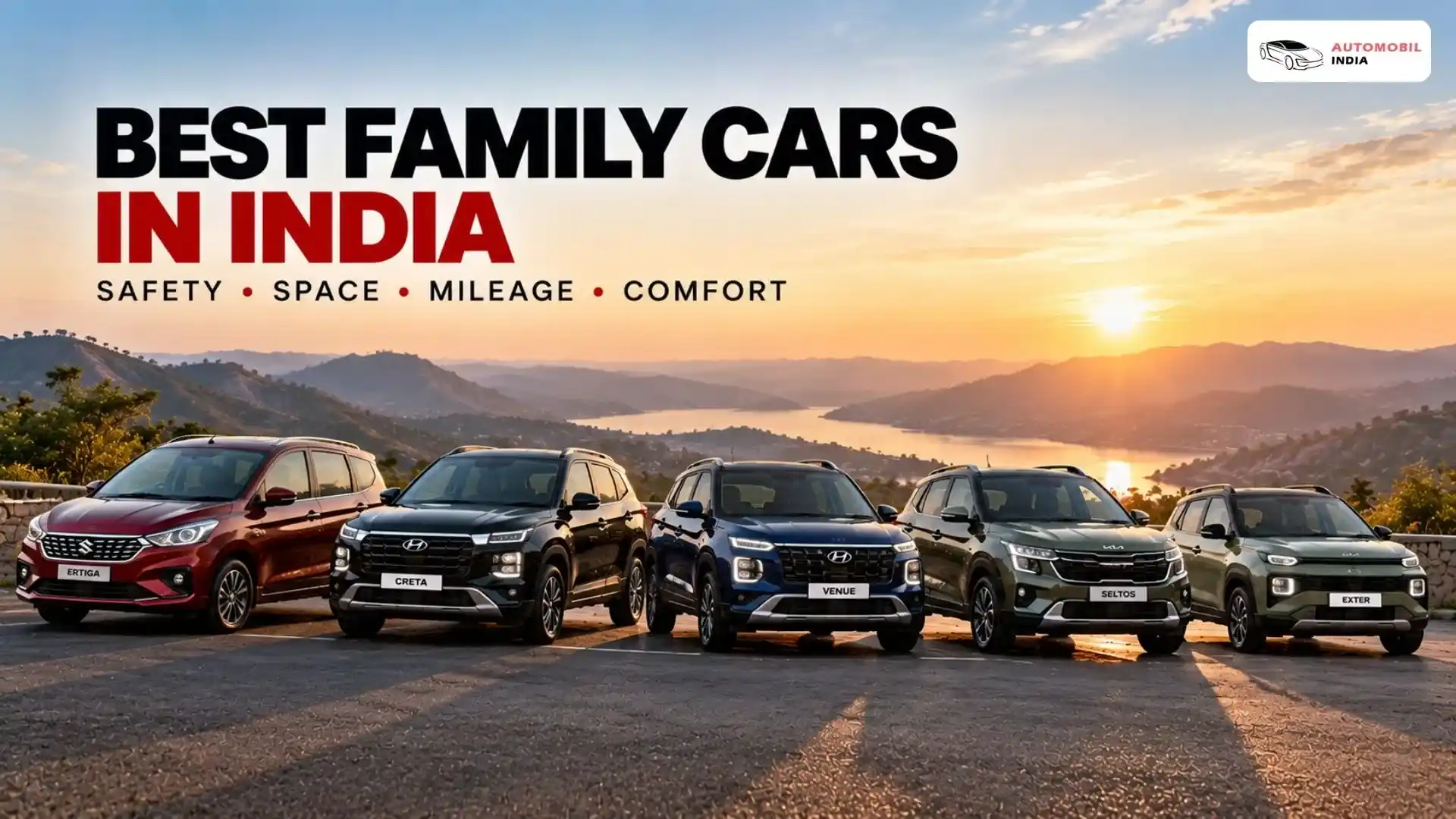
Choosing the best family car in India is not simply about buying the largest vehicle or the one with the longest features list. A good family car needs to balance safety, passenger space, comfort, fuel efficiency, luggage capacity, ease of driving and ownership costs.
For a small urban family, a hatchback or compact SUV may be easier to live with. Larger families may benefit from a three-row MPV or SUV, while frequent highway travellers may place greater importance on rear-seat comfort, boot space, engine performance and safety technology.
This guide looks at the factors that matter most when choosing a family car in India and highlights different types of vehicles that may suit different family requirements.
Quick answer: The right family car depends on your family size and usage. A compact hatchback can work well for city-focused families, a compact SUV can provide a useful balance of space and road clearance, while an MPV or three-row SUV makes more sense when six or seven people regularly travel together.
What Makes a Good Family Car in India?
A family car has to handle much more than the daily commute. It may be used for school runs, office travel, grocery shopping, airport trips and long-distance holidays.
The most important factors are:
-
Safety: Airbags, ESC, ABS, ISOFIX mounts, seat-belt equipment and crash-test performance.
-
Rear-seat comfort: Legroom, headroom, shoulder room, seat cushioning and access.
-
Boot space: Important when travelling with luggage, especially with children.
-
Fuel efficiency: A major consideration for families covering high annual kilometres.
-
Ride quality: The suspension should cope reasonably well with Indian roads.
-
Ease of driving: Light controls, good visibility and manageable dimensions help in cities.
-
Automatic transmission availability: Particularly useful for buyers who spend considerable time in traffic.
-
Air-conditioning: Rear vents and effective cooling can make a substantial difference in Indian summers.
-
Ownership costs: Service expenses, tyres, insurance and fuel costs should be considered alongside the purchase price.
A higher equipment level does not automatically make a car a better family choice. A feature is useful only if it improves safety, comfort or everyday usability.
Best Family Cars in India: What Should You Shortlist?
There is no single model that suits every family. Instead, buyers should shortlist cars according to their household size and driving pattern.
|
Family requirement |
Suitable body style |
What to prioritise |
|
2–4 people, mostly city |
Hatchback |
Easy parking, mileage, comfort |
|
4–5 people, mixed city/highway |
Compact SUV / sedan |
Rear space, safety, boot, ride quality |
|
5 people with frequent luggage |
Mid-size SUV / sedan |
Boot space, highway comfort |
|
6–7 people regularly |
MPV / 3-row SUV |
Third-row usability, AC, access |
|
High annual running |
CNG / hybrid / efficient petrol |
Running cost and service network |
|
Heavy traffic use |
Automatic |
Smooth low-speed operation |
|
Frequent highway travel |
SUV / sedan / MPV |
Stability, safety, power and comfort |
1. Maruti Suzuki Ertiga — A Practical Seven-Seater Family MPV
The Maruti Suzuki Ertiga remains an important option for families that genuinely need three rows.
The current Ertiga uses a 1.5-litre petrol engine and is available with both petrol and factory-fitted CNG powertrains. Maruti lists claimed efficiency of up to 20.51 km/l for petrol and 26.11 km/kg for CNG. The model is also available with a six-speed automatic on petrol variants.
Its 2,740-mm wheelbase helps provide useful cabin space, while the third row makes it more practical for larger families than most five-seat SUVs. Maruti lists 209 litres of boot space with all three rows in use, expandable substantially when the third row is folded.
Why families may consider it
-
Seven-seat configuration
-
Petrol and CNG choices
-
Automatic transmission availability
-
Rear AC with dedicated vents
-
Practical cabin layout
-
Strong relevance for high-mileage family use
What to consider
The third row is best viewed as an occasional or family-flexibility feature rather than a substitute for the spacious second row of a large SUV. Buyers should sit in all three rows before making a decision.
2. Hyundai CRETA — A Five-Seater for Families Wanting More Premium Features
The Hyundai Creta occupies the mid-size SUV category and can make sense for families that normally travel with four or five people.
Hyundai's current family-oriented lineup highlights the CRETA's spacious cabin, connected features, panoramic sunroof, ventilated front seats and available Level 2 ADAS.
For families, the important point is that a mid-size SUV can provide a more relaxed seating environment than a smaller compact SUV without moving to a three-row vehicle.
Why families may consider it
-
Comfortable five-seat layout
-
Broad powertrain choice
-
Premium cabin and convenience equipment
-
Strong highway suitability
-
Available driver-assistance technology
What to consider
If seven seats are genuinely required, a five-seat SUV cannot replace an MPV or three-row SUV. Buyers should also compare the running cost of the chosen engine and transmission rather than judging efficiency from claimed figures alone.
3. Hyundai VENUE — Compact SUV for City-Focused Families
The new Hyundai Venue is aimed at buyers who want compact exterior dimensions with SUV styling and a substantial equipment list.
Hyundai currently offers the VENUE with 1.2-litre petrol, 1.0-litre turbo-petrol and 1.5-litre diesel engines, with different transmission combinations depending on variant.
It is particularly relevant to families living in crowded cities because its smaller footprint is easier to manoeuvre and park than a larger SUV.
Safety is also a significant part of the current model's positioning. Hyundai says the new VENUE has received a five-star Bharat NCAP rating, with a reported Adult Occupant Protection score of 31.147/32 and 33 standard safety features.
Why families may consider it
-
Compact dimensions
-
Multiple engine options
-
Automatic transmission choices
-
Six airbags
-
Available Level 2 ADAS
-
Strong city usability
What to consider
A compact SUV does not automatically provide more rear-seat space than a larger hatchback or sedan. Families should physically check rear-seat width if three adults frequently sit in the second row.
4. Kia Seltos — Feature-Rich Five-Seater for Long-Distance Families
The Kia Seltos is worth considering for families that want a five-seat SUV with a strong focus on features and highway usability.
Kia lists multiple petrol and diesel powertrains, including naturally aspirated petrol, turbo-petrol and diesel options, with manual, automatic and DCT transmission choices depending on the variant.
The current Seltos provides a 2,610-mm wheelbase and a 447-litre boot according to Kia's current specifications page.
That boot capacity is useful for family travel because luggage space often becomes a limitation before passenger space does.
Why families may consider it
-
Five-seat cabin
-
Large boot
-
Multiple powertrain choices
-
Automatic transmission options
-
Strong feature availability
-
Suitable for highway travel
What to consider
Higher-end variants can become considerably more expensive than entry-level versions. Buyers should compare the exact variant rather than comparing only model-level specifications.
5. Hyundai GRAND i10 NIOS — Compact Family Car for Urban Use
The Hyundai Grand i10 Nios is aimed at buyers who primarily drive in cities and do not need SUV dimensions or three-row seating.
Hyundai currently positions the model as a practical hatchback for small families, with features such as an 8-inch infotainment system and wireless smartphone charging. Hyundai also lists six airbags as standard.
Why families may consider it
-
Compact footprint
-
Easy to park
-
Suitable for urban traffic
-
Practical for small families
-
Useful equipment without requiring a large vehicle
What to consider
The smaller dimensions that make a hatchback convenient in the city also mean less cabin and luggage space than a larger SUV or MPV.
6. Hyundai AURA — Family Sedan with a Separate Boot
The Hyundai Aura offers an alternative for buyers who prefer a sedan's separate boot.
Hyundai highlights rear AC vents, a rear centre armrest and six airbags on the AURA.
A sedan can be particularly useful for families that frequently carry luggage because the boot is physically separated from the passenger compartment.
Why families may consider it
-
Dedicated boot
-
Compact exterior dimensions
-
Useful rear-seat equipment
-
City-friendly footprint
-
Six airbags
What to consider
A sedan's longer rear overhang can make parking slightly different from a hatchback, although the overall vehicle remains relatively compact.
7. Hyundai EXTER — Compact SUV with a Practical Family Focus
The Hyundai Exter is positioned between the small hatchback and larger compact SUV categories.
Hyundai highlights six airbags, Hill-Start Assist Control, Vehicle Stability Management and a factory-fitted dashcam among its equipment. The model is also offered with a dual-cylinder CNG configuration intended to make better use of available luggage space.
Why families may consider it
-
Compact dimensions
-
Higher seating position
-
CNG option
-
City-friendly size
-
Useful safety and convenience features
What to consider
Families should assess rear-seat width and luggage requirements carefully. The higher driving position is useful, but it should not be treated as a substitute for greater interior volume.
Safety: What Should You Check in a Family Car?
Safety should be evaluated before features such as sunroofs, large displays or premium audio systems.
1. Crash-test performance
Bharat NCAP provides crash-test results and safety ratings for tested vehicles. Its database includes adult and child occupant protection scores as well as information about tested models and variants.
A crash-test rating should always be checked for the specific model and applicable version, because equipment and ratings can change between generations or test protocols.
2. Airbags
Look beyond the headline number.
Check:
-
Front airbags
-
Side airbags
-
Curtain airbags
-
Whether the equipment is standard
-
Whether the exact variant you want receives the same safety package
3. Electronic Stability Control
ESC can help maintain vehicle stability during certain loss-of-control situations. For family use, it is one of the more meaningful electronic safety systems to prioritise.
4. ISOFIX mounts
Families with young children should check for ISOFIX child-seat mounting points and confirm that their child seat is compatible.
5. ADAS
Advanced Driver Assistance Systems can provide features such as:
-
Forward collision warning
-
Autonomous emergency braking
-
Lane-keeping assistance
-
Adaptive cruise control
-
Blind-spot monitoring
ADAS should be treated as driver assistance, not autonomous driving. Its usefulness can also vary depending on road markings, traffic conditions and system calibration.
How Much Mileage Should a Family Car Deliver?
There is no single mileage figure that determines whether a car is economical.
Manufacturer or certified figures are useful for comparison, but actual consumption depends on:
-
Traffic congestion
-
Driving style
-
Vehicle load
-
Air-conditioner use
-
Tyre pressure
-
Road conditions
-
Average speed
-
Fuel type
-
Automatic versus manual transmission
For example, Maruti Suzuki lists the Ertiga at 20.51 km/l in petrol form and 26.11 km/kg in CNG form under its certified efficiency figures.
These figures should be treated as certified/claimed efficiency, not a guarantee of what every owner will achieve.
CNG vs Petrol vs Hybrid: What Makes Sense for Families?
|
Powertrain |
Usually suits |
Main advantage |
Important consideration |
|
Petrol |
Mixed usage |
Simple and widely available |
Fuel cost can be higher at high annual mileage |
|
CNG |
High city running |
Lower fuel cost per km in many use cases |
Requires convenient CNG access |
|
Hybrid |
City + mixed driving |
Can improve efficiency through electric assistance |
Higher purchase price on applicable models |
|
Diesel |
High highway running |
Strong torque and highway efficiency |
Higher purchase and maintenance considerations on some models |
|
EV |
Predictable daily routes with charging |
Low energy cost and quiet operation |
Charging access and long-distance planning |
The right powertrain depends on annual kilometres and where the vehicle is driven.
A family travelling only 8,000–10,000 km a year may not recover the additional purchase cost of a more expensive powertrain quickly. A family covering significantly higher annual kilometres may place much greater value on fuel efficiency.
5-Seater vs 7-Seater: Which Is Better for a Family?
The answer depends on how often the additional seats are actually used.
Choose a 5-seater when:
-
Four or five people make up the normal travelling group.
-
Third-row seating is rarely required.
-
You want more luggage flexibility.
-
Most driving happens in the city.
Consider a 7-seater when:
-
Six or seven people regularly travel together.
-
Grandparents or relatives frequently join family trips.
-
You regularly need additional seating capacity.
-
You are willing to accept the larger exterior dimensions.
Do not buy a seven-seater simply because it sounds more practical. If the third row is rarely used, a comfortable five-seater with a larger boot may better match everyday requirements.
Automatic vs Manual for Family Use
Automatic cars can be particularly convenient in stop-and-go traffic.
The type of automatic transmission matters, however.
|
Transmission |
General characteristic |
Suitable use |
|
AMT |
Simple automated manual |
Budget-focused city driving |
|
CVT/IVT |
Smooth, progressive operation |
Urban commuting |
|
Torque converter AT |
Conventional automatic |
Mixed city/highway use |
|
DCT |
Fast gear changes |
Buyers prioritising responsive driving |
|
e-CVT |
Hybrid-oriented system |
Efficient hybrid driving |
The transmission should be evaluated alongside the engine rather than separately. A smooth gearbox paired with an underpowered engine may not meet the needs of a family that frequently travels fully loaded.
Family Car Features That Actually Matter
Not every attractive feature has equal value.
High-priority features
-
Six or more airbags where offered
-
ESC
-
ISOFIX mounts
-
Rear AC vents
-
Good rear-seat visibility
-
3-point seat belts for all occupants
-
Rear parking camera/sensors
-
Effective headlights
-
Tyre-pressure monitoring where available
-
Strong crash-test performance
-
Good-quality child-seat mounting points
Useful convenience features
-
Automatic climate control
-
Wireless Android Auto/Apple CarPlay
-
Wireless charging
-
Multiple USB-C ports
-
Electrically adjustable seats
-
Cruise control
-
Ventilated front seats
-
Connected-car functions
Features that should not dominate the decision
-
Large sunroof
-
Huge touchscreen
-
Ambient lighting
-
Cosmetic exterior packages
These can improve the experience, but they should come after safety, comfort, space and powertrain suitability.
How to Choose the Right Family Car
Before booking, use this simple checklist.
Step 1: Count the regular occupants
Do not count the maximum possible passengers. Count the people who normally travel together.
Step 2: Measure your real luggage requirement
Take a typical family holiday as the benchmark rather than a normal office commute.
Step 3: Calculate annual running
Estimate your yearly kilometres.
For example:
Monthly distance × 12 = approximate annual distance
This gives you a better basis for deciding between petrol, CNG, hybrid, diesel or EV.
Step 4: Decide where you drive
A city-focused buyer may prioritise compact dimensions and an automatic gearbox.
A highway-focused buyer may give more importance to engine performance, stability, rear-seat comfort and boot capacity.
Step 5: Check the exact variant
Do not assume that every feature shown in advertising is standard across the range.
Compare the exact variant's:
-
Safety equipment
-
Engine
-
Transmission
-
Air-conditioning
-
Infotainment
-
Seat features
-
ADAS
-
Wheels and tyres
-
Parking equipment
Step 6: Take the entire family for a test drive
This is particularly important for family cars.
Ask the rear passengers:
-
Is the seat comfortable?
-
Is there enough knee room?
-
Can three people sit comfortably?
-
Are the doors easy to open?
-
Is getting into the third row easy?
-
Can children see outside?
-
Is the air-conditioning effective?
A specification sheet cannot answer all of these questions.
Best Family Cars in India: Quick Shortlist by Requirement
|
Requirement |
Cars/types worth considering |
Why |
|
Small city family |
Grand i10 NIOS, AURA |
Compact and practical |
|
Compact SUV requirement |
EXTER, VENUE |
Easier city use with SUV packaging |
|
Five-seat family SUV |
CRETA, Seltos |
More cabin and highway comfort |
|
Seven-seat requirement |
Ertiga |
Flexible three-row MPV layout |
|
High-mileage family use |
CNG-equipped models |
Potentially lower fuel cost per km |
|
Frequent highway trips |
Mid-size SUV / MPV |
Better suited to passengers and luggage |
|
Automatic city driving |
Automatic variants |
Reduced clutch work in traffic |
|
Child-focused family |
Cars with strong safety equipment and ISOFIX |
Better suited to child-seat use |
This is a use-case shortlist, not an overall ranking. The right model depends on the family's size, budget, annual running and driving environment.
What Is the Best Family Car in India?
There is no universal answer.
A small family that spends most of its time in Pune, Mumbai, Bengaluru or Delhi traffic may value a compact car, easy parking and fuel efficiency more than a large seven-seater.
A family that regularly travels with grandparents and children may find an MPV's three-row flexibility more useful.
Meanwhile, a five-member family that frequently travels between cities may prefer a mid-size SUV with better highway comfort and luggage capacity.
The most important principle is simple: buy for your family's regular use, not the maximum specification sheet.
A good family car should make everyday travel easier, keep occupants comfortable, provide appropriate safety equipment and remain financially manageable throughout ownership.
Disclaimer
Prices, variants, specifications, features, mileage figures and safety information can change over time and may vary by variant or location. Manufacturer-claimed mileage is based on certified test conditions and may differ from real-world usage. Always verify the latest information with the manufacturer or authorised dealer before making a purchase.