
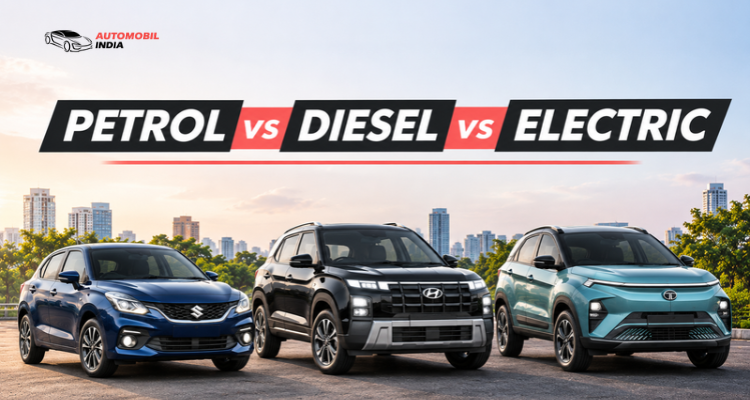
Choosing between a petrol, diesel or electric car is one of the biggest decisions for Indian buyers in 2026. Each powertrain offers a different balance of purchase price, running cost, performance, maintenance and convenience. Petrol remains a flexible choice for mixed use and moderate annual distances. Diesel can suit drivers who regularly cover long highway distances, while an electric car can reduce energy costs when home or workplace charging is practical. The right answer depends on your monthly kilometres, routes, parking, charging access and ownership period.
| Comparison | Petrol Car | Diesel Car |
|---|---|---|
| Typical upfront cost | Often lower entry price | May cost more than petrol equivalent |
| Energy source | Petrol from fuel stations | Diesel from fuel stations |
| Illustrative energy cost/km | About ₹7.00 | About ₹4.60 |
| Driving character | Smooth, familiar and versatile | Strong low- and mid-range torque |
| Best use case | Moderate running; mixed use | High annual distance; highway trips |
| Key ownership check | Real-world mileage and fuel spend | Purchase premium, servicing and local rules |
| Main convenience | Quick refuelling, broad coverage | Quick refuelling, long-distance flexibility |
Running-cost figures in this guide are illustrative calculations, not guaranteed costs for every car or city. They use the example assumptions shown in AutomobilIndia's cost-per-kilometre calculator; actual fuel prices, electricity tariffs, real-world efficiency and vehicle prices vary. Compare equivalent vehicles and use your local prices before making a purchase.
1. Purchase Price and Upfront Cost: What Do You Pay First?
Petrol cars offer a broad choice across hatchbacks, sedans and SUVs. In many comparable model ranges, the petrol variant has a lower starting price than the diesel or electric alternative. That can make petrol easier to justify if your annual distance is modest or your car is used irregularly.
Diesel variants often carry a purchase-price premium, although the difference varies by manufacturer and segment. Their stronger low- and mid-range torque and potentially better fuel efficiency can appeal to drivers who cover substantial distances. An EV may have a higher initial price than an equivalent petrol model, depending on segment, battery size and equipment.
Do not compare only advertised starting prices. Check the exact variant, on-road price, insurance, registration, home-charger installation, loan interest and expected resale value. Browse current petrol cars, diesel cars and electric cars on AutomobilIndia.
2. Running Cost: Petrol vs Diesel vs Electric
Running cost is where the three powertrains can differ significantly. Petrol cost per kilometre depends on the local pump price and the car's real-world mileage. Diesel usually consumes fewer litres over the same distance in comparable vehicles, but the saving must be weighed against the variant's higher purchase price and maintenance requirements.
Electricity can be substantially cheaper per kilometre when an EV is charged mainly at home. AutomobilIndia's calculator uses illustrative assumptions of 15km/l at ₹105 per litre for petrol, 20km/l at ₹92 per litre for diesel and 6km/kWh at ₹8 per unit for an EV. On those assumptions, energy cost is approximately ₹7.00/km for petrol, ₹4.60/km for diesel and ₹1.30/km for home-charged electric driving. These are examples, not fixed national averages.
The gap changes with your city, driving conditions, vehicle efficiency and charging tariff. Public fast charging can cost more than home charging, while traffic, high speeds, air-conditioning and load can reduce real-world efficiency. Use the AutomobilIndia cost-per-kilometre calculator with your own inputs, then compare total ownership cost rather than energy cost alone.
3. City Driving: Which Powertrain Is More Practical?
Petrol cars are generally easy to live with in cities because refuelling is quick and stations are widely available. They suit mixed short and medium trips, particularly when monthly running is not high enough to recover a more expensive powertrain.
Electric cars can feel smooth in stop-start traffic, with immediate torque and no conventional gear changes. They can be convenient for predictable commutes if you have a dedicated parking space and reliable home or workplace charging. Regenerative braking can recover some energy while slowing down.
Diesel cars can handle urban driving, but buyers who mostly make short trips should consider whether that usage suits the specific engine and its emissions-control systems. Diesel may be more compelling for regular longer journeys than occasional short errands.
4. Highway Trips and Long-Distance Travel
All three powertrains can handle highway journeys, but they offer different kinds of convenience. Petrol vehicles are easy to refuel and can suit occasional intercity trips, although fuel consumption may rise at sustained high speeds or under heavy loads.
Diesel engines often deliver strong low-rev torque and can be relaxed on long journeys, particularly in larger cars and SUVs. Their fuel efficiency may help frequent highway users, but the purchase premium, servicing and local restrictions must be included in the decision.
An EV can cover intercity distances when its usable range and charging network match the route. Plan charging stops in advance, check charger availability and connector compatibility, and keep a reserve for detours or queues. EV road trips are easier when fast chargers are dependable along your regular routes.
5. Maintenance, Charging and Refuelling Convenience
Petrol and diesel cars have familiar refuelling routines and established service ecosystems across much of India. Routine maintenance differs by model, but internal-combustion vehicles require engine-related servicing and consumables. Check the manufacturer's service schedule and parts prices rather than assuming all diesel cars cost more to maintain.
EVs have fewer moving drivetrain components and do not require engine oil changes, but they are not maintenance-free. Tyres, brakes, suspension, air-conditioning and other vehicle components still need attention. Battery warranty, repair support and trained technicians are important checks before purchase.
Charging access is a major ownership factor. Apartment residents should confirm parking permission, electrical capacity, charger installation and billing before booking. If relying on public charging, check stations on regular routes and the cost of using them. For every powertrain, compare insurance, tyres, servicing, warranty and resale prospects.
Estimate the cost of petrol, diesel or electricity using your monthly driving distance and local prices.
Calculate Your Cost Per Kilometre6. Performance, Reliability and Ownership Considerations
Petrol cars are often quieter and smoother than comparable diesel cars, although refinement varies by engine. Diesel engines typically offer strong low- and mid-range torque, useful for overtaking, gradients and carrying passengers or luggage. EVs deliver immediate torque and quiet acceleration. Reliability is model-specific: review owner feedback, warranty coverage, service reach and parts availability.
Before buying a diesel vehicle, also consider local regulations, particularly in cities with age-based or emissions-related restrictions. Rules differ by location and can change, so verify current requirements with the relevant transport authority. For EVs, pay particular attention to battery warranty conditions and high-voltage repair support.
Which Fuel Type Should You Buy in 2026?
| Your requirement | Better starting point | Reason |
|---|---|---|
| Low or irregular monthly running | Petrol | Lower initial outlay can matter more than fuel savings |
| Frequent long highway journeys | Diesel | Torque and efficiency may help offset purchase premium |
| Daily commute with home charging | Electric | Potentially lower energy cost and convenient charging |
| Mostly city use with no charging access | Petrol | Quick refuelling and broad availability |
| High annual kilometres and fixed routes | Compare diesel and electric | Calculate total cost with your own distance and energy prices |
| Unpredictable intercity travel | Petrol or diesel | No dependence on public charging availability |
Before making a decision, compare the actual models you are considering and calculate the cost using your monthly distance. Browse petrol cars, diesel cars and electric cars on AutomobilIndia. You can also use our cost-per-kilometre calculator before comparing the final on-road price, finance, insurance and warranty.
Estimate the cost of petrol, diesel or electricity based on your monthly driving distance and local prices.
Use the Cost Per KM Calculator