
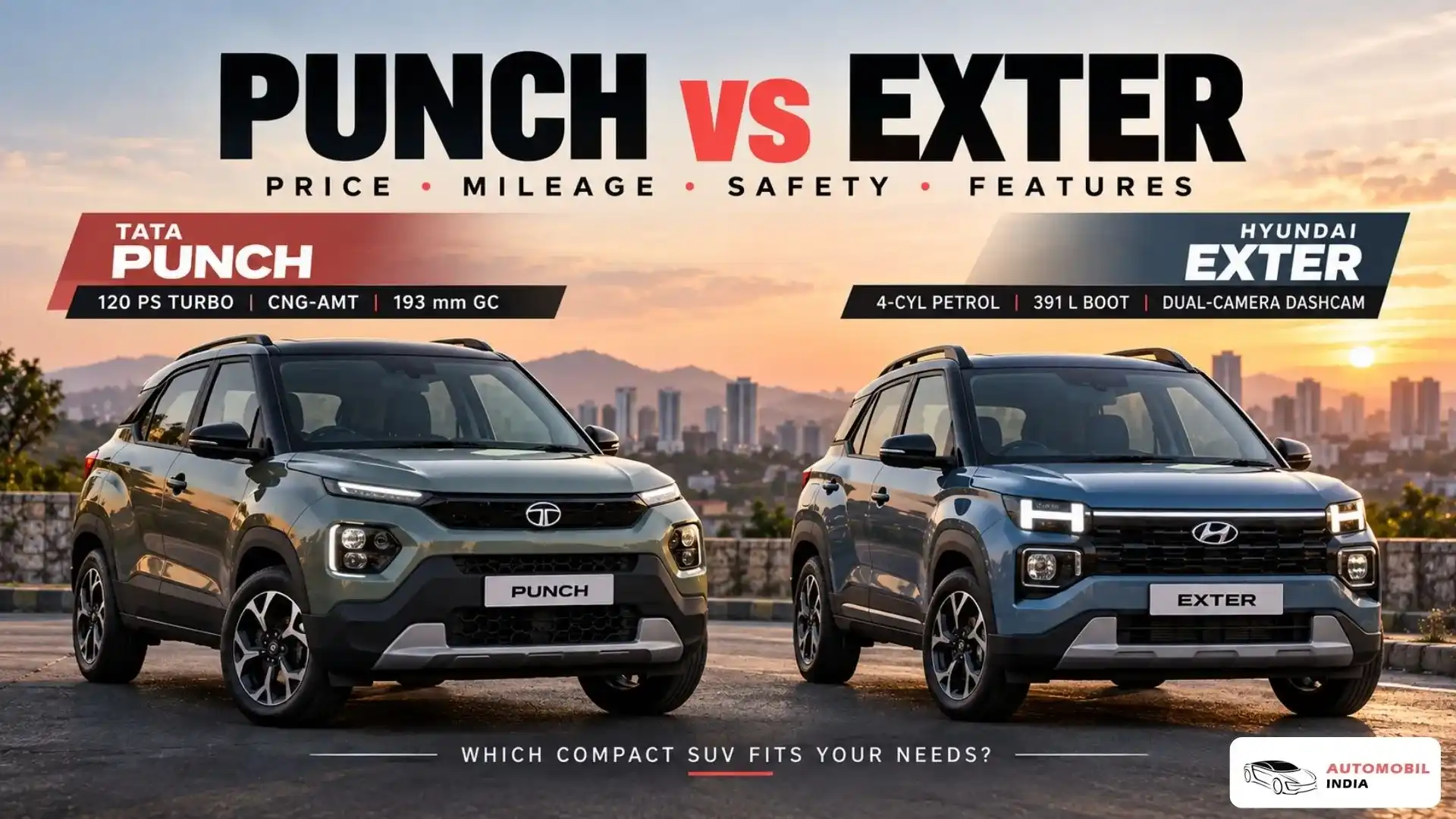
The Tata Punch vs Hyundai Exter comparison is one of the most relevant battles in India's compact SUV market. But in 2026, older comparison articles are no longer enough because both SUVs have received significant updates.
The 2026 Tata Punch facelift gets a new 1.2-litre turbo-petrol engine producing 120hp and 170Nm, along with a new CNG-AMT option. It also continues with the naturally aspirated petrol engine and receives updated styling and technology.
The 2026 Hyundai Exter, meanwhile, gets refreshed styling, a more premium cabin, a segment-first dual-camera dashcam, dual-cylinder CNG packaging and six airbags, ESC and hill-start assist as standard.
Both now have 5-star Bharat NCAP ratings, although the Punch and Exter achieve that through different test results and equipment packages.
So, which one should you buy?
The Punch makes a stronger case for buyers who want performance, ground clearance, CNG-AMT and a five-star safety rating, while the Exter is particularly attractive for city users who value refinement, cabin height, boot space, convenience features and Hyundai's technology package.
Tata Punch vs Hyundai Exter: Quick Comparison
|
Parameter |
Tata Punch |
Hyundai Exter |
|
Starting ex-showroom price* |
₹5.75 lakh approx. |
₹5.80 lakh |
|
Seating |
5 |
5 |
|
Length |
3,876 mm |
3,830 mm |
|
Width |
1,742 mm |
1,723 mm |
|
Height |
1,615 mm |
1,643 mm |
|
Wheelbase |
2,445 mm |
2,450 mm |
|
Ground clearance |
193 mm |
185 mm |
|
Petrol engine |
1.2L NA |
1.2L NA |
|
Turbo-petrol |
1.2L, 120hp |
Not available |
|
CNG |
1.2L |
1.2L |
|
Petrol automatic |
5-AMT |
Smart Auto AMT |
|
CNG automatic |
Yes, AMT |
No |
|
Petrol manual mileage |
Up to 20.09 km/l* |
19.4 km/l* |
|
CNG mileage |
Up to 26.99 km/kg* |
27.1 km/kg* |
|
Petrol boot |
366 litres |
391 litres |
|
CNG boot |
210 litres |
225 litres |
|
Airbags |
6 standard |
6 standard |
|
Bharat NCAP |
5 stars |
5 stars |
|
ADAS |
No |
No |
|
Dashcam |
Higher variants |
Available on selected variants |
|
Best suited for |
Performance, rough roads, powertrain variety |
City use, features, refinement and space |
*Prices and claimed mileage vary by variant. Current manufacturer and industry listings should be checked before purchase.
The short answer
Choose the Tata Punch if you want:
-
A turbo-petrol engine
-
Higher ground clearance
-
CNG with an AMT option
-
Stronger performance potential
-
5-star Bharat NCAP safety
Choose the Hyundai Exter if you want:
-
A smoother 4-cylinder petrol engine
-
More boot space
-
A taller cabin
-
Dual-cylinder CNG
-
A segment-first dashcam
-
Hyundai's connected-car technology
Punch vs Exter Price
The 2026 Tata Punch facelift was launched with an introductory starting price of ₹5.59 lakh, although current 2026 listings show the range around ₹5.75 lakh at the lower end depending on the latest price revision and source. The range extends beyond ₹10 lakh depending on variant and powertrain.
Hyundai currently lists the Exter from ₹5.80 lakh, with the range extending to approximately ₹9.41 lakh ex-showroom.
Hyundai's current Exter lineup uses HX2, HX3, HX4, HX4+, HX6, HX8 and HX10 designations.
Where the price comparison gets interesting
The Punch offers more expensive powertrain possibilities because of its new turbo-petrol engine.
The 120hp turbo-petrol is available only with a 6-speed manual, while the naturally aspirated petrol and CNG versions get manual and AMT choices.
The Exter remains simpler:
-
Petrol MT
-
Petrol AMT
-
CNG MT
That simplicity is actually useful for buyers who are primarily looking for an affordable city car rather than a performance-oriented compact SUV.
Punch vs Exter Dimensions: Which Is Bigger?
The Punch and Exter are both designed around India's compact-SUV category, but their proportions are different.
|
Dimension |
Tata Punch |
Hyundai Exter |
|
Length |
3,876 mm |
3,830 mm |
|
Width |
1,742 mm |
1,723 mm |
|
Height |
1,615 mm |
1,643 mm |
|
Wheelbase |
2,445 mm |
2,450 mm |
|
Ground clearance |
193 mm |
185 mm |
|
Petrol boot |
366 litres |
391 litres |
|
CNG boot |
210 litres |
225 litres |
The Punch is 46 mm longer and 19 mm wider, while the Exter is 28 mm taller and has a wheelbase that is 5 mm longer.
This creates two different interpretations of the SUV format.
The Punch looks and feels more planted, while the Exter's greater height contributes to its upright appearance and seating position.
What matters in everyday driving?
The Punch's 193 mm ground clearance is useful on poorly surfaced Indian roads, large speed breakers and rough residential streets.
The Exter's 185 mm ground clearance is still adequate for normal urban use, but the Punch has the numerical advantage.
On the other hand, the Exter offers 391 litres of petrol boot space, compared with 366 litres for the Punch.
For a family carrying luggage, the Exter's additional 25 litres can be more useful than the Punch's additional ground clearance.
Punch vs Exter Engine and Performance
This is where the biggest mechanical difference appears.
Tata Punch Engine Options
The 2026 Punch is available with three engines:
1.2-litre naturally aspirated petrol
-
88hp
-
115Nm
-
5-speed manual
-
5-speed AMT
1.2-litre turbo-petrol
-
120hp
-
170Nm
-
6-speed manual only
1.2-litre CNG
-
73hp
-
103Nm
-
5-speed manual
-
5-speed AMT
The turbo-petrol is derived from the Nexon's engine family and is the biggest mechanical change introduced with the 2026 Punch. Tata claims a 0-100 km/h time of 11.1 seconds.
This transforms the Punch from a primarily city-oriented micro-SUV into a much more capable option for buyers who regularly travel on highways.
Important limitation
The turbo-petrol Punch does not get an automatic gearbox.
If you want a Punch automatic, you have to choose the naturally aspirated petrol or CNG-AMT versions.
Hyundai Exter Engine Options
The Exter uses a single 1.2-litre Kappa petrol engine.
It produces:
-
83 PS
-
113.8 Nm
The engine is a four-cylinder unit and is available with:
-
5-speed manual
-
Smart Auto AMT
The CNG version uses the same basic engine architecture in bi-fuel form and is offered with a manual gearbox.
What does this mean?
The Exter's naturally aspirated four-cylinder engine is designed more around smoothness and predictable city driving than outright performance.
The Punch gives you a much wider performance envelope because the turbo engine produces 120hp and 170Nm.
Performance advantage: Punch
There is little ambiguity here.
If performance matters, the Punch turbo-petrol is in a different league from the Exter's naturally aspirated petrol.
However, if your driving consists mainly of city commuting, the Exter's smoother naturally aspirated character can be perfectly adequate.
Punch vs Exter Mileage
Mileage needs to be separated into manufacturer-certified figures and real-world consumption.
Tata Punch Mileage
Current published figures list approximately:
-
Petrol manual: 20.09 km/l
-
Petrol AMT: around 18.8 km/l
-
CNG: up to 26.99 km/kg
The turbo-petrol is a performance-oriented addition, so buyers should not assume that its fuel economy will match the naturally aspirated petrol's headline figure.
Hyundai Exter Mileage
The Exter's published figures are:
-
Petrol manual: 19.4 km/l
-
Petrol AMT: 19.2 km/l
-
CNG manual: 27.1 km/kg
Which has better mileage?
On the published figures:
Petrol manual: Punch has the higher headline figure.
Petrol automatic: The figures are close, with the Exter's published 19.2 km/l ahead of the Punch's approximately 18.8 km/l.
CNG: Exter has a marginally higher claimed figure at 27.1 km/kg versus up to 26.99 km/kg for Punch.
But the differences are small enough that they should not be the sole reason for choosing either vehicle.
Real-world mileage matters more
Autocar's testing of the Exter petrol manual returned 11.99 km/l, while its CNG test returned 26.55 km/kg.
Real-world consumption depends on:
-
Traffic
-
Driving style
-
Air-conditioning use
-
Passenger load
-
Tyre pressure
-
Road conditions
-
Average speed
Therefore, ARAI figures should be used for comparison, not as a guarantee of daily mileage.
Punch vs Exter CNG: Which Is More Practical?
Both cars offer factory-fitted CNG, but their packaging approaches differ.
Tata Punch CNG
The Punch uses twin CNG cylinders positioned under the boot floor.
The CNG version provides 210 litres of boot space.
More importantly, the 2026 Punch adds a CNG-AMT option.
That is significant for urban users because it combines lower running costs with two-pedal driving.
Hyundai Exter CNG
The new Exter uses Hyundai's Hy-CNG Duo dual-cylinder system.
The company states that the new layout preserves 225 litres of boot space, while the spare wheel is mounted underneath the vehicle.
However, the Exter CNG is currently offered with a manual gearbox only.
Which CNG car makes more sense?
For CNG + automatic: Punch.
For CNG + slightly more boot space: Exter.
For CNG efficiency: The claimed figures are almost identical.
This is one of the clearest use-case decisions in the entire comparison.
Punch vs Exter Features
Both cars offer significantly more equipment than their price suggests.
But the philosophy is different.
Tata Punch Features
Higher variants offer:
-
10.25-inch touchscreen
-
7-inch digital driver's display
-
Wireless Android Auto and Apple CarPlay
-
360-degree camera
-
Wireless charger
-
Automatic climate control
-
Cruise control
-
Electric sunroof
-
Connected-car technology
-
Auto-dimming IRVM
-
Rear AC vents
-
Type-C charging
-
8-speaker audio system
The Punch's higher variants also get a 360-degree camera and wireless charging.
Hyundai Exter Features
Depending on variant, the Exter offers:
-
Digital instrument cluster
-
20.32 cm touchscreen
-
Wireless Android Auto and Apple CarPlay
-
Hyundai Bluelink
-
Wireless smartphone charging
-
Home-to-Car with Alexa
-
Electric sunroof
-
Rear AC vents
-
Type-C rear USB port
-
Dashcam
-
TPMS
-
Rear parking camera
-
Connected-car features
The new Exter's dual-camera dashcam is particularly notable because Hyundai describes it as a segment-first feature.
Which has better features?
It depends on what you value.
Punch: 360-degree camera, larger touchscreen and stronger higher-variant equipment package.
Exter: Dashcam, Hyundai connected technology and a feature-rich city-focused cabin.
There is no meaningful reason to choose between them based on a simple feature-count battle.
Punch vs Exter Interior and Comfort
The Exter's 2,450 mm wheelbase is marginally longer than the Punch's 2,445 mm, while the Exter is also taller.
That gives Hyundai an advantage in creating an upright cabin.
Hyundai's updated Exter also gets:
-
Navy and grey interior theme
-
3D carbon-pattern dashboard
-
D-cut steering wheel
-
Metal pedals
-
Folding driver armrest
-
Driver-seat height adjustment
The Punch receives a revised cabin with a new steering wheel, digital driver's display, improved seat design and extended thigh support.
The Punch also retains 90-degree-opening doors, which can be useful for older passengers, child-seat installation and getting in and out of tight parking spaces.
Family usability
For families with elderly passengers or small children, the Punch's wide-opening doors are a genuinely useful feature rather than a cosmetic gimmick.
For buyers who prefer an upright driving position and a taller cabin, the Exter has a strong argument.
Punch vs Exter Boot Space
This is an area where the Exter has a measurable advantage.
|
Configuration |
Tata Punch |
Hyundai Exter |
|
Petrol boot |
366 litres |
391 litres |
|
CNG boot |
210 litres |
225 litres |
The Exter gives you 25 litres more petrol boot space and 15 litres more in CNG form.
For a small family carrying:
-
Shopping bags
-
Strollers
-
Weekend luggage
-
School bags
that extra space can be useful.
Neither car has the luggage capacity of a larger compact SUV, but the Exter is the stronger choice if boot space is one of your top priorities.
Boot-space advantage: Exter.
Punch vs Exter Safety
This is an important change from older comparisons.
Both vehicles now have 5-star Bharat NCAP ratings.
Tata Punch Bharat NCAP
The current Punch has:
-
30.58/32 Adult Occupant Protection
-
45/49 Child Occupant Protection
-
5-star overall rating
The tested vehicle was the Punch Pure+ CNG AMT and Accomplished CNG MT, with the rating applicable to the variants listed by Bharat NCAP.
The current Punch also has six airbags as standard across the range according to current model information.
Hyundai Exter Safety
The new Exter has six airbags as standard along with:
-
ESC
-
HAC
-
VSM
-
TPMS
-
ABS with EBD
-
Rear parking camera on applicable variants
Hyundai says the refreshed Exter has more than 45 advanced safety features and 30 standard safety features.
Does the Exter have a Bharat NCAP rating?
The current Exter's safety package is extensive, but the Bharat NCAP database does not currently list a separate current Exter crash-test rating alongside the Punch rating.
Therefore, an article should not claim that the Exter has a 5-star Bharat NCAP rating unless a current official BNCAP result is available.
This is an important distinction between safety equipment and independent crash-test certification.
Safety advantage: Punch
Based on currently available independent crash-test data, the Punch has the stronger documented safety credential because its current model has a published 5-star Bharat NCAP result.
Punch vs Exter ADAS
Neither vehicle offers the Level 2 ADAS package found in some more expensive SUVs.
That is not necessarily a disadvantage for their target audience.
Both focus on more basic active and passive safety systems such as:
-
ESC
-
ABS
-
Airbags
-
TPMS
-
Parking sensors/camera
-
Hill-start assistance
The Punch's higher variants can add a 360-degree camera and blind-view-related technology, while the Exter offers a dashcam on selected variants.
A 360-degree camera is particularly useful in Indian cities because it helps with:
-
Tight parking
-
Narrow lanes
-
Parking next to walls
-
Avoiding low obstacles
It should not be confused with autonomous driving or ADAS.
Punch vs Exter for City Driving
This is where both cars make the most sense.
Tata Punch for city use
The Punch offers:
-
Compact dimensions
-
High seating position
-
193 mm ground clearance
-
AMT
-
CNG
-
CNG-AMT
-
360-degree camera
-
90-degree-opening doors
Its AMT can remove clutch work in stop-and-go traffic, although automated manuals can be slower to shift than more sophisticated automatic transmissions. Autocar's testing specifically notes that the Punch AMT benefits from a gentle throttle approach.
Hyundai Exter for city use
The Exter offers:
-
1.2-litre four-cylinder petrol
-
AMT
-
CNG
-
391-litre petrol boot
-
Compact dimensions
-
High seating position
-
Dashcam
-
Connected technology
The four-cylinder engine is an important distinction because it is inherently different in character from the Punch's three-cylinder naturally aspirated engine.
Which is better for city driving?
If you prioritise refinement and convenience, the Exter has a strong case.
If you prioritise ground clearance, CNG-AMT and safety credentials, the Punch is more compelling.
Punch vs Exter for Highway Driving
The 2026 Punch's turbo-petrol engine changes this part of the comparison significantly.
Its:
120hp + 170Nm
is considerably stronger than the Exter's:
83 PS + 113.8Nm
naturally aspirated petrol.
The turbo Punch is therefore the obvious choice if highway acceleration and overtaking are important.
However, it comes only with a manual gearbox.
The Exter is not designed as a performance-oriented SUV. Its naturally aspirated engine is better suited to relaxed driving.
Highway advantage
Performance: Punch turbo
Automatic convenience: Neither has a conventional torque-converter/CVT automatic.
Long-distance luggage: Exter
Rough roads: Punch
Punch vs Exter Ownership and Practicality
Ownership requirements can change the answer completely.
Choose Punch CNG if:
-
You drive a lot every month
-
CNG is easily available
-
You want an AMT
-
You still want reasonable boot space
-
Running cost matters more than performance
Choose Exter CNG if:
-
You want CNG
-
You prefer a four-cylinder engine
-
You want slightly more usable boot space
-
You are comfortable with a manual gearbox
Choose Punch Turbo if:
-
You drive on highways regularly
-
You carry passengers and luggage
-
You want stronger overtaking performance
-
You enjoy driving
-
You don't mind a manual gearbox
Choose Exter Petrol if:
-
Most driving is in the city
-
You value refinement
-
You want an easy-to-drive automatic
-
You want a larger boot
-
You prefer Hyundai's technology ecosystem
Punch vs Exter: Which One Should You Buy?
There is no need for an arbitrary overall winner.
The better choice depends on the requirement.
Choose Tata Punch if:
-
Safety is a major priority
-
You want a current 5-star Bharat NCAP rating
-
You want a turbo-petrol option
-
You want CNG with an AMT
-
You drive on rough roads
-
Ground clearance matters
-
You want a 360-degree camera
-
You want stronger highway performance
Choose Hyundai Exter if:
-
Most of your driving is urban
-
You prefer a smoother four-cylinder petrol engine
-
Boot space matters
-
You want Hyundai's connected features
-
You want a dashcam
-
You want a taller cabin
-
You prefer a simple petrol/AMT/CNG lineup
-
You want a compact SUV primarily for city and family use
Punch vs Exter: Best Choice by Requirement
|
Requirement |
Better suited |
|
Lower entry price |
Punch* |
|
Petrol efficiency |
Punch on claimed MT figure |
|
CNG efficiency |
Exter, marginally |
|
CNG automatic |
Punch |
|
Turbo-petrol |
Punch |
|
Petrol refinement |
Exter |
|
Ground clearance |
Punch |
|
Boot space |
Exter |
|
Rough-road ability |
Punch |
|
360-degree camera |
Punch |
|
Dashcam |
Exter |
|
Bharat NCAP documentation |
Punch |
|
Six airbags |
Both |
|
City driving |
Both |
|
Highway performance |
Punch Turbo |
|
Elderly-friendly access |
Punch |
|
Connected technology |
Exter |
|
Large luggage requirement |
Exter |
*Exact starting prices change with manufacturer revisions and city-specific pricing.
Which Punch or Exter Variant Should You Consider?
The variant matters almost as much as the model.
Punch
For buyers who want performance, the turbo-petrol deserves attention.
For high-running urban use, the CNG-AMT is particularly interesting because it combines two features rarely found together at this price.
For buyers on a tighter budget, the lower petrol variants retain the Punch's core safety package.
Current 2026 listings show six airbags and the five-star Bharat NCAP rating across the Punch range, while features such as the 10.25-inch touchscreen, sunroof, 360-degree camera and wireless charger move higher up the variant ladder.
Exter
The new Exter's range starts with HX2 and goes up to HX10.
The higher variants add features such as the dashcam, TPMS, larger wheels and additional convenience equipment.
If you want an automatic, compare the HX3/HX4/HX6/HX8/HX10 AMT variants rather than assuming the cheapest Exter offers the same equipment.
What Should You Check Before Buying?
1. Drive both AMTs
AMTs are convenient, but they do not behave like CVTs or torque converters.
Try them in:
-
Traffic
-
Parking
-
Inclines
-
Stop-and-go conditions
2. Sit in the rear
Take two adults into the rear seat.
Check:
-
Knee room
-
Headroom
-
Shoulder room
-
Seat cushioning
-
Visibility
-
Under-thigh support
3. Test the boot
If you travel regularly, take your actual luggage to the dealership.
The Exter's 391-litre boot is larger on paper, but luggage shape and loading height matter too.
4. Calculate your monthly running
If you drive only 500 km a month, CNG may not automatically be the best financial decision.
If you drive 2,000 km or more, the calculation can look very different.
5. Don't buy a turbo just for the badge
The Punch turbo is significantly more powerful, but it is manual-only.
If you specifically want an automatic, the naturally aspirated Punch or Exter AMT may make more sense.
6. Calculate the on-road price
The advertised ex-showroom price is not your final payment.
Registration, road tax, insurance and other charges vary by state and city.
Conclusion
The Tata Punch vs Hyundai Exter comparison has become much closer — and more complicated — after both SUVs received their 2026 updates.
The Punch now has a major advantage that the older model lacked: a 120hp turbo-petrol engine. It also offers CNG-AMT, 193 mm ground clearance and a current 5-star Bharat NCAP rating.
The Exter takes a different route. Its 4-cylinder 1.2-litre petrol engine, 391-litre boot, dual-cylinder CNG system, dashcam and feature-rich cabin make it particularly well suited to city-focused buyers.
So the decision is relatively straightforward if your priorities are clear:
Want performance, rough-road ability and CNG-AMT? → Punch.
Want refinement, boot space and city-friendly features? → Exter.
Want the strongest documented current crash-test credential? → Punch.
Want a CNG car with slightly more boot space? → Exter.
Neither SUV is universally better. The right choice depends on the engine, gearbox and variant that fit your actual driving pattern, rather than simply choosing the model with the longer feature list.
Disclaimer
Prices, variants, specifications, features and claimed mileage figures can change without prior notice. Manufacturer/ARAI mileage figures are measured under controlled test conditions and may differ from real-world results. Bharat NCAP ratings apply to the tested vehicle configurations and variants specified by the programme. Buyers should verify the latest price, variant equipment, safety specifications and on-road cost with Tata Motors or Hyundai before purchase.