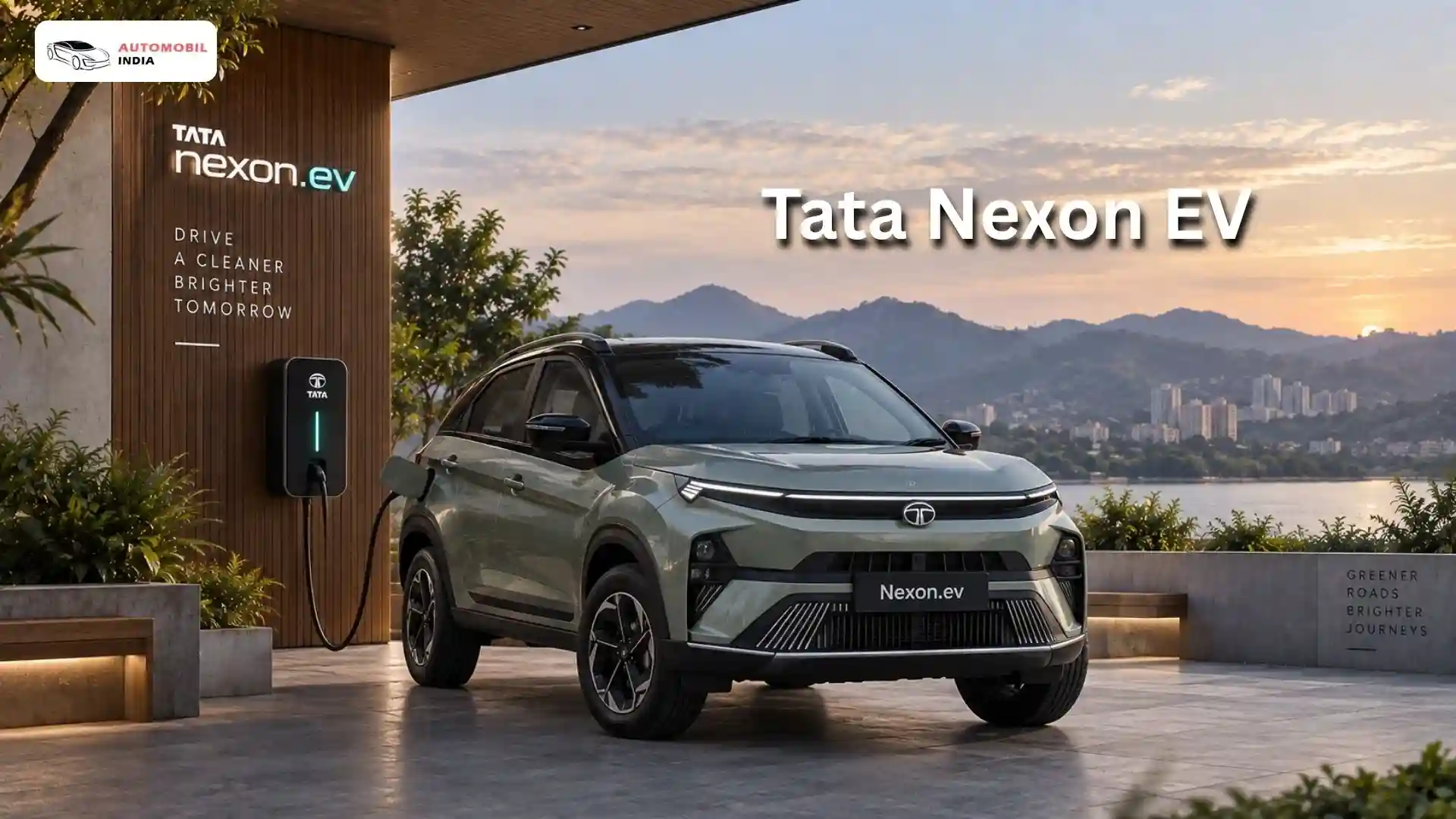
The Tata Nexon EV is one of India’s most established electric SUVs, combining a compact SUV footprint with two battery options aimed at different types of buyers.
For 2026, the Nexon.ev is available with 30 kWh and 45 kWh battery packs. The 30 kWh version has a claimed 325 km MIDC range, while the 45 kWh version is rated at 489 km MIDC. Tata also quotes a C75 real-world range of around 210–230 km for the 30 kWh version and 350–375 km for the 45 kWh version.
The current Nexon.ev range starts at ₹12.49 lakh ex-showroom for the Creative+ MR 30 kWh, while the 45 kWh range starts at around ₹14.34 lakh depending on the applicable city pricing.
The more important change for long-term buyers is the battery warranty. Tata now offers a Lifetime HV Battery Warranty for the Nexon.ev 45 kWh for the first registered owner, defined by Tata as 15 years from first registration with unlimited kilometres, subject to the applicable terms. The 30 kWh version continues with an 8-year/1,60,000 km battery and motor warranty.
That makes the Nexon.ev worth evaluating on more than just its claimed range. Charging access, daily driving distance, battery size, warranty terms and the difference between certified and real-world range are all important before buying.
Tata Nexon EV Price and Variants
The current Nexon.ev is offered in multiple trims and two battery configurations.
| Variant | Battery | Claimed MIDC Range | Approx. Ex-showroom Price |
|---|---|---|---|
| Creative+ MR | 30 kWh | 325 km | ₹12.49 lakh |
| Fearless MR | 30 kWh | 325 km | ₹13.29 lakh |
| Creative 45 | 45 kWh | 489 km | ₹14.34 lakh |
| Fearless 45 | 45 kWh | 489 km | ₹15.34 lakh |
| Empowered 45 | 45 kWh | 489 km | ₹16.34 lakh |
| Empowered+ A 45 | 45 kWh | 489 km | ₹17.69 lakh |
| Empowered+ A 45 #DARK | 45 kWh | 489 km | ₹17.89 lakh |
| Empowered+ A 45 Red #DARK | 45 kWh | 489 km | ₹17.89 lakh |
The key decision is therefore not simply which Nexon EV variant to buy. It is first deciding whether the 30 kWh or 45 kWh battery better matches your usage.
Tata Nexon EV Battery Options Explained
The Nexon.ev currently has two battery choices.
30 kWh Medium Range
The 30 kWh battery is intended for buyers who primarily use the vehicle around town and want a lower entry price.
Tata’s current information lists a 325 km MIDC range, while its C75 real-world range figure is around 210–230 km.
45 kWh Long Range
The larger 45 kWh battery increases the claimed range substantially to 489 km MIDC.
Tata’s C75 figure is approximately 350–375 km, which is a much more useful reference for planning real-world journeys than the laboratory-certified number alone.
Battery comparison
| Specification | Nexon.ev 30 kWh | Nexon.ev 45 kWh |
|---|---|---|
| Battery capacity | 30 kWh | 45 kWh |
| Claimed MIDC range | 325 km | 489 km |
| Tata C75 range | 210–230 km | 350–375 km |
| Motor output | 95 kW | 106 kW |
| Torque | 215 Nm | 215 Nm |
| 0–100 km/h | Around 9.2 sec | Around 8.9 sec |
| Battery/motor warranty | 8 years/1.6 lakh km | Lifetime* |
Tata Nexon EV Range: What Can You Actually Expect?
Range is probably the first question most prospective EV buyers ask.
The headline numbers are:
- 30 kWh: 325 km MIDC
- 45 kWh: 489 km MIDC
But these should not be interpreted as guaranteed distances that every owner can achieve.
Tata’s C75 methodology gives a more conservative reference:
- 30 kWh: 210–230 km
- 45 kWh: 350–375 km
Why is real-world range lower?
An EV’s range changes with:
- Vehicle speed
- Air-conditioner use
- Traffic
- Outside temperature
- Number of passengers
- Driving style
- Tyre pressure
- Road gradients
- Highway versus city driving
- Battery state of charge
Highway driving at sustained speeds generally consumes more energy than slower urban driving because aerodynamic drag rises significantly with speed.
This means a buyer who regularly drives at 100–110 km/h should not plan journeys using the 489 km MIDC figure as though it were guaranteed.
30 kWh vs 45 kWh: Which Battery Makes More Sense?
The answer depends on how you use the car.
30 kWh makes more sense if:
- Your daily driving is relatively short
- Most journeys are within the city
- You can charge at home
- You rarely undertake long highway trips
- Keeping the initial purchase price lower is important
45 kWh makes more sense if:
- You frequently travel between cities
- You want fewer charging stops
- You regularly cover several hundred kilometres in a day
- You want more range buffer
- You intend to keep the car for many years
- The lifetime battery warranty is important to your ownership decision
The additional battery capacity is not merely about achieving a larger number on a specification sheet. It gives you a larger usable travel buffer before the next charging stop.
Tata Nexon EV Charging Explained
The Nexon.ev supports three broad charging methods:
- Regular AC charging
- 7.2 kW AC wall-box charging
- DC fast charging
The car uses a CCS2 charging standard.
15A socket charging
For the 45 kWh battery, Tata’s owner’s manual lists approximately 17.6 hours for a 10–100% charge from a standard 15A supply under standard test conditions.
This is not intended to be the fastest everyday charging solution, but it can be useful when a wall box is unavailable.
For the 30 kWh version, Tata’s technical information lists approximately 10.5 hours from a 3.3 kW AC setup.
7.2 kW AC wall box
The 45 kWh battery takes approximately 6.6 hours from 10–100% using a 7.2/7.5 kW AC charger.
This is the charging method most relevant to a typical home-owning customer.
If you plug the car in overnight, a substantial amount of energy can be replenished while the vehicle is parked.
DC fast charging
The 45 kWh Nexon.ev can charge from 10–80% in around 40 minutes using a 60 kW DC fast charger, under Tata’s specified conditions.
The 30 kWh version takes approximately 56 minutes from 10–80% using a 50 kW DC charger according to Tata’s technical documentation.
Why isn’t 0–100% fast charging quoted?
DC charging slows as the battery approaches a high state of charge.
Therefore, EV manufacturers generally quote a 10–80% charging time rather than 0–100%. The final portion of the charge takes disproportionately longer.
For highway travel, it is usually more efficient to charge enough to continue the journey rather than waiting for 100%.
Compare EMI options for the 30 kWh or 45 kWh Nexon.ev before you finalise the variant.
How Much Does It Cost to Charge a Tata Nexon EV?
The actual cost depends on where you charge.
Home charging
Home charging is usually the easiest way to keep running costs predictable.
Your approximate energy cost can be calculated as:
For example, if your effective electricity rate were ₹8 per kWh:
- 30 kWh × ₹8 = ₹240
- 45 kWh × ₹8 = ₹360
These are simplified battery-energy calculations, not exact wall-to-wheel charging costs. Charging losses mean the electricity drawn from the grid will be higher than the battery’s nominal capacity.
Public charging
Public DC chargers can have substantially different tariffs depending on the operator, location and charging network.
Therefore, an EV buyer should not assume that every kilometre will cost the same regardless of charging location.
Tata Nexon EV Features
The Nexon.ev is offered with a wide range of technology and convenience features, although equipment varies significantly by variant.
Features available on lower variants
The current Creative+ MR includes equipment such as:
- Smart digital DRLs
- Smart digital LED headlamps
- Digital shifter
- Digital steering wheel
- ESP with i-VBAC
- Camera-based reverse park assist
- Six airbags
- Multi-drive modes
- Regenerative braking controls
- 17.78 cm TFT instrument cluster
- 17.78 cm touchscreen infotainment
- Apple CarPlay
- Android Auto
This means even the entry Nexon.ev is not positioned as an extremely basic EV.
Higher-Variant Nexon EV Features
Moving higher in the range adds considerably more equipment.
Depending on variant, the Nexon.ev can get:
- 26.03 cm cinematic touchscreen
- 26.03 cm digital cockpit
- Wireless Android Auto and Apple CarPlay
- LED projector headlamps
- Front fog lamps with cornering function
- Rear AC vents
- R16 alloy wheels
- Wireless smartphone charger
- Cruise control
- Auto-folding ORVMs
- Ventilated front seats
- Panoramic sunroof
- JBL audio
- Air purifier
- 360-degree camera
- Blind Spot View Monitor
- V2L
- V2V charging
- Level 2 ADAS
Not all of these features are available together on every variant. Tata’s connected-car platform runs across the range too — see our explainer on how Tata’s iRA technology works.
Tata Nexon EV ADAS
Tata introduced Level 2 ADAS on the Nexon.ev 45 Empowered+A in 2025.
The ADAS-equipped version adds driver-assistance features intended to assist with functions such as lane keeping and collision warning/avoidance. Tata also added a rear-window sunshade and ambient lighting to the relevant higher trim.
However, ADAS should not be treated as autonomous driving.
These systems are designed to assist the driver. The driver remains responsible for controlling the vehicle and monitoring the road.
Tata Nexon EV Safety
Safety equipment is one of the major parts of the Nexon.ev package.
The current car includes, depending on variant:
- Six airbags
- Electronic stability control
- ABS with EBD
- Hill-hold assistance
- Hill-descent control
- ISOFIX
- Rear parking sensors
- Reverse camera
- TPMS
- Electronic parking brake with Auto Hold
- Front parking sensors on higher trims
- 360-degree camera on higher trims
- Blind Spot View Monitor on higher trims
- ADAS on the top 45 kWh variant
Tata’s official material also identifies the Nexon.ev with a 5-star Bharat NCAP rating.
As with any crash-test result, the rating represents performance under the relevant test protocol. It should not be interpreted as a guarantee of outcomes in every real-world accident.
Tata Nexon EV Dimensions and Practicality
The Nexon.ev measures approximately:
| Dimension | Nexon.ev |
|---|---|
| Length | 3,995 mm |
| Width | 1,802 mm |
| Height | 1,625 mm |
| Wheelbase | 2,498 mm |
| Ground clearance | 190 mm* |
| Boot space | 350 litres |
| Seating | 5 |
| Turning radius | 5.3 metres |
The 350-litre boot is usable for everyday family requirements, although luggage capacity should be assessed with your typical bags rather than simply by comparing the published number with another vehicle.
The compact dimensions are also useful for city driving. A 3,995mm-long body is considerably easier to position in urban parking spaces than a large SUV.
Tata Nexon EV Ownership: What Is Different From a Petrol Car?
Buying an EV changes the ownership routine more than it changes the basic act of driving.
1. Charging becomes part of your routine
With a petrol car, refuelling generally means visiting a fuel station.
With an EV, the most convenient arrangement is often:
This works particularly well for owners with dedicated parking and a suitable electrical connection.
2. Home charging matters more than public charging
If you can charge at home overnight, the Nexon.ev becomes much easier to integrate into daily life.
If you cannot charge at home or work, you become more dependent on public charging infrastructure.
That should be considered before buying rather than after delivery.
3. Highway planning requires more attention
An EV road trip requires you to think about:
- Starting state of charge
- Route distance
- Charger location
- Charger compatibility
- Charging time
- Alternative charging locations
- Destination charging
The larger 45 kWh battery provides more buffer, but it does not eliminate the need for planning.
Compare insurance costs for the 30 kWh or 45 kWh version before you decide.
Tata Nexon EV Battery Warranty
Battery warranty is one of the most important parts of an EV purchase.
The current warranty position differs between the two battery sizes.
| Battery | Battery/Motor Warranty |
|---|---|
| 30 kWh | 8 years / 1,60,000 km |
| 45 kWh | Lifetime HV battery warranty for first registered owner* |
Tata’s standard technical documentation specifies an 8-year/1,60,000 km battery and motor warranty.
In July 2025, Tata introduced a Lifetime HV Battery Warranty for the Nexon.ev 45 kWh. Tata defines “Lifetime” as 15 years from the first registration of the vehicle, with unlimited kilometres for the applicable first registered owner, subject to the detailed warranty conditions.
Why this matters
The battery is one of the most expensive components of an EV.
Therefore, the difference between an 8-year warranty and Tata’s current lifetime policy for the first registered owner can materially change the long-term ownership calculation.
However, buyers should read the actual warranty terms rather than treating “lifetime” as unconditional coverage for every type of battery-related problem.
Does the Lifetime Battery Warranty Transfer to the Second Owner?
This is an important point for anyone thinking about resale.
Tata’s warranty page states that the Lifetime definition applies to the first registration, while coverage for second registration onwards for the Nexon.ev 45 kWh is listed as 8 years/1.6 lakh km.
In practical terms, a buyer purchasing a new 45 kWh Nexon.ev should not assume that the lifetime first-owner benefit will remain unchanged after selling the car.
For a used Nexon.ev, the exact remaining warranty should be checked against the vehicle’s registration date and warranty documentation.
How Long Does the Nexon EV Battery Last?
There is no single number of years after which an EV battery suddenly becomes unusable.
Lithium-ion batteries gradually lose capacity over time.
The relevant questions are:
- How much usable capacity remains?
- Is the battery still within its warranty?
- Has it experienced a fault?
- What does the battery health diagnostic report show?
- How has the vehicle been used?
For a used Nexon.ev, the battery’s State of Health (SoH) is therefore more useful than simply looking at the odometer.
A prospective used-EV buyer should request the battery health information and verify the remaining warranty with Tata before completing the purchase.
How Much Does the Tata Nexon EV Battery Replacement Cost?
Tata does not publish a universal retail battery-pack replacement price in its current consumer Nexon.ev specification pages.
Therefore, it would be misleading to present one fixed figure as the official replacement cost.
The actual cost can depend on:
- Battery version
- Failed component or module
- Whether the complete pack needs replacement
- Parts pricing at the time
- Labour
- Warranty status
This is why battery warranty is more useful to a new-car buyer than speculative future replacement-price estimates.
For a vehicle outside warranty, obtain a written diagnosis and quotation from an authorised Tata EV service centre before assuming that the entire battery pack needs replacement.
Tata Nexon EV Maintenance and Service
An EV has fewer conventional powertrain components than a petrol or diesel car.
There is no:
- Engine oil
- Spark plug
- Conventional exhaust system
- Multi-speed conventional gearbox
- Fuel-injection maintenance in the traditional sense
However, an EV still requires maintenance.
Typical areas include:
- Tyres
- Brake components
- Suspension
- Steering
- Air-conditioning system
- Brake fluid
- Coolant/thermal-management system
- 12V battery
- High-voltage system inspections
- Software updates
Regenerative braking can reduce reliance on the mechanical brakes during some driving conditions, but brake components still require inspection.
Tata Nexon EV: Home Charging Setup
For a homeowner, the ideal ownership setup is usually a dedicated AC charging point.
Before installation, check:
- Parking location
- Electrical connection capacity
- Cable routing
- Earthing
- MCB/RCD protection
- Distance from the electrical panel
- Whether your housing society permits charger installation
Tata’s documentation lists 3.3 kW and 7.2 kW AC charging options for the Nexon.ev, with charging times varying according to battery size and charger.
The exact installation process and charger arrangement should be confirmed with Tata at the time of purchase.
Tata Nexon EV for City Driving
The Nexon.ev is particularly straightforward to use in urban conditions.
Its advantages for city driving include:
- Instant electric torque
- No clutch operation
- No gear changes
- Regenerative braking
- Compact SUV dimensions
- Reverse camera
- Multiple drive modes
- Quiet operation
The 30 kWh version can be adequate for buyers with predictable daily commuting and reliable overnight charging.
The 45 kWh version provides considerably more buffer if daily travel is longer or if you want to reduce charging frequency.
Tata Nexon EV for Highway Trips
The 45 kWh Nexon.ev is the more appropriate configuration for frequent highway use because of its larger energy reserve.
Tata quotes a 489 km MIDC range and approximately 350–375 km under its C75 real-world methodology.
But highway range can vary significantly with speed.
For long-distance trips, plan around realistic usable range rather than the certified maximum. See our broader round-up of the best EVs for long-distance travel in India for how the Nexon.ev compares.
A practical road-trip plan should include a charging stop before the battery becomes critically low, along with an alternative charger where possible.
Tata Nexon EV: V2L and V2V Charging
Higher-end Nexon.ev variants offer technologies that go beyond simply driving the vehicle.
V2L — Vehicle to Load
V2L allows the vehicle to supply electrical power to compatible external equipment.
Tata describes the technology as allowing the EV to power external devices, with a maximum output of up to 3 kVA under the specified conditions.
Potential uses include powering:
- Electronics
- Camping equipment
- Small appliances
- Other compatible electrical loads
V2V — Vehicle to Vehicle
V2V charging allows a compatible EV to transfer energy to another compatible EV.
Tata lists this feature on the higher Nexon.ev 45 kWh variants.
These are interesting technologies, but they are not reasons by themselves to choose the most expensive variant. Their value depends on whether you actually have a use for them.
Tata Nexon EV: Which Variant Should You Consider?
Instead of treating one trim as universally superior, the lineup can be understood by usage.
Creative+ MR
Consider this if:
- Your budget is the main constraint
- Most driving is urban
- 325 km MIDC range is sufficient for your usage
- You can charge at home
- You do not need the larger battery
Fearless MR
This is relevant if you want the 30 kWh battery but need additional equipment over the entry trim.
Creative 45
This is an important variant for buyers who want the larger battery without immediately moving into the more expensive feature-heavy trims.
It combines the 45 kWh battery and 489 km MIDC claimed range with a lower entry point into the long-range lineup.
Fearless 45
This becomes relevant if you want the larger battery along with additional technology and convenience equipment.
Empowered 45
This is where the Nexon.ev becomes significantly more premium, with features such as ventilated seats, panoramic sunroof, JBL audio and additional technology.
Empowered+ A 45
This is the variant to consider if you specifically want the ADAS-equipped Nexon.ev, along with the highest-end technology package. Tata introduced the 45 Empowered+A with Level 2 ADAS in 2025.
Tata Nexon EV: What Are the Main Advantages?
Key strengths
- Two battery options
- Up to 489 km claimed MIDC range
- 350–375 km C75 range for 45 kWh
- 325 km MIDC range for 30 kWh
- Fast DC charging
- 7.2 kW AC charging capability
- Six airbags
- 5-star Bharat NCAP rating
- Multiple drive modes
- Regenerative braking
- V2L/V2V on higher variants
- ADAS available on the top 45 kWh variant
- Lifetime HV battery warranty for first-owner 45 kWh buyers
Tata Nexon EV: What Should You Watch Out For?
An EV’s disadvantages are different from those of a petrol car.
Charging dependency
If you cannot charge at home or work, ownership becomes more dependent on public infrastructure.
Highway planning
Long-distance travel requires more planning than simply stopping at the next fuel station.
Range variability
The certified 325 km and 489 km figures should not be treated as guaranteed real-world distances.
Battery warranty terms
The 45 kWh lifetime policy has specific ownership and time definitions. It should not be interpreted as an unconditional, transferable lifetime guarantee.
Higher variants can become expensive
Once you add the 45 kWh battery and premium features, the Nexon.ev’s price moves substantially above the entry point.
Therefore, compare the equipment you actually need rather than automatically moving to the top trim.
Tata Nexon EV vs Petrol Nexon: What Changes?
The EV version is not simply a petrol Nexon with a battery.
The driving experience is fundamentally different.
| Factor | Nexon EV | Nexon Petrol |
|---|---|---|
| Power delivery | Instant electric torque | Engine-dependent |
| Transmission | Single-speed EV drive | Manual/AMT/DCT depending variant |
| Refuelling/charging | Electricity | Petrol |
| Routine energy source | Home/public charging | Fuel station |
| Engine oil | Not required | Required |
| Long-trip planning | Charger planning | Fuel-stop planning |
| Regenerative braking | Yes | No |
| Tailpipe emissions | Zero | Yes |
| Maintenance | EV-specific | ICE powertrain service |
The choice therefore depends heavily on your driving pattern and charging access.
A buyer who has convenient home charging and drives predictable daily distances may find the EV ownership routine very different from a buyer who frequently undertakes unplanned long-distance journeys.
Is the Tata Nexon EV Worth Buying?
The answer depends on the ownership scenario rather than simply the specification sheet.
The 30 kWh Nexon.ev is the more budget-conscious option for buyers whose daily usage is predominantly urban and predictable.
The 45 kWh version makes more sense when range buffer, frequent highway travel and the first-owner lifetime battery warranty are important considerations.
The Nexon.ev’s strongest ownership case is generally created when three conditions are present:
- You can charge at home or work.
- Your daily driving pattern is predictable.
- You intend to keep the vehicle long enough to benefit from lower running and maintenance requirements.
If you regularly travel through areas where charging infrastructure is sparse, the ownership equation requires more careful route planning.
Tata Nexon EV: Final Verdict for Different Buyers
Rather than calling one version universally better, consider the range this way:
For urban commuters: The 30 kWh Nexon.ev can be sufficient if daily travel is modest and home charging is available.
For frequent highway users: The 45 kWh version provides substantially more range buffer and reduces the frequency of charging stops.
For long-term first owners: The 45 kWh battery’s lifetime HV battery warranty is an important part of the ownership proposition.
For technology-focused buyers: Higher 45 kWh variants add features such as ventilated seats, panoramic sunroof, premium audio, 360-degree camera, V2L/V2V and, at the top, ADAS.
For budget-conscious buyers: The Creative+ MR provides the lowest entry point into the current Nexon.ev lineup.
The key is to select the battery size and variant around your actual usage rather than buying the largest battery simply because its certified range number is higher.
Whether you are financing a new Nexon.ev or selling your current car to fund it, we can help.
Frequently Asked Questions
What is the Tata Nexon EV range?
The current Nexon.ev has a claimed 325 km MIDC range with the 30 kWh battery and up to 489 km MIDC with the 45 kWh battery. Tata’s C75 real-world range figures are approximately 210–230 km and 350–375 km respectively.
What is the Tata Nexon EV price?
The current Nexon.ev starts at ₹12.49 lakh ex-showroom for the Creative+ MR 30 kWh. The 45 kWh range starts at around ₹14.34 lakh depending on city pricing.
How long does the Nexon EV take to charge?
The 45 kWh battery takes approximately 6.6 hours using a 7.2/7.5 kW AC charger and around 40 minutes from 10–80% using a 60 kW DC fast charger.
What is the Nexon EV battery warranty?
The 30 kWh version has an 8-year/1,60,000 km battery and motor warranty. The 45 kWh version currently receives Tata’s lifetime HV battery warranty for the first registered owner, defined as 15 years from first registration with unlimited kilometres, subject to the applicable terms.
Does the Nexon EV have a 45 kWh battery?
Yes. The current long-range Nexon.ev uses a 45 kWh battery and has a claimed 489 km MIDC range.
Does the Tata Nexon EV have fast charging?
Yes. The Nexon.ev supports CCS2 DC fast charging. The 45 kWh version can charge from 10–80% in approximately 40 minutes using a 60 kW DC charger under Tata’s specified conditions.
Can the Nexon EV be charged at home?
Yes. Tata supports AC charging through home charging equipment, including 3.3 kW and 7.2 kW charging options depending on the configuration.
Does the Nexon EV have ADAS?
Yes, but only on the higher 45 kWh Empowered+ A configuration. Tata introduced Level 2 ADAS with the Nexon.ev 45 Empowered+A in 2025.
Does the Nexon EV have V2L?
Yes. V2L is available on higher variants and can allow the vehicle to supply power to compatible external electrical equipment.
Is the Nexon EV good for highway trips?
The 45 kWh version is more suited to frequent highway travel because of its larger battery and higher real-world range potential. However, highway speed, air-conditioning use, traffic and charger availability can materially affect range, so long trips should be planned around realistic range rather than the 489 km MIDC figure.