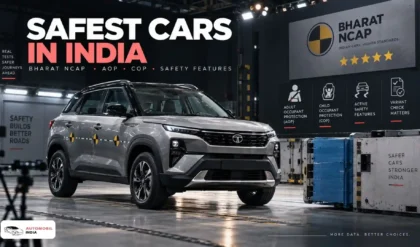

Indian car buyers now have two important names to understand when researching vehicle safety: Bharat NCAP and Global NCAP.
Both organisations publish crash-test results and use star ratings to communicate vehicle safety performance. But they are not the same testing programme, and their results should not automatically be placed side by side as though a five-star rating from one programme were directly equivalent to a five-star rating from the other.
This matters because Indian-market cars have been tested by Global NCAP for more than a decade, while Bharat NCAP is India’s own vehicle assessment programme. Bharat NCAP’s technical standard references earlier Global NCAP protocols, but its assessment framework is an Indian programme with its own rules, applicability and rating system.
As of September 2026, Bharat NCAP has a substantial database of tested Indian-market vehicles, while Global NCAP continues to publish Indian-market results, including newer 2025 assessments such as the Maruti Suzuki Victoris and Nissan Magnite.
So, Bharat NCAP vs Global NCAP is not really a question of choosing one rating system over the other. For an Indian buyer, the useful question is:
Bharat NCAP vs Global NCAP: Quick Comparison
Bharat NCAP officially states that its frontal offset test is performed at 64km/h, side impact at 50km/h and pole-side impact at 29km/h. It assesses Adult Occupant Protection, Child Occupant Protection and Safety Assist Technologies.
Global NCAP, meanwhile, has changed its protocols over time. Its resources currently include separate 2025–2029 assessment protocols, while many Indian results from 2022–2025 were conducted under the earlier protocol framework.
| Factor | Bharat NCAP | Global NCAP |
|---|---|---|
| Full name | Bharat New Car Assessment Programme | Global New Car Assessment Programme |
| Primary relevance | Indian-market vehicles | International consumer testing, including India |
| Organisation | Government of India/MoRTH programme | Towards Zero Foundation programme |
| Indian testing | Yes | Yes |
| Testing basis | AIS-197 framework | Global NCAP assessment protocols |
| Adult Occupant Protection | Yes | Yes |
| Child Occupant Protection | Yes | Yes |
| Safety-assistance assessment | Yes | Yes, depending on protocol |
| Star rating | 0–5 stars | 0–5 stars |
| Test speed | Frontal offset 64km/h; side 50km/h; pole side 29km/h | Depends on applicable protocol and test year |
| Variant applicability | Explicitly specified | Test/VIN and model applicability specified |
| Current relevance | Primary Indian NCAP reference | Important historical and current independent reference |
| Can ratings be directly compared? | Not automatically | Not automatically |
| Test | Bharat NCAP |
|---|---|
| Frontal offset | 64km/h |
| Side impact | 50km/h |
| Pole-side impact | 29km/h |
What Is Bharat NCAP?
Bharat NCAP is India’s vehicle safety assessment programme.
It was introduced to provide Indian consumers with standardised information about the crashworthiness and safety performance of new passenger vehicles.
The official Bharat NCAP framework covers M1-category vehicles with a gross vehicle weight of up to 3,500kg. The programme is voluntary for manufacturers, although the government can recommend vehicles for assessment under the programme.
Bharat NCAP assesses three major areas:
1. Adult Occupant Protection
This measures how well the vehicle protects adult occupants during the prescribed crash tests.
The maximum AOP score is 32 points.
2. Child Occupant Protection
COP assesses protection for child occupants using prescribed child-restraint systems and crash-test dummies.
The maximum COP score is 49 points.
3. Safety Assist Technologies
This evaluates specified active-safety technologies and safety equipment.
Bharat NCAP identifies systems such as:
- Electronic Stability Control
- Pedestrian protection
- Seatbelt reminders
- Other applicable safety-assistance technologies
What Is Global NCAP?
Global NCAP is an independent vehicle safety assessment programme operated by the Towards Zero Foundation.
It has played a major role in India’s vehicle-safety conversation through its Safer Cars for India campaign, which began testing Indian-market cars in 2014.
Global NCAP’s India programme has tested dozens of models over the years, including the Tata Nexon, Tata Safari/Harrier, Volkswagen Virtus, Škoda Slavia, Hyundai Verna, Nissan Magnite, Maruti Suzuki Victoris and others.
Its testing has also evolved.
That point is critical.
A Global NCAP rating from 2016 is not necessarily testing the same requirements as a Global NCAP rating published in 2023 or 2025.
Why Do Bharat NCAP and Global NCAP Exist Separately?
Global NCAP’s Indian testing programme helped create consumer awareness around crash safety and encouraged manufacturers to improve the safety performance of vehicles sold in India.
Bharat NCAP subsequently created an Indian national assessment programme.
The Bharat NCAP technical standard itself references earlier Global NCAP assessment protocols, including the Global NCAP Adult and Child Occupant Protection protocols and testing protocols used during the 2022–2025 period.
This means the relationship is more complicated than:
- Global NCAP = foreign test
- Bharat NCAP = completely unrelated Indian test
There is technical lineage between the programmes, but they remain separate assessment systems.
Bharat NCAP vs Global NCAP: Are the Tests the Same?
No.
They have similarities, but buyers should not assume that a Bharat NCAP test and a Global NCAP test are identical.
Bharat NCAP specifies:
- 64km/h frontal offset impact
- 50km/h side impact
- 29km/h pole-side impact
and evaluates AOP, COP and Safety Assist Technologies.
Global NCAP has also assessed frontal and side impacts, ESC and other safety areas, with additional requirements depending on the applicable protocol and star level. For example, Global NCAP’s updated India protocols introduced side impact, ESC and pedestrian-protection requirements, while pole-side protection became part of the requirements for the highest ratings.
The important word is protocol.
A crash test is not just about the speed of the impact. The dummy setup, impact configuration, scoring criteria, safety-assistance requirements, child-restraint assessment and star-rating thresholds all influence the final result.
The Biggest Problem With Comparing Star Ratings
Suppose one car has:
5 stars — Bharat NCAP
and another has:
5 stars — Global NCAP
It is tempting to conclude that they have identical safety performance.
That would be an oversimplification.
The tests may have:
- Different assessment years
- Different protocols
- Different scoring thresholds
- Different equipment requirements
- Different test configurations
- Different variant applicability
This is why the test year and protocol should always be read alongside the star rating.
Bharat NCAP vs Global NCAP: Test Speed
One of the easier points to compare is the published crash-test speed.
Bharat NCAP specifies:
Global NCAP’s exact requirements depend on the protocol under which the vehicle was tested.
For example, Global NCAP’s Indian programme moved to a more demanding protocol in 2022 that added side-impact and other requirements to the assessment framework.
Therefore, simply saying “both test cars at 64km/h” does not provide a complete comparison.
What Are AOP and COP?
These two terms appear frequently in Bharat NCAP results.
AOP — Adult Occupant Protection
AOP measures protection provided to adult occupants during the relevant crash tests.
The maximum Bharat NCAP score is 32 points.
It considers factors such as:
- Head protection
- Neck protection
- Chest protection
- Pelvis protection
- Leg protection
- Restraint-system performance
- Structural behaviour
A higher score means the vehicle performed better against the criteria assessed within the programme.
COP — Child Occupant Protection
COP evaluates child occupant protection.
The maximum Bharat NCAP score is 49 points.
It incorporates child dummies, child-restraint systems and other prescribed child-safety assessments.
This is particularly important for families because adult and child protection can produce different results.
A car can have a five-star overall result while its AOP and COP scores are not identical.
What Does the Star Rating Mean?
Bharat NCAP publishes separate Adult Occupant Protection and Child Occupant Protection star representations.
Its official usage guidelines show the rating scale from zero to five stars.
The important point is that:
Stars communicate a rating category. The underlying numerical scores provide more detail.
For example, two cars could both receive five stars but have different AOP and COP scores.
That is why Automobil India comparisons should ideally show:
Example: Maruti Suzuki Victoris
The Victoris provides an excellent example of why the test programme and protocol matter.
Bharat NCAP
The Victoris achieved:
- 31.66/32 AOP
- 43/49 COP
- Five-star rating
The Bharat NCAP assessment was published in 2025. The tested configurations included the ZXI+ strong-hybrid e-CVT and selected strong-hybrid and 6AT variants, with applicability specified by Bharat NCAP.
Global NCAP
Global NCAP also tested the Victoris in 2025 and awarded it five stars for both adult and child occupant protection under its applicable protocol. Global NCAP described the test as a voluntary assessment under its new protocols.
What should buyers take from this?
The Victoris demonstrates that a model can be evaluated by both programmes, giving consumers information from two separate assessment frameworks.
But the results should still be read within their respective protocols rather than simply adding the scores together or deciding that one star rating is automatically superior.
Example: Tata Nexon
The Tata Nexon provides another useful example.
Bharat NCAP
The current BNCAP database lists the Nexon with:
- 29.41/32 AOP
- 43.83/49 COP
- Five stars
The BNCAP test was published in 2024 and the rating applies to the variants listed by the programme.
Global NCAP
Global NCAP’s 2024 Nexon assessment recorded:
- 32.22/34 Adult Occupant Protection
- 44.52/49 Child Occupant Protection
The vehicle was tested under Global NCAP’s 2022 assessment protocols.
Notice something important:
The maximum AOP scores are different.
Bharat NCAP uses a 32-point AOP maximum, while the Global NCAP fact sheet for that Nexon test reports a 34-point maximum.
Therefore, comparing:
29.41 vs 32.22
as though they were directly comparable percentages would be misleading.
This is one of the clearest reasons not to compare raw NCAP scores across programmes without understanding the scoring framework.
Example: Nissan Magnite
The Nissan Magnite demonstrates another important lesson: the same model name can produce different safety results after equipment changes.
Global NCAP tested an earlier Magnite with two airbags and reported four stars for adult occupant protection and two stars for child protection in its earlier assessment.
Nissan subsequently introduced safety improvements, including six airbags and ESC as standard, and voluntarily submitted the improved vehicle for additional testing.
The latest 2025 Global NCAP assessment gave the updated Magnite:
- 5 stars for adult occupant protection
- 3 stars for child occupant protection
Global NCAP specifically described this as a major improvement over the earlier model.
This is a valuable lesson for buyers:
Never assume an old crash-test result automatically describes the current car.
Check the test year, VIN applicability and safety specification.
Why Test Year Matters So Much
Car manufacturers continuously update vehicles.
A facelift may introduce:
- More airbags
- ESC
- Better seatbelt systems
- Structural reinforcement
- New child-seat provisions
- ADAS
- Different restraint calibration
Conversely, a model can also change equipment or variants without receiving a new crash test.
Global NCAP’s Magnite assessments demonstrate how safety improvements can materially change the test outcome.
The same principle applies to Bharat NCAP.
The BNCAP database explicitly publishes the year of assessment and ratings applicability for each tested vehicle.
Variant Applicability: The Detail Buyers Often Miss
A crash-test result does not necessarily mean:
“Every version of this model is identical to the tested vehicle.”
Bharat NCAP’s official vehicle pages provide:
- Tested vehicle
- Variant
- Crash-test weight
- Country of origin
- Test year
- Ratings applicability
- Safety equipment
For example, the Victoris BNCAP result specifies the tested variants and states that the rating applies to the variants listed in its applicability information.
This is particularly important when a manufacturer sells a model with:
- Petrol
- Diesel
- CNG
- Hybrid
- Manual
- Automatic
- Different seating configurations
A buyer should check whether the exact variant being considered falls within the published applicability.
Does Bharat NCAP Test Indian Cars Differently Because They Are Made in India?
Not in the simplistic sense of giving Indian cars an easier crash test.
Bharat NCAP is specifically designed for vehicles sold in the Indian market and uses an Indian regulatory and assessment framework.
The programme’s scope covers applicable M1-category vehicles and its rating methodology specifies the crash tests and safety-assistance assessments.
The important distinction is therefore programme and protocol, not “Indian test versus foreign test”.
What Is the Relationship Between Bharat NCAP and Global NCAP Protocols?
This is where the history becomes particularly interesting.
The Bharat NCAP AIS-197 document lists Global NCAP’s:
- Adult Occupant Protection protocol
- Child Occupant Protection protocol
- Testing protocols
among its references.
This means Bharat NCAP’s technical development did not happen in isolation.
At the same time, Bharat NCAP is its own assessment programme with its own Indian standard, scoring system, documentation and administration.
Therefore, the best description is:
Does Global NCAP Still Test Indian Cars?
Yes.
Global NCAP’s current India results page continues to list Indian-market assessments.
Recent examples include:
- Maruti Suzuki Victoris
- Nissan Magnite
- Maruti Suzuki Celerio
- Maruti Suzuki Ciaz
- Maruti Suzuki Dzire
among other Indian-market vehicles.
Global NCAP’s Victoris assessment in 2025 was conducted under its newer protocol framework.
So Bharat NCAP’s arrival did not make Global NCAP results irrelevant.
Instead, Indian buyers now have to pay more attention to which programme and which protocol produced the result.
Bharat NCAP vs Global NCAP: What About Price?
NCAP ratings do not directly measure value for money.
A ₹7 lakh car and a ₹30 lakh car can both receive five stars, but they are not being assessed for:
- Purchase price
- Fuel economy
- Service cost
- Insurance
- Resale value
- Features-per-rupee
NCAP primarily provides information about vehicle safety performance under its assessment system.
Therefore, “Bharat NCAP vs Global NCAP price” is not really a technical comparison category.
For a buyer, price becomes relevant when asking:
“What level of crash protection and safety equipment can I get within my budget?”
That is a different question.
What About Mileage?
The same principle applies to mileage.
Neither Bharat NCAP nor Global NCAP is a fuel-efficiency test.
The programmes do not award stars based on:
- Petrol mileage
- Diesel mileage
- CNG efficiency
- EV range
Therefore, if you are comparing cars with similar safety ratings, use independent criteria for running costs.
For example:
- NCAP → safety
- ARAI/manufacturer-certified figures → efficiency
- Owner experience/testing → real-world consumption
Keeping these categories separate produces a much more useful car comparison.
Bharat NCAP vs Global NCAP: What Safety Features Matter?
Both programmes evaluate more than just airbags.
Depending on the protocol, assessments can include systems and characteristics such as:
- Seatbelt reminders
- Electronic Stability Control
- Pedestrian protection
- Side-impact protection
- Side-head protection
- Child-restraint performance
- Structural integrity
Bharat NCAP explicitly includes Safety Assist Technologies in its assessment.
Global NCAP’s updated protocols similarly incorporate active-safety and crash-protection requirements, with requirements changing according to the protocol and rating level.
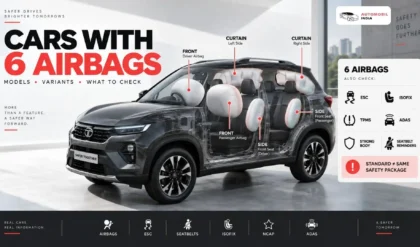
Six Airbags Do Not Automatically Mean Five Stars
This is another common misconception.
A six-airbag car can have a poor crash-test result.
The Global NCAP history of the Kia Carens illustrates this clearly.
The Carens was equipped with six airbags as standard, yet under Global NCAP’s 2022 protocol it received a three-star adult occupant result after improvements and retesting. Global NCAP noted that structural and restraint-system performance, not simply airbag count, affected the result.
The lesson is simple:
What Is More Important: Bharat NCAP or Global NCAP?
There is no useful universal rule that one should simply replace the other.
For an Indian buyer, Bharat NCAP is highly relevant because it is India’s dedicated current national assessment programme.
Global NCAP remains useful because:
- It has a long Indian testing history.
- It provides independent assessments of Indian-market cars.
- Some current vehicles have been tested under its newer protocols.
- Many older models have Global NCAP results but no equivalent Bharat NCAP result.
- It provides useful historical context for how safety performance has evolved.
The practical approach is to use the most relevant and recent test for the exact vehicle and specification you are researching.
How to Compare a Bharat NCAP and Global NCAP Result
Use this checklist.
Step 1: Identify the programme
Is the result:
- Bharat NCAP?
- Global NCAP?
- Euro NCAP?
- Another NCAP?
Do not mix them.
Step 2: Check the publication year
A 2025 result may use a different protocol from a 2018 result.
Step 3: Identify the tested vehicle
Check:
- Model
- Engine
- Transmission
- Seating configuration
- Variant
- VIN, where applicable
Step 4: Read the protocol
Look at:
- Frontal impact
- Side impact
- Pole test
- Pedestrian protection
- ESC
- ADAS/Safety Assist
- Child protection
Step 5: Check the scores
For Bharat NCAP:
- AOP /32
- COP /49
For Global NCAP:
Check the maximum score specified on that particular fact sheet.
Do not assume the maximum score is identical across protocols.
Step 6: Check applicability
Make sure the result applies to the vehicle you intend to purchase.
Step 7: Check actual equipment
Verify:
- Airbags
- ESC
- ISOFIX
- Seatbelt reminders
- ADAS
- Cameras
- TPMS
on the exact variant.
Bharat NCAP vs Global NCAP: A Practical Example
Suppose you are comparing two SUVs.
SUV A
- Bharat NCAP
- 5 stars
- 31/32 AOP
- 44/49 COP
- Six airbags
- ESC
- ADAS on top variant
SUV B
- Global NCAP
- 5 stars
- Different test year
- Different maximum AOP score
- Six airbags
- ESC
- No ADAS
It would be misleading to say:
“SUV A is safer because 31/32 is higher than SUV B’s score.”
You first need to establish whether both scores were produced under comparable protocols.
The better conclusion is:
That is the kind of distinction buyers should look for.
Does Bharat NCAP Replace Global NCAP?
For Indian-market vehicle safety assessment, Bharat NCAP has become the country’s dedicated national programme.
But it does not erase the value of historical Global NCAP results.
Global NCAP’s Safer Cars for India programme was an important part of the development of consumer-focused vehicle safety testing in India. The organisation says it completed more than 60 safety assessments during the 2014–2024 campaign.
At the same time, Global NCAP continues to operate internationally and maintains an India results database.
For a car buyer, therefore:
- Bharat NCAP = current Indian national assessment
- Global NCAP = independent international assessment programme with extensive Indian-market testing history and ongoing results
What Indian Buyers Should Check Before Trusting an NCAP Rating
Before booking a car, check these seven things:
1. Rating agency
Do not stop at “five stars”.
2. Test year
Older tests may use older requirements.
3. Tested variant
Find out exactly which version was tested.
4. Applicability
Check whether the rating applies to the variant you want.
5. AOP
Look at adult occupant protection.
6. COP
Families should pay particular attention to child occupant protection.
7. Safety equipment
Confirm what is actually standard on your car.
This last point matters because a manufacturer may sell one model in several versions with different ADAS, airbag or restraint equipment.
Bharat NCAP vs Global NCAP: What Should You Use When Buying a Car?
A sensible decision-making process is:
- First: Check the latest Bharat NCAP result if one exists for the Indian-market model.
- Second: Check whether Global NCAP has a newer or relevant independent assessment.
- Third: Compare the test year and protocol.
- Fourth: Read the AOP and COP results rather than only the stars.
- Fifth: Check the exact variant and safety equipment.
- Sixth: Consider child-seat compatibility if you have children.
- Seventh: Consider ADAS separately from crash protection.
- Eighth: Compare price, mileage and ownership costs separately from safety testing.
This avoids mixing completely different measurements into a single “safety score”.
The Future of Car Safety Testing in India
The testing landscape is likely to continue evolving.
Global NCAP has already moved to newer 2025–2029 assessment protocols, while Bharat NCAP’s current methodology has a defined validity period. Global NCAP has also said it is working with ARAI ahead of the planned Bharat NCAP 2.0 rollout in 2027.
That means future Indian safety ratings may include increasingly demanding crash-avoidance and vulnerable-road-user assessments.
For consumers, this is useful because a safety rating is not a permanent certificate of a vehicle’s performance under every future test methodology.
Final Takeaway
The easiest way to understand Bharat NCAP vs Global NCAP is this:
Bharat NCAP is India’s dedicated national vehicle assessment programme, while Global NCAP is an independent international consumer-testing programme that has conducted extensive testing of Indian-market cars.
Both use crash testing and star ratings, but their protocols, scoring frameworks, test years and variant applicability can differ.
Bharat NCAP currently assesses Adult Occupant Protection, Child Occupant Protection and Safety Assist Technologies, with published crash-test speeds of 64km/h for frontal offset, 50km/h for side impact and 29km/h for pole-side impact.
Global NCAP’s requirements have also evolved, and its Indian-market results span multiple generations of testing protocols. Its current India database includes both newer 2025 assessments and older results from the Safer Cars for India campaign.
The Maruti Suzuki Victoris is a useful modern example because it has been assessed by both programmes. Bharat NCAP recorded 31.66/32 AOP and 43/49 COP, while Global NCAP awarded five stars for adult and child protection under its applicable protocol.
The Tata Nexon demonstrates another important point: the two programmes can use different scoring maxima. Its Bharat NCAP result is reported out of 32 AOP points, while its 2024 Global NCAP fact sheet reports a 34-point AOP maximum.
And the Nissan Magnite shows why test year and vehicle specification matter: Global NCAP’s result changed substantially after Nissan introduced additional safety equipment and submitted an improved vehicle for retesting.
So when researching a car, don’t ask only:
“Is it five-star rated?”
Ask:
“Which NCAP tested it, when was it tested, under which protocol, which variant was tested, what were the AOP and COP results, and what safety equipment does my exact variant get?”
That gives an Indian buyer a much more accurate understanding of vehicle safety.
Frequently Asked Questions