Buying an SUV in India no longer means spending ₹15–20 lakh or more. The budget SUV segment has expanded rapidly, with models offering SUV-like ground clearance, practical cabins, automatic transmissions, CNG options, connected features and increasingly strong safety equipment at much lower prices.
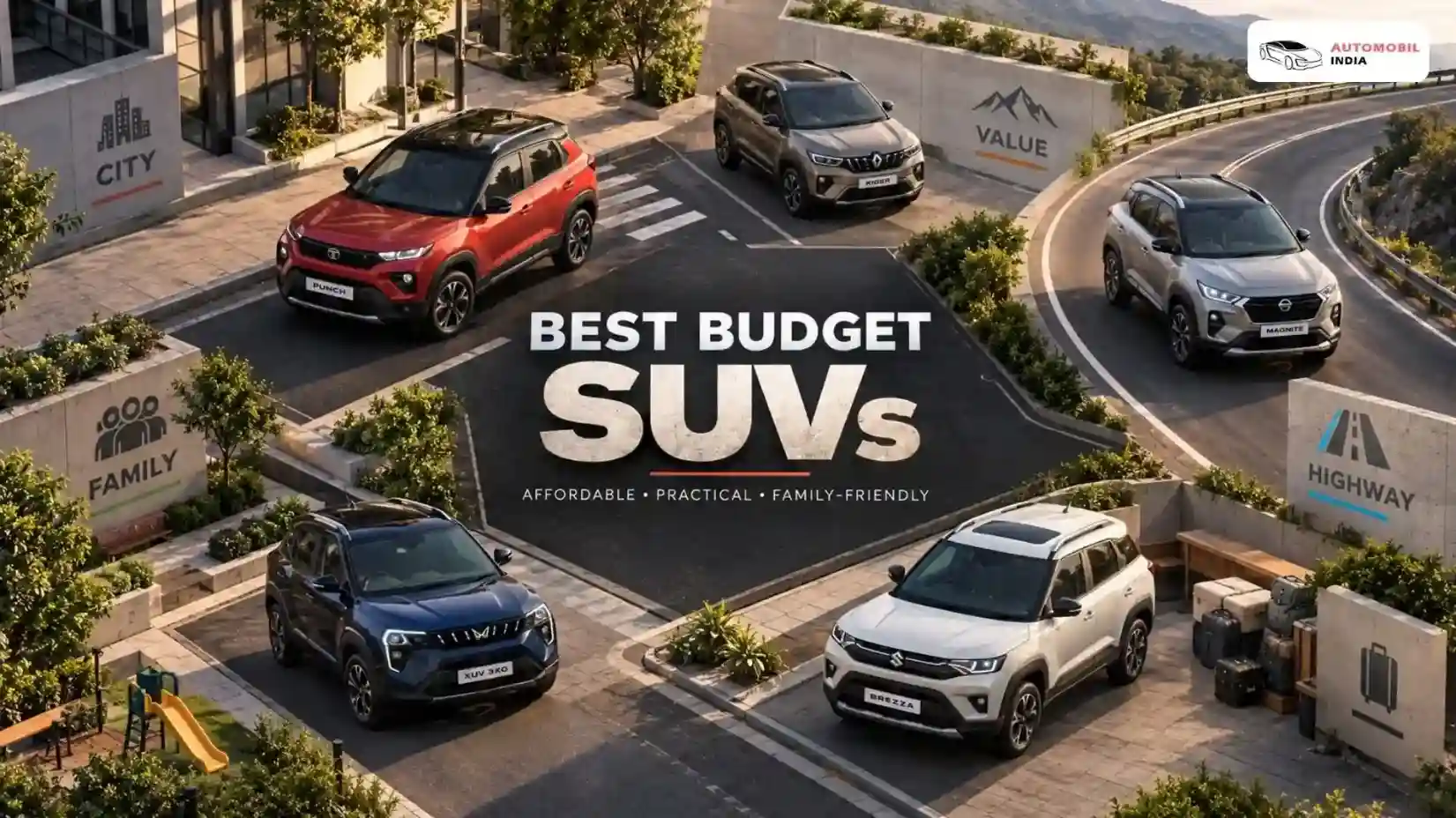
For buyers looking for budget SUV cars in India, the choice now ranges from small city-focused SUVs such as the Tata Punch and Renault Kiger to larger compact SUVs such as the Maruti Suzuki Brezza and Mahindra XUV 3XO.
There is no single SUV that suits every budget buyer. A first-time city car buyer may prioritise compact dimensions and low running costs, while a family travelling frequently on highways may value rear-seat space, boot capacity, engine performance and crash-test results more.
This guide compares the most relevant budget-friendly SUVs currently available in India, with prices, engines, mileage, safety, features and practical use cases.
Budget SUV Cars in India: Quick Comparison
| SUV | Approx. Ex-Showroom Price | Powertrain Choices | Claimed Mileage* | Boot Space | Safety |
|---|---|---|---|---|---|
| Tata Punch | ₹5.70 lakh–₹10.67 lakh | Petrol, Turbo-Petrol, CNG | Up to 20.09 kmpl / 26.99 km/kg | 366 litres | 5-star Bharat NCAP |
| Renault Kiger | ₹5.81 lakh–₹10.40 lakh | Petrol, Turbo-Petrol | Up to around 20 kmpl | 405 litres | 4-star Global NCAP |
| Nissan Magnite | ₹5.65 lakh–₹11.00+ lakh* | Petrol, Turbo-Petrol | 17.9–19.9 kmpl | 336 litres | 5-star Global NCAP |
| Kia Sonet | ₹7.40 lakh–₹13.80 lakh | Petrol, Turbo-Petrol, Diesel | Varies by engine | 385 litres | 6 airbags standard |
| Mahindra XUV 3XO | ₹7.79 lakh–₹15.04 lakh | Petrol, Turbo-Petrol, Diesel | 17.96–21.2 kmpl | Smaller than key rivals | 5-star Bharat NCAP |
| Maruti Suzuki Brezza | ₹7.40 lakh–₹13.55 lakh | Turbo-Petrol, Petrol, CNG | 19.96–26.9 km/kg | 328 litres | 5-star Bharat NCAP |
| Hyundai Exter | Around ₹6 lakh–₹10 lakh class | Petrol, CNG | Around 19–27 km/kg petrol | 391 litres | 6 airbags standard |
The Tata Punch, Mahindra XUV 3XO and Maruti Suzuki Brezza stand out for very different reasons: the Punch combines a relatively small footprint with a 5-star Bharat NCAP result, the XUV 3XO offers stronger engines and compact-SUV proportions, while the Brezza brings a broader powertrain choice including CNG and a newly introduced turbo-petrol engine.
What Makes a Good Budget SUV in India?
A low purchase price is only one part of the equation. For a budget SUV, buyers should consider:
- Ex-showroom and on-road price: Registration, insurance and accessories can significantly increase the final bill.
- Engine and transmission: A naturally aspirated petrol may be sufficient for city use, while a turbo-petrol or diesel can make highway driving easier.
- Fuel economy: Claimed mileage is useful for comparison, but real-world consumption will be lower.
- Rear-seat space: Important if the SUV will regularly carry four or five adults.
- Boot space: Families should consider luggage capacity before choosing a smaller SUV.
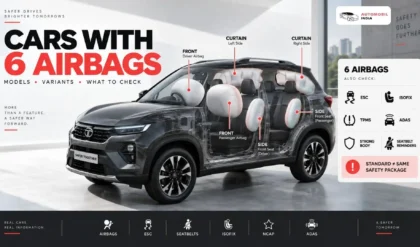
- Safety equipment: Six airbags, ESC, ISOFIX, seatbelt reminders and a proven crash-test result are increasingly important.
- Ground clearance: Useful on broken roads, speed breakers and uneven rural routes.
- Service network: A slightly more expensive SUV may make more sense if service and parts are readily available in your area.
The most important point is to look at the variant, not just the model. A budget SUV may have an impressive equipment list at its top trim while the entry-level version may have considerably fewer convenience features.
1. Tata Punch
The Tata Punch remains one of the most interesting choices for buyers who want an SUV-like driving position without moving into the larger compact-SUV category.
The 2026 Punch is available with a 1.2-litre petrol engine, a new 1.2-litre turbo-petrol engine and a CNG powertrain. Depending on the version, buyers can choose manual or AMT transmissions.
The naturally aspirated petrol produces 88hp and 115Nm, while the turbo-petrol develops 120hp and 170Nm. The CNG version produces 73hp.
Why the Punch makes sense for families
Its compact dimensions make it easier to drive and park in congested cities, while the 366-litre boot provides useful luggage space. The Punch also has a relatively high driving position and around 193mm of ground clearance, which is useful on poorly maintained roads and large speed breakers.
Safety
Safety is one of the strongest reasons to consider the Punch. The 2026 Punch scored 30.58/32 for Adult Occupant Protection and 45/49 for Child Occupant Protection in Bharat NCAP, earning a five-star rating. The tested CNG variants’ rating applies across the Punch range.
Six airbags, ESC, TPMS, ISOFIX, hill-hold and hill-descent assistance are among the safety equipment available.
Mileage
The petrol manual is rated at around 20.09kmpl, while the petrol AMT is rated at 18.8kmpl. The CNG version is rated at 26.99km/kg. These are laboratory-certified figures rather than guaranteed everyday consumption.
Who should consider the Punch?
Best suited for:
- First-time SUV buyers
- City families
- Buyers prioritising safety
- Buyers who want CNG
- Owners dealing with poor roads and speed breakers
The turbo version makes the Punch more interesting for buyers who want stronger performance without moving to a much larger SUV.
2. Renault Kiger
The Renault Kiger occupies the value-focused end of the compact SUV market.
The current Kiger range starts at around ₹5.81 lakh, while the facelifted model introduced updated styling and equipment. It is offered with 1.0-litre petrol and turbo-petrol engines, with manual, AMT and CVT options depending on the variant.
One of the Kiger’s biggest advantages is its packaging. The SUV measures around 3.99 metres long and offers a claimed 405-litre boot, giving families useful luggage capacity despite its compact footprint.
Why the Kiger is practical
The Kiger’s 205mm ground clearance is useful for Indian roads, while the 2,500mm wheelbase gives it a relatively spacious cabin for its size. The turbo-petrol version develops around 100hp and 160Nm, making it more suitable for highway use than the naturally aspirated engine.
Mileage
Depending on engine and gearbox, the Kiger’s claimed fuel efficiency can reach around the 20kmpl mark. Turbo-CVT versions have different certified figures from the manual versions. As with other small turbo-petrol SUVs, actual city mileage will depend heavily on traffic and how frequently the engine is driven under boost.
Who should consider the Kiger?
Best suited for:
- Buyers on a tight initial budget
- Families wanting a large boot
- Buyers who prefer higher ground clearance
- Buyers looking for a turbo-petrol option
- City users who want a compact footprint
The Kiger deserves consideration if cabin and boot practicality matter more than having the latest feature-heavy interior.
3. Nissan Magnite
The Nissan Magnite continues to be one of the most aggressively priced compact SUVs in India.
The current Magnite uses two 1.0-litre three-cylinder petrol engines: naturally aspirated and turbocharged. Transmission options include manual, AMT and CVT depending on the powertrain.
Its price starts at around ₹5.65 lakh, making the Magnite particularly relevant for buyers searching for a budget SUV car in India under ₹7 lakh.
Engine and performance
The turbo-petrol engine is the more appropriate choice for regular highway use, while the naturally aspirated engine is adequate for predominantly urban driving.
The Magnite has a 336-litre boot, which is smaller than the Kiger’s claimed 405 litres but still practical for everyday family use. With the rear seats folded, Nissan’s packaging allows considerably more luggage volume.
Safety
The Magnite has a 5-star Global NCAP safety rating. Its safety equipment includes six airbags, ESC, traction control, hill-hold assistance, TPMS and ABS with EBD. Higher variants also offer a 360-degree camera.
Features
Depending on variant, the Magnite can be equipped with:
- 8-inch touchscreen
- Wireless smartphone connectivity
- Wireless charger
- Dashcam
- Air purifier
- JBL audio
- 360-degree camera
- Connected features
Who should consider the Magnite?
Best suited for:
- Buyers with a strict purchase budget
- First-time SUV buyers
- City users
- Buyers wanting a turbo-petrol option
- Buyers who value a strong Global NCAP result
The Magnite’s entry price is particularly relevant for buyers who want an SUV shape without stretching their initial budget too far.
4. Kia Sonet
The Kia Sonet moves the discussion from basic affordability toward a more feature-rich compact SUV experience.
The current Sonet starts at ₹7.40 lakh according to Kia’s current variant information, while the X-Line reaches roughly ₹13.80 lakh. It is available with a 1.2-litre naturally aspirated petrol, 1.0-litre turbo-petrol and 1.5-litre diesel.
The turbo-petrol makes 88kW and 172Nm, while the diesel produces 85kW and 250Nm.
Why the Sonet is different
The Sonet is smaller than some compact SUVs but offers a comparatively premium feature list. Depending on variant, buyers can get:
- 10.25-inch touchscreen
- 10.25-inch digital instrument cluster
- Ventilated front seats
- Electric sunroof
- Wireless charger
- 360-degree camera
- Blind View Monitor
- Bose audio
- ADAS Level 1
- Connected-car features
Kia also provides six airbags as standard across the range along with ESC, hill-assist control, vehicle stability management and ISOFIX.
Dimensions and practicality
The Sonet is 3,995mm long, 1,790mm wide and has a 2,500mm wheelbase. Boot space is rated at 385 litres. That makes it relatively easy to manoeuvre in cities while retaining useful luggage space.
Who should consider the Sonet?
Best suited for:
- Buyers wanting premium features
- Small families
- City-heavy usage
- Buyers who want diesel availability
- Buyers interested in ADAS and connected technology
The important caveat is that many of the most impressive features are concentrated in higher variants, so buyers should compare the exact variant price before deciding.
See current on-road prices for the Punch, Kiger, Magnite and Sonet before you decide.
5. Mahindra XUV 3XO
The Mahindra XUV 3XO is one of the more performance-oriented choices in the budget compact-SUV space.
The current range starts at ₹7.79 lakh and extends to ₹15.04 lakh ex-showroom. It offers three engine choices:
- 1.2-litre petrol
- 1.2-litre turbo-petrol
- 1.5-litre diesel
The turbo-petrol develops 131hp and 230Nm, while the diesel produces 300Nm. Depending on engine and variant, buyers can choose manual, torque-converter automatic or AMT transmissions.
Why the XUV 3XO stands out
The 3XO makes sense for buyers who expect to use their SUV beyond city traffic. Its 131hp turbo-petrol engine offers substantially stronger performance than many entry-level naturally aspirated petrol SUVs. The diesel’s 300Nm torque also makes it relevant for highway users and buyers who frequently travel with passengers and luggage.
Mileage
ARAI-certified mileage is listed between approximately 17.96kmpl and 21.2kmpl depending on powertrain. Again, real-world mileage will depend on driving conditions.
Safety
The XUV 3XO has a 5-star Bharat NCAP rating, with six airbags, stability control and ISOFIX mounts standard across the range. Higher variants add equipment such as:
- Twin 10.25-inch screens
- Panoramic sunroof
- Harman Kardon audio
- Advanced convenience features
One practical limitation
The XUV 3XO is compact, but its boot capacity is not its strongest attribute compared with some rivals. Autocar also notes that the boot is smaller than some competitors. For a family that regularly carries large suitcases, this is worth checking during a test drive.
Who should consider the XUV 3XO?
Best suited for:
- Buyers who prioritise performance
- Highway users
- Buyers wanting diesel
- Families wanting strong safety credentials
- Buyers wanting a feature-rich compact SUV
6. Maruti Suzuki Brezza
The 2026 Maruti Suzuki Brezza has changed considerably from the previous model year.
Its price now starts at ₹7.40 lakh, while the range extends to ₹13.55 lakh ex-showroom. The biggest mechanical change is the addition of a 1.0-litre direct-injection turbo-petrol engine.
The current engine choices include:
- 1.0-litre turbo-petrol — 110hp, 170Nm
- 1.5-litre petrol — 103hp, 139Nm
- 1.5-litre CNG — 89hp, 121.5Nm
The turbo-petrol is paired with a six-speed manual, while the 1.5-litre petrol is available with manual and torque-converter automatic options. CNG is manual-only.
Mileage
The 2026 Brezza’s certified figures range from around 19.96kmpl to 26.9km/kg depending on powertrain. The CNG version is particularly relevant for buyers covering high annual kilometres and living in areas with convenient CNG availability.
Safety
The new Brezza has a 5-star Bharat NCAP rating, scoring 30.41/32 in Adult Occupant Protection and 43/49 in Child Occupant Protection. The rating applies across the facelifted range.
Six airbags are standard, along with ESC, hill-hold assist, ISOFIX and other safety systems. Higher versions add equipment such as a 360-degree camera, blind-spot warning and rear cross-traffic alert.
Family practicality
The Brezza measures 3,995mm long and has a 2,500mm wheelbase. Its boot capacity is 328 litres. It is therefore a useful middle ground for buyers who want something larger and more substantial than a micro-SUV but do not want a full-size family SUV.
Who should consider the Brezza?
Best suited for:
- Families wanting a conventional compact SUV
- High-mileage users considering CNG
- Buyers wanting an automatic
- Highway and city users
- Buyers prioritising a broad service ecosystem
7. Hyundai Exter
The Hyundai Exter sits at the smaller end of the SUV market and is aimed primarily at urban buyers.
Its 1.2-litre petrol engine produces around 83hp and 114Nm and is offered with a five-speed manual or AMT. The CNG version produces around 69hp and 95Nm and is manual-only.
The Exter measures 3,830mm long and has a 2,430mm wheelbase. Its claimed petrol boot capacity is 391 litres, while the CNG version has less luggage capacity because of the gas-cylinder packaging.
Safety
Six airbags are standard across the Exter range according to Hyundai. The Exter also offers features such as electronic stability-related safety equipment, all-seat three-point seatbelts and other active/passive safety systems depending on variant.
Who should consider the Exter?
Best suited for:
- City-first buyers
- First-time car owners
- Small families
- Buyers wanting an easy-to-drive compact SUV
- Buyers considering CNG for frequent urban use
The Exter’s relatively small dimensions can be an advantage in crowded cities, particularly where parking space is limited.
Talk to our team about financing options to make your next budget SUV purchase easier.
Budget SUV Cars in India: Which One Suits Which Buyer?
Rather than choosing one universal winner, it makes more sense to match the SUV to the buyer.
| Buyer requirement | SUVs worth considering |
|---|---|
| Lowest purchase budget | Nissan Magnite, Renault Kiger, Tata Punch |
| Strong safety credentials | Tata Punch, Mahindra XUV 3XO, Maruti Brezza |
| Mostly city driving | Hyundai Exter, Tata Punch, Renault Kiger |
| Highway travel | Mahindra XUV 3XO, Maruti Brezza, Kia Sonet |
| CNG running costs | Tata Punch, Maruti Brezza, Hyundai Exter |
| Turbo-petrol performance | Mahindra XUV 3XO, Maruti Brezza, Kia Sonet, Kiger |
| Diesel option | Kia Sonet, Mahindra XUV 3XO |
| Premium features | Kia Sonet |
| Large boot among small SUVs | Renault Kiger |
| Easy automatic city driving | Sonet, Magnite, Punch, Brezza |
| Family-focused compact SUV | Punch, Brezza, XUV 3XO |
This is not a ranking. The right choice depends on how the SUV will actually be used.
Budget SUV Cars in India: Petrol, CNG or Diesel?
Petrol
Petrol remains the simplest choice for most buyers. It generally makes sense when:
- Annual running is moderate
- Most journeys are short or medium-distance
- You do not have convenient CNG access
- You want lower purchase complexity
For city users, a naturally aspirated petrol can be sufficient.
CNG
CNG can make financial sense for buyers who drive significant kilometres every year. The key advantages are lower fuel cost per kilometre and good certified efficiency.
However, CNG availability varies considerably by city. Refuelling queues and reduced performance compared with petrol should also be considered. The Punch, Brezza and Exter provide CNG alternatives in this budget-SUV space.
Diesel
Diesel is increasingly concentrated in larger compact SUVs and a few premium small SUVs. It can make sense for buyers who:
- Drive long distances regularly
- Spend substantial time on highways
- Want strong low-end torque
- Cover high annual kilometres
The Mahindra XUV 3XO and Kia Sonet are among the budget-oriented SUVs offering diesel powertrains.
How Much Should You Spend on a Budget SUV?
A common mistake is setting the budget using only the advertised ex-showroom price. For example, a ₹7 lakh SUV does not mean the final amount payable will be ₹7 lakh.
Your actual budget should include:
- Ex-showroom price
- RTO and registration
- Insurance
- Fastag and statutory charges
- Accessories
- Extended warranty, if selected
- Service packages, where applicable
- Financing and interest costs
A practical rule
If your maximum all-inclusive budget is ₹10 lakh, do not shortlist cars solely because their ex-showroom price is ₹9.99 lakh. Instead, calculate the exact on-road price of the specific variant in your city.
Budget SUV Cars in India: What Features Actually Matter?
Feature lists can make one SUV appear dramatically better than another, but not every feature deserves equal weight.
Features worth prioritising
- Six airbags: Useful as part of a broader passive-safety package.
- ESC: Particularly useful for maintaining vehicle stability during sudden manoeuvres or loss of traction.
- ISOFIX: Important for families using compatible child seats.
- TPMS: Helps monitor tyre pressure and can prevent driving with significantly under-inflated tyres.
- Rear camera and parking sensors: Valuable in crowded Indian parking areas.
- 360-degree camera: Particularly useful for larger vehicles or tight parking spaces.
- ADAS: Can provide additional driver assistance, but it should complement—not replace—attentive driving.
- Automatic climate control: More of a comfort feature, but useful in India’s hot climate.
- Rear AC vents: Worth considering if rear passengers frequently travel with you.
- Sunroof: Attractive to many buyers, but it should not outweigh safety, seating comfort or powertrain suitability.
Budget SUV Mileage: What Should Buyers Expect?
Claimed mileage figures should be treated as a comparison benchmark rather than a promise.
ARAI figures are produced under controlled test conditions. Real-world mileage can be affected by:
- Traffic
- Air-conditioning usage
- Driving style
- Vehicle load
- Tyre pressure
- Road gradient
- Average speed
- Automatic transmission behaviour
A vehicle certified for 20kmpl will not necessarily deliver 20kmpl in bumper-to-bumper Mumbai, Bengaluru or Delhi traffic. Similarly, highway mileage can be substantially better than city mileage when the vehicle is driven smoothly at a steady speed.
Budget SUV Cars in India: New or Higher Variant?
This is another decision worth considering.
Suppose your budget allows either a larger SUV in its base variant, or a smaller SUV in a better-equipped mid variant.
The second option may make more sense if you value:
- Rear camera
- Better infotainment
- Automatic climate control
- Better lighting
- Additional airbags
- More comfortable seats
- Wireless connectivity
- Parking assistance
However, do not sacrifice a significant improvement in structural safety or powertrain suitability simply to get more features. The variant comparison should happen after you shortlist the model, not before.
Are Budget SUVs Good Family Cars?
Yes, but size matters.
A small SUV such as the Punch or Exter can work very well for a family of four that spends most of its time in the city. For a family of five that regularly travels with luggage, a Brezza, XUV 3XO or Sonet may provide a more appropriate balance of cabin width, boot space and highway performance.
Before buying, take the entire family for a test drive. Check:
- Rear-seat knee room
- Rear-seat shoulder room
- Seat-cushion width
- Door opening
- Child-seat installation
- Boot space with luggage
- Rear AC performance
- Ease of entering and exiting
- Visibility for the driver
These practical checks can tell you more than a long equipment list.
Talk to our team about test drives, financing or trade-in options for your next budget SUV.
Final Takeaway: Choosing the Right Budget SUV
For buyers researching budget SUV cars in India, the most sensible approach is therefore not to ask which SUV is universally best. Instead, shortlist two or three models based on your budget, annual running, family size, fuel preference, transmission requirement and typical roads—and then compare the exact variants that fit your final on-road budget.
Frequently Asked Questions
Which is the cheapest budget SUV in India?
The Nissan Magnite and Renault Kiger are among the lowest-priced conventional SUVs in the current market, while the Tata Punch also starts in the lower end of the SUV segment. Prices vary with model-year updates and manufacturer revisions.
Which budget SUV is suitable for a small family?
The Tata Punch, Hyundai Exter, Kia Sonet, Nissan Magnite and Renault Kiger can all work for small families. The right choice depends on rear-seat requirements, boot space, safety priorities and budget.
Which budget SUV has the best safety rating?
Several budget-oriented SUVs now have strong crash-test credentials. The Tata Punch, Mahindra XUV 3XO and 2026 Maruti Suzuki Brezza have five-star Bharat NCAP ratings. The Nissan Magnite has a five-star Global NCAP rating.
Which budget SUV has the highest ground clearance?
The Renault Kiger has around 205mm of ground clearance, making it useful for buyers who regularly encounter uneven roads, large speed breakers and broken surfaces.
Which budget SUV is good for highway driving?
The Mahindra XUV 3XO, Kia Sonet and Maruti Suzuki Brezza offer powertrains that are well suited to regular highway use. The XUV 3XO’s 131hp turbo-petrol and 300Nm diesel provide particularly strong performance figures for the segment.
Which budget SUV is available with CNG?
The Tata Punch, Maruti Suzuki Brezza and Hyundai Exter are among the budget-oriented SUVs available with CNG powertrains. CNG availability in your city should be checked before choosing this fuel type.
Is a turbo-petrol SUV better than a naturally aspirated petrol SUV?
Not automatically. A turbo-petrol generally provides stronger torque and better flexibility, especially on highways, but a naturally aspirated petrol engine can be perfectly adequate for city driving and may suit buyers who prioritise simpler everyday driving characteristics.
Which budget SUV has the biggest boot?
The Renault Kiger claims 405 litres of boot space, while the Hyundai Exter claims 391 litres in petrol form and the Kia Sonet offers 385 litres. The Tata Punch claims 366 litres.
Should I buy a budget SUV with an automatic gearbox?
An automatic can be worthwhile if you regularly drive in heavy traffic. However, the type of automatic matters. AMTs can be affordable but may feel different from a torque-converter automatic or CVT. Test-driving the exact transmission is therefore important.
How much should I budget for a budget SUV in India?
Start with your maximum on-road budget rather than the ex-showroom price. Registration, insurance and other charges can add significantly to the final amount, and the difference varies between states and cities.