The cheapest SUV in India is no longer simply the car with the lowest sticker price. Buyers looking at the entry-level SUV segment now have several options offering SUV styling, a raised seating position, modern infotainment, multiple airbags, automatic transmissions and even CNG powertrains without crossing ₹10 lakh ex-showroom.
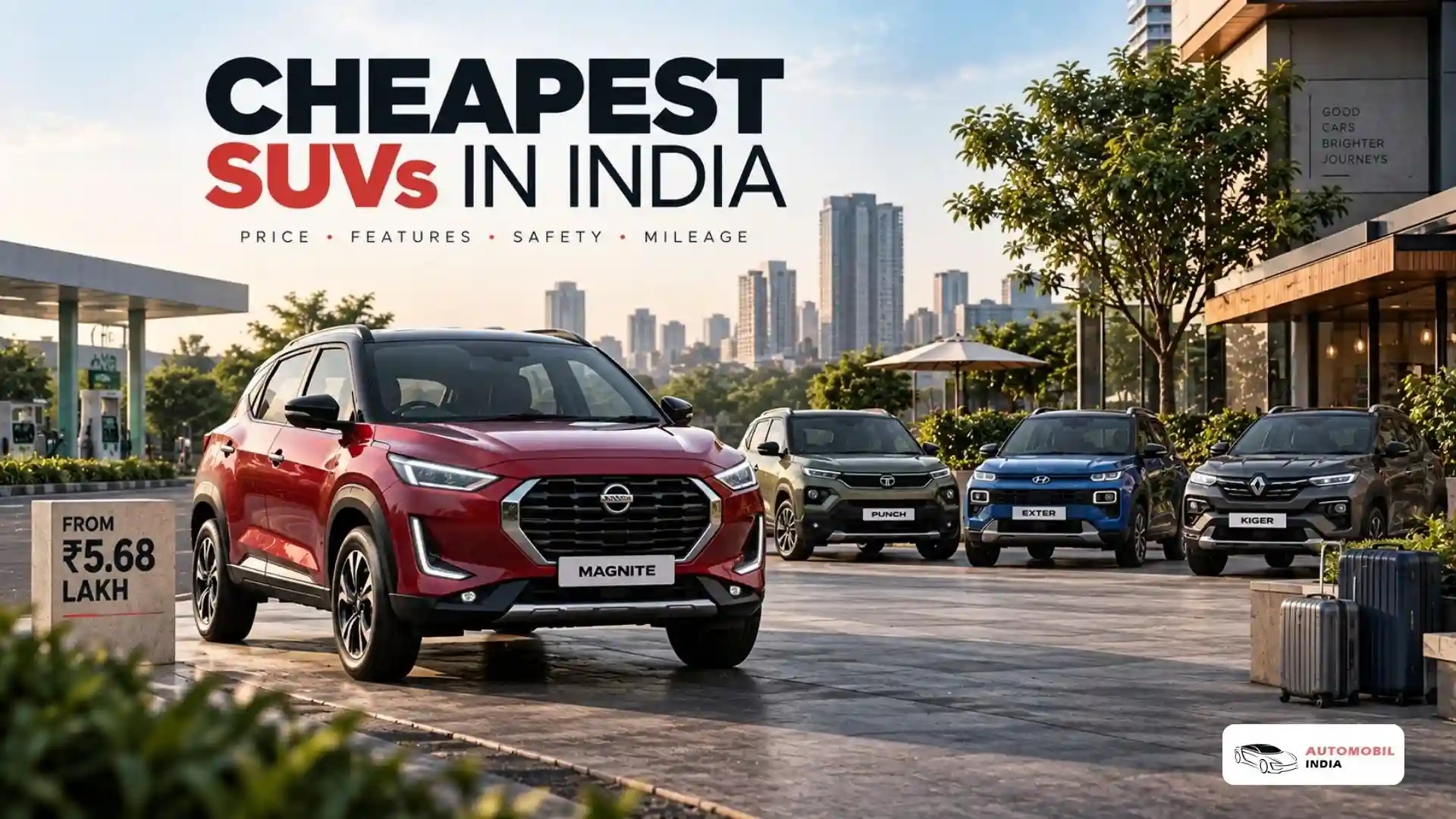
As of September 2026, the Nissan Magnite starts at ₹5.68 lakh, while the Hyundai Exter is priced from ₹5.80 lakh, the Renault Kiger from ₹5.81 lakh, and the Tata Punch from around ₹5.70 lakh. These prices make the difference between the most affordable SUVs surprisingly small.
But the cheapest starting price does not necessarily mean the lowest-cost ownership experience or the best-equipped variant.
The important question is: what do you actually get at the lowest price point?
This guide compares the cheapest SUV options in India by price, engines, mileage, safety, features, space and variants, while also explaining where spending a little more can make a meaningful difference.
Cheapest SUVs in India: Quick Comparison
| SUV | Starting Price | Engine Options | Transmission | Claimed Mileage* | Key Point |
|---|---|---|---|---|---|
| Nissan Magnite | ₹5.68 lakh | 1.0 petrol, 1.0 turbo-petrol | MT, AMT, CVT | Up to around 20 kmpl | Low entry price + strong feature list |
| Tata Punch | ~₹5.70 lakh | 1.2 petrol, 1.2 turbo-petrol, CNG | MT, AMT | Up to 20.09 kmpl / 26.99 km/kg | 5-star Bharat NCAP |
| Hyundai Exter | ₹5.80 lakh | 1.2 petrol, CNG | MT, AMT | Up to around 19 kmpl / 27.1 km/kg | Compact dimensions + equipment |
| Renault Kiger | ₹5.81 lakh | 1.0 petrol, 1.0 turbo-petrol | MT, AMT, CVT | Up to 20.38 kmpl | 405-litre boot + 205mm GC |
| Maruti Suzuki S-Presso | ₹3.50 lakh | 1.0 petrol, CNG | MT, AGS | Up to 25.30 km/kg | Cheapest SUV-styled option, but not a conventional SUV |
| Hyundai Venue | ₹7.99 lakh | 1.2 petrol, 1.0 turbo, 1.5 diesel | MT, AT, DCT | Varies | More substantial compact SUV |
What Is the Cheapest SUV in India Right Now?
If the comparison is limited to conventional SUV models, the Nissan Magnite currently has the lowest starting price among the major options discussed here, at ₹5.68 lakh ex-showroom.
The difference, however, is extremely small.
The Tata Punch starts around ₹5.70 lakh, the Hyundai Exter at ₹5.80 lakh and the Renault Kiger at ₹5.81 lakh.
That means a buyer should not choose solely on the ₹10,000–₹15,000 difference between starting prices.
At this price point, the equipment included in the base variant can matter more than the headline starting price.
1. Nissan Magnite
Price: From ₹5.68 lakh
The Nissan Magnite remains one of the most aggressive entry points into the compact-SUV segment.
Nissan’s current India website lists the Magnite at a starting ex-showroom price of ₹5.68 lakh.
The Magnite uses a 1.0-litre naturally aspirated petrol engine and a 1.0-litre turbo-petrol engine.
Depending on the variant, buyers can choose manual, AMT or CVT transmissions.
What do you get at the lowest price?
The base Magnite is designed to keep the purchase price low, so buyers should not expect the feature list of the higher variants.
However, the Magnite’s appeal grows as you move up the range, where equipment such as a larger touchscreen, wireless connectivity, rear camera, 360-degree camera and other convenience features become available.
Nissan highlights more than 20 first-in-segment and best-in-segment features across the Magnite range.
Why consider it?
The Magnite is particularly relevant for buyers whose first priority is keeping the initial purchase price as low as possible without moving into a hatchback.
Its compact footprint also makes it suitable for urban driving.
Who should consider the Magnite?
- First-time SUV buyers
- City users
- Buyers with a strict initial budget
- Buyers wanting a turbo-petrol option
- Buyers who want a compact SUV rather than an SUV-styled hatchback
2. Tata Punch
Price: Around ₹5.70 lakh onwards
The Tata Punch sits almost directly alongside the Magnite in terms of starting price.
Following its 2026 price revision, the Punch petrol range starts at around ₹5.70 lakh, while the overall ICE range extends to around ₹10.67 lakh.
The Punch is available with:
- 1.2-litre naturally aspirated petrol
- 1.2-litre turbo-petrol
- CNG
The 1.2-litre petrol produces 88hp and 115Nm, while the turbo version produces 120hp and 170Nm. The CNG version develops 73hp.
Why the Punch is different
Safety is a major part of its appeal.
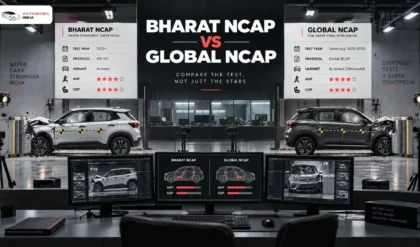
The 2026 Punch achieved 5 stars in Bharat NCAP, scoring 30.58/32 for Adult Occupant Protection and 45/49 for Child Occupant Protection.
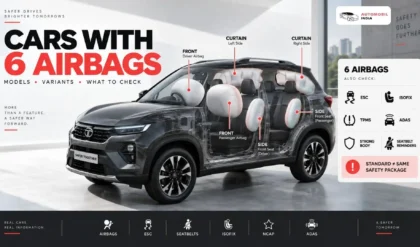
Six airbags are standard from the entry-level petrol version upwards, according to current model information.
Features
Higher variants can be equipped with:
- 10.25-inch touchscreen
- Digital instrument display
- Wireless Android Auto and Apple CarPlay
- Wireless charger
- 360-degree camera
- Cruise control
- Rain-sensing wipers
- Auto-dimming IRVM
- Air purifier
- Eight-speaker audio system
The important distinction is that these are not all base-variant features. The entry price and top-end feature list represent very different versions of the Punch.
Boot space
The Punch offers a claimed 366-litre boot in petrol form. The CNG version uses two smaller cylinders and retains around 210 litres of luggage space.
Who should consider the Punch?
- Buyers prioritising crash-test credentials
- Families wanting a compact SUV
- Buyers considering CNG
- Buyers who want a higher driving position
- Buyers who frequently encounter poor roads
3. Hyundai Exter
Price: From ₹5.80 lakh
The 2026 Hyundai Exter starts at ₹5,80,600 ex-showroom according to Hyundai’s current pricing information.
Hyundai launched the updated Exter in March 2026 with more than 25 changes covering design, technology, comfort and safety.
Engine options
The Exter uses a 1.2-litre Kappa petrol engine producing:
- 83PS
- 113.8Nm
Transmission options include a five-speed manual and Smart Auto AMT.
A 1.2-litre bi-fuel petrol-CNG version is also available.
The interesting part: safety at the lower price point
Hyundai has added six airbags, ESC and hill-start assist as standard.
The company says the new Exter has more than 45 advanced safety features and 30 safety features as standard across variants.
This makes the Exter worth considering even if its starting price is slightly above the Magnite and Punch.
What features are available?
Depending on variant, the Exter can be equipped with:
- Digital instrument cluster
- Wireless Android Auto and Apple CarPlay
- Wireless smartphone charging
- Hyundai Bluelink
- Alexa-based Home-to-Car functionality
- 20.32cm touchscreen/navigation system
- Dashcam
- Rear Type-C USB
- Automatic climate control on selected variants
Hyundai says the dashcam is a segment-first feature for the updated Exter.
CNG practicality
The updated CNG Exter uses Hyundai’s dual-cylinder setup.
The company says the arrangement allows an underbody spare tyre and provides 225 litres of boot space.
That is an important practical improvement for CNG buyers who do not want their luggage area dominated by a conventional large cylinder.
Who should consider the Exter?
- City-focused buyers
- First-time car buyers
- Small families
- Buyers wanting CNG
- Buyers who value standard safety equipment
- Buyers who want Hyundai’s feature and service ecosystem
4. Renault Kiger
Price: From ₹5.81 lakh
The Renault Kiger currently starts at ₹5.81 lakh ex-showroom. Renault’s current India price page lists the Kiger at this starting price.
The current Kiger is available with:
- 1.0-litre naturally aspirated petrol
- 1.0-litre turbo-petrol
- Manual
- AMT
- CVT
The turbo-petrol produces around 100hp, while the naturally aspirated engine produces around 72hp.
What makes the Kiger interesting?
Its biggest practical advantage is packaging.
The Kiger has:
- 205mm ground clearance
- 405-litre boot
- 2,500mm wheelbase
Those numbers make it useful for families that need luggage space but still want a compact SUV.
Mileage
Renault’s claimed figures put the naturally aspirated manual at around 19.83kmpl and the turbo-manual at around 20.38kmpl.
Actual fuel economy will depend on traffic, driving style and transmission.
Entry-level variant
The ₹5.81 lakh Authentic variant uses the naturally aspirated petrol engine with a manual gearbox.
It is therefore important to distinguish between:
- ₹5.81 lakh Kiger: basic naturally aspirated petrol/manual configuration
- Higher Kiger variants: turbo engine, automatic gearbox and additional convenience equipment
The turbo-petrol range currently starts at ₹7.89 lakh, following Renault’s 2026 variant expansion.
Who should consider the Kiger?
- Buyers who want a large boot
- Families
- Buyers wanting high ground clearance
- Buyers interested in turbo-petrol performance
- Buyers looking for an automatic without moving into a larger SUV
5. Maruti Suzuki S-Presso: Does It Count as the Cheapest SUV?
Price: From ₹3.49 lakh
The Maruti Suzuki S-Presso starts at ₹3.49 lakh, making it dramatically cheaper than conventional compact SUVs.
But calling it the cheapest SUV in India requires some qualification.
The S-Presso is a small hatchback with SUV-inspired styling and a tall body. It is not directly comparable with the Punch, Magnite, Kiger or Exter in size or positioning.
It uses a 998cc petrol engine and is also available with S-CNG. An AGS automatic is offered on selected petrol variants.
What do you get?
Even the entry version gets:
- Dual airbags
- ABS with EBD
- ESP
Higher versions add touchscreen infotainment, electrically adjustable ORVMs and other convenience features.
Should it be considered?
If your definition of an SUV includes SUV-inspired hatchbacks, the S-Presso belongs in the discussion.
If you specifically want a conventional compact SUV with greater width, boot capacity and road presence, it makes more sense to compare the Magnite, Punch, Exter and Kiger instead.
Cheapest SUV in India: Entry Price vs Useful Price
This is one of the most important distinctions for a buyer.
A manufacturer advertises its lowest variant because it creates an attractive starting price.
But the cheapest variant may not contain the features you actually want.
Consider a buyer who needs:
- Rear camera
- Touchscreen
- Wireless connectivity
- Automatic transmission
- Rear AC vents
- Better infotainment
- CNG
- Additional convenience features
That buyer should not compare only the starting prices.
Instead, compare the cheapest variant that contains the required equipment.
For example, a ₹5.68 lakh SUV that requires you to move to an ₹7 lakh-plus variant for basic convenience equipment may ultimately be less attractive to you than a rival whose useful mid variant costs only slightly more.
Cheapest SUV in India: What Do Base Variants Actually Offer?
This is why “cheapest SUV” and “cheapest SUV worth buying for your needs” can be two different questions.
Cheapest SUV in India: Mileage Comparison
Mileage is one of the biggest reasons buyers consider small SUVs.
These figures should not be treated as real-world guarantees.
| SUV | Powertrain | Claimed/Certified Mileage |
|---|---|---|
| Nissan Magnite | Petrol | Around 18–20kmpl depending on version |
| Tata Punch | Petrol | Up to 20.09kmpl |
| Tata Punch | CNG | Up to 26.99km/kg |
| Hyundai Exter | Petrol | Around 19kmpl class |
| Hyundai Exter | CNG | Around 27km/kg class |
| Renault Kiger | Petrol | Up to 19.83kmpl |
| Renault Kiger | Turbo Petrol | Up to 20.38kmpl |
Cheapest SUV in India: Petrol or CNG?
Petrol makes sense when:
- Your annual running is moderate
- You don’t have a CNG station conveniently nearby
- You frequently drive outside major cities
- You want better performance than the equivalent CNG version
- You want more luggage space
CNG makes sense when:
- You drive many kilometres every month
- CNG stations are convenient on your routes
- Running cost is more important than outright performance
- Most driving happens in or around a city with good CNG availability
The Punch and Exter are particularly interesting because their CNG packaging attempts to preserve useful luggage capacity.
Cheapest SUV in India: Manual or Automatic?
The automatic options in this segment are not all mechanically similar.
AMT
AMTs are generally used to keep the automatic price relatively accessible.
They can be convenient in traffic but may produce noticeable pauses or head movements during some gear changes.
CVT
A CVT generally provides smoother acceleration in city traffic.
The Kiger and Magnite offer CVT-based automatic configurations on selected turbo-petrol variants.
What should a city buyer choose?
If your daily commute involves long periods of crawling traffic, an automatic can be worth paying extra for.
However, do not assume every automatic drives the same way. A test drive of the exact variant is more useful than comparing transmission names on paper.
Cheapest SUV in India: Which One Makes Sense for a Family?
For a family, the lowest price should not be the only consideration.
For a small family mostly driving in the city
The Hyundai Exter, Tata Punch and Nissan Magnite are practical starting points.
Their relatively compact dimensions make parking and manoeuvring easier.
For families carrying luggage
The Renault Kiger deserves attention because of its claimed 405-litre boot.
For buyers prioritising crash-test credentials
The Tata Punch has a 5-star Bharat NCAP result, making its safety credentials a significant part of its proposition.
For buyers who want more performance
The turbo-petrol versions of the Magnite and Kiger, along with the Punch turbo, provide stronger performance than their naturally aspirated entry variants.
For buyers prioritising CNG
The Punch and Exter provide factory CNG configurations with practical packaging solutions.
Cheapest SUV in India: How Much Should You Actually Budget?
If your budget is ₹6 lakh on-road, a ₹5.8 lakh ex-showroom SUV may already be outside your budget after adding registration and insurance.
This is especially important because on-road pricing varies significantly by state.
Your calculation should be:
For a financed purchase, also consider:
A ₹500–₹1,000 difference in monthly EMI should not be the sole deciding factor if another SUV gives you substantially better equipment or a more suitable powertrain.
Is the Cheapest SUV Always the Cheapest to Own?
No.
Purchase price and ownership cost are different.
A buyer should consider:
- Fuel consumption
- Annual kilometres
- Insurance
- Service costs
- Warranty
- Replacement tyre cost
- Parts availability
- Financing cost
- Resale value
- Local service network
For example, a CNG SUV may cost more initially but potentially reduce fuel expenditure for a high-mileage owner.
Conversely, a petrol SUV may make more sense for a low-mileage user because the upfront premium for CNG may take longer to recover.
What Should You Check During the Test Drive?
Before booking any of these SUVs, spend at least 20–30 minutes with the exact variant you intend to buy.
1. Rear-seat comfort
Take the people who will actually use the rear seats.
2. Boot
Put your regular luggage inside. Do not judge boot space purely from the litre figure.
3. Visibility
Check the bonnet view, ORVMs and rear visibility.
4. Low-speed ride
Drive over speed breakers and uneven surfaces.
5. Highway performance
If possible, test acceleration and overtaking response safely.
6. Automatic behaviour
For AMT/CVT versions, drive in traffic rather than only on an empty road.
7. Air-conditioning
India’s climate makes AC performance more important than many showroom feature lists suggest.
8. Variant equipment
Check whether the exact car has the features you expect.
A salesperson showing you a top-end model does not mean the base variant has the same equipment.
Cheapest SUV in India: What You Give Up at the Lowest Price
Entry-level variants exist to hit an attractive price point.
As a result, buyers may find that the base version lacks features such as:
- Large touchscreen
- Alloy wheels
- Automatic climate control
- Rear camera
- Wireless charger
- Sunroof
- Premium audio
- Advanced driver-assistance features
- Connected-car technology
That is not necessarily a problem.
If your priority is safe, reliable and affordable transportation, paying for features you do not need can be counterproductive.
The key is to identify which features are genuinely useful to you before selecting the variant.
Cheapest SUV in India: The Right Way to Compare Prices
A useful comparison should look something like this:
| Factor | Question to ask |
|---|---|
| Purchase price | What is the exact ex-showroom price? |
| On-road price | What will I actually pay in my city? |
| Useful variant | Which variant has everything I need? |
| Fuel | Petrol or CNG? |
| Transmission | MT, AMT or CVT? |
| Safety | What is standard on the chosen variant? |
| Space | Can five people sit comfortably? |
| Boot | Can it carry my regular luggage? |
| Performance | Is the engine suitable for my routes? |
| Service | Is there a convenient authorised workshop? |
| Running cost | What will fuel and maintenance cost annually? |
This method is much more useful than simply asking which model has the lowest introductory price.
Cheapest SUVs in India: Final Takeaway
The entry-level SUV market in India has become competitive enough that buyers have several choices within a narrow price band.
The Nissan Magnite currently has the lowest starting price among the conventional compact SUVs covered here, at ₹5.68 lakh.
The Tata Punch starts only slightly higher and brings a 5-star Bharat NCAP result, multiple powertrain choices and a strong safety proposition.
The Hyundai Exter starts at ₹5.80 lakh and offers petrol and CNG powertrains, AMT availability and a substantial standard safety package.
The Renault Kiger starts at ₹5.81 lakh and stands out for its 405-litre boot, 205mm ground clearance and availability of a turbo-petrol engine and automatic options.
Meanwhile, the Maruti Suzuki S-Presso is substantially cheaper at ₹3.49 lakh, but it belongs in a different category from these compact SUVs and should be considered an SUV-styled hatchback rather than a direct equivalent.
For most buyers, therefore, the most useful question is not simply “What is the cheapest SUV in India?”
It is: “Which SUV gives me the equipment, safety, space and running costs I need without pushing my on-road budget too far?”
That distinction can save considerably more money than choosing a car based on its lowest advertised price alone.
Frequently Asked Questions