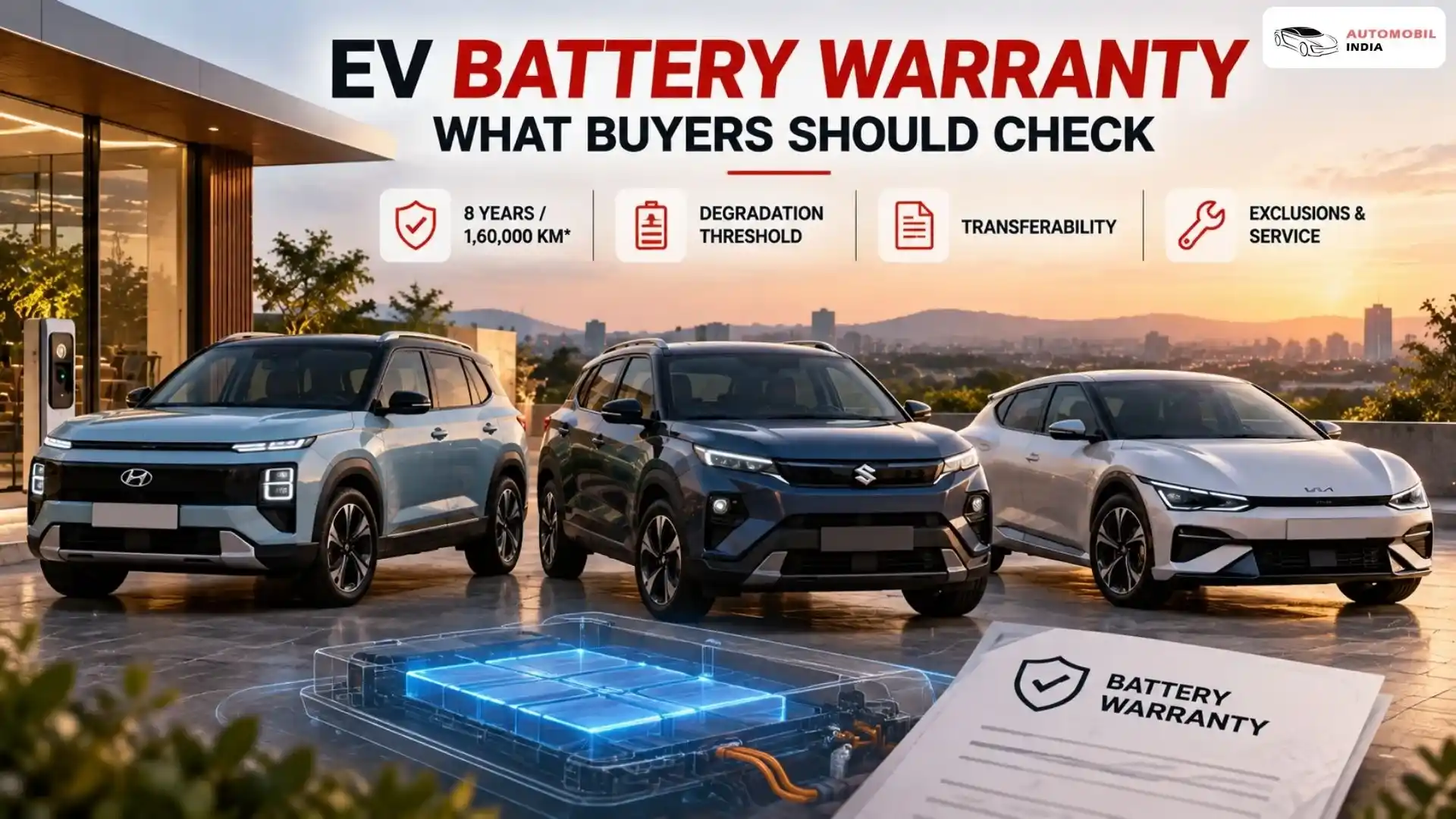
Buying an electric car in India is no longer only about range, charging speed and features. For many buyers, the more important long-term question is: what happens to the battery after several years of ownership?
The high-voltage battery is one of the most important components in an EV, and its warranty can provide significant protection against manufacturing defects and, depending on the manufacturer’s terms, excessive loss of battery capacity.
In India, battery warranty terms vary by manufacturer and model. For example, Hyundai currently lists an 8-year/1,60,000-km battery warranty for the CRETA Electric, while Maruti Suzuki’s e VITARA is backed by an 8-year/1,60,000-km battery warranty. VinFast currently advertises a substantially longer 10-year/2,00,000-km high-voltage battery warranty on specified models.
But the headline number is only the starting point. Before buying an EV, you should check what the battery warranty actually covers, the minimum battery-capacity threshold, kilometre limit, ownership conditions, exclusions and what happens when the car is sold.
What Is an EV Battery Warranty?
An EV battery warranty is the manufacturer’s contractual protection for the vehicle’s high-voltage battery system.
Depending on the manufacturer, it can cover issues such as:
- Manufacturing defects
- Battery-pack component failures
- Certain electrical or electronic faults
- Battery capacity falling below a specified threshold
- Failures caused by defects in battery-management components
However, battery warranty does not automatically mean the manufacturer guarantees the battery will retain its original range for the entire warranty period.
That distinction is important.
A battery naturally loses some capacity over time. The warranty normally becomes relevant when the battery’s condition falls below a specified limit or when a covered defect occurs, subject to the manufacturer’s terms.
How Long Is an EV Battery Warranty in India?
There is no single standard warranty period across all electric cars.
A common structure in the Indian market has been around 8 years or 1,60,000 km, whichever comes first, although some manufacturers offer different terms.
| Manufacturer / Example | High-Voltage Battery Warranty |
|---|---|
| Hyundai CRETA Electric | 8 years / 1,60,000 km |
| Maruti Suzuki e VITARA | 8 years / 1,60,000 km |
| Tata EV examples | 8 years / 1,60,000 km on specified battery/motor coverage |
| Kia EV6 / EV9 | 8 years / 1,60,000 km |
| VinFast specified models | 10 years / 2,00,000 km |
These are examples rather than a universal industry standard. Exact terms depend on the model, date of purchase and warranty documentation.
Why “8 Years or 1,60,000 km” Matters
The phrase whichever comes earlier is particularly important.
For example, if a manufacturer provides an 8-year/1,60,000-km warranty and you reach 1,60,000 km in five years, the kilometre limit may end the battery warranty before eight years.
Conversely, a low-mileage owner may reach the eight-year time limit without approaching 1,60,000 km.
Always check whether the warranty is calculated from the vehicle’s delivery date, registration date or another date specified in the warranty document.
Does Battery Warranty Cover Battery Degradation?
This is one of the most important questions to ask.
Not every battery warranty works in exactly the same way.
Some manufacturers specify a minimum battery-capacity threshold. For example, Kia’s current documentation for the Carens Clavis EV and Syros EV describes capacity coverage for loss below 70% of the original high-voltage battery capacity, subject to the applicable ownership and usage conditions.
This means you should not assume that a noticeable reduction in range automatically qualifies for a warranty replacement.
Example
Suppose an EV originally has a usable range of around 400 km under a particular test cycle.
If its battery gradually loses capacity, the car may still operate normally even though its maximum range has fallen.
The critical question is:
That threshold should be checked in the warranty booklet or official terms before purchase.
Battery Warranty vs Vehicle Warranty
These are not necessarily the same thing.
A manufacturer could offer:
- A shorter comprehensive vehicle warranty
- A longer high-voltage battery warranty
- Separate coverage for the electric motor
- Separate coverage for the 12V battery
- Specific conditions for charging equipment
For example, Tata’s published specification documentation for certain EVs lists an 8-year/1,60,000-km battery pack and motor warranty, while the vehicle warranty is listed separately.
This is why simply seeing “8-year warranty” in an advertisement is not enough.
You need to identify which component has that eight-year coverage.
What Should an EV Battery Warranty Cover?
Before purchasing an electric car, check these areas.
1. Battery Pack
Find out whether the warranty covers the complete high-voltage battery pack or only specified components.
2. Battery Management System
The Battery Management System, or BMS, monitors parameters such as voltage, temperature and battery state.
Ask whether BMS-related failures are covered.
3. Battery Capacity
This is perhaps the most important point for long-term EV ownership.
Look for wording that specifies a minimum state-of-health or capacity percentage.
4. Electric Motor
Some manufacturers combine motor and battery coverage, while others specify separate terms.
5. Charging System
Check coverage for the onboard charger and associated components.
Do not automatically assume that the home charger has the same warranty as the vehicle’s high-voltage battery.
What Can Void or Exclude Battery Warranty Coverage?
Warranty exclusions vary, but buyers should pay particular attention to:
- Physical damage to the battery pack
- Accident-related damage
- Tampering
- Unapproved modifications
- Incorrect repairs
- Damage caused by non-approved charging equipment
- Failure to follow prescribed maintenance procedures
- Software or electrical modifications
- Commercial use restrictions where applicable
Kia, for example, specifically lists external impact, physical damage and tampering involving the high-voltage battery among exclusions. Its documentation also contains conditions relating to charging equipment and unauthorized installation.
This is especially relevant in India because the battery pack is usually positioned underneath the vehicle. A serious impact with a large pothole, rock or road obstacle can potentially cause physical damage.
Does Using Fast Charging Affect Battery Warranty?
Fast charging itself does not automatically mean that your warranty becomes invalid.
However, EV owners should understand the difference between normal use and warranty exclusions.
Modern EVs use battery-management systems to regulate charging, temperature and battery operation. Manufacturers also provide recommended charging procedures.
The important point is to follow the manufacturer’s instructions rather than assuming that every charging method is equally appropriate in every situation.
If you regularly use DC fast charging, check the owner’s manual and warranty terms for the manufacturer’s recommendations.
Is the Battery Warranty Transferable to the Second Owner?
This varies between manufacturers and models.
This question matters because an EV’s battery warranty can have a significant effect on its attractiveness in the used-car market.
Kia’s current warranty documentation, for example, provides different battery-capacity coverage for first and second purchasers on the Carens Clavis EV and Syros EV. The first purchaser gets lifetime capacity coverage under specified conditions, while the second purchaser receives 8 years/1,60,000 km coverage from the original delivery date, subject to the stated terms.
Therefore, if you are buying a used EV, do not rely on the seller’s statement that “battery warranty is still available.”
Ask the manufacturer or authorised dealer to confirm the remaining battery warranty using the vehicle identification number.
What Happens If the Battery Fails Under Warranty?
The remedy depends on the manufacturer’s warranty terms and the nature of the fault.
Possible outcomes can include:
- Repair of a defective battery component
- Replacement of individual modules or components
- Battery-pack replacement
- Software or electronic-system repair
A warranty does not necessarily mean the manufacturer will replace the entire battery pack for every battery-related issue.
The final remedy depends on the diagnosis and applicable warranty conditions.
How Expensive Is an EV Battery Replacement?
There is no single replacement price for an EV battery in India.
Battery cost depends on:
- Battery capacity
- Chemistry
- Vehicle platform
- Cell supplier
- Battery-pack design
- Module availability
- Labour
- Cooling system
- Electronics
- Manufacturer policies
For this reason, publishing a single “EV battery replacement cost” as a universal figure can be misleading.
A buyer should instead ask the manufacturer or authorised service centre for information about battery-pack replacement, module-level repair availability and applicable post-warranty support for the specific model.
What Should You Check Before Buying an EV?
Use this checklist when comparing electric cars.
| Question | Why It Matters |
|---|---|
| How many years is the battery covered? | Establishes time protection |
| What is the kilometre limit? | High-mileage owners may reach it early |
| Which comes first: years or kilometres? | Determines when coverage ends |
| Is battery degradation covered? | A key long-term ownership concern |
| What is the minimum capacity threshold? | Defines when degradation may qualify |
| Is the motor covered separately? | Prevents confusion about drivetrain protection |
| Is the charger covered? | Home charging equipment may have separate terms |
| Is the warranty transferable? | Important for resale |
| What happens to warranty after ownership transfer? | Terms can change for second owners |
| Are commercial vehicles covered differently? | Taxi/commercial usage may have different conditions |
| What damage is excluded? | Important for an underbody-mounted battery |
| Are service records required? | Missing maintenance documentation can create problems |
EV Battery Warranty: What Indian Buyers Should Prioritise
When comparing two electric cars, don’t automatically choose the car with the longest headline warranty.
Instead, compare the actual coverage.
A useful way to evaluate EV battery warranty is:
Warranty duration + kilometre limit + degradation threshold + transferability + exclusions + service requirements
For example, an 8-year warranty with a clearly defined capacity threshold can be more informative than an advertisement simply stating “8-year battery warranty.”
Similarly, a longer warranty may have different conditions for first and subsequent owners.
What Does Battery Warranty Mean for EV Resale Value?
Battery warranty can be particularly relevant when buying or selling a used electric car.
A used EV with several years of transferable battery warranty remaining may give a prospective buyer more documented protection than an otherwise similar vehicle whose battery warranty has expired.
However, warranty alone does not establish battery health.
For a used EV, buyers should also consider:
- Battery State of Health (SoH)
- Remaining warranty
- Charging history where available
- Service records
- Accident history
- Battery diagnostic report
- Remaining vehicle warranty
- Condition of the charging system
This is likely to become increasingly important as India’s used-EV market matures.
What Is Battery State of Health?
Battery State of Health, commonly abbreviated as SoH, is an indication of the battery’s condition relative to its original capability.
For an EV buyer, SoH can help answer a practical question:
However, SoH readings should be interpreted using the manufacturer’s diagnostic procedure rather than relying on a generic third-party number.
For a used EV, a battery-health report from an authorised service centre can therefore be useful.
Should Battery Warranty Influence Your EV Buying Decision?
Yes, but it should be considered alongside the rest of the ownership package.
For an Indian buyer, the warranty should be evaluated together with:
- Real-world range
- Charging network
- Home-charging feasibility
- Battery cooling system
- Service network
- Parts availability
- Insurance cost
- Vehicle warranty
- Resale prospects
- Manufacturer’s EV experience
A long battery warranty can reduce one area of long-term ownership uncertainty, but it does not eliminate every potential EV ownership cost.
EV Battery Warranty India: Key Takeaways
The most important points are:
- EV battery warranties vary considerably between manufacturers and models.
- 8 years/1,60,000 km is a common coverage structure among several mainstream EVs, but it is not universal.
- Some newer manufacturers offer longer coverage; VinFast currently advertises 10 years/2,00,000 km for the high-voltage battery on specified models.
- Check whether battery degradation is covered and identify the minimum capacity threshold.
- Do not confuse the battery warranty with the comprehensive vehicle warranty.
- Check exclusions involving physical damage, tampering and charging equipment.
- Confirm whether the warranty transfers to a second owner.
- For used EVs, obtain battery-health information rather than relying only on the remaining warranty.
- Always read the warranty booklet and model-specific terms before making a purchase.
Frequently Asked Questions
How long is an EV battery warranty in India?
It depends on the manufacturer and model. Several EVs currently offer around 8 years/1,60,000 km, while some manufacturers offer longer coverage. Hyundai’s CRETA Electric, for example, has an 8-year/1,60,000-km battery warranty, while VinFast advertises 10 years/2,00,000 km on specified models.
Does an EV battery warranty cover battery degradation?
It depends on the manufacturer’s terms. Some warranties specify a minimum battery-capacity threshold. Buyers should check the exact percentage and measurement procedure rather than assuming any loss of range is covered.
What happens if an EV battery loses capacity during the warranty period?
If the battery falls below the manufacturer’s specified warranty threshold and the conditions are satisfied, the manufacturer may provide the remedy specified in its warranty policy. This could involve repair or replacement of affected components rather than automatically replacing the entire battery.
Is an EV battery warranty transferable?
It depends on the manufacturer and model. Some warranties can transfer to subsequent owners, while certain battery-capacity programmes may provide different coverage to first and subsequent owners. Kia’s current terms are one example of this distinction.
Does fast charging void an EV battery warranty?
Not automatically. Owners should follow the manufacturer’s charging recommendations and warranty conditions. Unapproved equipment, tampering or damage caused by charging-related issues may be excluded.
Does the battery warranty cover the home charger?
Not necessarily. Charging equipment can have separate warranty terms. Kia, for example, specifies conditions and exclusions for home-charging equipment separately from its high-voltage battery coverage.
Is the electric motor covered under the battery warranty?
Not always. Some manufacturers combine motor and battery coverage, while others specify separate warranties. Check the model’s official warranty documentation.
What should I check when buying a used EV?
Check the remaining battery warranty, warranty transfer conditions, battery State of Health, service records, accident history, charging system and any available battery diagnostic report.
Is a longer battery warranty always better?
A longer duration can provide additional coverage, but the headline period is only one part of the equation. Capacity threshold, kilometre limit, exclusions, transferability and actual coverage are equally important.
Where can I find the exact battery warranty for an EV?
The best sources are the manufacturer’s official warranty booklet, model-specific terms and an authorised dealer. Warranty policies can change, so buyers should verify the terms applicable to the exact vehicle and purchase date.