Best Electric Vehicle Companies in India: Brands, Models and Market Position
India’s electric-car market has changed significantly in 2026. Buyers are no longer limited to a few small EVs or expensive premium models. The market now includes affordable city cars, compact SUVs, large family SUVs, performance-oriented electric SUVs, premium sedans and even electric seven-seaters.
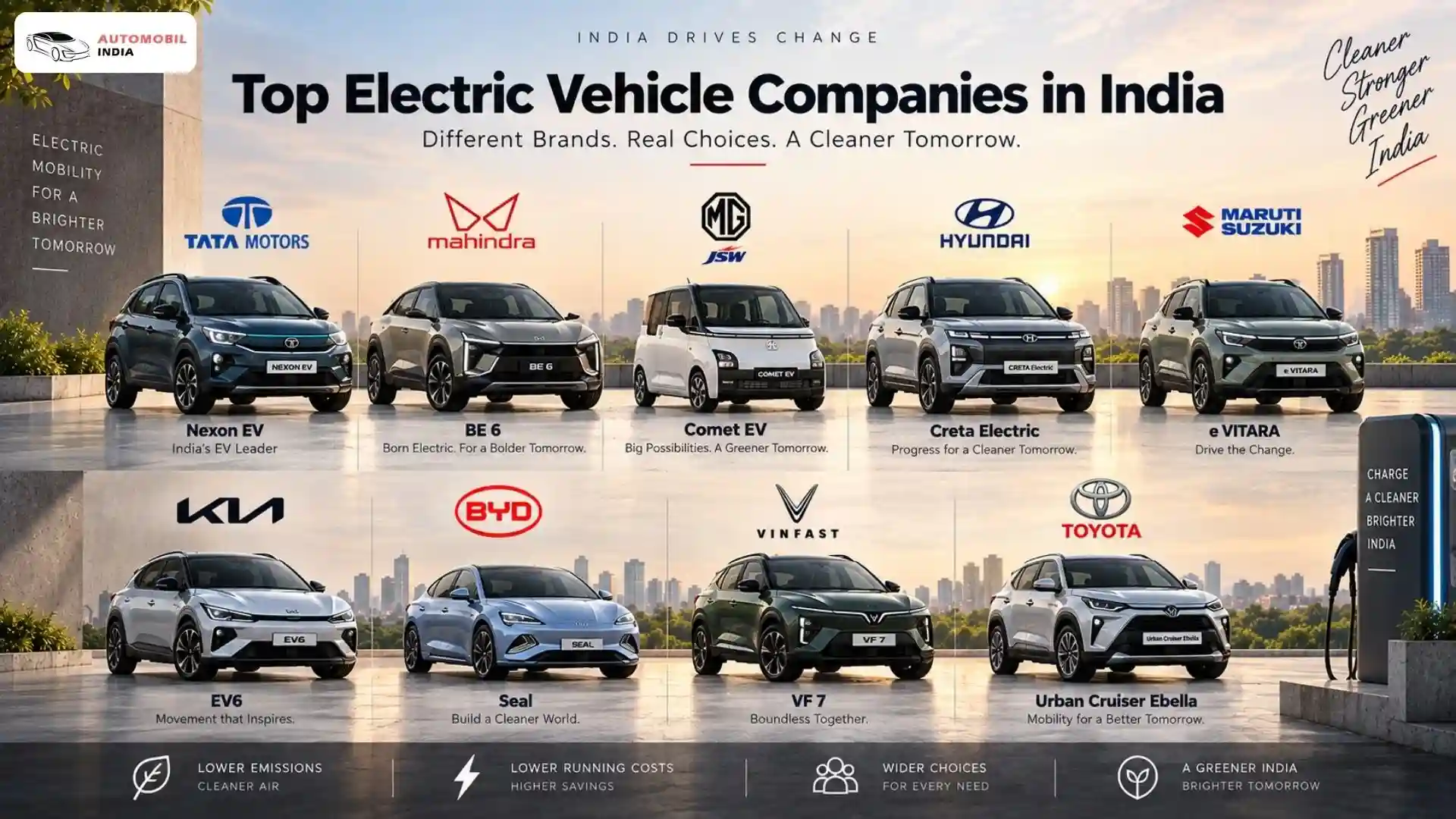
The top EV companies in India today include Tata Motors, Mahindra, JSW MG Motor India, Hyundai, Maruti Suzuki, Kia, BYD, VinFast and Toyota, with several luxury manufacturers also expanding their electric portfolios.
Tata remains particularly important in the mass-market EV segment. In August 2026, Tata accounted for 43.74% of India’s electric passenger-vehicle market according to industry sales data, while Mahindra and JSW MG Motor occupied the next two mass-market positions. VinFast moved into fourth place during the month, ahead of Maruti Suzuki.
But market position is only one part of the story.
Different manufacturers are approaching electric mobility differently:
- Tata Motors has the broadest mainstream EV portfolio across several price segments.
- Mahindra is concentrating heavily on electric SUVs and dedicated EV architecture.
- JSW MG Motor India has built a broad EV portfolio and popularised BaaS.
- Hyundai combines mainstream SUVs with premium EV technology.
- Maruti Suzuki has entered the EV market with the e VITARA and its own charging ecosystem.
- Kia is expanding from premium EVs into more accessible electric family vehicles.
- BYD focuses on technology-led EVs across multiple premium segments.
- VinFast is building a new EV-focused presence in India.
- Toyota has entered India’s battery-electric market with the Urban Cruiser Ebella.
This guide explains what each major EV company offers, where its models sit in the market and what type of Indian buyer each brand is targeting.
Top EV Companies in India: Quick Overview
| EV company | Key current EV models | Broad price positioning | Market position |
|---|---|---|---|
| Tata Motors | Tiago EV, Punch EV, Nexon EV, Curvv EV, Sierra EV, Harrier EV | Mass-market to premium | Major mass-market EV player |
| Mahindra | XUV 3XO EV, BE 6, XEV 9e, XEV 9S | Mid-size to premium SUVs | Electric SUV-focused player |
| JSW MG Motor India | Comet EV, Windsor EV, Windsor Pro, ZS EV, Hector Tomahawk EV | Mass-market to premium | Major EV challenger; BaaS focus |
| Hyundai | Creta Electric, IONIQ 5 | Mid-size to premium | Mainstream + premium EV strategy |
| Maruti Suzuki | e VITARA | Mid-size SUV | New mass-market EV entrant |
| Kia | Syros EV, Carens Clavis EV, EV6, EV9 | Mid-size to luxury | Expanding EV portfolio |
| BYD | Atto 3, Seal, eMAX 7, Sealion 7 | Premium | EV-focused technology brand |
| VinFast | VF 6, VF 7, VF MPV 7 | Premium/mid-premium | New EV-focused entrant |
| Toyota | Urban Cruiser Ebella | Premium/mid-size SUV | New BEV entrant |
| Luxury brands | BMW, Mercedes-Benz, Audi, Volvo, Porsche and others | Premium/luxury | Premium EV market |
The current Indian market contains more than 60 electric passenger-car models across multiple brands and segments.
1. Tata Motors
Market position
Tata Motors has been one of the most important companies in India’s electric passenger-vehicle market.
Its advantage is the breadth of its EV portfolio. Instead of concentrating on one expensive electric SUV, Tata has models ranging from the Tiago EV to the Harrier EV.
August 2026 retail data showed Tata with 13,070 electric passenger-vehicle registrations and 43.74% market share according to Autocar India’s analysis of Vahan data.
Tata’s August EV sales included more than 13,000 units across models such as the Punch EV, Nexon EV, Tiago EV, Harrier EV, Sierra EV and Curvv EV. Independent industry data recorded 13,433 Tata EVs during the month, with the Punch EV leading the company’s EV range.
Tata electric cars in India
The current Tata EV portfolio includes:
- Tiago EV
- Punch EV
- Nexon EV
- Curvv EV
- Sierra EV
- Harrier EV
Key strengths
Tata’s EV strategy covers several price points:
Tiago EV: affordable urban EV
Punch EV: compact electric SUV
Nexon EV: family-oriented electric SUV
Curvv EV: coupe-SUV with long-range positioning
Sierra EV: premium family SUV
Harrier EV: larger SUV with long-range and AWD capability
Why Tata matters to EV buyers
For a buyer who wants to stay within a mainstream Indian brand and have several EV sizes to choose from, Tata’s portfolio is particularly broad.
It also means Tata has experience selling EVs across a much wider price range than many newer EV entrants.
2. Mahindra
Market position
Mahindra has taken a different route from Tata.
Rather than converting several existing models to electric power, Mahindra has invested heavily in its dedicated INGLO electric architecture and Electric Origin SUV portfolio.
Its current EV range includes:
- XUV 3XO EV
- BE 6
- XEV 9e
- XEV 9S
Mahindra also introduced the BE 6 SPORTEQ in 2026 and expanded its Battery-as-a-Service programme across the BE 6 SPORTEQ, XEV 9e and XEV 9S.
Key strengths
Mahindra’s EV strategy focuses heavily on:
- SUV body styles
- Large batteries
- High performance
- Dedicated EV architecture
- Advanced infotainment
- Level 2/2+ driver assistance
- Premium interiors
- Long-range versions
The BE 6, for example, is designed around performance and technology, while the XEV 9e takes a more premium SUV approach.
The XEV 9S adds another dimension by offering a three-row electric SUV.
Mahindra BaaS
Mahindra expanded BaaS across its Electric Origin portfolio in August 2026.
Under the programme, the company announced introductory prices of:
- BE 6 SPORTEQ: ₹11.45 lakh + battery financing
- XEV 9S: ₹12.65 lakh + battery financing
- XEV 9e: ₹13.90 lakh + battery financing
The battery financing component is stated as an effective usage cost of ₹3.75/km under the programme.
These prices should not be directly compared with conventional battery-included prices because BaaS uses a separate financing structure.
Who should consider Mahindra?
Mahindra’s EV range is particularly relevant to buyers who want:
Performance + SUV proportions + large batteries + advanced technology.
3. JSW MG Motor India
Market position
JSW MG Motor India has built one of India’s most varied electric portfolios.
Its current range includes:
- Comet EV
- Windsor EV
- Windsor EV Pro
- ZS EV
- Hector Tomahawk EV
The company has also introduced its ADAPT new-energy platform, designed to support multiple electrified powertrain architectures.
According to JSW Group, JSW MG Motor India has sold more than 1.5 lakh EVs in India since its first electric model and increased its EV market share from 26% in CY2024 to 35%, with 7,508 wholesale units sold in August 2026. These are company-provided figures and should be distinguished from Vahan retail-registration data.
Key models
MG Comet EV
Designed primarily for urban mobility, the Comet is a tiny four-seat EV focused on easy manoeuvrability and compact dimensions.
MG Windsor EV
The Windsor focuses on cabin space, comfort and value, with a crossover-style body.
MG Windsor EV Pro
The Pro adds a larger battery and higher range.
MG ZS EV
A more conventional electric SUV with a 50.3kWh battery.
MG Hector Tomahawk EV
A new electric SUV based on the company’s ADAPT architecture, launched in August 2026.
BaaS strategy
MG has been one of the most visible brands in India to promote Battery-as-a-Service.
Its website currently displays BaaS pricing for models such as the Windsor EV and ZS EV.
Who should consider MG?
MG is particularly relevant for buyers who want:
- Feature-rich EVs
- Spacious cabins
- Alternative ownership structures
- Connected technology
- Multiple body styles
4. Hyundai
Market position
Hyundai has taken a relatively conservative but technology-focused approach to India’s EV market.
Its current electric lineup consists primarily of:
- Creta Electric
- IONIQ 5
Hyundai’s official India EV page currently lists the Creta Electric from ₹18.02 lakh and the IONIQ 5 from ₹55.70 lakh.
The company is therefore positioned across two very different segments.
Hyundai Creta Electric
The Creta Electric is Hyundai’s mainstream electric SUV.
It uses:
- 42kWh battery
- 51.4kWh battery
The certified ranges are:
- 420km
- 510km
depending on configuration.
The SUV offers features such as:
- Dual 10.25-inch displays
- ADAS
- V2L
- Connected-car technology
- DC fast charging
- Regenerative braking
Hyundai has also introduced BaaS for the Creta Electric, starting at ₹10.99 lakh plus battery rental from ₹3.90/km.
Hyundai IONIQ 5
The IONIQ 5 occupies a much higher price bracket.
Hyundai updated the model in 2026 with an 84kWh battery and claimed range of up to 690km. The update also brought revised styling, a new 12.3-inch ccNC navigation system and additional driver-assistance features.
Who should consider Hyundai?
Hyundai’s EV portfolio suits buyers looking for:
Familiar SUV ownership + modern technology + premium cabin experience.
The Creta Electric is the more mainstream proposition, while the IONIQ 5 is a premium technology-led EV.
5. Maruti Suzuki
Market position
Maruti Suzuki’s entry into battery-electric cars is particularly significant because of the company’s enormous presence in India’s conventional passenger-car market.
Its first mainstream BEV for India is the e VITARA.
The e VITARA is available with:
- 49kWh battery
- 61kWh battery
Maruti quotes a driving range of up to 543km.
Maruti e VITARA
The e VITARA is positioned as a mid-size electric SUV and brings several elements that are important for mainstream adoption:
- 7.4kW AC wall-box charger
- Public charging integration
- Connected charging functions
- 49kWh and 61kWh battery options
- Up to 543km claimed range
- 8-year/1.6-lakh-km battery warranty
Maruti has also developed its e for me charging ecosystem to help owners discover and use public chargers.
Why Maruti’s EV entry matters
Maruti’s biggest potential advantage is not simply the vehicle itself.
It is the combination of:
- Large dealer network
- Established service network
- Existing customer base
- Financing ecosystem
- Familiarity with the brand
However, because the e VITARA is Maruti’s first major battery-electric passenger car in India, its long-term EV market position is still developing.
Who should consider Maruti?
The e VITARA is particularly relevant to buyers who want:
A mainstream electric SUV backed by a large established automotive network.
6. Kia
Market position
Kia began its Indian EV journey with premium models such as the EV6 and EV9, but its strategy has now broadened.
The current Kia India website lists:
- Syros EV
- Carens Clavis EV
- EV6
- EV9
as part of its electric portfolio.
Kia Syros EV
The Syros EV moves Kia towards a more accessible electric SUV segment.
It is intended to compete closer to mainstream compact/mid-size electric SUVs rather than only premium EVs.
Kia Carens Clavis EV
The Carens Clavis EV is particularly significant for Indian families because it brings the family-oriented MPV/crossover format into Kia’s electric portfolio.
Kia describes it as a family-focused EV built around space, comfort and connected technology.
Kia EV6
The EV6 remains Kia’s technology-oriented premium electric crossover.
It focuses more heavily on:
- Performance
- Fast charging
- Premium design
- Advanced cabin technology
Kia EV9
The EV9 sits at the top of Kia’s EV portfolio and is designed around large-family space and premium electric SUV requirements.
Who should consider Kia?
Kia’s EV range is particularly relevant for buyers looking for:
Premium design + technology + family practicality, depending on the model and budget.
7. BYD
Market position
BYD is different from most Indian automakers because electric vehicles are central to its global business rather than being an extension of an existing petrol-car portfolio.
Its Indian range includes:
- Atto 3
- Seal
- eMAX 7
- Sealion 7
BYD’s Indian portfolio therefore covers SUVs, sedans and MPVs.
BYD Atto 3
The Atto 3 is positioned as a premium electric SUV.
It combines:
- Large battery
- Long-range capability
- Premium equipment
- Advanced driver-assistance technology
BYD Seal
The Seal is a premium electric sedan focused on:
- Performance
- Long range
- High-speed charging
- Premium cabin technology
BYD eMAX 7
The eMAX 7 brings BYD’s EV technology to a larger family MPV format.
This makes it relevant to buyers who need more seating and interior space.
BYD Sealion 7
The Sealion 7 is a premium electric SUV positioned above the Atto 3.
BYD’s current Indian pricing shows the Seal starting at around ₹41.50 lakh and the Sealion 7 at around ₹49.90 lakh, while the Atto 3 starts around ₹24.99 lakh in Pune.
Who should consider BYD?
BYD is relevant to buyers who want:
EV-focused engineering + premium technology + larger batteries + international EV design.
8. VinFast
Market position
VinFast is one of the newer EV-focused manufacturers to enter India.
The company unveiled the VF 6 and VF 7 for India at the 2025 Bharat Mobility Global Expo and subsequently expanded its Indian product plan.
Its current Indian portfolio has expanded to include:
- VF 6
- VF 7
- VF MPV 7
VF 6
The VF 6 is positioned as a compact electric SUV.
VF 7
The VF 7 moves into a larger and more premium SUV segment.
VF MPV 7
The VF MPV 7 is particularly relevant to Indian families because it is a seven-seat electric MPV.
VinFast launched it in April 2026 with a 2,840mm wheelbase and up to 1,240 litres of storage capacity.
Market position
VinFast is still building its Indian sales and service footprint, so buyers should pay close attention to:
- Dealer availability
- Service coverage
- Spare-parts logistics
- Charging support
- Resale expectations
These considerations are particularly important when buying from a newer automotive brand.
Who should consider VinFast?
The brand is relevant to buyers looking for:
New EV platforms + distinctive design + larger premium EVs, especially if they are comfortable with a newer market entrant.
9. Toyota
Market position
Toyota entered India’s battery-electric passenger-car market with the Urban Cruiser Ebella in 2026.
Toyota describes the Ebella as its first battery-electric vehicle for the Indian market.
Toyota Urban Cruiser Ebella
The electric SUV is available with:
- 49kWh battery
- 61kWh battery
- Up to 543km claimed range
It offers:
- Level 2 ADAS
- Seven airbags
- 360-degree camera
- Panoramic roof
- Ventilated front seats
- JBL audio
- 10.1-inch infotainment system
- Connected features
Toyota also states that it has more than 500 BEV-enabled service touchpoints and more than 2,500 BEV master technicians in India.
Toyota announced the Ebella E3 at ₹23.60 lakh ex-showroom in May 2026, while the broader range includes different battery and trim configurations.
Who should consider Toyota?
The Ebella is particularly relevant to buyers who want:
A mid-size electric SUV combined with Toyota’s established service and ownership ecosystem.
Other Important EV Companies in India
The Indian electric-car market is now large enough that the nine brands above do not represent every meaningful option.
Several premium and specialist manufacturers are also active.
BMW
BMW has expanded its Indian EV range across models such as:
- iX
- iX1
- i5
- i7
- i4
The brand operates primarily in the premium and luxury segment.
Mercedes-Benz
Mercedes-Benz offers electric versions across several premium segments, including:
- EQB
- EQE
- EQS
- G-Class Electric
- CLA Electric
Its EV strategy is focused on premium technology and luxury vehicles.
Audi
Audi’s electric portfolio includes models such as:
- Q4 e-tron
- Q8 e-tron
- Q8 Sportback e-tron
- e-tron GT
The brand competes primarily in the premium luxury segment.
Volvo
Volvo has also maintained an EV-focused premium portfolio in India, with models such as the EX30, XC40 Recharge and C40 Recharge historically forming part of its electric strategy.
Porsche
Porsche’s EV portfolio includes the Taycan and Macan Electric, targeting buyers for whom performance is a major priority.
These companies are important to India’s EV market, but their products occupy a completely different price range from cars such as the Tiago EV, Punch EV and Nexon EV.
EV Companies in India by Price Segment
Looking at brands by price is often more useful for buyers than simply looking at market share.
| Price segment | Major EV companies/models |
|---|---|
| Under ₹10 lakh | Tata, MG |
| ₹10–15 lakh | Tata, MG, Mahindra, Maruti, Kia |
| ₹15–20 lakh | Tata, Mahindra, MG, Hyundai, Kia, Maruti |
| ₹20–30 lakh | Mahindra, Tata, Hyundai, Toyota, Kia, VinFast |
| ₹30–50 lakh | Mahindra, Tata, Toyota, BYD, Kia, Hyundai, VinFast |
| ₹50 lakh+ | BYD, Hyundai, Kia, BMW, Mercedes-Benz, Audi, Porsche, MG |
Prices can overlap considerably depending on BaaS, variant, battery size and promotional pricing.
EV Companies in India by Vehicle Type
Affordable city EVs
Relevant brands:
- Tata
- MG
Key models:
- Tiago EV
- Comet EV
These cars make the most sense for buyers whose driving is predominantly urban.
Compact electric SUVs
Relevant brands:
- Tata
- Mahindra
- MG
- Maruti
- Kia
Models include:
- Punch EV
- XUV 3XO EV
- ZS EV
- e VITARA
- Syros EV
These are increasingly becoming the core of India’s mass-market EV segment.
Mid-size electric SUVs
Relevant brands:
- Tata
- Hyundai
- Toyota
- Mahindra
- VinFast
- MG
Examples include:
- Nexon EV
- Creta Electric
- Urban Cruiser Ebella
- BE 6
- VF 6
- Windsor EV
- Curvv EV
Premium electric SUVs
Relevant brands:
- Mahindra
- Tata
- BYD
- Hyundai
- Kia
- VinFast
- MG
Examples include:
- XEV 9e
- Harrier EV
- Sealion 7
- IONIQ 5
- EV9
- VF 7
- Hector Tomahawk EV
Electric family MPVs
This segment is becoming increasingly important in India.
Relevant models include:
- Kia Carens Clavis EV
- BYD eMAX 7
- VinFast VF MPV 7
- Mahindra XEV 9S
The XEV 9S is particularly notable because it brings three-row seating into Mahindra’s dedicated EV portfolio.
Which EV Company Has the Most Models?
Tata currently has one of the broadest mainstream EV portfolios in India.
Its lineup spans from the Tiago EV at the affordable end to the Harrier EV and Sierra EV in the larger SUV segments.
Mahindra’s portfolio is narrower in terms of body styles but highly concentrated on electric SUVs.
JSW MG Motor India also has a broad EV range, spanning the compact Comet to larger SUVs and the new Hector Tomahawk EV.
This means “most models” and “strongest market position” are not necessarily the same thing.
Which EV Company Is Focused Most on Electric SUVs?
Mahindra’s current strategy is particularly concentrated on electric SUVs.
Its dedicated Electric Origin portfolio consists of:
- BE 6
- XEV 9e
- XEV 9S
and its XUV 3XO EV extends that presence into a smaller segment.
The BE 6 and XEV models are based on Mahindra’s dedicated INGLO EV architecture rather than being simple electrified versions of conventional petrol SUVs.
This gives Mahindra a clear product identity within India’s electric-SUV market.
Which EV Company Offers the Widest Price Range?
Tata currently covers a particularly wide range of mainstream EV prices.
Its portfolio extends from:
Tiago EV → Punch EV → Nexon EV → Curvv EV → Sierra EV → Harrier EV
This lets a buyer move between vehicle sizes without leaving the brand’s EV portfolio.
MG also covers multiple price points through the Comet, Windsor, ZS EV and newer products.
At the premium end, BYD, Kia, Hyundai, BMW, Mercedes-Benz and others operate at substantially higher price points.
Which EV Company Has the Strongest Charging Ecosystem?
This is difficult to answer with a single brand because EV charging in India is becoming increasingly networked across manufacturers.
However, several companies are developing dedicated ownership ecosystems.
Tata
Tata’s EV ecosystem is built around its growing passenger-EV portfolio and charging partnerships.
Maruti Suzuki
Maruti’s e for me ecosystem supports charger discovery, scheduling and payment. The company has also provided home wall-box charging with the e VITARA.
Hyundai
Hyundai offers connected charging functions and supports AC and DC charging for the Creta Electric.
Toyota
Toyota says its Ebella is supported by more than 500 BEV-enabled service touchpoints and 2,500+ BEV master technicians.
What matters more for buyers
Rather than asking which manufacturer has the largest theoretical network, check:
- Chargers along your regular highway routes
- Chargers near your home
- Charger reliability
- DC charging speed
- Payment options
- Whether your car supports the available connector/output
A smaller but reliable network can be more useful than a larger network with poor uptime.
EV Market Position in India: August 2026
The current market data provides useful context.
India recorded 30,418 retail electric passenger-vehicle registrations in August 2026, up 51% year-on-year according to Vahan data analysed by Autocar India. It was the third consecutive month in which monthly EV registrations crossed 30,000.
The mass-market brand order for August was:
- Tata Motors
- Mahindra
- JSW MG Motor India
VinFast moved ahead of Maruti Suzuki into fourth place during the month.
Tata’s EV volumes were approximately 13,070 units in that Vahan-based analysis, giving it a 43.74% market share.
Market Share vs Brand Strength: What Should Buyers Look At?
A common mistake is to assume that the company selling the most EVs must automatically be the best company to buy from.
Sales volume tells you something about market acceptance, but it does not answer every ownership question.
Before buying, consider:
1. Service network
How close is the nearest EV-capable workshop?
2. Battery warranty
Check:
- Duration
- Kilometre limit
- Battery-degradation coverage
- Transferability
- First-owner restrictions
3. Charging support
Ask whether the manufacturer provides:
- Home charger
- Installation
- Public charging integration
- Roadside assistance
- Charging support
4. Battery technology
Look at:
- Battery chemistry
- Thermal management
- Usable capacity
- DC charging speed
- Warranty
5. Resale
EV resale values are still developing in India.
A brand with a large installed base may offer greater familiarity in the used-car market, but future resale values remain difficult to predict.
What Should You Check Before Buying an EV?
The manufacturer’s logo should be only the starting point.
Check your daily driving
If you drive 30–50km a day, you may not need an extremely large battery.
Check your parking
If you cannot park near an electrical connection, home charging becomes more difficult.
Check your electricity connection
Ask the manufacturer whether your existing electrical connection is sufficient for the recommended charger.
Check highway routes
Before buying a long-range EV, identify the DC chargers along your most common inter-city routes.
Check charging time
Don’t look only at battery capacity.
A 60kWh battery with slow charging can be less convenient on a road trip than a slightly smaller battery with much faster DC charging.
Check warranty terms
Battery warranty is one of the most important documents in an EV purchase.
Understand BaaS
A low headline price may involve:
- Battery financing
- Per-kilometre battery charges
- Separate finance agreements
- Usage conditions
Always calculate the total ownership cost.
Top EV Companies in India: At a Glance
| Company | Main EV identity | Key current models |
|---|---|---|
| Tata Motors | Broad mainstream EV portfolio | Tiago EV, Punch EV, Nexon EV, Curvv EV, Sierra EV, Harrier EV |
| Mahindra | Electric SUVs and dedicated EV architecture | XUV 3XO EV, BE 6, XEV 9e, XEV 9S |
| JSW MG Motor India | Broad EV portfolio + BaaS | Comet, Windsor, Windsor Pro, ZS EV, Hector Tomahawk EV |
| Hyundai | Mainstream + premium EVs | Creta Electric, IONIQ 5 |
| Maruti Suzuki | Mainstream electric SUV | e VITARA |
| Kia | Expanding family and premium EV range | Syros EV, Carens Clavis EV, EV6, EV9 |
| BYD | EV-focused premium technology | Atto 3, Seal, eMAX 7, Sealion 7 |
| VinFast | New EV-focused entrant | VF 6, VF 7, VF MPV 7 |
| Toyota | Electric SUV with established service ecosystem | Urban Cruiser Ebella |
| BMW / Mercedes / Audi / Porsche | Luxury EVs | Multiple premium EVs |
Which EV Company Should You Consider?
Rather than choosing a company solely by market share, match the brand to your requirement.
If you want an affordable mainstream EV
Look at Tata and MG.
If you want a compact electric SUV
Consider Tata, Mahindra, MG, Maruti and Kia.
If you want a performance-focused electric SUV
Mahindra’s BE 6 and XEV models are particularly relevant.
If you want a spacious family EV
Look at MG Windsor, Tata Nexon/Harrier, Hyundai Creta Electric, Kia Carens Clavis EV and Mahindra XEV 9S.
If you want a long-range premium EV
Consider Mahindra BE 6/XEV 9e, Tata Harrier EV, Hyundai IONIQ 5, BYD Seal/Sealion 7 and Kia EV6/EV9, depending on budget.
If you want an EV from a new dedicated EV manufacturer
BYD and VinFast are particularly relevant.
If an established service ecosystem is important
Tata, Mahindra, Hyundai, Maruti, Kia and Toyota all have established Indian automotive operations, although EV-specific service capability can vary by city and dealership.
Frequently Asked Questions
Which are the top EV companies in India?
The major current passenger-EV companies include Tata Motors, Mahindra, JSW MG Motor India, Hyundai, Maruti Suzuki, Kia, BYD, VinFast and Toyota. Luxury manufacturers such as BMW, Mercedes-Benz, Audi and Porsche also have significant premium EV portfolios.
Which company sells the most electric cars in India?
Tata Motors held the largest mass-market share in August 2026. Vahan-based data analysed by Autocar India recorded 13,070 Tata electric passenger-vehicle registrations and a 43.74% share during the month. Mahindra and JSW MG Motor India followed among mass-market brands.
Which EV company has the most electric car models?
Tata currently has one of the broadest mainstream EV portfolios in India, covering hatchbacks and multiple SUV segments. MG also has a broad EV range spanning city cars, crossovers and SUVs.
Which company makes the longest-range EV in India?
The answer depends on the segment and definition of “available.” Among mainstream passenger EVs, Mahindra’s BE 6 offers up to 682km certified range in its 79kWh configuration. Hyundai’s updated IONIQ 5 claims up to 690km, but it sits in a much more premium segment.
Which EV company is best for a family?
There is no single answer because family requirements vary. Tata, Mahindra, MG, Hyundai, Kia, Toyota and VinFast all have electric vehicles aimed at family buyers, ranging from five-seat SUVs to three-row and seven-seat models.
Which EV company has the cheapest electric car?
The lowest entry price depends on whether battery-rental/BaaS schemes are included. Tata’s Tiago EV starts at ₹6.99 lakh with the battery included, while MG’s Comet and some BaaS offerings can display lower headline prices when battery charges are separated.
Which EV companies offer Battery-as-a-Service?
MG, Hyundai, Mahindra, Maruti Suzuki and several other manufacturers have introduced battery-financing or BaaS structures in India. The exact pricing and ownership structure varies significantly, so buyers should calculate total costs rather than compare only the upfront vehicle price.
Is BYD available in India?
Yes. BYD sells electric passenger vehicles in India, including the Atto 3, Seal, eMAX 7 and Sealion 7. Its Indian portfolio is positioned primarily in the premium EV market.
Is Maruti Suzuki selling an electric car in India?
Yes. Maruti Suzuki’s first mainstream battery-electric vehicle for India is the e VITARA. It is offered with 49kWh and 61kWh batteries and a claimed range of up to 543km.
Is VinFast selling electric cars in India?
Yes. VinFast has launched the VF 6 and VF 7 and has also introduced the seven-seat VF MPV 7 for Indian customers.