For most electric-car owners in India, EV charging at home is the most convenient way to keep the vehicle ready for daily use. Instead of visiting a public charging station every time the battery gets low, an EV can be plugged in while it is parked overnight or during the day.
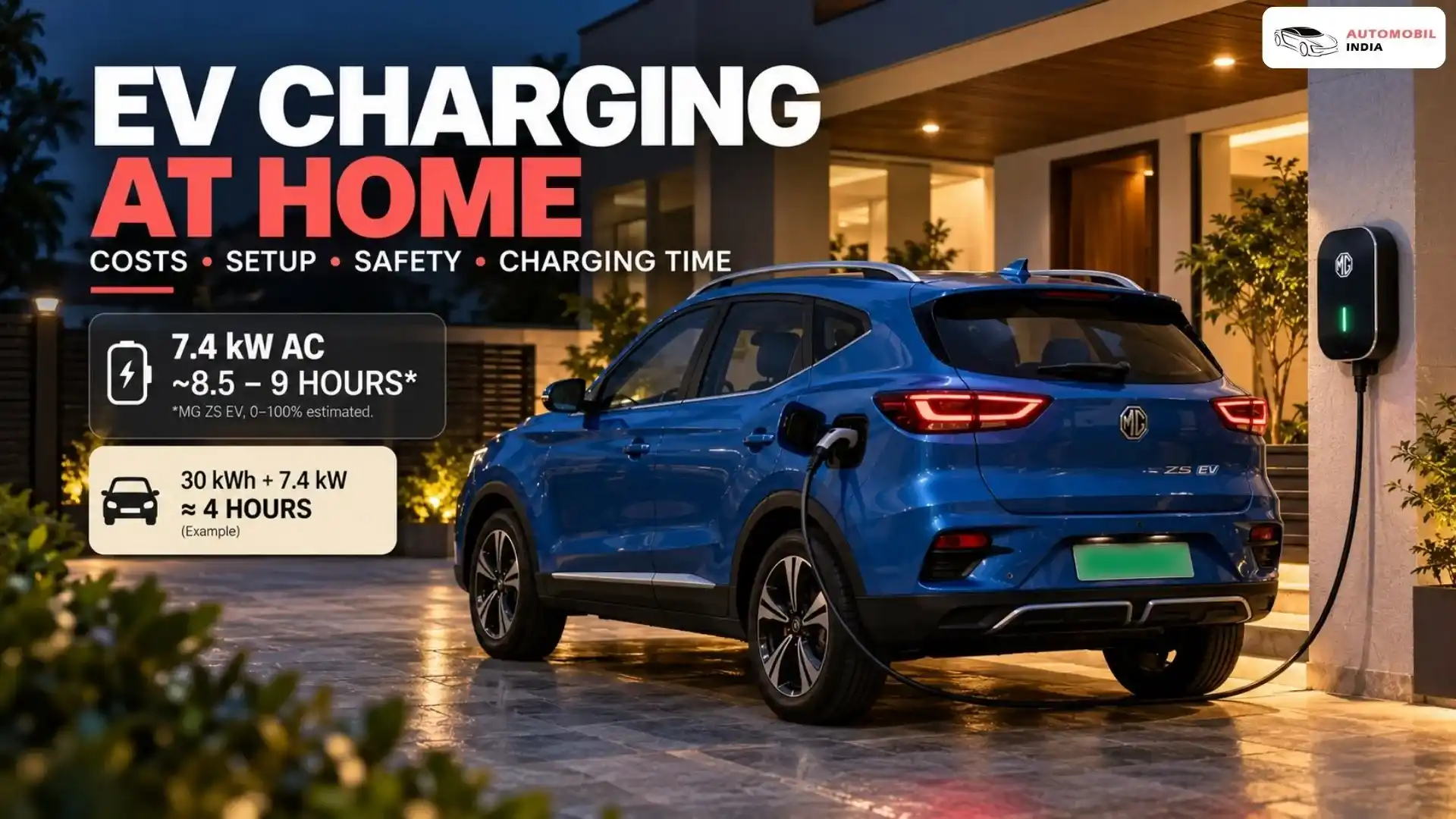
The actual setup depends on the car, charger, available electrical connection, parking arrangement and housing society rules. Smaller EVs can work with lower-power AC charging, while many larger electric cars use a dedicated 7.2–7.4 kW AC wall charger for faster overnight charging. Tata Power, for example, says a 30 kWh EV generally takes around four hours with a 7.4 kW charger, although actual charging time varies by the vehicle and battery.
The important point for buyers is that home charging is not simply about buying a charger and plugging it into a socket. The electrical load, earthing, cable routing, protection equipment and installation location all matter.
What Is EV Charging at Home?
Home EV charging means charging an electric vehicle using an AC charging connection installed at a house, apartment parking space or other private residential location.
There are broadly two approaches:
| Charging method | Typical use | Charging speed |
|---|---|---|
| Portable charger | Occasional or low daily usage | Slow |
| Dedicated AC wall charger | Regular home charging | Faster and more convenient |
| DC fast charger | Primarily public charging | Much faster, but generally not a home setup |
Many electric cars can be charged using a portable charger connected to a suitable socket. However, a dedicated AC wall box is generally more practical for owners who drive regularly.
For example, MG’s ZS EV documentation lists both a portable charger that can use a 15A socket and a 7.4 kW AC fast charger for home or office charging.
How Does Home EV Charging Work?
The process is straightforward:
- The car is parked close enough to the charging point.
- The charger is connected to the home’s electrical supply.
- The charging connector is plugged into the vehicle.
- The vehicle and charger communicate and begin charging.
- The battery management system controls the charging process.
- Charging stops or reduces once the required battery level is reached.
Unlike filling a petrol or diesel car, there is no need to wait at a charging station for every charging session. The vehicle can charge while you are sleeping, working or at home.
That changes the way EV ownership works: the car effectively starts each day with the amount of energy you added overnight.
What Type of Home Charger Do You Need?
The right charger depends primarily on the EV’s onboard AC charging capability.
Portable charger
A portable charger is useful when:
- Daily driving is relatively low
- You have access to a suitable electrical socket
- You occasionally need charging at different locations
- Overnight charging is sufficient
The disadvantage is charging speed. MG’s ZS EV documentation, for example, quotes approximately 18-19 hours for a full charge using its portable charger, compared with around 8.5-9 hours using its 7.4 kW AC charger.
3.3 kW AC charger
A 3.3 kW charger can be sufficient for smaller batteries and low daily driving.
For example, the MG Comet EV’s current specifications list approximately seven hours for a 0-100% charge using 3.3 kW AC charging.
This type of charging is particularly useful for compact EVs that spend many hours parked.
7.2–7.4 kW AC wall charger
For many electric cars, a 7.2-7.4 kW AC wall charger is the more practical home solution.
Tata Motors has offered a 7.2 kW AC home charger with installation on selected EV purchases, while Tata Power’s technical specifications list a 7.4 kW AC home charger operating at 230V with up to 32A current.
A higher-rated charger does not automatically mean the car will charge at that speed. The vehicle’s onboard AC charger determines how much power it can actually accept.
How Much Does EV Charging at Home Cost?
There are two separate costs to consider:
1. Charger and installation cost
The installation cost can depend on:
- Charger power rating
- Cable length
- Distance from the electrical panel
- Electrical protection requirements
- Earthing condition
- Parking location
- Whether additional wiring is necessary
- Housing-society requirements
Some manufacturers include a home charger and installation with particular EVs or variants. Tata Motors, for example, announced a 7.2 kW AC home charger and installation as part of a customer offer in 2025.
Therefore, prospective buyers should check exactly what is included with their vehicle variant before budgeting separately for a charger.
2. Electricity consumed during charging
The running cost is determined primarily by the electricity consumed and your applicable electricity tariff.
A simple calculation is:
Charging cost ≈ Energy consumed from the grid × electricity tariff
For example, if an EV requires 30 kWh of electricity for a particular charging session and the applicable effective tariff is ₹8 per kWh:
30 × ₹8 = ₹240
This is only an example, not a universal Indian EV charging rate. Electricity tariffs vary between states, DISCOMs, tariff slabs and consumers.
There can also be charging losses between electricity drawn from the grid and energy stored in the battery, so the actual amount billed can be higher than the battery’s nominal capacity.
How Long Does It Take to Charge an EV at Home?
Charging time depends on three major factors:
Battery size + charger power + vehicle’s onboard charger
A simplified theoretical calculation is:
Charging time ≈ Battery capacity ÷ Charging power
Real-world charging is more complicated because charging power can reduce as the battery approaches a high state of charge.
Example
A 30 kWh battery connected to a 7.4 kW charger would theoretically require roughly:
30 ÷ 7.4 = 4.05 hours
Tata Power gives a similar example, stating that a 30 kWh vehicle with a 7.4 kW charger generally takes around four hours.
Actual charging time can vary according to battery temperature, state of charge, vehicle charging limits and other conditions.
Home Charging vs Public Fast Charging
Home and public charging serve different purposes.
| Factor | Home AC charging | Public DC fast charging |
|---|---|---|
| Main purpose | Daily charging | Faster top-ups and road trips |
| Typical location | Home/office | Highway, mall, dealership, charging hub |
| Charging speed | Slow to moderate | Fast |
| Best suited for | Overnight charging | Long-distance travel |
| Convenience | High if parking is available | Depends on charger availability |
| Installation | Requires private setup | No installation for the vehicle owner |
| Cost structure | Electricity tariff + charging losses | Network/operator tariff |
The practical EV ownership model is therefore often home charging for everyday use and DC fast charging for longer journeys.
India’s charging network is also expanding. Tata Power says its network currently includes more than 5,500 public charging stations and more than 1.2 lakh home chargers, while its broader Q3 FY26 update reported more than 1.93 lakh home chargers.
Can You Charge an EV in an Apartment?
Yes, but the installation process can be more complicated than at an independent house.
Apartment owners should check:
- Whether the parking space is assigned
- Whether the electrical connection can be routed to the parking area
- Whether the society permits individual EV chargers
- Whether a separate meter is required
- Whether the charger can be connected to the owner’s electricity account
- Whether common-area electrical infrastructure can support the load
- Who is responsible for installation and maintenance
Housing societies can also use shared charging infrastructure. Tata Power specifically provides community charging solutions for residential societies and workplaces.
For apartment buyers, confirming the charging arrangement before purchasing an EV is more important than simply checking the car’s claimed range.
What Electrical Setup Is Needed?
A proper home charger installation should be assessed by a qualified installer.
The installation may require:
- Appropriate electrical circuit
- Correct cable sizing
- Proper earthing
- Suitable circuit protection
- Residual-current protection where required
- Correct mounting
- Weather protection for outdoor installations
- Adequate electrical load capacity
Tata Power’s technical specification for a 7.4 kW AC home charger lists a 230V, single-phase supply and a maximum current of 32A.
That illustrates why a high-power charger should not simply be treated as an ordinary household appliance.
Is Home EV Charging Safe?
Yes, when the charging equipment is correctly installed and used according to the vehicle and charger’s instructions.
However, EV charging involves sustained electrical loads, so installation quality matters.
Basic safety precautions
- Use an approved charger compatible with your EV.
- Have the electrical installation checked before commissioning the charger.
- Do not use damaged charging cables or connectors.
- Avoid extension boards and makeshift wiring.
- Keep connectors dry and protected from water ingress.
- Do not allow cables to become a trip or vehicle-traffic hazard.
- Keep the charging area free from combustible clutter.
- Follow the vehicle manufacturer’s charging instructions.
- Have electrical faults investigated rather than repeatedly resetting protection devices.
For outdoor installations, the charger and electrical equipment should have appropriate protection for the environment in which they are installed.
Does Home Charging Damage the EV Battery?
Normal AC charging at home is part of the intended operating cycle of an EV.
Battery life is influenced by several factors, including:
- Battery chemistry
- Temperature
- Charging habits
- State-of-charge range
- Vehicle battery-management system
- Frequency of high-power DC charging
- Driving and environmental conditions
Home AC charging is generally slower than DC fast charging, which makes it particularly suitable for routine charging.
That does not mean DC fast charging is inherently unsuitable. Modern EVs are designed to support it where specified. The important point is to follow the manufacturer’s recommendations.
Should You Charge to 100% Every Night?
Not necessarily.
The ideal charging practice depends on the vehicle manufacturer’s battery-management recommendations.
For everyday use, many EV owners may not need a full battery every night. If the car only travels 40-60 km a day, charging from a lower state of charge to a moderate level may provide enough energy for the next day’s commute.
For long journeys, charging to a higher level before departure can make sense.
The owner’s manual should take priority over generic charging advice because battery chemistry and charging strategies differ between models.
What Affects Home Charging Time?
Two cars with similar battery capacities can have different charging times.
The main variables are:
Battery capacity
A larger battery generally requires more energy to reach the same state of charge.
Charger output
A 7.4 kW charger can theoretically transfer energy much faster than a 3.3 kW charger, assuming the car can accept the additional power.
Vehicle’s onboard AC charger
This is often overlooked.
If a vehicle can only accept 3.3 kW AC, connecting it to a 7.4 kW wall box will not turn the car into a 7.4 kW AC-charging vehicle.
Battery temperature
Very hot or cold battery conditions can affect charging performance.
State of charge
Charging does not necessarily happen at maximum power throughout the entire session. Power can reduce as the battery gets closer to full.
How Much Electricity Does an EV Use at Home?
The answer depends on the vehicle’s efficiency and how far you drive.
For example, if an EV consumes approximately 15 kWh per 100 km and you drive 1,000 km:
15 × 10 = 150 kWh
At an illustrative electricity cost of ₹8 per kWh:
150 × ₹8 = ₹1,200
This is a simplified calculation. Actual consumption can vary considerably with traffic, speed, air-conditioning use, temperature, tyre pressure, road conditions and driving style.
For Indian buyers, this is why energy efficiency in kWh/100 km can be more useful than simply comparing battery capacity.
What About Solar Charging?
An EV can potentially be charged using electricity generated from rooftop solar, subject to the home’s solar system, inverter, electrical configuration and applicable local regulations.
The key distinction is that the EV charger itself does not magically make charging solar-powered. The electricity supply to the charger must be integrated appropriately with the home’s solar-generation system.
For homeowners considering both technologies, EV charging can be included in the broader household energy plan.
Is a Dedicated EV Meter Necessary?
Not universally.
The requirement depends on the property, electrical connection, DISCOM rules, charger setup and local regulations.
Some owners may use their existing residential electricity connection, while apartment or community installations can have different arrangements.
Before installation, buyers should confirm the arrangement with their electricity provider, vehicle manufacturer or charger installer rather than assuming that a separate meter is mandatory.
What Should You Check Before Installing a Home Charger?
Use this checklist before installation:
For an independent house
- Parking location confirmed
- Distance to electrical panel measured
- Electrical load assessed
- Earthing checked
- Suitable charger selected
- Cable route planned
- Protection equipment assessed
- Outdoor/weather protection considered
- Installation completed by qualified personnel
For an apartment
- Society approval confirmed
- Parking ownership/allocation confirmed
- Electrical connection method confirmed
- Metering arrangement confirmed
- Cable route approved
- Fire and electrical safety requirements checked
- Charger location agreed
- Maintenance responsibility established
Is Home Charging Worth It for EV Owners?
For owners with reliable parking and access to a suitable electrical connection, home charging can significantly simplify EV ownership.
Its biggest advantage isn’t necessarily charging speed. It is convenience.
A petrol-car owner has to visit a fuel station. An EV owner with home charging can plug the vehicle in after returning home and start the next day with a charged battery.
However, home charging is less straightforward for people who:
- Have no fixed parking space
- Depend entirely on street parking
- Cannot obtain permission in an apartment
- Frequently travel long distances
- Have inadequate electrical infrastructure
In these cases, access to public charging becomes much more important.
Home EV Charging: What Buyers Should Remember
The most important points are:
- A home charger should match the EV’s charging capability.
- A higher-rated charger does not guarantee faster charging if the car cannot accept that power.
- Charging time depends on battery size, charger output and the vehicle’s onboard charging system.
- Installation quality is as important as charger specifications.
- Electricity tariffs vary, so home charging costs differ between households.
- Apartment owners should investigate charging permissions before buying an EV.
- AC home charging is generally best suited to routine overnight charging.
- DC fast charging remains useful for long-distance travel and quick top-ups.
For most EV buyers, the right question is therefore not simply “How fast can this EV charge?” but Can I charge it conveniently where I park every day?
That answer can have a bigger impact on everyday ownership than the headline charging figure.
Frequently Asked Questions
Can I charge an electric car at home?
Yes. Most electric cars can be charged at home using either a portable charger or a dedicated AC wall charger, depending on the vehicle.
How much does EV charging at home cost?
The running cost depends on how much electricity the vehicle consumes and the applicable electricity tariff. Installation and charger costs are separate and vary by vehicle and property.
How long does it take to charge an EV at home?
It can range from several hours to much longer depending on battery size, charger power and the vehicle’s onboard AC charging capability. A 30 kWh EV with a 7.4 kW charger is an example that can take around four hours under suitable conditions.
Is a 7.4 kW charger better than a 3.3 kW charger?
It can provide faster charging, but only if the vehicle is capable of accepting the higher AC charging power. A higher-rated charger does not automatically increase the car’s charging speed.
Can I charge an EV using a normal 15A socket?
Some EVs are supplied with portable chargers designed for suitable 15A sockets. However, the socket, wiring and electrical circuit must be appropriate for the charging load and comply with the manufacturer’s instructions. MG’s ZS EV documentation is one example of a vehicle offering portable 15A charging.
Can I install an EV charger in an apartment parking space?
Potentially, yes, but the process depends on the housing society, parking arrangement, electrical connection and local requirements. Shared community charging is another option.
Does charging an EV at home increase the electricity bill?
Yes. The energy used by the EV is added to the household’s electricity consumption. The additional cost depends on the electricity consumed and the applicable tariff.
Is AC home charging safer than DC fast charging?
Both can be safe when the vehicle, charger and electrical installation are designed and used correctly. AC home charging generally operates at a lower charging rate and is commonly used for routine charging.
Can I charge my EV overnight?
Yes. Overnight charging is one of the main use cases for home AC charging. The exact charging time depends on the battery and charger.
Do I need a separate electricity meter for an EV charger?
Not necessarily. Requirements vary according to the property, electricity provider, charging setup and local rules. Confirm the arrangement before installation.