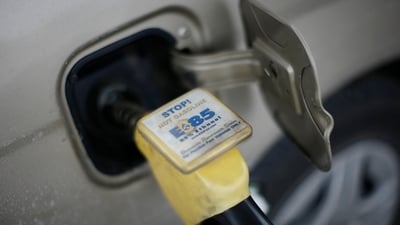
The Indian government has moved to formally include the higher ethanol blends in motor fuel, such as E85 and E100, under the Central Motor Vehicles Rule, through a draft amendment that is open to public comments till May 28. This move signals a renewed push for ethanol blending in motor fuel, months after consumer concerns over E20’s impact on vehicles’ performance across the country.
The Ministry of Road Transport and Highways (MoRTH) issued draft rules on April 27 to formally incorporate E85 and E100 into the Central Motor Vehicles Rules. This regulatory step allows for the testing, certification, and eventual mass production of vehicles designed to run entirely on ethanol. This push follows the nationwide rollout of E20, comprising 20% ethanol-blended petrol, which became the default petrol grade in India on April 1, 2026. While this created quite some consumer concerns around the country, the government remained adamant on its track to increased ethanol use in motor fuel. The latest draft rule comes as the next step towards that direction.
Interestingly, India’s push for this further increase of the ethanol amount in petrol comes at a time when the crude oil prices have been witnessing a significant surge in the international market due to the Middle East conflict.
Ethanol has a lot of drawbacks against petrol as a motor fuel, but the recent developments in the international oil market are making the case in favour of this greener energy solution stronger.
What’s ethanol, and how it’s making headlines
Ethanol is made from crops such as sugarcane, rice and maize. It is a biofuel considered less polluting than pure petrol. The less polluting nature has made ethanol central to India’s plan to cut costly oil imports and reduce planet-heating emissions from the transport sector. Under the government programme, state-run oil companies currently mix 20% ethanol with each litre of petrol before it reaches the fuel pumps.
The 20% ethanol-blended petrol, known as E20, started being widely sold across the country last year, five years ahead of the schedule set by the government, despite a backlash from vehicle owners complaining of reduced fuel efficiency and increased engine wear. Now, the government is aiming to take the bar up and increase the blend to 85% and eventually to 100%.
Risks are real for ethanol
Ethanol has some key disadvantages compared to petrol as a motor fuel. These include lower energy density leading to reduced fuel economy, a hygroscopic nature that can lead to engine damage through water absorption, corrosive nature on certain key metal parts of the powertrain.
Ethanol contains approximately 30–35% less energy per litre than pure petrol. This typically results in a 3–4% drop in fuel economy for standard E10 blends and up to 6–8% for E20 blends. Ethanol naturally attracts and bonds with moisture from the air, which can cause phase separation, where a water-ethanol mixture settles at the bottom of the fuel tank, potentially leading to issues like engine stalling, misfires, or even hydrolock in extreme cases.
Ethanol’s solvent properties can degrade, swell, or crack rubber hoses, seals, and gaskets, especially in older vehicles. It can also corrode certain metals like aluminium and steel. Ethanol has a higher heat of vaporisation than petrol, which can make engines harder to start in very cold climates, especially when the ethanol blend is high. Fuel stability is another issue, as ethanol-blended fuel degrades faster than pure petrol, making it less suitable for long-term storage in vehicles that are not used frequently.
Researchers looking at India’s transport sector have warned that the benefits of higher ethanol blending in motor fuel are more constrained as the blending level rises. Reuters has quoted Shyamasis Das, a fellow at the Centre for Social and Economic Progress, a public policy think tank, saying that higher blending can cut oil imports, but not as much as often claimed. As he explained, ethanol has roughly a third less energy per litre than pure petrol, requiring vehicles to burn more fuel to generate the same power, which limits the extent to which blended fuels can reduce the demand for oil.
Besides the technical challenges, there are other major concerns as well. Ethanol production is a highly energy-intensive process, often requiring significant fertiliser, pesticides, and fossil fuel energy for farming and processing the biofuel. Ethanol production can lead to increased water pollution and scarcity, as well as high water usage for cultivating crops like sugarcane.
The food vs fuel debate has been a key aspect of the government’s ethanol program. The demand for land to produce ethanol reduces the land available for food crops, which can impact food security. Another key issue is the higher emissions in specific conditions. While often cleaner, ethanol blends can increase the evaporation of Volatile Organic Compounds (VOCs) in warmer temperatures, which can contribute to smog, a key element of environmental pollution.
The way forward
The key reason behind the government being adamant to remain firm on the push for the ethanol track is its benefits on the crude oil import bill. India is the world’s third-largest crude oil importer. Around 85% of its fuel needs are met through imports. The government’s drive to raise blending levels stems from a desire to cut its crude import bill and boost energy security. Keeping pace with that goal, India currently also has a surplus ethanol production capacity.
Prime Minister Narendra Modi said in March 2026 that ethanol blending had helped reduce the country’s crude import dependence during the Middle East conflict that impacted the global fuel supply chain significantly.
In just over 11 years, India has raised the percentage of ethanol blending in petrol more than 13 times, from 1.5% in 2014 to 20% in 2025, a far faster rate of increase than many other major ethanol-producing countries. The government says the shift to biofuel saved ₹1.06 trillion ($12 billion) in crude oil imports and avoided 54.4 million tonnes of carbon emissions in a decade, equivalent to emissions from 12 million petrol cars a year. It also claims the reduction in fuel efficiency due to ethanol-blended petrol is marginal.
Now it is being claimed that the heavy reliance on imported crude oil could be further increased with even higher blends. But the steps ahead need to be cautious and judiciously taken, since ethanol may bring down the import bill, but doesn’t offer a pollution-free fuel solution, as many claim. Experts warn that a clear, long-term strategy for decarbonising transport is lacking and could bring trade-offs on efficiency, water use and the climate.
Anumita Roychowdhury, Executive Director at the Centre for Science and Environment, a Delhi-based think tank, reportedly said that ethanol blending is not the most effective way to reduce emissions or improve fuel efficiency in the transport sector. While the biofuel reduces greenhouse gas emissions, it coughs out other pollutants, she explained.
“While some pollutants may fall, others like nitrogen oxides can increase, and burning ethanol also produces toxic emissions such as carbonyl compounds,” Roychowdhury said, while also adding that India would need to introduce regulations, like those in Brazil, which also uses high levels of ethanol to power vehicles, but regulates emissions of toxic compounds such as acetaldehyde and formaldehyde.
Shyamasis Das also echoed the same thought. “The climate impact depends on how the ethanol is produced, not just how it is used,” he said. In India, most of the ethanol used for blending in petrol is derived from food crops, rather than agricultural waste, which raises concerns about both emissions and resource use. “Using crops like sugarcane and maize for ethanol will put more pressure on water and land,” Das said, warning that this could deepen stress in already water-scarce regions that could, in turn, trigger social tensions.
According to experts, ethanol could be better suited for industry, where systems can be adapted to handle lower-energy fuels more efficiently, rather than pushing it into transport and risk slowing the transition to cleaner technologies. According to them, if too much pressure is put on transport to absorb ethanol, it could derail the transition to zero-emission mobility.