For years, the Indian automotive market has had one burning question: “When will Maruti Suzuki, the undisputed king of internal combustion engines (ICE), launch a serious electric vehicle?” The brand that sells nearly one in every two cars in India has been conspicuously quiet in the EV space, even as rivals like Tata Motors and MG Motor carved out a significant lead. This period of observation and planning, however, is about to end.
The years 2025-2026 mark the beginning of Maruti Suzuki’s full-scale electric offensive. This isn’t just about launching one token EV; it’s about a strategic, multi-pronged assault on the electric mobility sector, leveraging the brand’s unparalleled strengths in cost-effectiveness, vast service network, and deep understanding of the Indian consumer. For millions of Indians waiting for a trusted, accessible, and reliable electric car, the wait is almost over.
This deep dive explores Maruti Suzuki’s comprehensive EV strategy, from its first born-electric model to its future portfolio and the underlying technology that will power this electric revolution. We will analyze what to expect, when to expect it, and how it will reshape the entire Indian EV landscape.
The Maruti Suzuki EV Journey So Far
Maruti Suzuki’s approach to electrification has been characteristically cautious and calculated. Unlike some early adopters, the company focused on understanding the evolving technology, supply chain, and, most importantly, the Indian consumer’s readiness.
Early Experiments: The brand tested the waters with mild-hybrid technology in models like the Ciaz and Ertiga, introducing the concept of electrification to its massive customer base.
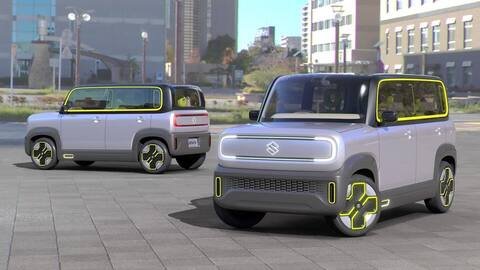
The Wagon R EV Pilot: A fleet of Wagon R-based electric prototypes was deployed for real-world testing, gathering invaluable data on battery performance, durability, and charging behavior in Indian conditions. This was not a commercial launch but a critical R&D exercise.
Strong Hybrid Push: As a bridge technology, Maruti, in partnership with Toyota, aggressively pushed strong hybrids with the Grand Vitara and Invicto. This strategy served two purposes: reducing the corporate average fuel economy (CAFE) norms and acclimatizing customers to electric-driven powertrains.
This phased approach demonstrates a strategy not of being first, but of being right. Maruti Suzuki has been building the foundation for a sustainable and scalable EV business, and 2025 is when the superstructure begins to rise.
The Game Changer: Maruti Suzuki eVX
The cornerstone of Maruti’s EV strategy is the eVX, its first purpose-built electric vehicle, slated for launch in 2025.
Key Highlights of the Maruti Suzuki eVX:
Segment: Mid-size Electric SUV, poised to compete directly with the Tata Curvv EV and Hyundai Creta EV.
Platform: Built on a new, dedicated skateboard architecture developed in partnership with Toyota. This global platform is designed specifically for EVs, allowing for optimal space utilization and safety.
Range: The concept car showcased a promised range of around 550 km on a single charge (as per standard test cycles). This directly addresses the primary concern of Indian buyers: range anxiety.
Design: Based on the concept unveiled at the Auto Expo, the eVX boasts a bold, futuristic design with a commanding SUV stance, a striking light signature, and a modern, aerodynamic profile.
Production & Launch: The production version is expected to be revealed by late 2024, with sales commencing in 2025. It will be sold through Maruti’s premium NEXA network, positioning it as a flagship, aspirational product.
The success of the eVX is critical. It’s not just a product launch; it’s a statement of intent from Maruti Suzuki to the entire industry.
Broader EV Portfolio: What’s Coming After the eVX?
The eVX is just the beginning. Maruti Suzuki’s parent company, Suzuki Motor Corporation, has announced plans to introduce six EV models in India by 2030. The pipeline for 2025-2026 is particularly exciting.
Electric Micro-SUV (Might be an Electric Fronx/Brezza): To truly democratize EVs, Maruti will need an electric offering in the high-volume compact SUV segment. An electric version of a popular model like the Fronx or a next-generation Brezza is highly likely, targeting the heart of the Indian market.
Electric Hatchback (Potential Electric Swift/Baleno): The core of Maruti’s empire is the hatchback segment. An affordable electric hatchback with a realistic range of 300-350 km could be the ultimate game-changer, bringing EV ownership to the masses. This is expected to be a key launch around 2026.
An Electric MPV: Given Maruti’s dominance in the people-mover segment with the Ertiga and XL6, an electric MPV is a logical step. This would cater to families and fleet operators looking for space and efficiency.
Technology & Manufacturing Strategy
Maruti’s EV strategy is underpinned by massive investments in local manufacturing and supply chain development, which is key to achieving its signature affordability.
Local Battery Manufacturing: Suzuki is investing heavily in a lithium-ion battery plant in Gujarat through its joint venture with Toshiba and Denso. Local cell manufacturing is the single biggest factor in reducing the cost of an EV.
The “Gujarat Hub”: Suzuki’s plant in Hansalpur, Gujarat, is being developed as a dedicated EV manufacturing hub, with an initial capacity of 250,000 units per annum. This will ensure scalable production to meet the anticipated demand.
Charging Infrastructure: Maruti is expected to leverage its partnership with Toyota and its vast dealer network to develop charging solutions. Expect tie-ups with charging point operators and the installation of fast chargers at key NEXA outlets.
Challenges and Opportunities
Challenges:
High Initial Cost: The biggest hurdle remains the upfront cost. Maruti’s core challenge is to bring down the price to a level that is palatable for its traditional customer base.
Charging Anxiety: Convincing buyers in Tier 2 and Tier 3 cities, where home charging may not be feasible, will be a significant task.
Intense Competition: Tata Motors has a formidable head start and a strong brand image in the EV space.
Opportunities:
Brand Trust: Millions of Indians trust Maruti Suzuki for reliability and after-sales service. This trust is a priceless asset that can be transferred to EVs.
Unparalleled Network: With over 4,000 sales touchpoints and 3,900+ service centers across the country, Maruti can offer an EV ownership experience that is unmatched in its reach and convenience.
Economies of Scale: No other manufacturer can achieve the production scale and cost optimization that Maruti can, which could lead to the first truly “mass-market” EV in India.
Conclusion
Maruti Suzuki’s entry into the electric vehicle fray is the most significant development for the Indian EV market. While they may be late to the party, their strategy of meticulous planning, deep localization, and a phased product portfolio shows they are in it for the long haul.
The period of 2025-2026 will be a watershed moment. The launch of the eVX and the subsequent announcements will signal the start of a new electric chapter for the auto giant. For the competition, it’s a warning shot. For the Indian consumer, it’s the promise of electric mobility that is finally within reach—backed by a name they have trusted for decades. The electric revolution is coming, and it will be led by Maruti Suzuki.
FAQs
Q1. When will the Maruti Suzuki eVX be launched? The Maruti Suzuki eVX is expected to be launched in the Indian market in 2025. The production version will likely be unveiled in late 2024, with bookings opening shortly after.
Q2. What will be the expected price of the Maruti Suzuki eVX? While official prices are not announced, industry experts speculate that the Maruti eVX will be competitively priced to take on rivals like the Tata Curvv EV and Hyundai Creta EV. Expect a starting price range of ₹15 lakh to ₹20 lakh (ex-showroom).
Q3. Will Maruti Suzuki offer fast charging with its EVs? Yes, absolutely. The Maruti eVX, like all modern EVs, will support DC fast charging. The company is also expected to partner with charging networks and utilize its vast dealer network to enhance the public charging infrastructure for its customers.
Q4. What is Maruti Suzuki doing about EV battery manufacturing? Suzuki Motor Corp. is setting up a lithium-ion battery plant in Gujarat through a joint venture with Toshiba and Denso. This local manufacturing will be crucial in reducing costs and ensuring a steady supply of batteries for Maruti’s future EVs.
Q5. Where will Maruti Suzuki EVs be sold and serviced? Maruti’s electric vehicles, starting with the eVX, will be sold and serviced through its premium NEXA channel. This aligns with the premium positioning of initial EV models. As more affordable EVs join the portfolio, they may also be made available through the ARENA network.
Tags: Maruti Suzuki EV, Maruti eVX, Electric Car India, Maruti Electric Car, EV Strategy 2025, Toyota Suzuki Partnership, Electric SUV India, NEXA EV, EV Battery Plant Gujarat, Future Maruti Cars.