
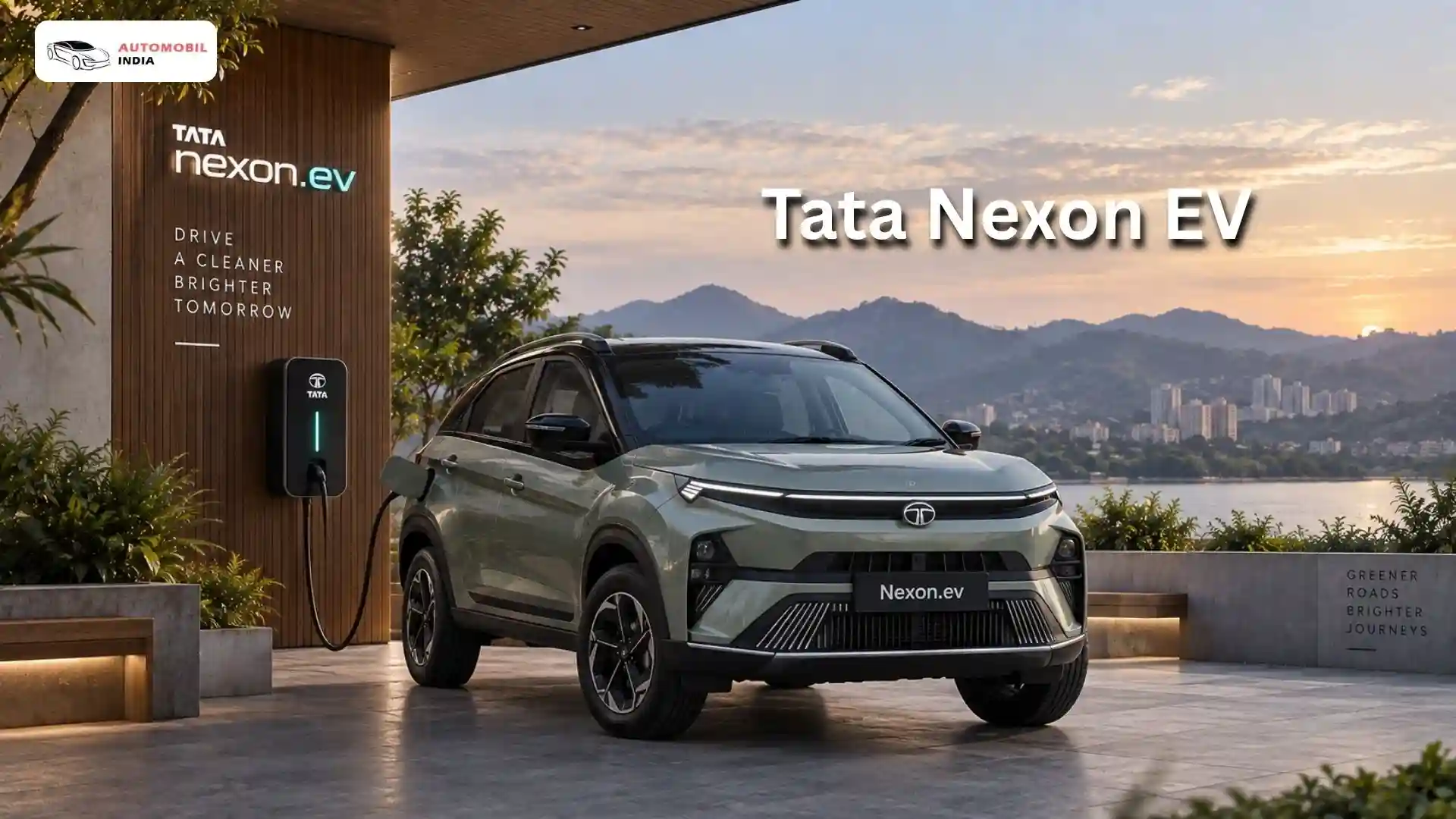
If you are researching the Nexon EV range, the first number you will usually see is 489 km. That is the claimed MIDC range of the 45kWh version. However, it is important not to treat 489 km as the distance every owner will cover on a normal day.
The current Tata Nexon EV is available with 30kWh and 45kWh battery options. The 30kWh version has a claimed MIDC range of 275 km, while the 45kWh version is rated at 489 km. Tata's own C75 real-world range figures are lower at around 210-230 km for the 30kWh battery and 350-375 km for the 45kWh battery.
Independent testing gives a similar picture. Autocar India's real-world test of the Nexon EV 45 recorded about 350 km in mixed driving, while its latest range guide lists around 350-375 km as a practical range expectation for the 45kWh model.
That difference is the key to understanding Nexon EV range in India: certified range tells you how the car performs under a standardised test cycle, while real-world range depends on speed, traffic, temperature, air-conditioning, driving style, terrain, tyre pressure and how much energy the car is using for accessories.
Tata Nexon EV Range at a Glance
|
Nexon EV version |
Battery |
Claimed MIDC range |
Tata C75 real-world range |
Typical tested context |
|
Nexon EV 30 |
30kWh |
275km |
210-230km |
Lower battery capacity |
|
Nexon EV 45 |
45kWh |
489km |
350-375km |
Practical mixed-use expectation |
The 40.5kWh version that was previously offered has been discontinued. The current range therefore centres on the 30kWh and 45kWh battery options.
For most buyers, the 45kWh Nexon EV is the version to consider if long-distance usability and fewer charging stops are priorities. That does not mean the 30kWh version is unsuitable; it simply serves a different usage pattern.
What Is the Real-World Nexon EV Range?
For the 45kWh Nexon EV, a sensible real-world planning figure is around 350 km, rather than assuming the full 489 km MIDC figure.
Autocar India's controlled test achieved 350 km from the Nexon EV 45, with an average efficiency of 7.79km/kWh. Tata's C75 methodology gives a somewhat wider 350-375km practical range.
This does not mean every Nexon EV 45 will deliver exactly 350 km.
For example:
-
A city user driving smoothly in moderate traffic may see strong efficiency.
-
Heavy traffic with frequent acceleration and prolonged air-conditioning use can reduce efficiency.
-
High-speed highway driving generally consumes more energy than slower urban cruising.
-
Fully loaded trips can increase energy consumption.
-
Hills and steep gradients require more energy.
-
Low tyre pressure increases rolling resistance.
-
Aggressive acceleration uses substantially more energy than gradual inputs.
Therefore, 350 km should be viewed as a useful real-world reference point, not a guaranteed range figure.
Why the 489 km figure is much higher
The MIDC figure is generated under a controlled certification procedure. Real Indian driving is much less predictable.
A driver does not travel at one fixed speed on an empty road. Indian conditions involve traffic signals, congestion, overtaking, speed breakers, flyovers, uneven roads, passengers, luggage and extensive use of air-conditioning.
This is why comparing the 489 km certified figure directly with petrol-car mileage or another EV's certified figure can be misleading.
Nexon EV Range: 30kWh vs 45kWh
The battery size is one of the biggest factors affecting how far the Nexon EV can travel between charges.
|
Specification |
Nexon EV 30 |
Nexon EV 45 |
|
Battery capacity |
30kWh |
46.08kWh |
|
Certified range |
275km MIDC |
489km MIDC |
|
Tata C75 range |
210-230km |
350-375km |
|
Motor power |
Around 95kW/129hp |
106kW/around 142hp |
|
Torque |
215Nm |
215Nm |
|
Drive |
FWD |
FWD |
|
0-100km/h |
— |
8.9 sec |
|
Charging connector |
CCS2 |
CCS2 |
Tata's current specifications list the 45kWh battery as 46.08kWh, with a 106kW motor, 215Nm torque and a claimed 0-100km/h time of 8.9 seconds.
The difference in battery capacity is significant. The 45kWh version has roughly 54% more battery capacity than the 30kWh version, which is why its certified range is dramatically higher.
For a buyer doing mostly short city trips, the 30kWh version can be sufficient. For regular intercity travel, the additional battery capacity of the 45kWh version provides considerably more flexibility.
How Much Range Can You Expect From the Nexon EV in Different Conditions?
There is no single real-world number that applies to every driver, but the following framework is more useful than simply quoting the 489km certified figure.
City driving
City driving can sometimes be relatively efficient because average speeds are lower and regenerative braking can recover some energy during deceleration.
However, stop-and-go traffic can also increase consumption if the driver repeatedly accelerates hard from traffic lights.
The biggest advantages come from:
-
Smooth acceleration
-
Predictable driving
-
Moderate speeds
-
Appropriate regenerative braking
-
Correct tyre pressure
-
Sensible use of climate control
The Nexon EV's multi-mode regenerative braking and drive modes allow the driver to adapt the car's energy usage to different conditions. Tata specifically highlights its multi-mode regen and paddle-operated regenerative braking system.
Highway driving
Highway range is where many EV buyers need to adjust their expectations.
At higher speeds, aerodynamic resistance rises significantly. An EV can therefore consume more energy even when the road is relatively flat and traffic is light.
This means a 45kWh Nexon EV that is capable of around 350 km in mixed real-world testing should not automatically be expected to cover 350 km at sustained high highway speeds.
For long highway journeys, planning a charging stop before the battery gets very low is more practical than trying to extract the last possible kilometres.
Heavy traffic
Traffic itself does not necessarily destroy EV range. Unlike an ICE vehicle, an EV does not consume fuel while idling in the conventional sense.
However, repeated acceleration, prolonged use of the air-conditioner and slow-moving traffic can still affect efficiency.
Smooth throttle inputs are particularly useful in congested urban conditions.
How Air-Conditioning Affects Nexon EV Range
Air-conditioning is one of the most relevant real-world factors for Indian EV owners.
In summer, the cabin may begin at a much higher temperature than the desired setting. The climate-control system then has to work harder to cool the cabin.
The effect is more noticeable when:
-
The car is parked in direct sunlight.
-
The cabin starts extremely hot.
-
The AC is operated at maximum cooling for long periods.
-
The vehicle is stationary or moving slowly.
-
Several passengers are inside.
This does not mean you should avoid using the AC to save range. In India's climate, cabin cooling is a normal requirement. The practical approach is to use the climate-control system sensibly rather than trying to drive without it.
Does Driving Speed Affect Nexon EV Range?
Yes. Speed is one of the most important factors affecting highway efficiency.
The reason is aerodynamic drag. As speed rises, the energy required to push the vehicle through the air increases rapidly.
For an EV driver, this means a steady moderate highway speed can be considerably more efficient than repeatedly driving at very high speeds.
The effect is especially important when planning a long trip because the difference between:
"Can the car reach the destination?"
and
"Can the car reach the destination without an additional charging stop?"
can depend heavily on highway speed.
Does Regenerative Braking Improve Nexon EV Range?
Yes, but regenerative braking should not be treated as a way to create free energy.
When the vehicle slows down, the electric motor can operate as a generator and recover some kinetic energy, sending it back to the battery.
The Nexon EV offers multi-mode regenerative braking with paddle controls, allowing the driver to adjust the level of energy recovery.
Regeneration is particularly useful in:
-
Stop-and-go traffic
-
Descents
-
Urban driving
-
Frequent deceleration
However, the car cannot recover all the energy used to accelerate. Some energy is always lost through mechanical, electrical and aerodynamic inefficiencies.
The biggest range benefit therefore comes from avoiding unnecessary acceleration in the first place, rather than relying entirely on regeneration afterward.
Tyre Pressure Can Affect Nexon EV Range
Tyres are another easily overlooked factor.
Under-inflated tyres create greater rolling resistance. The motor then needs to use more electrical energy to maintain speed.
EVs can make this more noticeable because their efficiency is often closely monitored in km/kWh.
Owners should therefore check tyre pressures regularly and follow Tata's recommended specifications rather than using a random pressure based on personal preference.
This is a simple maintenance habit that can help maintain efficiency without changing the vehicle itself.
Does Passenger Load Affect Nexon EV Range?
Yes.
Adding passengers and luggage increases the vehicle's weight. The additional energy requirement becomes more noticeable during:
-
Frequent acceleration
-
Uphill driving
-
Stop-start traffic
-
Mountain roads
The difference may not be dramatic on every journey, but a fully loaded vehicle can consume more energy than a lightly loaded one.
This is another reason why an owner should leave a sensible range buffer when planning a long family trip.
How Terrain Changes Nexon EV Range
Flat roads are generally easier on range than sustained climbs.
When travelling uphill, the vehicle needs additional energy to gain elevation. On the way down, regenerative braking can recover some of that energy, but not all of it.
For drivers in hilly regions, the certified range should therefore be treated with even more caution.
A route involving:
Flat highway → mountain climb → descent
can produce a very different consumption figure from:
Flat city → flat highway → flat city.
Navigation planning is therefore an important part of EV ownership.
Nexon EV Charging Time
The Nexon EV supports multiple charging options.
For the 45kWh version, Tata lists:
-
7.2kW AC wall box: 10-100% in about 6 hours 36 minutes
-
60kW DC fast charger: 10-80% in about 40 minutes
-
15A portable charging: substantially slower and intended more as a convenient backup/home option
These are manufacturer's estimated charging times and can vary depending on charging conditions, battery temperature and other factors.
The 30kWh version can charge faster on AC because of its smaller battery, with Tata's brochure quoting approximately 4 hours 18 minutes from 10-100% using a 7.2kW AC charger.
Why 10-80% charging is important
EV charging is not linear from 0% to 100%.
The battery can accept power more quickly during much of the lower-to-middle state-of-charge range, while charging generally slows as the battery approaches full.
For highway travel, charging from roughly 10% to 80% can therefore be more time-efficient than repeatedly waiting for 100%.
For overnight home charging, however, charging to a higher level can make sense when the vehicle needs maximum range the following day.
How Much Does It Cost to Charge the Nexon EV?
Charging cost depends mainly on:
-
Electricity tariff
-
Battery capacity
-
Energy consumed
-
Charging losses
-
Whether you use home or public charging
A simple way to estimate the cost is:
Charging cost = electricity consumed × electricity tariff
For example, if an EV uses 40kWh of electricity and the effective tariff is ₹8 per kWh, the energy cost would be approximately ₹320.
However, the amount drawn from the wall can be higher than the battery energy actually stored because charging involves losses.
Public DC fast charging can also have a different tariff structure from household electricity.
Therefore, Nexon EV range and charging cost should be considered together, rather than looking only at the battery size.
Nexon EV Range vs Other EVs
Range comparisons are useful, but the numbers need to be compared carefully.
|
EV |
Battery option |
Claimed range |
Real-world context |
|
Tata Nexon EV |
30kWh |
275km |
Tata C75: 210-230km |
|
Tata Nexon EV |
45kWh |
489km |
Independent test: ~350km |
|
Mahindra XUV 3XO EV |
39.4kWh |
351km |
Mahindra claims ~285km practical |
|
Tata Punch EV |
30kWh |
365-375km |
Smaller SUV; range depends on battery/variant |
The comparison shows why battery size alone does not tell the whole story.
The Nexon EV 45's 489km certified range looks substantially higher than the 351km claimed by the XUV 3XO EV. But Autocar's real-world Nexon EV 45 test produced around 350km, while Mahindra claims around 285km as a practical figure for the XUV 3XO EV.
In other words, real-world differences can be considerably smaller than certified-range differences suggest.
Nexon EV Range, Price and Variants in India
As of September 2026, the Nexon EV is priced from approximately ₹12.49 lakh to ₹17.89 lakh ex-showroom, depending on variant and edition.
Current listings include the 30kWh Creative+ MR and 45kWh variants such as Creative, Fearless, Empowered and Empowered+ A, with additional Dark/Red Dark editions at the top end. Exact variant availability and dealer pricing can change.
|
Version |
Battery |
Certified range |
Approx. ex-showroom positioning |
|
Creative+ MR |
30kWh |
275km |
₹12.49 lakh |
|
Creative 45 |
45kWh |
489km |
₹15.21 lakh |
|
Fearless 45 |
45kWh |
489km |
₹16.27 lakh |
|
Empowered 45 |
45kWh |
489km |
₹17.33 lakh |
|
Empowered+ A 45 |
45kWh |
489km |
₹18.76 lakh on-road example; ex-showroom range varies by current listing |
Current variant pricing should always be confirmed with Tata Motors or the dealer at the time of purchase because discounts, editions and local pricing can change.
Nexon EV Features That Can Help With Range Management
The Nexon EV is not only about battery capacity. Its technology also gives drivers several tools for managing energy consumption.
Drive modes
The Nexon EV offers Eco, City and Sport modes. Tata positions these modes for different driving requirements, with Eco focusing more heavily on efficiency.
For everyday commuting, an efficiency-focused mode can make sense when maximum performance is not required.
Regenerative braking
The multi-level regenerative braking system allows the driver to recover energy during deceleration.
Range information
The instrument display provides information that can help drivers understand remaining range and energy consumption.
However, the displayed range should be treated as an estimate. It is influenced by recent driving conditions and can change as the vehicle's consumption pattern changes.
Does the Nexon EV Have Enough Range for Long Trips?
For many Indian users, the answer depends more on charging infrastructure and route planning than the headline range number.
A 45kWh Nexon EV with a practical range around 350km gives a reasonable buffer for many intercity journeys, particularly when reliable DC fast chargers are available along the route.
For example, a driver travelling 250-300km between cities may be able to complete the journey without charging depending on conditions. A longer 400-500km journey is more likely to require a charging stop.
The important point is not to plan the journey around the absolute maximum range.
Instead, consider:
-
Starting battery percentage
-
Expected highway speed
-
Number of passengers
-
Weather
-
AC usage
-
Terrain
-
Charger availability
-
Backup charging locations
-
Destination charging
For highway travel, arriving with a reasonable battery reserve is generally more practical than attempting to use almost the entire battery.
How to Improve Nexon EV Range in Everyday Driving
If you already own a Nexon EV, these habits can help improve efficiency:
-
Accelerate smoothly instead of using full throttle frequently.
-
Maintain recommended tyre pressure and check it regularly.
-
Use Eco mode when performance is not a priority.
-
Use regenerative braking intelligently in traffic and during descents.
-
Avoid unnecessarily high highway speeds.
-
Pre-cool the car while plugged in, where the vehicle and charging setup support the function.
-
Avoid carrying unnecessary weight in the boot.
-
Plan highway charging stops before the battery gets critically low.
-
Monitor km/kWh rather than only the predicted kilometres remaining.
-
Keep the battery and vehicle software updated where applicable.
The goal should not be to maximise the range figure on every drive. A consistent and predictable consumption pattern is more useful for everyday ownership.
Nexon EV Range: What Buyers Should Actually Remember
The most important numbers are straightforward:
Nexon EV 30: 275km MIDC, with Tata's C75 figure at around 210-230km.
Nexon EV 45: 489km MIDC, with Tata's C75 figure at around 350-375km.
Independent testing of the 45kWh model has produced around 350km, showing why real-world expectations should be lower than the headline certified figure.
For buyers, the practical question is therefore not simply "What is the Nexon EV range?"
It is:
"How many kilometres do I normally drive between charges, and how much range do I need as a comfortable buffer?"
If most daily driving is below 100 km and charging is available at home, even the 30kWh model can cover a large portion of normal commuting requirements.
If the vehicle will regularly be used for intercity travel, family trips or longer highway runs, the 45kWh version's larger battery provides substantially more flexibility.
Disclaimer
Range, charging time, prices and specifications can vary depending on variant, driving conditions, temperature, charging equipment, traffic and vehicle usage. Manufacturer-certified figures are tested under standardised conditions and should not be treated as guaranteed real-world results. Prices and variants are subject to change.