
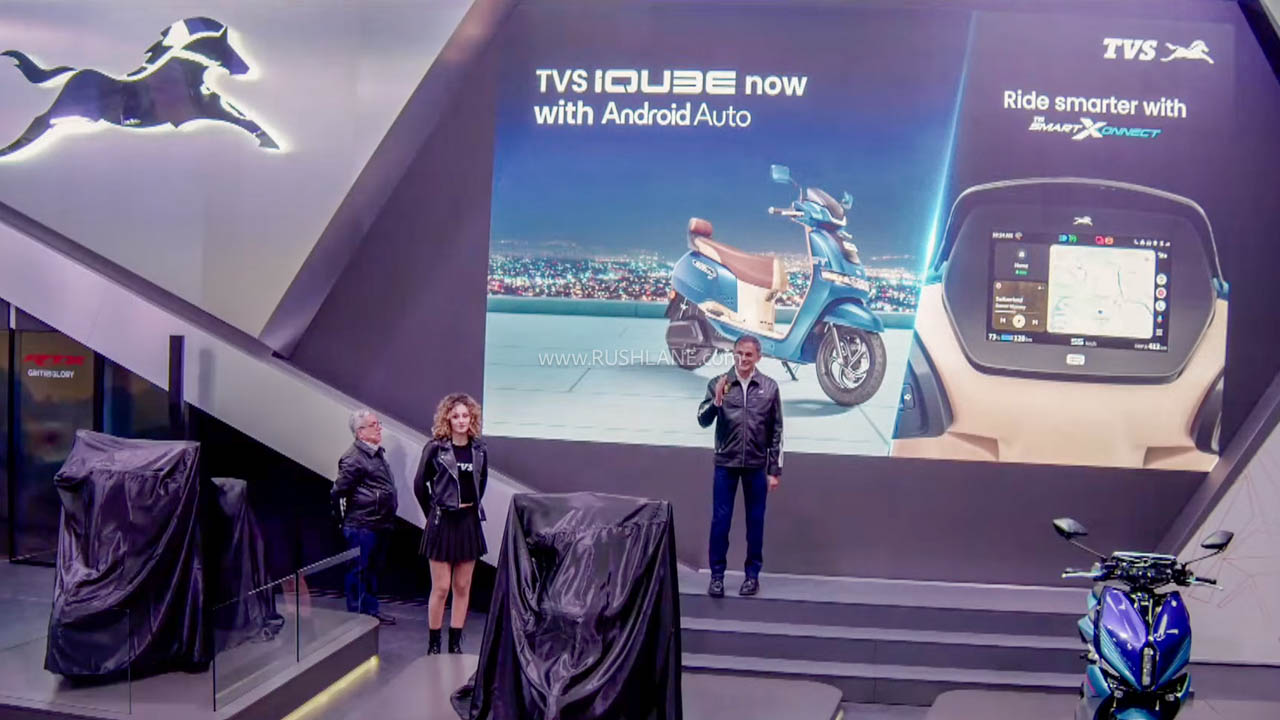
TVS Motor established a major pavilion at the EICMA 2026 event in Milan, Italy, utilizing the platform to outline its electric vehicle lineup for Europe. The display featured the M1S model—slated for an initial launch in Indonesia before arriving in Europe—followed by the TVS X and the Orbiter. Amidst these presentations, the manufacturer revealed that its popular iQube electric scooter will soon receive Android Auto integration via a collaboration with Google. Furthermore, the European-specification TVS Orbiter made its official public debut at the exhibition.
TVS iQube Gets Android Auto Integration
Upper variants of the iQube currently utilize a 7-inch touchscreen that accommodates numerous connected attributes and smart capabilities. This same display real estate will now incorporate Android Auto for the initial time, running the familiar automotive interface. The screen will continue to show essential vehicle information alongside the new software, presenting battery state of charge, range data, trip computers, speedometer clock, and integrated warning indicators.
The company previously collaborated with Google for the TVS X model in India, which already features wireless Android Auto integration across its 10.2-inch TFT instrument cluster. This exact capability will also extend to the European version of the TVS X. Users of the upcoming iQube system will gain access to direct mobile applications rather than relying solely on proprietary software. The manufacturer did not clarify whether the connection relies on wireless or wired protocols, nor was there any indication whether current owners can unlock the feature or if it applies strictly to new purchases. Additionally, no plans for Apple CarPlay were mentioned, aligning with the predominant Android user base in India.
Euro-Spec TVS Orbiter Features and Specifications
Positioned as the practical offering among the brand's European electric scooter range, the TVS Orbiter is tailored for city commutes and short journeys. It relies on a tubular steel frame, telescopic front fork, and twin rear shock absorbers, sharing most mechanical foundations with the Indian variant. The European version distinguishes itself primarily through removable battery packs and a front disc brake. European type approval is scheduled for 2027, with market-specific pricing and sales schedules to be revealed closer to release.
The Orbiter provides an upright riding posture enabled by a wide handlebar and a long flat seat positioned at a height of 760 mm. Storage beneath the seat accommodates 34 litres of space. Overall vehicle length measures 1,855 mm, width spans 728 mm, and the wheelbase is 1,330 mm. Exterior illumination comprises an LED front light, LED indicators, and an LED tail lamp. A 14-inch alloy front wheel wears a 90/80 tyre, while the 12-inch rear wheel utilizes a 90/90 tyre. Stopping power is managed by a 220 mm front disc and a 130 mm rear drum brake, backed by a Combined Braking System.

| Specification | TVS Orbiter |
|---|---|
| Battery Options | 1.8 kWh / 3.1 kWh |
| Expected WMTC Range | 70 km / 105 km |
| Rated Motor Output | 1.85 kW |
| Peak Motor Output | 2.9 kW |
| Top Speed | 45 km/h |
| Charger | 550 W |
| 0-80% Charging Time | 2 hr 39 min / 4 hr 33 min |
| Front Wheel | 14-inch alloy |
| Rear Wheel | 12-inch |
| Front Brake | 220 mm disc |
| Rear Brake | 130 mm drum |
| Seat Height | 760 mm |
| Under-Seat Storage | 34 litres |
| Display | 5-inch LCD |
| Connectivity | Bluetooth, LTE |
Performance, Charging, and Electronics
Powering the European Orbiter is a BLDC hub motor delivering a rated output of 1.85 kW and a peak output of 2.9 kW, allowing for a top speed of 45 km/h. Two removable NMC lithium-ion battery choices are provided: a smaller 1.8 kWh unit delivering a projected WMTC range of 70 km, and a larger 3.1 kWh version extending the range to 105 km. Charging is handled by an onboard 550 W system compatible with standard household sockets. Recharging from zero to 80 percent takes 2 hours and 39 minutes for the 1.8 kWh battery, and 4 hours and 33 minutes for the 3.1 kWh battery. An optional charging dock will also be available to power the removable batteries away from the scooter.
The electronic feature list incorporates Hill Hold, Cruise Mode, and Reverse Assist. A 5-inch LCD instrument panel connects via Bluetooth to the TVS SmartXonnect application, while onboard LTE facilitates live tracking, geofencing, crash alerts, and fall alerts. The smartphone software additionally supplies turn-by-turn navigation, call notifications, and Distance to Empty readouts. Manufactured, engineered, and developed in India, the scooter has undergone 600 safety and structural stress tests across millions of kilometres of riding data. Visitors can view the model at the TVS Motor stand in Milan from November 5 to 8.
Implications for Buyers
The introduction of Android Auto to the iQube brings enhanced smartphone integration directly to the scooter's existing 7-inch display, aligning with the tech features previously reserved for higher-end models like the TVS X. For European buyers, the TVS Orbiter introduces practical urban mobility with removable battery options, flexible home and dock charging solutions, and extensive safety tech. With type approval expected in 2027 and local pricing pending, these developments highlight TVS Motor's ongoing expansion of advanced connectivity and practical electric mobility options across international and domestic markets.
